
 100% FREE ACCESS
11th Standard CBSE Syllabus & Materials
11th Standard CBSE
CBSE 11th Economics PART-A - Presentation of Data - New Sample Question Papers Study Material - QB365 Set A
NEW11th Standard CBSE
CBSE 11th Economics PART-A - Organisation of Data - New Sample Question Papers Study Material - QB365 Set A
NEW11th Standard CBSE
CBSE 11th Economics PART-A - Collection of Data - New Sample Question Papers Study Material - QB365 Set A
NEW11th Standard CBSE
CBSE 11th Economics PART-A - Introduction to Economics and Statistics - New Sample Question Papers Study Material - QB365 Set A
NEW11th Standard CBSE
CBSE 11th Business Studies International Trade Sample Question Papers Study Material - QB365 Set A
NEW11th Standard CBSE
CBSE 11th Business Studies Evolution and Fundamentals of Business Sample Question Papers Study Material - QB365 Set A

Published on: 05/03/2019
Anatomy of Flowering Plants Important Questions
Download CBSE Class 11th Standard CBSE Biology question papers, sample papers, important questions, and previous year solved papers in PDF format. Get free study materials, NCERT solutions, and exam preparation resources for Class 11th Standard CBSE Biology
Questions + Answers key
Take MCQ Biology Test
1.
Which type of inflorescence shows an unlimited growth and why?
2.
What is the function of pneumatophores?
3.
Give the functional difference between phellogen and phelloderm.
4.
Mention the features of isobilateral leaves.
5.
Certain epidermal adaxial cells along the midrib modify themselves to large , empty, colurless cells.Name these
6.
What is the difference between hypodermis of dicot and monocot stems?
7.
What constitutes the cambium ring?
8.
How the study of anatomy is useful to us ?
9.
What is the other name of bulliform cells?
10.
What is the epidermal cell modification in plants which prevent water loss?
11.
Product of phototsynthesis is transported from the leaves to various parts of the plant and stored in some cells before being utilised. What are the cells/tissues that store them?
12.
Starting from periphery and going towards centre which is the correct sequence of different whorls of a flower?
Corolla, Calyx, Gynoecium, Androecium
Calyx, Corolla, Gynoecium, Androecium
Calyx, Corolla, Androecium, Gynoecium
Either (b) or (c).
13.
Which of the following shows modification of stem for food storage?
Carrot
Turnip
Ginger
None of these
14.
Roots develop from which part of seed?
Plumule
Cotyledons
Radicle
Endosperm
15.
Identify the tissue system from the following.
Parenchyma
Xylem
Epidermis
Phloem
16.
On the basis of which structure you can say that neem shows a compound leaf?
17.
Ginger grows under the ground, yet it is called a modified stem. What is the reason?
18.
Describe the arrangement of floral members in relation to their insertion on thalamus.
19.
Differentiate between
(a) Racemose and cymose inflorescence
(b) Fibrous root and adventitious root
(c) Apocarpous and syncarpous ovary
20.
How is a pinnately compound leaf different from a palmately compound leaf?
21.
List out the important characteristics of meristematic tissue
22.
Write the characteristics of heartwood and sapwood.
23.
Make a list of common fruits, their type and their edible parts.
24.
What is a semi-technical description of a flowering plant?
25.
With the help of proper diagram describe various regions of root.
26.
Describe modifications of stem with suitable examples.
27.
What is the commercial source of cork?How is it formed?
1.
The racemose inflorescence shows unlimited growth. The apex in this type of inflorescence does not terminate into a flower and continues to grow. Flowers are borne laterally in racemose
2.
The primary function of pneumatophores is to help plants to get the oxygen needed for the respiration process. It stores the gases that help the plants to survive in floods.
3.
Difference between phellogen and phelloderm is
| Phellogen | Phelloderm |
| It is a ring of meristematic cells that divide and form cork on outside and secondary cortex on the inner side. | It is a tissue made up of suberised parenchymatous cells that transfer nutrients and water to phellogen cells for their activity. |
4.
Isobilateral ( equifacial ) leaves are placed in a plant in such a way that both its surfaces receive equal amount of sunlight.It doesnot have distinct upper and lower surfaces. Mesophyll is usually indistinguishable. Most of the monocot plants have isobilateral leaves.
5.
In grasses, certain adaxial epidermal cells along the veins modify themselves into large empty, colourless cells called bulliform cells. These cells are responsible for the curling of leaf surfaces in grass.
6.
In dicot stems, hypodermis consisits of a few layers of collenhyma cells, whereas , in case of monocot stems, hypoderms consists of 2-3 layers of sclerenchyma cells
7.
Fusion of intervascicular and intrafascicular cambium strips.
8.
The study of anatomy helps to us in
(i) solving taxonomic problems.
(ii) analysing the microstructure , adulteration of spice, tea, tobacco, etc.
(iii) extraction of compounds for use as medicine.
(iv) differentiation of inferior quality wood from the superior quality.
9.
Bulliform cells, also known as motor cells, are huge, bubble-shaped epidermal cells found on the top surface of leaves in groups of multiple monocots. These cells are found on the top or adaxial leaf surface.
10.
Cuticularised trichoblasts or epidermal hair which produce a stationary layer of air over the surface that reduces isolation and rate of transportation.
11.
Parenchyma cells/tissue.
12.
(c)
Calyx, Corolla, Androecium, Gynoecium
13.
(c)
Ginger
14.
(c)
Radicle
15.
Epidermis from epidermal tissu system
16.
The number and position of auxillary bud is an indicator if a leaf is a simple one or a compound one. In neem leaves there is a single auxillary bud at the start of the bunch of leaflets. So it is a compound leaf.
17.
The presence of nodes and internodes on ginger gives a clue that it is not a root, but a stem.
18.
Floral members, like calyx, corolla and androecium are arranged differently in relation to ovary on the thalamus. Based on this arrangement flowers can be divided as follows
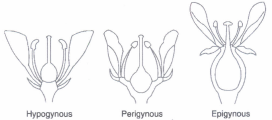
Hypogynous Flower: In hyopgynous flowers, the ovary occupies the highest position. Other floral members are inserted below the ovary, on thalamus. Perigynous Flower: In perigynous flowers, the ovary and other floral members are inserted on the same level on thalamus.
Epigynous Flower: In epigynous flowers, the ovary is at the lowest position on thalamus. Other floral members are inserted above the ovary.
19.
a) Racemose Inflorescence. In racemose type of inflorescence the main axis continues to grow, the flowers are borne laterally in an acropetal succession. Acropetal succession means that older flowers are at the base and younger flowers are near the apex.
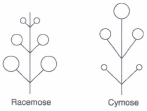
Cymose Inflorescence. In cymose type of inflorescence the main axis terminates in a flower, hence is limited in growth. The flowers are borne in a basipetal order. In basipetal succession older flowers are at the apex and younger flowers are near the base.
b) Fibrous Root System. In monocotyledonous plants, the primary root is short lived and is replaced by a large number of roots. These roots originate from the base of the stem and constitute the fibrous root system, as seen in the wheat plant.
Adventitious Roots. In some plants, like grass, Monstera and the banyan tree, roots arise from parts of the plant other than the radicle and are called adventitious roots.
(c) When more than one carpel is present, they may be free (as in lotus and rose) and are called apocarpous. They are termed syncarpous when carpels are fused, as in mustard and tomato.
20.
Pinnately Compound Leaf. In pinnately compound leaf a number of leaflets are present on a common axis. Example, neem leaves.
Palmately Compound Leaf. In palmately compound leaf number of leaflets are attached at the common point. Example, cotton leaves.
21.
Characteristics of meristematic tisssues are
(i)Cells are usuall rectangular with thin cell wall made up of cellulose
(ii)They are closely arranged without any intercellular space
(iii)They show a prominent nucleus and are full of cytoplasm.
(iv) They are always capable of division
22.
Heartwood It is seconadry xylem with highly lignified walls.In old trees, considerableregion of secondary xylem is dark brown due to accumulation of tanini, resins, oils, gums and other organic materials .The substances make is heart and resistant to microbes and insects.
Sapwood Sapwood is the peripheral region of secondary which is lighter in colour and involved in conduction of water and minerals from root to leaf
23.
| Fruits | Type | Edible Parts |
|---|---|---|
| Apple, Pear | Pome | Fleshy thalamus |
| Banana | Berry | Mesocarp |
| Cashewnut | Nut | Cotyledons, fleshy thalamus |
| Coconut | Drupe | Endosperm |
| Cucumber | Pepo | Mesocarp, endocarp, seeds |
| Date palm | Berry | Pericarp |
| Fig | Synconus | Thalamus |
| Jack fruit | Sorosis | Bracts, perianth & seeds |
| Grapes | Berry | Pericarp and placenta |
| Guava | Berry | Thalamus and pericarp |
| Litchi | Nut | Aril |
| Wheat, maize | Caruopsis | Endosperm |
| Mango | Drupe | Mesocarp |
| Pea, Gram | Legume | Cotyledons |
| Orange | Lemon | Hesperidium Juicy placentae |
| Papaya | Berry | Mesocarp |
| Pineapple | Sorosis | Bracts, receptacle |
| Pomegranate | Balausta | Seed coat |
| Tomato | Berry | Pericarp and placentae |
| Mustard | Siliqua | Seed |
24.
Semi-technical description of a typical flowering plant
a. The description has to be brief, in a simple and scientific language and presented in a proper sequence.
b. The plant is described beginning with its habit, vegetative characters - roots, stem and leaves and then floral characters inflorescence and flower parts.
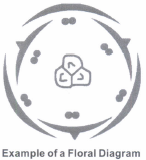
c. After describing various parts of plant, a floral diagram and a floral formula are presented. The floral formula is represented by some symbols.
d. In the floral formula, Br stands for bracteate, K stands for calyx, C for corolla, P for perianth, A for androecium and G for gynoecium, G for superior ovary and \(\bar G\) for inferior ovary, ♂️ for male,♀️ for female ⚥ for bisexual plants, Å for actinomorphic and % for zygomorphic nature of flower.
e. Fusion is indicated by enclosing the figure within bracket and adhesion by a line drawn above the symbols of the floral parts.
Structure of Floral Diagram
f. A floral diagram provides information about the number of parts of a flower, their arrangement and the relation they have with one another.
g. The positior of the mother axis with respect to the flower is represented by a dot on the iop of the floral diagram.
h Calyx, corolla, androecium and gynoecium are drawn in successive whorls, calyx being the outermost and the gynoecium being in the centre.
25.
(a) Root Cap. The root is covered at the apex by a thimble-like structure called the root cap. It protects the tender apex of the root as it makes its way through the soil.
(b) Region of Elongation. A few millimetres above the root cap is the region of meristematic activity. The cells of this region are very small, thin-walled and with dense protoplasm. They divide repeatedly. The cells proximal to this region undergo rapid elongation and enlargement and are responsible for the growth of the root in length. This region is called the region of elongation
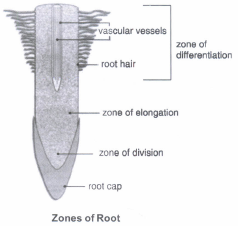
(c) Region of Maturation. The cells of the elongation zone gradually differentiate and mature. Hence, this zone, proximal to region of elongation, is called the region of maturation. From this region some of the epidermal cells form very fine and delicate, thread-like structures called root hairs. These root hairs absorb water and minerals from the soil.
26.
Modifications of Stem
Food Storage. Stems are modified to perform different functions. Underground stems of potato, ginger, turmeric, zaminkand, Colocasia are modified to store food in them. They also act as organs of perenation to tide over conditions unfavourable for growth.
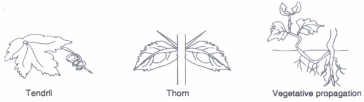
Tendrils. Stem tendrils which develop from axillary buds, are slender and spirally coiled and help plants to climb, such as in gourds (cucumber, pumpkins, watermelon) and grapevines
Thorns. Axillary buds of stems may also get modified into woody, straight and pointed thorns. Thorns are found in many plants such as Citrus, Bougainvillea. They protect plants from browsing animals.
Some plants of arid regions modify their stems into flattened (Opuntia), or fleshy cylindrical (Euphorbia) structures. They contain chlorophyll and carry out photosynthesis.
Vegetative Reproduction. Underground stems of some plants such as grass and strawberry, etc., spread to new niches and when older parts die new plants are formed. In plants, like mint and jasmine a slender lateral branch arises from the base of the main axis and after growing aerially for some time arch downwards to touch the ground. A lateral branch with short internodes and each node bearing a rosette of leaves and a tuft of roots is found in aquatic plants like Pistia and Eichhornia. In banana, pineapple and Chrysanthemum, the lateral branches originate from the basal and underground portion of the main stem, grow horizontally beneath the soil and then come out obliquely upward giving rise to leafy shoots.
27.
Commercial source of cork is cork oak or Quercus suber.
Cork is formed on the outer side by phellogen or cork cambium. Phellogen is purley a secondary meristem which generally develops from an outer layer of cortex by dediffrentiation of cortical cells.The intercellular spaces dissappear.Phellogen cells start dividing on their outer and inner sides.Cells formed on the outerside remain compactly arranged.they undergo subsideration,get filled with atnninsand die. the tissue of dead , tanin, and air filled subsidered cells are formed on outer side of phellogen is called phellen or cork. At some places, aerating structures called lenticles are also formed

11th Standard CBSE Syllabus & Materials
11th Standard CBSE
CBSE 11th Business Studies Forms of Business Organisation Sample Question Papers Study Material - QB365 Set A
NEW11th Standard CBSE
CBSE 11th Business Studies Business, Trade and Commerce Sample Question Papers Study Material - QB365 Set A
NEW11th Standard CBSE
CBSE 11th Physics Waves Sample Question Papers Study Material - QB365 Set A
NEW11th Standard CBSE
CBSE 11th Physics Kinetic Theory Sample Question Papers Study Material - QB365 Set A



CBSE 11th Standard CBSE Subjects
CBSE Standards









