
 100% FREE ACCESS
11th Standard CBSE Syllabus & Materials
11th Standard CBSE
CBSE 11th Economics PART-A - Presentation of Data - New Sample Question Papers Study Material - QB365 Set A
NEW11th Standard CBSE
CBSE 11th Economics PART-A - Organisation of Data - New Sample Question Papers Study Material - QB365 Set A
NEW11th Standard CBSE
CBSE 11th Economics PART-A - Collection of Data - New Sample Question Papers Study Material - QB365 Set A
NEW11th Standard CBSE
CBSE 11th Economics PART-A - Introduction to Economics and Statistics - New Sample Question Papers Study Material - QB365 Set A
NEW11th Standard CBSE
CBSE 11th Business Studies International Trade Sample Question Papers Study Material - QB365 Set A
NEW11th Standard CBSE
CBSE 11th Business Studies Evolution and Fundamentals of Business Sample Question Papers Study Material - QB365 Set A

Published on: 05/03/2019
Animal Kingdom Important Questions
Download CBSE Class 11th Standard CBSE Biology question papers, sample papers, important questions, and previous year solved papers in PDF format. Get free study materials, NCERT solutions, and exam preparation resources for Class 11th Standard CBSE Biology
Questions + Answers key
Take MCQ Biology Test
1.
Which organ is responsible for excretion in Arthropoda?
2.
Which type of digestive system is found in Platyhelminthes?
3.
How do the appendages support the bird's body?
4.
Name a molluscs which has an internal shell and which does not have a shell?
5.
What is hydroskatic skeleton?
6.
What are the peculiar features that you find in parasitic platyhelminthes?
7.
Write the scientific name of a flightless bird and an oviparous mammal
8.
Provide appropriate technical terms for lateral appendages in aquatic annelids.
9.
Give an example of animal which exhibits alternation of generation.
10.
How important is the presence of air bladder in Pisces?
11.
Describe economic importance of the largest phylum.
12.
Diagrammatically show the types of symmetry in animals.
13.
Which factors were responsible for the extinction of dinosaurs (ancient reptiles)? Why reptiles became the first successful land animals?
14.
What are the key features of Mollusca?
15.
On the basis of which characters you can say that Aschelminthes are more advanced compared to Platyhelminthes?
16.
Prepare a list of some animals that are found parasitic on human beings.
17.
Why molluscs are considered advanced over annelids?
18.
How is cephalisation considered as an asset in an adjustment with the environment?
19.
How many chambers are there in the heart of reptiles?
2
3
4
5
20.
Which of the following is an incorrect statement?
There is a common opening for both digestive system and excretory system in Aves.
Forelimbs are modified for flight in Bats
Bioluminescence is also shown by an insect
Open digestive system is more advanced than the closed digestive system
21.
How many chambers are there in the heart of a crocodile?
2
3
4
5
22.
Water vascular system is the characteristic of which group of the following:
Porifera
Ctenophora
Echinodermata
Chordata
1.
Malpighian tubules : Organs of excretion in arthropoda are malpighian tubules. They are slender tubes normally found in the posterior regions of alimentary canal at the junction of the midgut and hindgut.
2.
Closed type digestive system.
3.
Birds have two pairs of limbs, forelimbs are modified into wings for flight.The wings are powered by the powerful flight or breast muscles attached to the large sternum of breast bone.Hindlimbs support the body and used for grasping, perching, wading and swimming
4.
Internal shell-In Sepia(cuttle fish),Loligo(squid)
Shell absent-Octopus(devil fish)
5.
Hydrostatic skeleton is a system of water-filled spaces that act as turgor operated chambers or valve for movements and pressure points
6.
Parasitic platyhelminthes have a thick cuticle.They lack alimentary canal and absorb the nutrients directly through their body surface.Some parasites are provided with hooks and suckers.
7.
Struthio (ostrich-a-flightless bird) and Ornithorhynchus (platypus-an egg laying mammal).
8.
Parapodia for lateral,unjointed and paired appendages
9.
Obellia,shows alternation if asexual and sexual phases in its life cycle.
10.
Gas bladder or air bladder is a gas-filled sac present in fishes. It helps in maintaining buoyancy. Thus, it helps fishes to ascend or descend and stay in the water current.
11.
The largest phylum is Arthropoda and its economic importance is as follows:
They are major agents for cross pollination. Insects, like butterflies and honey bee facilitate cross pollination.
Honey is an important food for human.
Many crustaceans, like lobsters and prawns are part of cuisine around the world.
The red dye cochineal, produced from a Central American species of insect, was economically important to the Aztecs and Mayans.
The blood of horseshoe crabs contains a clotting agent Limulus Amebocyte Lysate which is now used to test that antibiotics and kidney machines are free of dangerous bacteria, and to detect spinal meningitis and some cancers.
Maggots of housefly are used to treat those wounds which take time to heal because of absence of blood supply.
The relative simplicity of the arthropods' body plan, allowing them to move on a variety of surfaces both on land and in water, have made them useful as models for robotics.
They are carriers of many human parasite causing diseases like malaria, filaria and sleeping sickness.
Cockroaches are one of the major nuisance as they contaminate food in kitchens.
Termites are major causes of playing havoc with wooden furnitures.
Scorpions are known for their deadly sting, which can kill human and livestock.
12.
Types of symmetry in animals
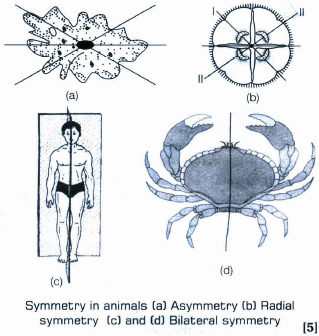
13.
During the Jurassic period of Mesozoic era, certain gigantic reptiles roamed on land, swarm in water and flew in the air. these reptiles were called dinosaurs. These animals disappeared during a short time at the end of the cretacean period.
Their extinction occurred due to competition with early mammals or from climatic changes due to the collision must have produced huge dust clouds into air, screening sunlight from the earth. The lack of sunlight would have destroyed vegetation and cooled the atmosphere. These may be the reason for extinction of dinosaurs.
Reasons for successful adaptation on land by reptiles are
(i) Horny scales which reduce loss of water.
(ii) Internal fertilisation as gametes cannot survive on land.
(iii) Shell around the egg to check desiccation.
(iv) Fluid-filled amnion around the embryo to provide aquatic environment for development on land.
14.
Key Features of Mollusca:
Molluscs are terrestrial or aquatic (marine or fresh water) having an organ-system level of organisation. They are bilaterally symmetrical, triploblastic and coelomate animals.
Structure. Body is covered by a calcareous shell and is unsegmented with a distinct head, muscular foot and visceral hump. A soft and spongy layer of skin forms a mantle over the visceral hump. The space between the hump and the mantle is called the mantle cavity in which feather like gills are present. They have respiratory and excretory functions. The anterior head region has sensory tentacles. The mouth contains a file-like rasping organ for feeding, called radula. They are usually dioecious and oviparous with indirect development.
15.
(a) Platyhelminthes are acoelomate, while Aschelminthes are pseudocoelomates. This indicates development of mesoderm.
(b) In Platyhelminthes both sexes are on the same animal, while in Aschelminthes there is segregation of sexes. This shows another point of evolution.
16.
Parasites on Human Body
1. Taenia solium (Tape worm) Platyhelminthes.
2. Fasciola hepatica (Blood worm) Platyhelminthes.
3. Ascaris lumbricoides (Round worm) Aschelminthes.
4. Wuchereria bancrofti (Filarial worm) Aschelminthes.
5. Ancyclostoma (Hook worm) Aschelminthes.
17.
The molluscs have advancement over annelids, as they have distinct head, better sense organs and gills or lungs for respiration.
18.
The animals having bilateral symmetry move with a anterior end forward this has led to cephalisation i.e differentiate of a define head at the anterior end. cephalization involves concentration on nervous, tissue(brain) and sense organs in the head.
Thess arrangement is an asset in an adjustment in enviornment, has the anterior end of moving animal is first to encounter changes in the area it is entering.
19.
(b)
3
20.
(b)
Forelimbs are modified for flight in Bats
21.
(c)
4
22.
(c)
Echinodermata

11th Standard CBSE Syllabus & Materials
11th Standard CBSE
CBSE 11th Business Studies Forms of Business Organisation Sample Question Papers Study Material - QB365 Set A
NEW11th Standard CBSE
CBSE 11th Business Studies Business, Trade and Commerce Sample Question Papers Study Material - QB365 Set A
NEW11th Standard CBSE
CBSE 11th Physics Waves Sample Question Papers Study Material - QB365 Set A
NEW11th Standard CBSE
CBSE 11th Physics Kinetic Theory Sample Question Papers Study Material - QB365 Set A



CBSE 11th Standard CBSE Subjects
CBSE Standards









