
 100% FREE ACCESS
10th Standard CBSE Syllabus & Materials
10th Standard CBSE
CBSE 10th Social Science ECO - Globalisation and the Indian Economy - New Model Questions Papers Study Material - QB365 Set A
NEW10th Standard CBSE
CBSE 10th Social Science ECO - Money and Credit - New Model Questions Papers Study Material - QB365 Set A
NEW10th Standard CBSE
CBSE 10th Social Science ECO - Sectors of the Indian Economy - New Model Questions Papers Study Material - QB365 Set A
NEW10th Standard CBSE
CBSE 10th Social Science ECO - Development - New Model Questions Papers Study Material - QB365 Set A
NEW10th Standard CBSE
CBSE 10th Social Science PS - Outcomes of Democracy - New Model Questions Papers Study Material - QB365 Set A
NEW10th Standard CBSE
CBSE 10th Social Science PS - Gender, Religion and Caste - New Model Questions Papers Study Material - QB365 Set A

Published on: 01/08/2018
Based on the Areas Related to Circles, some of the important questions are covered in this question paper. The questions are prepared from the book back and PTA question.
For parents, Please subscribe and get the plenty of question with answer for your children practice. For Subscription please Click here.
Download CBSE Class 10th Standard CBSE Maths question papers, sample papers, important questions, and previous year solved papers in PDF format. Get free study materials, NCERT solutions, and exam preparation resources for Class 10th Standard CBSE Maths
Questions + Answers key
Take MCQ Maths Test
1.
A farmer has field of length 20 m and breadth 14 m. By the farmer a well of diameter 7 mis dug 10 m deep for villagers. The earth taken out is spread in the field. Find the level rise in the field. Write the value depicted.
2.
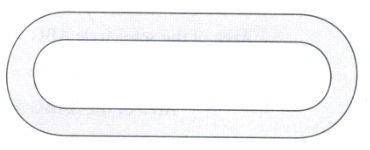
The given figure depicts a racing track whose left and right ends are semicircular. The distance between the two inner parallel line segments is 60 m and they are each 106 m long. If the track is 10 m wide, find:
(i) the distance around the track along its inner edge.
(ii) the area of the track.
3.
A horse is tied to a peg at one corner of a square shaped grass field of side 15 m by means of a 5 m long rope (see figure). Find
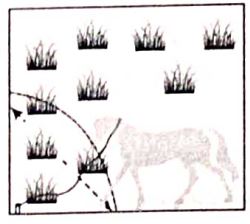
(i) the area of the part of the field in which the horse can graze.
(ii) the increase in the grazing area if the rope were 10 m long instead of 5 m. \((take, \pi\ =3.14)\)
4.
If the circumference of a circle increases from 4\(\pi\) to 8\(\pi\), then what about its area?
5.
A steel wire when bent in the form of a square encloses an area of 121 cm2. If the same wire is bent in the form of a circle, then find the circumference of the circle.
6.
What is the diameter of a circle whose area is equal to the sum of the areas of two circles of radii 40 cm and 9 cm ?
7.
Find the area of circle that can be inscribed in a square of side 10 cm.
8.
The diameter of a wheel is 1.26 m. What the distance covered in 500 revolutions?
9.
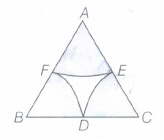
In the given figure, arcs are drawn by taking vertices A. B and C of an equilateral triangle of side 10 cm, to intersect the sides BC, CA and AB at their respective mid-points D, E and F. Find the area of the shaded region.
10.
Find the area of a quadrant of a circle, whose circumference is 22 cm.
11.
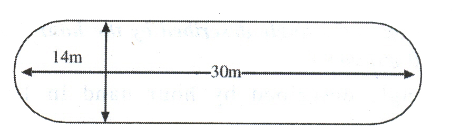
Find the area of the flower-bed having semicircular ends as shown in the figure. \([Use \ \ \pi = \frac{22}{7}]\)
12.
On a square cardboard sheet of area \(784\ cm^2\), four congruent circular plates of maximum size are placed such that each circular plate touches the other two plates and each side of the square sheet is tangent to two circular plates. Find the area of the square sheet not covered by the circular plates.
13.
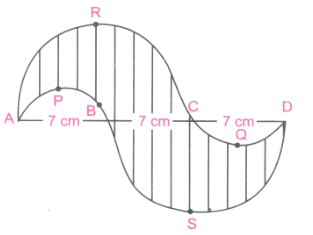
In figure APB and CQD are semicircles of diameter 7 cm each, while ARC and BSD are semicircles of diameter 14 cm each. Find the perimeter of the shaded region. \([Use\ \pi={22\over 7}]\)
14.
The cost of planting grass in a circular park at the rate of \(Rs.\ 4.90/m^2\) is \(Rs.\ 24,640\) path at the rate of \(Rs.\ 3696\).Find the cost of fencing the path on both sides at the rate of \(Rs.\ 2.10/m\).
15.
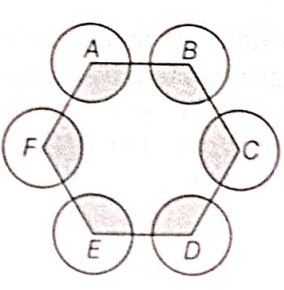
ABCDEF is a regular hexagon. With vertices A, B, C, D, E and F as the centres of circles with same radius r are drawn. Find the area of the shaded portion shown in the given figure.
16.
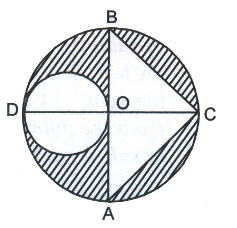
In the adjoining figure, B and CD are two diameters of a circle (with centre O) perpendicular to each other and OD is the diameter of the smaller circle.If OA=7cm, find the area of shaded region.
17.
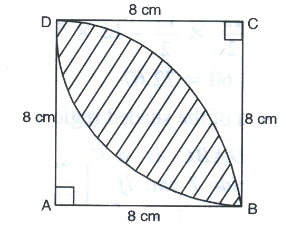
Calculate the area of the shaded region in the figure common between two quadrants of circle of radius 8cm each.
18.
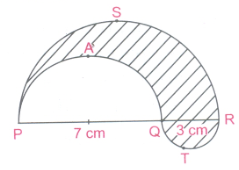
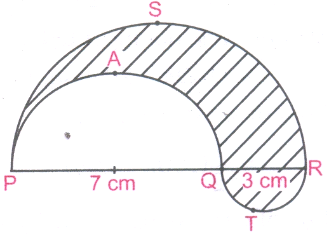
In fig., PSR, RTQ and PAQ are three semicircles of diameters 10 cm, 3 cm and 7 cm respectively. Find the perimeter of the shaded region. [ Use \(\pi\) = 3.14]
19.
Area of sector with angle q° and radius r is ...............
20.
Angle described by the minute hand in one minute is ..................
21.
Area of the ring of external radius R and internal radius r is .................
22.
The perimeter of a sector of angle 90° of a circle with radius 14 cm is ...............
23.
A circular region is divided into equal sectors by 6 diameters. The angle of each sector is 60o .
24.
The circumference of a circle exceeds its diameter by 180 m, then radius is 42 m.
25.
If circumference of a circle and perimeter of square are equal than area of circle is equal to area of sqaure.
26.
If circumferences of two circles are equal, then their areas must be equal.
27.
Area of a circle is the portion enclosed under perimeter.
1.
Radius of the well = \(\frac { 7 }{ 2 } m=3.5\quad m\)
Volume of the earth taken out \(=\pi { \left( \frac { 7 }{ 2 } \right) }^{ 2 }\times 10\)
\(=\frac { 22 }{ 7 } \times \frac { 7 }{ 2 } \times \frac { 7 }{ 2 } \times 10\)
= 385 m3
Area of the rectangular field = 20 \(\times\) 14
= 280 m2
Area of the top of the well = \(\\ \pi { \left( \frac { 7 }{ 2 } \right) }^{ 2 }\)
\(=\frac { 77 }{ 2 } { m }^{ 2 }\)
Area of the remaining field = \(280-\frac { 77 }{ 2 } \)
\(=\frac { 483 }{ 2 } { m }^{ 2 }\)
Let 'h' is the rise in the level of the field
\(h=\frac { 385 }{ \frac { 483 }{ 2 } } =1.6m\) (approx)
2.
-S.png)
Distance around the track along its inner edge = AB + arc BEC + CD + arc DFA
\(\begin{array}{l} =106+\frac{1}{2} \times 2 \pi r+106+\frac{1}{2} \times 2 \pi r \\ =212+\frac{1}{2} \times 2 \times \frac{22}{7} \times 30+\frac{1}{2} \times 2 \times \frac{22}{7} \times 30 \\ =212+2 \times \frac{22}{7} \times 30 \\ =212+\frac{1320}{7} \\ =\frac{1484+1320}{7}=\frac{2804}{7} m \end{array}\)
Area of the track = (Area of GHIJ − Area of ABCD) + (Area of semi-circle HKI − Area of semi-circle BEC) + (Area of semi-circle GLJ − Area of semi-circle AFD)
\(\begin{array}{l} =106 \times 80-106 \times 60+\frac{1}{2} \times \frac{22}{7} \times(40)^{2}-\frac{1}{2} \times \frac{22}{7} \times(30)^{2}+\frac{1}{2} \times \frac{22}{7} \times(40)^{2}-\frac{1}{2} \times \frac{22}{7} \times(30)^{2} \\ =106(80-60)+\frac{22}{7} \times(40)^{2}-\frac{22}{7} \times(30)^{2} \\ =106(20)+\frac{22}{7}\left[(40)^{2}-(30)^{2}\right] \\ =2120+\frac{22}{7}(40-30)(40+30) \\ =2120+\left(\frac{22}{7}\right)(10)(70) \end{array}\)
=2120+2200
= 4320 m2
Therefore, the area of the track is 4320 m2.
3.
Given, side of a square = 15 m
\(\therefore\) Area of square = (15)2 = 225 m2 [\(\because\)area of square = (side)2]
also given, length of rope = 5 m
\(\therefore\) Radius of arc = 5 m
(i) Area of the field graze by the horse,
\(A_1=\frac{\theta}{360^{\circ}} \times \pi r^2=\frac{90^{\circ}}{360^{\circ}} \times 3.14 \times(5)^2\)
[\(\because\) each angle of a square is 90°]
\(=\frac{3.14 \times 25}{4}=\frac{78.5}{4}=19.625 \mathrm{~cm}^2\)
(ii) If length of rope = 10 m = r1 (say)
then, area of the field graze by the horse,
\(\begin{aligned} A_2 & =\frac{\theta}{360^{\circ}} \times \pi r_1^2=\frac{90^{\circ}}{360^{\circ}} \times 3.14 \times(10)^2 \\ \end{aligned}\)
\(\begin{aligned} =\frac{3.14 \times 100}{4}=\frac{314}{4}=78.5 \mathrm{~cm}^2 \end{aligned}\)
\(\therefore\) Required increase in the grazing area
= A2 - A1
= 78.5 - 19.625 = 58.875 cm2
4.
Circumference of the circle = 4\(\pi\) cm \(\Rightarrow\) r = 2 cm.
Increase circumference = 8\(\pi\) cm. \(\Rightarrow\) r = 4 cm.
Area of the 1st circle = \(\pi\) \(\times\) (2)2= 4\(\pi\) cm2
Area of the new circle = \(\pi\) (4)2= 16\(\pi\) = 4 \(\times\) 4\(\pi\)
\(\therefore\) Area of the new circle = 4 times the area of first circle.
5.
Area of square = 121 cm2
Side of the square \(=\sqrt{121}=11 \mathrm{~cm}\)
Perimeter of the square = 4 \(\times\) 11 = 44 cm.
Circumference of the circle = Perimeter of the square
=44 cm
6.
Area of the circle = sum of areas of two circles
\(\begin{aligned}
& \pi \mathrm{R}^2=\pi \times(40)^2+\pi(9)^2 \\
\end{aligned}\)
\(\begin{aligned}
& \Rightarrow \mathrm{R}^2=1600+81 \\
\end{aligned}\)
\(\begin{aligned}
& \Rightarrow R=\sqrt{1681}=41 \mathrm{~cm}
\end{aligned}\)
\(\therefore\) Diameter of required circle = 41 \(\times\) 2 = 82 cm.
7.
Radius of the circle = \(\frac{10}{2}=5 \mathrm{~cm}\)
Area of the circle = \(\pi\) \(\times\) r2
= \(\pi\)\(\times\) (5)2 = 25\(\pi\) cm2
8.
Distance covered in 1 revolution = circumference of wheel
= \(\pi\)d
= \(\pi\) \(\times\) 1.26m.
Distance covered in 500 revolutions
= 500 \(\times\) \(\pi\) \(\times\) 1.26
=500 \(\times\) \(\frac {22}{7}\) \(\times\) 1.26
= 1980 m.
9.
Given, triangle ABC is an equilateral triangle.
\(\therefore \quad \angle A=\angle B=\angle C={ 60 }^{ 0 }\quad and\quad radius,\quad r=\frac { 10 }{ 2 } cm=5cm\)
Area of sector AFEA\(=\frac { \theta }{ { 360 }^{ 0 } } \times \pi { r }^{ 2 }\)
\(=\frac { { 60 }^{ 0 } }{ { 360 }^{ 0 } } \times \pi { \times (5) }^{ 2 }\)
\(=\frac { 25 }{ 6 } \pi \quad { cm }^{ 2 }\)
Since, area of all three sectors are equal.
Total area of shaded region
=3 x Area of sector AFEA\(=3\left( \frac { 25 }{ 6 } \pi \right) \)
\(=3\times \frac { 25 }{ 6 } \times 3.14=39.25\quad { cm }^{ 2 }\)
Hence, the area of shaded region is 39.25 cm2
10.
9.625 cm2
11.
378 m2
12.
Let side of a square = acm2
Area= 784cm
A.T.Q. a2=784
⇒ \(a=\sqrt{784}=28cm\)
If two circles touch externally then centres of both circles and point of contact are in a same line.
Sum of diameters of two circles = 28cm
⇒ diameter of one circle = 14cm
⇒ radius of one circle = 7 cm
⇒ area of one circle=π(7)2
\(={22\over 7}\times7\times7=154cm^2\)
Area of four circles = 4 X 154 = 616 cm2.
∴ Area of square sheet not covered by the circular plates
= 784-616 = 168 cm2.
13.
Perimeter of shaded region = Perimeter of semicircles
ARC+APB+BSD+CQD
\(=\pi[r_1+r_2+r_3+r_4]\)
\(={22\over 7}\left[7+{7\over 2}+7+{7\over2}\right]={22\over 7}\times21=66cm\)
14.
Area of circular park=\({24650\over 4.9}m^2\)
Let radius of the park be=r
\(∴\ \ \pi r^2={24640\over 4.9}\)
\(⇒\ r^2={24640\over 4.9}\times{7\over22}\ \ ⇒ r=40\)
Area of path \(={3696\over 3.5}=1056m^2\)
Let width of path be x m
∴ Outer radius = (40 + x) m
Area of path=πR2-πr2
⇒ π(R2 -r2) = 1056
\(⇒\ {22\over 7}[(40+x^2)^2-40^2]=1056\)
\(⇒\ (40+x)^2-40^2={1056\times7\over 7}\)
⇒(40+x-40)(40+x+40)=336
⇒ x2 + 80x- 336=0
⇒ x2 +80x 336=0
⇒x2+84x-4x-336=0
⇒ (X + 84) (X + 4) = 0
⇒ x=4 or x= 84 m (rejected)
∴ x=4m
Outer radius=40+4=44m
\(={1760\over 7}m\)
Outer circumference=\({1936\over 7}m\)
Total length for fencing=\({1760\over 7}+{1936\over 7}\)
=528m
∴ Total cost=Rs.528x2.10=Rs.1108.80
15.
Each angle of regular hexagon \(=\frac{\text { Sum of all angles }}{\text { Number of sides }}\)
\(=\frac{(6-2) \times 180^{\circ}}{6}=120^{\circ}\)
\(\therefore \angle A=\angle B=\angle C=\angle D=\angle E=\angle \mathrm{F}=120^{\circ}\)
Area of shaded region = 6 \(\times\) Area of sector with \(\angle\)A.
Ans. 2\(\pi\)r2
16.
Here, two diameters AB and CD are perpendicular to each other.
ஃ OA = 0B = OC = OD = 7 cm
Radius of smaller circle with OD as diameter = \(7\over2\) cm
ஃ Area of the shaded region
= Area of big circle - Area of smaller circle - Area of \(\triangle\)ABC
= \({22\over7}\times7\times7-{22\over7}\times{7\over2}\times{7\over2}-{1\over2}\times14\times7\)
= 154 - 38.5 - 49
= 66.5 cm2
17.
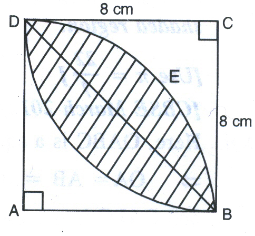
Area of quadrant ABED = \(1\over4\) x \(\pi\) x 82
= \({1\over4}\times{22\over7}\times8\times8\)
= \(352\over7\) cm2
Area \(\triangle\)ABD = \(1\over2\) x AB x AD
= \(1\over2\) x 8 x 8 = 32 cm2
Area of shaded region
= 2[Area of quadrant ABED - Area of \(\triangle\)ABD]
= \(2\left[ \frac { 352 }{ 7 } -32 \right] =2\left[ \frac { 352-224 }{ 7 } \right] =\frac { 2\times 128 }{ 7 } =\frac { 256 }{ 7 } \)
= 36.57 cm2
18.
Diameter of Semicircle PSR, PAQ and QTR are 10 cm, 7 cm and 3 cm respectively.
Perimeter of shaded region
= length of arc PSR + length of arc PAQ + length of arc QTR
= [\(\pi\)(5) + \(\pi\)(3.5) + \(\pi\)(1.5)] cm
= x 10 cm = 3.14 x 10 cm = 31.4 cm
19.
()
\(\frac { \pi { r }^{ 2 }{ q }^{ ° } }{ { 360 }^{ ° } } \)
20.
()
6°
21.
()
\(\pi \left( { R }^{ 2 }-{ r }^{ 2 } \right) \)
22.
()
50 cm
23.
(b)
24.
(a)
25.
(b)
26.
(a)
27.
(a)

10th Standard CBSE Syllabus & Materials
10th Standard CBSE
CBSE 10th Social Science PS - Federalism - New Model Questions Papers Study Material - QB365 Set A
NEW10th Standard CBSE
CBSE 10th Social Science PS - Power Sharing - New Model Questions Papers Study Material - QB365 Set A
NEW10th Standard CBSE
CBSE 10th Social Science GEO - Manufacturing Industries - New Model Questions Papers Study Material - QB365 Set A
NEW10th Standard CBSE
CBSE 10th Social Science GEO - Minerals and Energy Resources - New Model Questions Papers Study Material - QB365 Set A



CBSE 10th Standard CBSE Subjects
CBSE Standards





