
 100% FREE ACCESS
11th Standard CBSE Syllabus & Materials
11th Standard CBSE
CBSE 11th Economics PART-A - Presentation of Data - New Sample Question Papers Study Material - QB365 Set A
NEW11th Standard CBSE
CBSE 11th Economics PART-A - Organisation of Data - New Sample Question Papers Study Material - QB365 Set A
NEW11th Standard CBSE
CBSE 11th Economics PART-A - Collection of Data - New Sample Question Papers Study Material - QB365 Set A
NEW11th Standard CBSE
CBSE 11th Economics PART-A - Introduction to Economics and Statistics - New Sample Question Papers Study Material - QB365 Set A
NEW11th Standard CBSE
CBSE 11th Business Studies International Trade Sample Question Papers Study Material - QB365 Set A
NEW11th Standard CBSE
CBSE 11th Business Studies Evolution and Fundamentals of Business Sample Question Papers Study Material - QB365 Set A

Published on: 31/07/2018
From the chapter Biomolecules, some of the important questions are covered in this question paper. The questions are covers from the book back and the previous year questions.
Download CBSE Class 11th Standard CBSE Biology question papers, sample papers, important questions, and previous year solved papers in PDF format. Get free study materials, NCERT solutions, and exam preparation resources for Class 11th Standard CBSE Biology
Questions + Answers key
Take MCQ Biology Test
1.
How do proteins act as carrier proteins?
2.
Nucleotides are phosphorylated nucleosides. Justify.
3.
The double helical model of DNA was proposed by two famous scientists. Name them and discuss that why are the two strands of DNA described as antiparallel?
4.
Differentiate between homopolysaccharide and heteropolysaccharide?
5.
Oil does not dissolve in water.Give scientific explanation.
6.
The polymer of fructose is known as?
7.
Name one element invariably found in proteins, but not in all carbohydrates and lipids.
8.
Where is glycogen found in the body?
9.
Pepsin is an intracellular or extracellular enzyme. Which is correct?
10.
The macromolecules that form the hereditary determinants of the living organism. Name it.
11.
Name the polysaccharide which constitutes the exoskeleton of arthropods.
12.
Name two physical factors which can affect the enzyme activity
13.
Write the name of any one amino acid, sugar nucleotide and fatty acid.
14.
What is the name given to that part of the enzyme where catalytic work is carried out?
15.
What is the name given to a polysaccharide composed of two different monomers? Also give example for this.
16.
What is the concept of metabolism? What are the metabolic basis for living?
17.
What are the functions of polysaccharides?
18.
Discuss the types of enzyme cofactors that are required for the efficient activity for enzymes.
19.
Describe the influence of temperature on enzyme action.
20.
Without metabolism, the living state can not exist Justify.
21.
Differentiate between anabolism and catabolism, along with an example for each.
22.
Is rubber a primary metabolite or a secondary metabolite? Write four sentence about rubber?
23.
Find out how much cellulose is made by all the plants in the biosphere and compare it with how much of paper is manufactured by man and hence what is the consumption of plant material by man annually. What a loss of vegetation!
1.
Proteins act5s as a carrier protein in the following ways
(i) Some proteins act as carrier which bind and transport specific molecules across a membrane or in a body fluid.
(ii) Haemoglobin of RBCs transports oxygen in the body.
(iii) Myoglobin of muscles store oxygen.
(iv) Serum albumin carries fatty acids and lipids in the blood.
2.
A nucleoside consists of a nitrogen base and a pentose sugar, but when a phosphate is added to the nucleoside, it is called nucleotide, hence, a nucleotide is a phosphorylated nucleoside.
3.
Watson and Crick proposed the double helical model of DNA structure.
The two strands are antiparallel because they run in opposite directions, one in the \({ 5 }^{ ' }\rightarrow { 3 }^{ ' }\)direction and the other in \({ 3 }^{ ' }\rightarrow { 5 }^{ ' }\) direction.
4.
| Homopolysaccharide | Heteropolysaccharide |
| They are the complex carbohydrates formed by the polymerisation of one type of monosaccharide units. | They are the complex carbohydrates formed by the polymerisation of more than one type of monosaccharide units. |
| e.g., starch, glycogen and cellulose. | e.g., chitin and agar. |
5.
Oil is non-polar and is not attracted to water.so oil is not soluble in water
6.
Inulin is a fructose polymer found in many plants. It can be found in the roots and rhizomes of plants.
7.
Nitrogen is found invariably in proteins, but not in all carbohydrates and lipids.
8.
Glycogen is found in liver cells and molecules in the body.
9.
| Intracellular Enzymes | Extracellular Enzymes |
|---|---|
| Examples – DNA and RNA polymerase, ATP synthetase, etc. The lysosome and peroxisomes also contain intracellular enzymes. | Examples – Peptidase, amylase, trypsin, collagenase, pepsin, sucrase, maltase, kinases, etc. |
10.
Nucleic acid : All the hereditary information is stored in the DNA.
11.
Arthropods have sclerotein protein and polysaccharide called chitin in their exoskeleton.
12.
Temperature and pressure are the two physical factors that affects activity of an enzyme
13.
Alanine is an amino acid, adenylic acid is a nucleotide and linolenic acid is a fatty acid.
14.
Active or catalytic site is that part of an enzyme where catalytic work is carried out
15.
The name given is heteropolysaccharide to the type of polysaccharide, which is composed of different types of monomers, e.g., pectin.
16.
The continuous process of breakdown and synthesis of biomolecules through chemical reactions occurring in the living cells is called metabolism.
(i) Each of the metabolic reaction results in a transformation of biomolecules.
(ii) Most of these metabolic reactions do not occur in isolation but are always linked with some other reactions.
(iii) In these reactions, the metabolisms are converted into another metabolite in a series of linked reactions called metabolic pathways.
(iv) Each metabolite has a define rate and direction during the flow through a metabolic pathways called the dynamic state.
In living systems, metabolism involves two following types of pathways
(i) The anabolic pathways is called biosynthetic pathway. It leads to a more complex structure from a simpler structure, e.g., the pathway involving the conversion of acetic acid into cholesterol. These pathways consume energy.
(ii) The catabolic pathways leads to simpler structure from a complex structure, e.g., the pathways involving conversion of glucose into lactic acid in our skeletal muscles. This pathway leads to the release of energy, e.g., energy is liberated when glucose is degrated to lactic acid in our skeletal muscles.
17.
The function of polysaccharides are
(i) Starch and glycogen are the major storage food of organic world.
(ii) On hydrolysis, storage carbohydrates provide both energy and carbon chains.
(iii) Chitin is the structural carbohydrate of fungal walls and exoskeleton of arthropods. (insects).
(iv) Cellulose is the structural substance of cell walls in most of the plants.
(v) Cellulose is economically important in the production of furniture, shelter, fuel, paper, textiles, ropes, rayon, cellophane, plastics, etc.
18.
Cofactors are non-protein molecules that are relatively stable at high temperature consisting of thhree main types i.e inorganic ions, coenzymes and prosthetic groups.
(i) Examples of inorganic ions are calcium ions(activates the enzyme thrombokinase to convert prothrombin into thrombin during thye blood clotting process) and chloride ions(activates salivary amylas to convert starch into maltose)
(ii) Examples of coenzymes are NAD, acetyl coenzyme A ATP and NADP
(iii) Prosthetic groups are molecules that are permanently attached to the enzyme.Examples of prosthetic groups are heam and FAD
19.
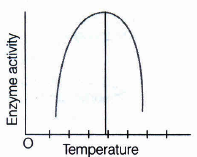
Enzymes generally function at a narrow range of temperature. The temperature at which the enzyme shows its maximum activity, is called its optimum temperature. The enzyme activity decreases at temperatures below and above the optimum temperature.
At low temperatures, the enzyme is inactive, while at high temperature, the enzyme is denatured and so it loses its activity.
20.
The most important fact of biology systems is that all living organisms exist in a steady-state characterised by the concentration of each of the biomolecule. These biomolecules are in a metabolic flux. Any chemical or physical process moves spontaneously to equilibrium. Thus, the steady state is a non-equilibrium state.
As living organisms work continuously, they cannot afford to reach equilibrium. Hence, the living state is a non-equilibrium steady-state to be able to perform work. This is achieved by energy input. Metabolism provides a mechanism for the production of energy.
Hence, the living state and metabolism are synonymous. Without metabolism, there cannot be a living state.
21.
Difference between anabolism and catabolism are
| Anabolism | Catabolism |
| The metabolic pathways that lead to the synthesis of complex molecules from simpler ones, constitute anabolism. | The metabolic pathways that lead to the formation of simpler molecules from a larger molecule by its breakdown, constitute catabolism |
| These are the biosynthetic pathways. | These are the degradative pathways. |
| Energy is stored in the form of chemical bonds. | Chemical bonds are broken and energy is released. |
| They consume energy, e.g., protein synthesis from amino acids | They release energy e.g., breakdown of glucose into pyruvic acid in glycolysis. |
22.
(i) Yes, it is natural rubber (cis-1, 4-polyisoprene) is a secondary metabolite. It is extracted from the rubber tree (Hevea brasiliensus).
(ii) In the rubber tree, latex is produced in the highly specialised cells, called laticifers in phloem.
(iii) Rubber is a terpenoid and due to its high tensile strength, elasticity and plasticity properties. It is widely used in industries.
(iv) It is a polymeric substance.
23.
Most paper is formedfrom wood pulp. The main component of wood pulp is cellulose. Almost 100 billion stonnes of cellulose is produced by all the plants in the biosphere. About 400 million tonnes of paper is used by man in a year and we consume most of the mnanufacture paper.
Therefore, the loss of vegetation is very high and we need to use the sources wisely.

11th Standard CBSE Syllabus & Materials
11th Standard CBSE
CBSE 11th Business Studies Forms of Business Organisation Sample Question Papers Study Material - QB365 Set A
NEW11th Standard CBSE
CBSE 11th Business Studies Business, Trade and Commerce Sample Question Papers Study Material - QB365 Set A
NEW11th Standard CBSE
CBSE 11th Physics Waves Sample Question Papers Study Material - QB365 Set A
NEW11th Standard CBSE
CBSE 11th Physics Kinetic Theory Sample Question Papers Study Material - QB365 Set A



CBSE 11th Standard CBSE Subjects
CBSE Standards









