
 100% FREE ACCESS
10th Standard CBSE Syllabus & Materials
10th Standard CBSE
CBSE 10th Social Science ECO - Globalisation and the Indian Economy - New Model Questions Papers Study Material - QB365 Set A
NEW10th Standard CBSE
CBSE 10th Social Science ECO - Money and Credit - New Model Questions Papers Study Material - QB365 Set A
NEW10th Standard CBSE
CBSE 10th Social Science ECO - Sectors of the Indian Economy - New Model Questions Papers Study Material - QB365 Set A
NEW10th Standard CBSE
CBSE 10th Social Science ECO - Development - New Model Questions Papers Study Material - QB365 Set A
NEW10th Standard CBSE
CBSE 10th Social Science PS - Outcomes of Democracy - New Model Questions Papers Study Material - QB365 Set A
NEW10th Standard CBSE
CBSE 10th Social Science PS - Gender, Religion and Caste - New Model Questions Papers Study Material - QB365 Set A

Published on: 24/09/2019
Areas Related to Circles
Download CBSE Class 10th Standard CBSE Maths question papers, sample papers, important questions, and previous year solved papers in PDF format. Get free study materials, NCERT solutions, and exam preparation resources for Class 10th Standard CBSE Maths
Questions + Answers key
Take MCQ Maths Test
1.
If the hypotenuse of an isosceles right triangle is \(7\sqrt{2}cm\), find the area of the circle inscribed in it.
2.
A chord of a circle of radius 12cm subtends an angle of 1200 at the centre.Find the area of the corresponding segment of the circle.[Use \(\pi=3.14\ and\ \sqrt{3}=1.73\)]
3.
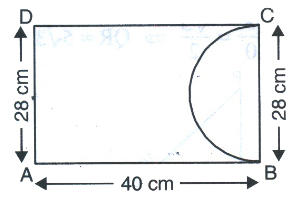
From a rectangular sheet of paper ABCD with AB=40cm and AD=28cm, a semicircular portion with BC as diameter is cut off.Find the area of the remaining paper.[Use \(\pi={22\over7}\)]
4.
How long will Onkar take to run \(12{1\over2}\) rounds at the rate of 3.3km/h, around a circular track of area 5544m2?
5.
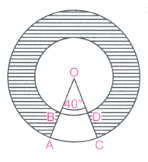
In fig., find the area of the shaded region, enclosed between two concentric circles of radii 7 cm and 14 cm where \(\angle AOC={ 40 }^{ o }.\ (Use\quad \pi =\frac { 22 }{ 7 } )\)
6.
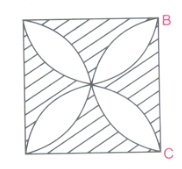
In fig., ABCD is a square of side 14 cm. Semicircles are drawn with each side of square as diameter. Find the area of the shaded region ( use \(\pi\) = 22 / 7 )
7.
AB is chorod of circle of radius 10 cm. The chorod subtends a right angle at the centre of the circle. Find the area of the minor segment. [Take \(\pi\) = 3.14 ]
8.
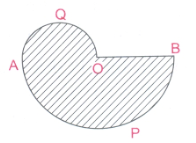
In fig., APB and AQO are semicircle, and AO = OB. If the perimeter of the figure is 40 cm, find the area of the shaded region. [ Use \(\pi\) = 22 / 7]
9.
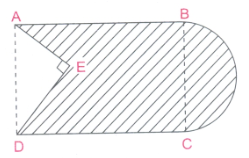
In fig., from a rectangular region ABCD with AB=20 cm, a right triangle AED with AE=9 cm and DE = 12 cm, is cut off. ON the other end, taking BC as diameter; a semicircle is added on outside the region. Find the area of the shaded region. [ Use \(\pi\) =3.14 ]
10.
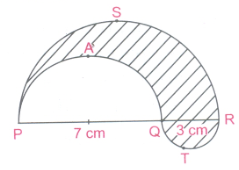
In fig., PSR, RTQ and PAQ are three semicircles of diameters 10 cm, 3 cm and 7 cm respectively. Find the perimeter of the shaded region. [ Use \(\pi\) = 3.14]
11.
The inner perimeter of a racetrack is 400 m and the outer perimeter is 488 m. The length of each straight portion is 90 m. Find the cost of developing the track at the rate of \(Rs. \ 12.50/m^2\)
12.
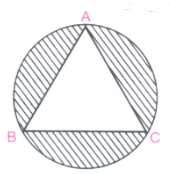
In given figure, an equilateral triangle has been inscribed in a circle of radius 6 cm. Find the area of the shaded region. \([Use\ \pi=3.14]\)
13.
Find the area of the shared region in figure, where a circular arc of radius 7 cm has been drawn with vertex O of an equilateral triangle OAB of side 12 cm, as centre.
14.
The area of an equilateral triangle in \(49\sqrt3\ cm^2\). Taking each angular point as centre, circles are drawn with radius equal to half the length of the side of the triangle. Find the area of triangle not included in the circles.\([Take\ \sqrt3=1.73]\)
15.
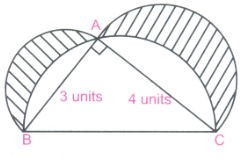
In fig., ABC is a right-angled triangle, right-angled at A. Semicircles are drawn on Ab, Ac and BC as diameters. Find the area of the shaded region.
1.
\(\triangle\) PQR is an isosceles right triangle
⇒ Q = 90°, PQ = RQ = x (say)
⇒ 2x2 = (7\(\sqrt2\))2
⇒(\(\sqrt2\)x)2 = (7\(\sqrt2\))2
⇒ x = 7 cm
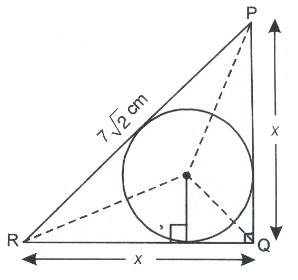
Now, semi-perimeter(s) = \({7+7+7\sqrt2 \over2} = {14+7\sqrt2 \over2}\)
Also, we know that radius of inscribed circle,
r = \(\triangle\over s\)
⇒ r = \(\frac { \frac { 1 }{ 2 } \times 7\times 7 }{ \frac { 14+7\sqrt { 2 } }{ 2 } } =\frac { 7\times 7 }{ 7(2+\sqrt { 2 } ) } \)
= \(\frac { 7 }{ 2+\sqrt { 2 } } \)cm
Area of the circle inscribed in \(\triangle\) PQR
= \(\frac { 22 }{ 7 } \times \frac { 7 }{ 2+\sqrt { 2 } } \times \frac { 7 }{ 2+\sqrt { 2 } } \)
= \(\frac { 152 }{ { \left( 2+\sqrt { 2 } \right) }^{ 2 } } { cm }^{ 2 }\)
2.
Here, OA = OB = r = 12cm, \(\angle \)AOB = 120°
In \(\triangle\)AOB, AO = BO = 12 cm, draw OD ⊥ AB
Since \(\triangle\)AOB is an isosceles and OD ⊥ AB
ஃ OD is the angle bisector as well as median
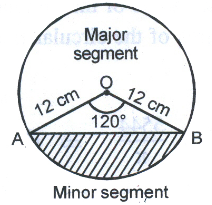
Now, in rt. \(\triangle\)ADO, \(\angle \)D = 90° , \(\angle \)AOD = 60°
∴ \(OD\over AO\) = cos 60°
= 12 x 1/2 =6 cm
and \(AD\over AO\) = sin 60°
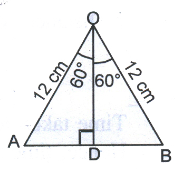
⇒ AD = AO, sin 60° = 12 x \(\sqrt3 \over2\) = 6\(\sqrt3\) cm
∴ AB = 2 AD = 2\(\sqrt3\) x = 12\(\sqrt3\) cm
Area of minor segment
= Area of sector AOB - Area of \(\triangle\)AOB
= \(\theta\over360°\) x \(\pi\)r2 - \(1\over2\) x AB x OD
= \(120° \over360°\) x 3.14 x 12 x 12 - \(1\over2\) x 12\(\sqrt3\) x 6
= 150.72 - 62.28 = 88.44 cm2.
3.
The area of rectangular sheet ABCD = 40 x 28
= 1120 cm2
The diameter of semicircle = 28 cm
ஃ Radius of semicircle = 14 cm
Area of semicircle = \(\frac { 1 }{ 2 } \times \frac { 22 }{ 7 } \times 14\times 14\quad { cm }^{ 2 }\)
= 308 cm2
Thus, area of remaining paper = Area of paper - Area of semicircle
= 1120 - 308 = 812
∴ Required area = 812 cm2
4.
Let r be the radius of the circular track.
Now, area of the circular track = 5544 m2 [given]
⇒ \(\pi\)r2 = 5544
⇒ r2 = \(5544\over \pi\) ⇒ r2 = \(5544 \times7 \over22\)
⇒ r2 = 1764 ⇒ r = \(\sqrt{1764}\) = 42 m
Circumference of the circular track = 2\(\pi\)r
= 2 x \(22\over7\)x42
= 264 m
ஃ Distance covered in 12\(1\over2\) rounds = 264 x \(25\over2\)
= 3300 m
= 3.3 km
Time taken to cover 3.3 km = 1 hour [given] Hence, time taken to cover 3300 m (12\(1\over2\) rounds) around the circular track is 1 hour.
5.
Area of bigger circle
= \(\pi { R }^{ 2 }=\frac { 22 }{ 7 } \times 14\times 14=616\quad { cm }^{ 2 }\)
Area of smaller circle
= \(\pi { R }^{ 2 }=\frac { 22 }{ 7 } \times 7\times 7=154\quad { cm }^{ 2 }\)
Area of sector AOC
= \(\frac { 40 }{ 360 } \times \pi \times { 14 }^{ 2 }=\frac { 1 }{ 9 } \times \frac { 22 }{ 7 } \times 14\times 14\) = \(\frac { 616 }{ 9 } \) cm2
Area of sector BOD
= \(\frac { 40 }{ 360 } \times \pi \times { 7 }^{ 2 }=\frac { 1 }{ 9 } \times \frac { 22 }{ 7 } \times 7\times 7\) = \(154\over9\) cm2
Area of shaded part
= area of bigger circle - area of smaller circle - area of ABCD
= \(\frac { 40 }{ 360 } \times \pi \times { 7 }^{ 2 }=\frac { 1 }{ 9 } \times \frac { 22 }{ 7 } \times 7\times 7\) cm2
= \(1232\over3\) cm2
6.
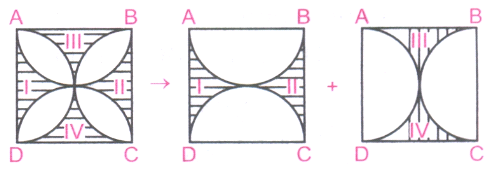
Area of shaded part (I + II)]
= Area of square ABCD - Area of two semicircles
= a2 - 2 x \(\frac { \pi { r }^{ 2 } }{ 2 } \) = 14 x 14 - \(22\over7\) x 7 x 7
= 196 - 154 = 42 cm2
Similarly, Area of shaded part (III + IV) = 42 cm2
∴ Area of shaded part = 42 + 42 = 84 cm2
7.
-s.png)
Area of the segment
= area of the shaded portion
= area of the sector - area of the triangle
= \(\frac { 90° }{ 360° } \times \frac { 22 }{ 7 } \times { (10) }^{ 2 }-\frac { 1 }{ 2 } \times 10\times 10\)
= \(\left( \frac { 1 }{ 4 } \times \frac { 22 }{ 7 } \times 100-50 \right) \) cm2
= (78.57 - 50) cm2
= 28.57 cm2
8.
Let AO = OB = r
Then perimeter of semicircle APB
= \(2\pi r \over 2\) = \(\pi\)r
Perimeter of semicircle AQO
= \(\frac { 2\pi \frac { r }{ 2 } }{ 2 } =\frac { \pi r }{ 2 } \)
(∵ radius of semicircle AQO = \(r\over2\))
∴ Perimeter of shaded region
\(=\ \pi r+\frac { \pi r }{ 2 } +r=\frac { 2\pi r+\pi r+2r }{ 2 } \)
But perimeter of shaded region
ஃ \(\frac { 2\pi r+\pi r+2r }{ 2 } =40\)
⇒ r(2\(\pi\) + \(\pi\) + 2) = 80
⇒ r(3\(\pi\) + 2) = 80
⇒ \(r\left( 3\times \frac { 22 }{ 7 } +2 \right) =80\)
⇒ \(r\left( \frac { 66 }{ 7 } +2 \right) =80\)
⇒ \(r\left( \frac { 80 }{ 7 } \right) =80\)
ஃ \(r=\frac { 80\times 7 }{ 80 } =7cm\)
Now, Area of APB = \(\frac { \pi { r }^{ 2 } }{ 2 } =\frac { 22\times 7\times 7 }{ 7\times 2 } \)
= 77 cm2
Area of AQO = \(\frac { \pi { r }^{ 2 } }{ 2 } \)
\(=\frac { 22 }{ 7 } \times \frac { 7 }{ 2 } \times \frac { 7 }{ 2 } \times \frac { 1 }{ 2 } \)
= \(77\over4\) cm2
ஃ Area of shaded region
= 77 + \(\frac { 77 }{ 4 } =\frac { 308+77 }{ 4 } \)
= \(\frac { 385 }{ 4 } \) = 96.25 cm2
9.
Triangle AED is right-angled at E.
ஃ AD2 = AE2 + ED2
⇒ AD = \(\sqrt { { 9 }^{ 2 }+{ 12 }^{ 2 } } \) = \(\sqrt { 81+144 } \)
= \(\sqrt{225}\) = 15 cm
ஃ BC = AD = 15 cm = Diameter of semicircle
Now area of shaded portion
= Area of rectangle + Area of semicircle - Area of triangle AED
= \(\left[ 20\times 15+\frac { 1 }{ 2 } \pi { \left( \frac { 15 }{ 2 } \right) }^{ 2 }-\frac { 1 }{ 2 } \times 9\times 12 \right] { cm }^{ 2 }\)
= \(\left[ 300+\frac { 1 }{ 2 } \times 3.14\times { \left( \frac { 15 }{ 2 } \right) }^{ 2 }-54 \right] { cm }^{ 2 }\)
= [246 + 88.31] cm2 = 334.31 cm2
10.
Diameter of Semicircle PSR, PAQ and QTR are 10 cm, 7 cm and 3 cm respectively.
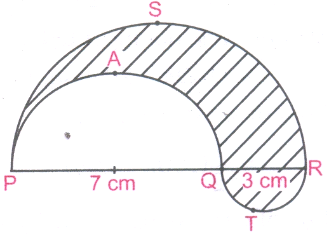
Perimeter of shaded region
= length of arc PSR + length of arc PAQ + length of arc QTR
= [\(\pi\)(5) + \(\pi\)(3.5) + \(\pi\)(1.5)] cm
= x 10 cm = 3.14 x 10 cm = 31.4 cm
11.
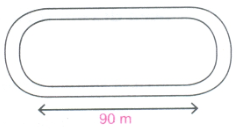
Perimeter of 2 inner semicircle = (400 - 2 x 90) m = (400 - 180) m = 220 m
Radius of each semicircle = \(\frac { 220 }{ 2\pi } \) = \(\frac { 220\times 7 }{ 2\times 22 } \) = 35 m
Perimeter of 2 outer semicircle = (488 - 180) m = 308 m
Radius of each outer semicircle = \(\frac { 308 }{ 2\pi } =\frac { 308\times 7 }{ 2\times 22 } =\quad 49m\)
width of the track = outer radius - inner radius = 49 - 35 = 14 m
Area of rectangular tracks = 2 x area of rectangle
= 2 x i x b = 2 x 90 x 14 (i = 90, b = 14 m)
= 28 x 90 = 2520 m2
Area of two semicircle rings = area of one circle ring
\(=\quad \pi \left( { R }^{ 2 }-{ r }^{ 2 } \right) =\frac { 22 }{ 7 } \left( { 49 }^{ 2 }-{ 35 }^{ 2 } \right) { m }^{ 2 }\)
= \(22\over7\) x (49 - 35) (49 - 35) m2
= \(22\over7\) x 14 x 84 m2 = 44 x 84 = 3696 m2
Total area of track = (2520 + 3696) m2 = 6216 m2
Cost of developing the track at the rate of Rs.12.50/ m2 = Rs. 6216 x 12.50 = Rs.77,700
12.
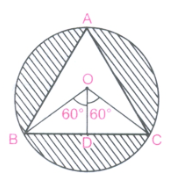
In OBD
cos 60°=\(OD \over OB\)and sin 60°=\(BD\over OB\)
⇒ \(1\over2\)= \(OD\over6\) and \(\frac { \sqrt { 3 } }{ 2 } \) = \(BD\over6\)
⇒ \(6\over2\)=OD and \(\frac { \sqrt { 3 } }{ 2 } \)x6 = BD
⇒ OD = 3 and BD = 3\(\sqrt3\)
BC = 2BD = 2 x 3\(\sqrt3\)=6\(\sqrt3\)
Area of the shaded region = area of circle - area of \(\triangle\)ABC
= \(2\pi { (6) }^{ 2 }-\frac { \sqrt { 3 } }{ 2 } { \left( 6\sqrt { 3 } \right) }^{ 2 }\)
= 3.14 x 6 x - \(\frac { \sqrt { 3 } }{ 4 } \) x 6\(\sqrt3\) x 6 \(\sqrt3\)
= 113.04 - 27 x 1.732 = 113.04 - 46.76 = 66.28 cm2
13.
Radius of circle = 7cm
Side of equilateral triangle = 12cm
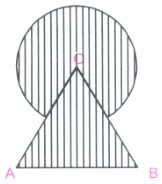
∴ Area of shaded portion = (Area of a circle — area of sector of central angle 600) + area of equilateral triangle OAB
\(=\left[\left\{\pi(7)^2-{60^0\over 360^0}\times\pi(7)^2\right\}+{\sqrt3\over 4}(12)^2\right]cm^2\)
\(=\left[{5\over6}\times{22\over 7}\times49+{\sqrt3\over4}\times144\right]cm^2\)
=(128.33+62.35)cm2=190.68cm2
14.
-S.png)
Let the side of equilateral triangle be a cm
∴ Area \(={\sqrt3\over 2}\times a^2\)
\(⇒\ 49\sqrt3={\sqrt3\over 4}\times a^2\)
⇒ a2=49 x 4 ⇒ a=14
∴ Radius of circle=1/2 (side of triangle)
∴ Radius of circle=7cm
Area of 1 sector of circle with central angle 600
\(={60^0\over 360^0}\times \pi\times7\times7={49\pi\over 6}cm^2\)
Area of 3 sector=\({3\times49\pi\over 6}cm^2\)
\(={49\over 2}\times{22\over 7}cm^2=77cm^2\)
Area of triangle not included in the circle
= area of triangle — area of 3 sectors
=49√3 - 77 = 49 x 1.73-77
= 84.77 -77 = 7.77 cm2
15.
In right-angled ΔABC,
AB2+AC2=BC2
(3)2+(4)2=BC2
9+16=BC2
BC=5units
Now,
Area of shaded region = area of semicircle on side AB + area of semicircle on side AC - area of semicircle on side BC + area of ΔABC
Area of semicircle on side \(AB={\pi r^2\over 2}={22\over 7}\times{9\over 2}={9\over2}sq.units\)......(i)
Area of semicircle on side \(AC={\pi r^2\over 2}={22\over 7}\times4\times{1\over 2}={44\over 7}sq.units\) .....(ii)
Area of semicircle on side \(BC={\pi r^2\over 2}={22\over 7}\times{25\over 4}\times{1\over 2}={275\over 28}sq.units\)....(iii)
Area of ΔABC=\({1\over 2}\times AB \times AC={1\over 2}\times3\times4=6 sq.units\) ....(iv)
Now, Area of shaded region = (i)+(ii)-(iii)+(iv)
\(={99\over 28}+{44\over 7}-{275\over 28}+6={99+176-275+168\over 28}={168\over 28}\)
∴ Area of shaded region=6 square units.

10th Standard CBSE Syllabus & Materials
10th Standard CBSE
CBSE 10th Social Science PS - Federalism - New Model Questions Papers Study Material - QB365 Set A
NEW10th Standard CBSE
CBSE 10th Social Science PS - Power Sharing - New Model Questions Papers Study Material - QB365 Set A
NEW10th Standard CBSE
CBSE 10th Social Science GEO - Manufacturing Industries - New Model Questions Papers Study Material - QB365 Set A
NEW10th Standard CBSE
CBSE 10th Social Science GEO - Minerals and Energy Resources - New Model Questions Papers Study Material - QB365 Set A



CBSE 10th Standard CBSE Subjects
CBSE Standards





