
 100% FREE ACCESS
10th Standard CBSE Syllabus & Materials
10th Standard CBSE
CBSE 10th Social Science ECO - Globalisation and the Indian Economy - New Model Questions Papers Study Material - QB365 Set A
NEW10th Standard CBSE
CBSE 10th Social Science ECO - Money and Credit - New Model Questions Papers Study Material - QB365 Set A
NEW10th Standard CBSE
CBSE 10th Social Science ECO - Sectors of the Indian Economy - New Model Questions Papers Study Material - QB365 Set A
NEW10th Standard CBSE
CBSE 10th Social Science ECO - Development - New Model Questions Papers Study Material - QB365 Set A
NEW10th Standard CBSE
CBSE 10th Social Science PS - Outcomes of Democracy - New Model Questions Papers Study Material - QB365 Set A
NEW10th Standard CBSE
CBSE 10th Social Science PS - Gender, Religion and Caste - New Model Questions Papers Study Material - QB365 Set A

Published on: 20/09/2019
Circles
Download CBSE Class 10th Standard CBSE Maths question papers, sample papers, important questions, and previous year solved papers in PDF format. Get free study materials, NCERT solutions, and exam preparation resources for Class 10th Standard CBSE Maths
Questions + Answers key
Take MCQ Maths Test
1.
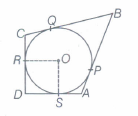
A circle is inscribed in a ΔBC having sides AB=8 cm, BC = 10 cm and CA = 12 cm as shown in figure. Find AD, BE and CF
2.
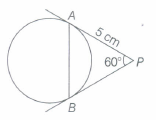
In the given figure, PA and PB are tangents to the given circle such that PA = 5 cm and \(\angle APB={ 60 }^{ \circ }\). Find the length of chord AB.
3.
ABCD is a quadrilateral such that \(\angle D=90^{ \circ }\). A circle C (O, r) touches the sides AB, BC, CD and DA at P, Q, R and S, respectively. If BC = 38 cm, CD = 25 cm and BP = 27 cm, then find the value of r.
4.
Prove that in two concentric circles, the chord of the larger circle, which touches the smaller circle, is bisected at the point of contact.
5.
What will you call a line, if it intersect a circle at two distinct points?
6.
If PA and PB are two tangents drawn from a point P to a circle with centre O touching it at A and B, prove that OP is perpendicular bisector of AB.
7.
The lengths of tangents drawn from an external point to a circle are equal.
8.
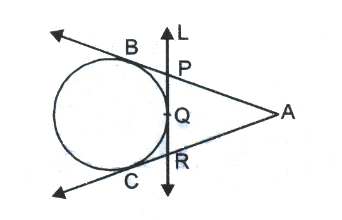
Two tangents are drawn to a circle from an external point A, touching the circle at B and C. From another point L, a third tangent is drawn to the circle intersecting AB in P and AC in R and touching the circle at Q. If AB = 32 cm, find the perimeter of \(\triangle APR\).
9.
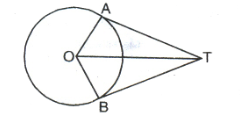
In fig., if \(\angle ATO={ 40 }^{ \circ }\), find\(\angle AOB\).
10.
AB is a diameter of a circle. AH and BK are perpendicular from A and B respectively to the tangent at P.Prove that AH + BK = AB.
11.
In two concentric circles, a chord of length 24 cm of larger circle becomes a tangent to the smaller circle whose radius is 5 cm. Find the radius of the larger circle.
12.
ABC is a right-angled triangle, right angled at A.A circle is inscribed in it.The lengths of two sides containing the angle are 24cm and 10cm.Find the radius of the incircle.
13.
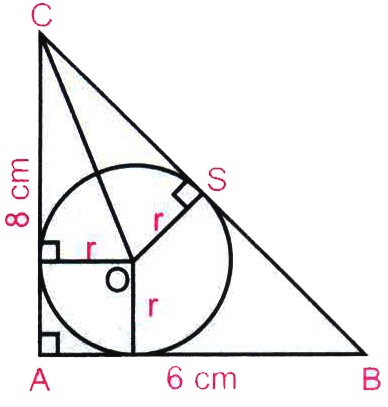
In the given figure, ABC is a right-angled triangle, right angled at A, with AB =6cm and AC=8cm.A circle with centre O has been inscribed inside the triangle Calculate the value of r, the radius of the inscribed circle.
14.
Prove that the intercept of a tangent between two parallel tangents to a circle subtends a right angle at the centre.
1.
We know that, tangents drawn from an exterior point to a circle are equal in length.
AD = AF = x cm
BD = BE = y cm
CE = CF = z cm
Given, AB = 8 cm
⇒ AD + BD = 8cm
⇒ x + y = 8
BC = 10 cm ⇒ BE + CE = 10 cm
⇒ y + z = 10
and CA = 12 cm ⇒ CF + AF = 12 cm
⇒ z + x = 12
On adding Eqs. (i), (ii) and (iii), we get
2(x + y + z) =30
⇒ x + y + z = 15
On subtracting Eq. (ii) from Eq. (iv), we get
x =15 - 10 = 5
On subtracting Eq. (iii) from Eq. (iv), we get
y = 15-12 = 3
On subtracting Eq. (i) from Eq. (iv), we get
z=15-8=7
AD = xcm = 5 cm
BE= ycm = 3 cm
and CF = z cm = 7 cm
Hence, the length of AD, BE and CE are 5 cm, 3 cm and 7 cm, respectively.
2.
5 cm
3.
r = 14 cm
4.
We are given two concentric circles C1 and C2 with centre O and a chord AB of the larger circle C1 which touches the smaller circle C2 at the point P (see Fig). We need to prove that AP = BP.
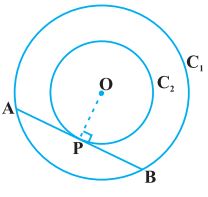
Let us join OP. Then, AB is a tangent to C2 at P and OP is its radius. Therefore, by Theorem.
OP \(\perp\) AB
Now AB is a chord of the circle C1 and OP \(\perp\) AB. Therefore, OP is the bisector of the chord AB, as the perpendicular from the centre bisects the chord,
i.e., AP = BP
5.
Secant
6.
Let OP intersect AB at a point C. Here, PA and PB are the two tangents from a point P lying outside the circle, to the circle with centre O.
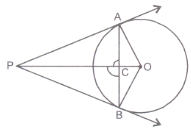
\(\angle \)APO = \(\angle \)BPO [∵ O lies on the bisector of ZAPB]
Now, in \(\triangle\)ACP and \(\triangle\)BCP, we have
AP = BP [tangents from an external pointl
PC = PC [commonl]
\(\angle \)APO = \(\angle \)BPO [proved above]
⇒ \(\triangle\)ACP ≅ \(\triangle\)BCP [by SAS congruence axiom]
⇒ AC = BC [c.p.c.t.]
and \(\angle \)ACP = \(\angle \)BCP
= \(1\over2\) x 180° = 90° [c.p.c.t.]
Hence, OP is the perpendicular bisector of AB.
7.
We are given a circle with centre O, a point P lying outside the circle and two tangents PQ, PR on the circle from P see fig. We are required to prove that PQ = PR.
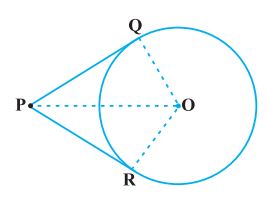
For this, we join OP, OQ and OR. Then \(\angle\)OQP and \(\angle\)ORP are right angles, because these are angles between the radii and tangents, and according to Theorem 10.1 they are right angles. Now in right triangles OQP and ORP,
OQ = OR (Radii of the same circle)
OP = OP (Common)
Therefore, \(\Delta\)OQP \(\cong\)\(\Delta\) ORP (RHS)
This gives PQ = PR (CPCT)
8.
64 cm
9.
\({ 100 }^{ \circ }\)
10.
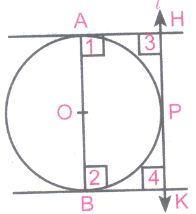
Given: A circle with centre O. AB is the diameter of this circle. I is tangent to the circle. AH and BK are perpendicular to I from A and B at H and K respectively.
To prove: AH + BK = AB
Proof: AH and HP are tangents from the external point H
ஃ AH = HP .....(i)
and BK, KP are tangent from the external point K
ஃ BK = KP ......(ii)
Adding (i) and (ii) we get
AH + BK = HP + PK = HK ......(iii)
AB ⊥ AH
AB ⊥ BK
[Tangent makes 90° angle with radius at the point of contact]
⇒ \(\angle \)1 = \(\angle \)2 = 90°
Given that AH ⊥ i ⇒ \(\angle \)3 = 90°
and BK ⊥ i ⇒ \(\angle \)4 = 90°
∵ \(\angle \)1 = \(\angle \)2 = \(\angle \)3 = \(\angle \)4 = 90°
⇒ AHKB is a rectangle
⇒ AB = HK ......(iv)
[Opposite sides of a rectangle are equal]
From (iii) and (iv) ⇒ PH + PK = AB
AH + BK = AB from (i) and (ii) Hence proved.
11.
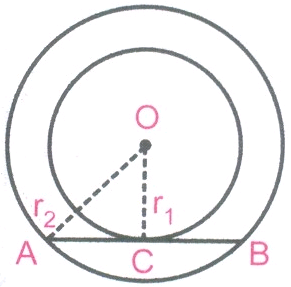
r1 = 5 cm, r2 = ?,
AB = 24 cm
∵ AB is tangent to circle
C(C, r1) at C
ஃ OC ⊥ AB
In circle C(O, r2), AB is a chord and OC ⊥ AB
ஃ AC = BC
[∵ Perpendicular from the centre bisects the chord]
In right \(\triangle\)OCA
OC2 + AC2 = AC2
⇒ 52 + (12)2 = (r2)2
⇒ 25 + 144 = (r2)2 ⇒ (r2)2 = 169
r2 = 13 cm
12.
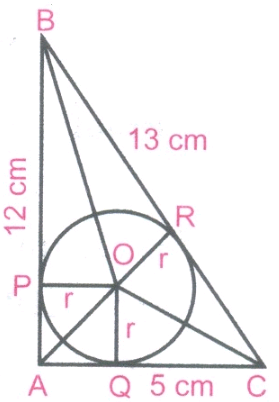
AB = 24 cm
AC = 10 cm
In righta angled ABC
BC2 = AB2 + AC2
= 242 + 102
= 276
⇒ BC =- 26 cm
Let r be the radius of the incircle
⇒ OP ⊥ AB, OQ ⊥ AC and OR ⊥ BC
[Tangent 90° angle with the radius at the point of contact]
OP = OQ = OR
[Incentre of a triangle is equidisation from its sides]
ar (\(\triangle\)ABC) = ar (\(\triangle\)AOB) + ar (\(\triangle\)BOC) + ar(\(\triangle\)AOC)
\(1\over2\)AB x AC = \(1\over2\)AB x OP + \(1\over2\)AC x OQ + \(1\over2\) x BC x OR
\(1\over2\) x 24 x 10 = \(1\over2\)[24 x r x +10 x r + 26 x r]
⇒ 120 = r[24 + 10 + 26]
⇒ 120 = 30r ⇒ r = 4 cm
13.
In right CAB
BC2 = AC2 + AB2 = 82 + 62
BC?2 = 100 ⇒ BC = 10 cm
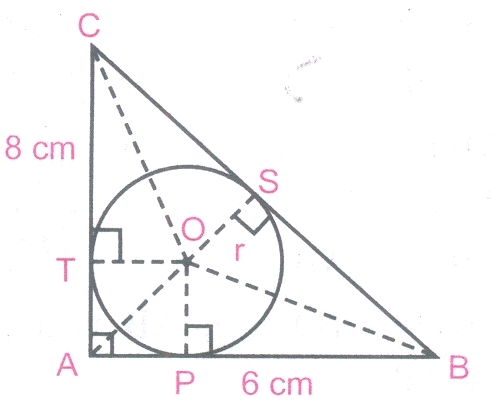
Area of \(\triangle\)CAB = \(1\over2\) x AB x AC
= \(1\over2\) x 6 x 8 = 24 cm2
Area of \(\triangle\)AOB = \(1\over2\) x AB x OP
= \(1\over2\)x 6 x r = 3r cm2
Area of \(\triangle\)AOC = \(1\over2\) x AC x OT
= \(1\over2\) x 8 x r = 4r cm2
Area of \(\triangle\)BOC = \(1\over2\)x BC x OS
= \(1\over2\) x 10 x 10 x r = 5r cm2
Now, area \(\triangle\)AOB + area \(\triangle\)AOC + area \(\triangle\)BOC = Area \(\triangle\)ABC
⇒ 3r + 4r + 5r = 24 ⇒ 12r = 24
ஃ r = 2 cm
14.
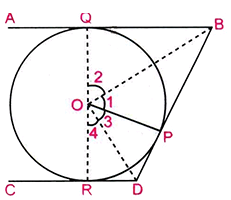
Given. AB and CD are two tangents to a circle and AB || CD.
Tangent BD intercepts an angle BOD at the centre.
To prove. \(\angle \)BOD = 90°
Construction. Join OQ, OB and OR.
Proof. OP ⊥ BD.
[A tangent at any point of a circle is perpendicular to the radius through the point of contact.]
In right angled \(\triangle\) s OQB and OPB
\(\angle \)1 = \(\angle \)2,
Similarly in right angled \(\triangle\)s OPD and ORD
\(\angle \)3 = \(\angle \)4
ஃ \(\angle \)BOD = \(\angle \)1 + \(\angle \)3 = \(1\over2\)[2\(\angle \)1 + 2\(\angle \)3] =\(1\over2\)(\(\angle \)1 + \(\angle \)1 + \(\angle \)3 + \(\angle \)3)
= \(1\over2\)(\(\angle \)1 + \(\angle \)2 + \(\angle \)3 + \(\angle \)4 ) = \(1\over2\)(180°) = 90°

10th Standard CBSE Syllabus & Materials
10th Standard CBSE
CBSE 10th Social Science PS - Federalism - New Model Questions Papers Study Material - QB365 Set A
NEW10th Standard CBSE
CBSE 10th Social Science PS - Power Sharing - New Model Questions Papers Study Material - QB365 Set A
NEW10th Standard CBSE
CBSE 10th Social Science GEO - Manufacturing Industries - New Model Questions Papers Study Material - QB365 Set A
NEW10th Standard CBSE
CBSE 10th Social Science GEO - Minerals and Energy Resources - New Model Questions Papers Study Material - QB365 Set A



CBSE 10th Standard CBSE Subjects
CBSE Standards





