
 100% FREE ACCESS
10th Standard CBSE Syllabus & Materials
10th Standard CBSE
CBSE 10th Social Science ECO - Globalisation and the Indian Economy - New Model Questions Papers Study Material - QB365 Set A
NEW10th Standard CBSE
CBSE 10th Social Science ECO - Money and Credit - New Model Questions Papers Study Material - QB365 Set A
NEW10th Standard CBSE
CBSE 10th Social Science ECO - Sectors of the Indian Economy - New Model Questions Papers Study Material - QB365 Set A
NEW10th Standard CBSE
CBSE 10th Social Science ECO - Development - New Model Questions Papers Study Material - QB365 Set A
NEW10th Standard CBSE
CBSE 10th Social Science PS - Outcomes of Democracy - New Model Questions Papers Study Material - QB365 Set A
NEW10th Standard CBSE
CBSE 10th Social Science PS - Gender, Religion and Caste - New Model Questions Papers Study Material - QB365 Set A

Published on: 14/09/2019
Constructions
Download CBSE Class 10th Standard CBSE Maths question papers, sample papers, important questions, and previous year solved papers in PDF format. Get free study materials, NCERT solutions, and exam preparation resources for Class 10th Standard CBSE Maths
Questions + Answers key
Take MCQ Maths Test
1.
Draw a circle of radius 1·5 cm. Take a point P outside it. Without using the centre draw two tangents to the circle from the point P
2.
Construct a triangle with sides 4 cm, 5 cm and 6 cm. Then, construct a similar triangle to it whose sides are \(\frac{2}{3}\) times of the corresponding sides of the given triangle.
3.
Draw a line segment of length 6 cm and divide it in the ratio 1 : 3. Measure the two parts.
4.
To divide a line segment AB in the ratio 5 : 6, draw a ray AX such that \(\angle BAX\) is an acute angle. Then, draw a ray BY parallel to AX and the points A1 , A2 , A3 ..... and B1, B2, B3 are located at equal distances on rays AX and BY, respectively. Then, find the required joined points.
5.
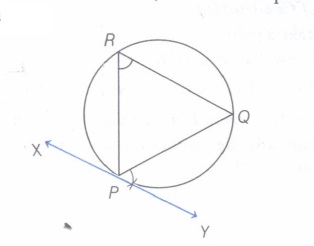
Draw a circle of radius 5 cm. Take a point P on it. Without using the centre of the circle, draw a tangent to the circle at point P.
6.
PQ is a line segment of length 6.4 cm. Geometrically, obtain point R on PQ such that \(\frac { QR }{ PQ } =\frac { 5 }{ 8 } \)
7.
Write the two concepts used for justification in division of a line segment .
8.
A pair of tangents can be constructed from a point P to a circle of radius 3.5 cm situated at a distance of 3 cm from the centre.
9.
Draw an equilateral triangle of altitude 4 cm. Construct another triangle similar to it such that its sides are \(\frac { 2 }{ 3 } \) of the given triangle.
10.
Draw two tangents from the end points of the diameter of a circle of radius 3.5 cm. After these tangents parallel?
11.
Construct tangents to a circle of radius 3 cm from a point on concentric circle of radius 5 cm and measure its length.
12.
Draw line segment AB of length 8 cm. Taking A as centre, draw a circle of radius 4cm and taking B as centre, draw another circle of radius 3cm. Construct tangents to each circle from the centre of the other circle.
13.
Construct a triangle ABC in which \(AB=5\ cm, BC=6\ cm\) and \(AC=7cm.\) Construct another triangle similar to \(\triangle ABC\) such that its sides are \(3\over 5\) of the corresponding sides of \(\triangle ABC\).
14.
Draw a triangle ABC with side BC = 7 cm,
1.
Steps of construction :
1. Draw a circle of radius 1·5 cm. Take a point P outside it.
2. Through P draw a secant PAB to meet the circle at A and B.
3. Produce AP to C such that PC = PA. Bisect CBat Q.
4. With CB as diameter and centre as Q, draw a semi circle
5. Draw \(PD\bot CB\) cutting the semi-circle at the point D.
6. With P as centre and PO as radius an arc to cut the circle at T and T
PT and P are the required tangents.
2.
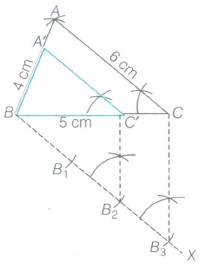
The required triangle is \(\triangle\)A' BC'
3.
1.5 cm, 4.5 cm
4.
Given, a line segment AB and we have to divide it in the ratio 5 : 6.
Steps of Construction
1. Draw a ray AX making an acute \(\angle BAX\)
2. Draw a ray BY parallel to AX by making LABY equal to \(\angle BAX\)
3. Now, locate the points A1 , A2 , A3 ,A4 and A5 (m=5) on AX and B1, B2, B3 , B4, B5 and B6 ( n = 6) on BY such that all the points are at equal distances from each other.
4.Join B6A5' Let it intersect AB at a point C. Then, AC : BC =5 : 6.
Hence, the points joined are A5 and B6 .
5.
Given, radius of circle = 5 cm
1.Draw a circle with 0 as centre and radius 5 cm.
2. Draw any chord PQ through the given point P on the circle.
3.Take a point R on the circle and join P and Q to a pointR.
4. Construct \(\angle QPY=\angle PQX\) on the opposite side of the chord PQ.
5. Produce yP to X to get YPX, as the required tangent.
6.
Given, PQ = 6.4 cm and
\(\frac { QR }{ PQ } =\frac { 5 }{ 8 } or\quad \frac { QR }{ PR } =\frac { 5 }{ 3 } \)
Steps of Construction
1. Draw a line segment of length PQ = 6.4 cm.
2. Draw any ray QX making an acute \(\angle PQX\) with PQ.
3. Draw a ray parallel to Q)( by making \(\angle QPY=\angle PQX\)
4. Mark five points A1 , A2 , A 3 , A4 and A5 on QX and three points B1, B2 , and, B3 on PY such that
QA1 = A1A2 = A2A3 = A3A4 = A4A5 = PB1 = B1B2 = B2B3
5.Join A5 to B3.
Then it intersect PQ at a point R.Thus, R is the point of dividing PQ such that \(\frac { QR }{ PQ } =\frac { 5 }{ 8 } or\quad \frac { QR }{ PR } =\frac { 5 }{ 3 } \)
7.
The justification will be given by using the basic proportionality theorem and similar triangles.
8.
False
9.
Steps of Construction :
1. Draw any line l and take any point X on it.
2. At X, construct a right angle.
3. With X as centre and of radius 4 cm, draw an arc intersecting XY in A.
4. At A and initial line AX, draw angle of 30o to each sides and let these lines intersect line I in B and C.
5. Join AB and AC to get the given triangle.
6. At B, construct an acute angle ㄥCBZ (<90o).
7. Mark three points on BZ such that BB1= B1B2 = B2B3.
8. Join B3C.
9. Through B2, draw B2C' || B3C, intersecting line I in C'.
10. Through C', draw C'A' || CA, intersecting BA in A'. Thus, ΔA'BC' is the required triangle.
10.
Steps of Construction :
1. Draw a circle with centre O and radius 3.5 cm.
2. Draw the diameter POQ.
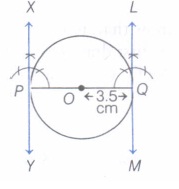
3. Construct angle of 90o at the end points P and Q.
4. XPY and LQM are the two tangents at P and Q to the circle with centre O.
XPY || LQM, because ㄥP + ㄥQ = 180o.
11.
AB'C' is the required triangle.
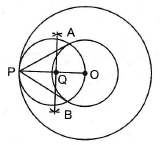
(i) Draw a circle of radius 3 cm with O as its centre
(ii) Draw AB as diameter of thc circle.
(iii) A point P is taken on outer circle and OP is joined.
(iv) Perpendicular bisector of Op is drawn interesting OP at Q.
(v) With Q as centre and OQ as radius a circle is drawn intersecting the smaller circle at A and B
(vi) PA and PB is joined
(vii) PA and PB are the required tangents.
Length of tangent = 4 cm.
12.
Steps of Construction:
1. Draw a line segment AB = 8 cm.
2. Taking A as centre draw a circle C of radius 4 cm and taking B as centre draw a circle C' of radius 3 cm.
3. Draw perpendicular bisector of AB, which intersects AB at point O.
4. Taking point O as centre draw a circle of radius 4 cm passing through points A and B which intersect circle C at P and S and circle C' at points R and Q.
5. Join AQ, AR, BP, and BS. These are the required tangents.
Justification:
Join AP
In ΔABP AP 丄 BP [Radius 丄 to tangent]
AP = 4 cm and AB=8 cm
AB2 = AP2 + BP2
⇒ (8)2 =(4)2+ BP2 ⇒ 64 = 16 + BP2
⇒ 64 - 16 = BP2 ⇒ 48 = BP2
⇒ BP= \(\sqrt { 16\times 3 } \) ⇒ BP = \(4\sqrt { 3 } cm\)
Similarly BS = \(4\sqrt { 3 } cm\)
Join BQ.
In ΔABQ BQ丄 AQ [Radius 丄 to tangent]
BQ=3 cm
AB2= BQ2 + AQ2⇒ (8)2 = (3)2 + AQ2
⇒ 64=9+AQ2 ⇒ 64-9=AQ2
⇒ 55=AQ2 ⇒ AQ=\(\sqrt { 55 } cm\)
Similarly AR=\(\sqrt { 55 } cm\)
A pair of tangents can be drawn to a circle from an external point outside the circle. These two tangents are equal in lengths.
∴ AQ = AR and BP = BS.
13.
Steps of Construction:
(i) A line segment BC = 6 cm is drawn.
(ii) An arc is drawn from B of radius 5 cm.
(iii) An arc is drawn from C of radius 7 cm, cutting the first arc at A. AB and AC are joined to get ΔABC.
(iv) An acute angle CBX is drawn below BC.
(v) On BX, points B1,B2,B3,B4,B5 are taken such that BB1=B1B2=B2B3=B3B4=B4B5.
(vi) B5 and C are joined.
(vii) B3C' is drawn parallel to B5C meeting BC at C'.
(viii) C'A' is drawn parallel to CA, meeting BA at A'.
(ix) Then ΔA'BC' is the required triangle similar to ΔABC, where sides are \(\frac { 3 }{ 5 } \) corresponding sides of ΔABC.
14.
In Δ ABC, ∠A+∠B+∠C=180o
⇒ 105o+ 45o +∠C = 180o⇒∠C30o
Steps of Construction:
1. Draw a line segment BC = 7 cm. At point B draw ∠B = 45o and at point C draw ∠C = 30o and get ΔABC.
2. Draw an acute ∠CBX on the base BCat point B. Mark the ray BX with B1,B2,B3,B4, such that BB1= B1B2= B2B3= B3B4.
3. Join B3 to C. Draw B4C' || B3C, where C' is point on extended line segment BC.
4. At C' draw C'A' || AC, where A' is a point on extended line segment BA.
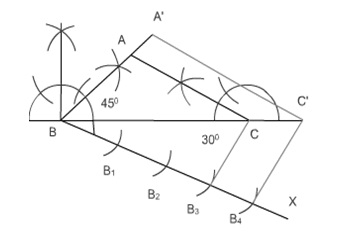
5. Δ A'BC' is the required triangle.
Justification:
In Δ ABC and Δ A'BC' AC || A'C'
∴ By BPT \(\frac { AB }{ A'B } =\frac { BC }{ BC' } \) ...(i)
From (i) and (ii) we get
\(\frac { AB }{ A'B } =\frac { 3 }{ 4 } \Rightarrow A'B=\frac { 4 }{ 3 } AB\)
In Δ BB3C and ΔBB4C'
By BPT \(\frac { BC }{ BC' } =\frac { { BB }_{ 3 } }{ { BB }_{ 4 } } =\frac { 3 }{ 4 } \) ...(ii)
∴ Sides of new triangle formed is \(\frac { 4 }{ 3 } \) times the corresponding sides of first triangle.

10th Standard CBSE Syllabus & Materials
10th Standard CBSE
CBSE 10th Social Science PS - Federalism - New Model Questions Papers Study Material - QB365 Set A
NEW10th Standard CBSE
CBSE 10th Social Science PS - Power Sharing - New Model Questions Papers Study Material - QB365 Set A
NEW10th Standard CBSE
CBSE 10th Social Science GEO - Manufacturing Industries - New Model Questions Papers Study Material - QB365 Set A
NEW10th Standard CBSE
CBSE 10th Social Science GEO - Minerals and Energy Resources - New Model Questions Papers Study Material - QB365 Set A



CBSE 10th Standard CBSE Subjects
CBSE Standards





