
 100% FREE ACCESS
10th Standard CBSE Syllabus & Materials
10th Standard CBSE
CBSE 10th Social Science ECO - Globalisation and the Indian Economy - New Model Questions Papers Study Material - QB365 Set A
NEW10th Standard CBSE
CBSE 10th Social Science ECO - Money and Credit - New Model Questions Papers Study Material - QB365 Set A
NEW10th Standard CBSE
CBSE 10th Social Science ECO - Sectors of the Indian Economy - New Model Questions Papers Study Material - QB365 Set A
NEW10th Standard CBSE
CBSE 10th Social Science ECO - Development - New Model Questions Papers Study Material - QB365 Set A
NEW10th Standard CBSE
CBSE 10th Social Science PS - Outcomes of Democracy - New Model Questions Papers Study Material - QB365 Set A
NEW10th Standard CBSE
CBSE 10th Social Science PS - Gender, Religion and Caste - New Model Questions Papers Study Material - QB365 Set A

Published on: 01/11/2019
Download CBSE Class 10th Standard CBSE Maths question papers, sample papers, important questions, and previous year solved papers in PDF format. Get free study materials, NCERT solutions, and exam preparation resources for Class 10th Standard CBSE Maths
Questions + Answers key
Take MCQ Maths Test
1.
The following table gives the daily income of 50 workers f a factory
| Daily income (in Rs) | 100-120 | 120-140 | 140-160 | 160-180 | 180-200 |
| Number of workers | 12 | 14 | 8 | 6 | 10 |
Find the mean, mode and median of the above data .
2.
The angle of elevation of a cloud from a point 120 m above a lake is 30° and the angle of depression of its reflection in the lake is 60°. Find the height of the cloud.
3.
In the right triangle, B is a point on AC such that AB + AD = BC + CD. If AB = x, BC = h and CD = d, then find x (in term of h and d).
4.
Solve the following pair of linear equations graphically:
2x + 3y = 12 and x - y = 1.
Find the area of the region bounded by the two lines representing the above equations and Y-axis.
5.
Show that \(2(\sin ^{ 6 }{ \theta } +\cos ^{ 6 }{ \theta } )-3(\sin ^{ 4 }{ \theta } +\cos ^{ 4 }{ \theta } )+1=0.\)
6.
A ladder 17 m long, reaches at a window of a building 15 m above the ground. Find the distance of the foot of the ladder from the building.
7.
Check graphically, whether the following pair of linear equations is consistent. If yes, solve it graphically.
2x-y=0, x+y=0
8.
If the pth terms of an AP is \(\frac{1}{q}\) and the qth term is \(\frac{1}{p}\), show that the sum of pq terms is \(\frac{1}{2}\) (pq + 1).
9.
A motor boat whose speed is 24km/h in still water takes 1 hour more to go 32 km upstream than no return downstream to the same spot. Find the speed of the steam.
1.
| C.I | f1 | c.f | xi | \(ui=\frac { xi-a }{ h } \quad \) | fiui |
| 100-120 | 12 | 12 | 110 | -2 | -24 |
| 120-140 | 14 | 26 | 130 | -1 | -14 |
| 140-160 | 8 | 34 | 150 | 0 | 0 |
| 160-180 | 16 | 40 | 170 | 1 | 6 |
| 180-200 | 10 | 50 | 190 | 2 | 20 |
| \(\Sigma f=50\) | \(\Sigma fiui=-12\) |
a = assumed mean = 150
\(\overset { - }{ =a+ } \quad \frac { \Sigma f_{ i }u_{ i } }{ \Sigma f_{ i } } \times h\)
\(=150+\frac { -12 }{ 50 } \times 20\)
= 150 - 4.8 = 145.2
\(\frac { N }{ 2 } =\frac { 50 }{ 2 } =25\)
Median class = 120 -140
I = 120,/= 14, cf. = 12
Median = l + \(\left( \frac { N }{ 2 } -c.f \right) \times h\)
\(=120+\frac { 25-12 }{ 14 } \times 20\)
= 120 + 18.57 138.57
Mode = 3 Medain - 2 Mean
= 3 x 138.57 - 2 x 145.2
= 415.71 - 290.4 = 125.31
Hence, mean = 145.2, median = 138.57, mode = 125.31
2.
In \(\Delta AOP\), tan 30°=\(\frac{H-120}{OP}\)
\(\frac { 1 }{ \sqrt { 3 } } =\)\(\frac{H-120}{OP}\)
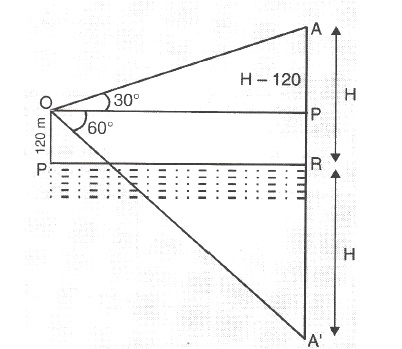
OP = (H -120)\(\sqrt{3}\) ...(i)
In \(\Delta OPA'\), tan 60°=\(\frac{H+120}{OP}\)
OP =\(\frac { H+120 }{ \sqrt { 3 } } \)...(ii)
From (i) and (ii), we get
\(\frac { H+120 }{ \sqrt { 3 } } \)=\(\sqrt{3}\)(H-120)
So height of cloud H = 240 m.
3.
Given
AB + AD = BC + CD
AD = BC + CD-AB
AD= h + d - x
In rt \(\triangle\)ACD,
AD2 = AC2 + DC2
\(\Rightarrow\) (h + d - x)2 = (x + h)2+ d2
\(\Rightarrow\) (h + d - x)2 - (x + h)2 = d2
\(\Rightarrow\) (h + d - x - x - h) (h + d - x + x + h) = d2 [\(\therefore\) (a2 - b2) = (a - b)(a + b)]
\(\Rightarrow\) (d - 2x)(2h + d) = d2
\(\Rightarrow\)2hd + d2-4hx-2xd = d2
\(\Rightarrow\) 2hd = 4hx + 2xd
=2 (2h+d)x
\(\Rightarrow x=\frac { hd }{ 2h+d } \)
4.
2x + 3y = 12
\(\Rightarrow \quad y=\frac { 12-2x }{ 3 } \)
| x | 0 | 6 | 3 |
| y | 4 | 0 | 2 |
x - y = 1
\(\Rightarrow\) y = x -1
| x | 0 | 1 | 3 |
| y | -1 | 0 | 2 |
Plotting the above points and drawing a line joining them, we get the graph of the equations 2x + 3y = 12 and x - y = 1. Clearly, the two lines intersect at point P(3, 2).
Hence, x = 3 and y = 2 is the solution of the system.
Area of shaded region = Area of \(\Delta\)PAB
= \(\frac { 1 }{ 2 } \) \(\times\) base \(\times\) height
=\(\frac { 1 }{ 2 } \) \(\times\) AB \(\times\) PM
=\(\frac { 1 }{ 2 } \)\(\times\) 5 \(\times\) 3
= 7.5 square unit.
5.
LHS = \(2(\sin ^{ 6 }{ \theta } +\cos ^{ 6 }{ \theta } )-3(\sin ^{ 4 }{ \theta } +\cos ^{ 4 }{ \theta } )+1\)
\(=2[{ (\sin ^{ 2 }{ \theta } ) }^{ 3 }+{ (\cos ^{ 2 }{ \theta } ) }^{ 3 }]-3(\sin ^{ 4 }{ \theta } +\cos ^{ 4 }{ \theta } )+1\)
\(=[(\sin ^{ 2 }{ \theta } +\cos ^{ 2 }{ \theta } )(\sin ^{ 4 }{ \theta } +\cos ^{ 4 }{ \theta } -\sin ^{ 2 }{ \theta } \cos ^{ 2 }{ \theta } )]-3\sin ^{ 4 }{ \theta } -3\cos ^{ 4 }{ \theta } +1\)\(=-\sin ^{ 4 }{ \theta } -\cos ^{ 4 }{ \theta } -2\sin ^{ 2 }{ \theta } \cos ^{ 2 }{ \theta } +1\)
\(=1-(\sin ^{ 4 }{ \theta } -\cos ^{ 4 }{ \theta } -2\sin ^{ 2 }{ \theta } \cos ^{ 2 }{ \theta } )\)
\(=1-[{ (\sin ^{ 2 }{ \theta } +\cos ^{ 2 }{ \theta } ) }^{ 2 }]=1-1=0=RHS\)
Hence proved.
6.
Use Pythagoras theorem, to find the distance of the foot of the ladder from the building.
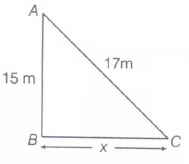
= 8 m
7.
The graph of given linear equations intersect each other at origin. So, the given pair of linear equations is consistent. x=0, y=0
8.
Tp = a + ( p - 1 )d
\(\Rightarrow\) \({1\over q}=a+(p-1)d\) ...(i)
Tq = a + ( p - 1 )d
\(\Rightarrow\) \({1\over q}a+(q-1)d\) ...(ii)
Subtracting (ii) from (i), we get
\({p-q\over pq}=(p-q)d\Rightarrow d={1\over pq}\)
Putting d = \({1 \over pq}\) in (i), we have
\({1\over q}=a+{(p-q)\over pq}\Rightarrow a={1\over pq}\)
\(\therefore\) Spq = \({pq\over2}[2a+(pq-1)d]\)
or, Spq = \({pq\over2}\left[ {{2\over pq}+{(pq-1)\over pq}} \right]\)
\(={1\over 2}(pq+1)\)
9.
Speed of motor boat in still water is 24 km/h
Let speed of the stream be x km/h
Speed of the boat in downstream direction
=(24+x)km/h
Distance covered in downstream direction
= 32 km
Time taken in downstream direction
\(=\frac { 32 }{ 24+x } \) hours
Speed of the boat in upstream direction (24 +x) km/h
Distance covered in upstream direction = 32 km
ATQ \(\frac { 32 }{ 24-x } -\frac { 32 }{ 24+x } =1\)
\(\Rightarrow \frac { 32(24+x)-32(24-x) }{ (24-x)(24+x) } =1\)
\(\Rightarrow 64x=576-x^{ 2 }\)
\(\Rightarrow x^{ 2 }+64x-576=0\)
\(\Rightarrow x^{ 2 }+72x-8x-576=0\)
\(\Rightarrow (x+72)(x-8)=0\)
x=-72 (rejected) or x=8
\(\therefore \) x=8 speed of stream = 8 km/hr

10th Standard CBSE Syllabus & Materials
10th Standard CBSE
CBSE 10th Social Science PS - Federalism - New Model Questions Papers Study Material - QB365 Set A
NEW10th Standard CBSE
CBSE 10th Social Science PS - Power Sharing - New Model Questions Papers Study Material - QB365 Set A
NEW10th Standard CBSE
CBSE 10th Social Science GEO - Manufacturing Industries - New Model Questions Papers Study Material - QB365 Set A
NEW10th Standard CBSE
CBSE 10th Social Science GEO - Minerals and Energy Resources - New Model Questions Papers Study Material - QB365 Set A



CBSE 10th Standard CBSE Subjects
CBSE Standards





