
 100% FREE ACCESS
10th Standard CBSE Syllabus & Materials
10th Standard CBSE
CBSE 10th Social Science ECO - Globalisation and the Indian Economy - New Model Questions Papers Study Material - QB365 Set A
NEW10th Standard CBSE
CBSE 10th Social Science ECO - Money and Credit - New Model Questions Papers Study Material - QB365 Set A
NEW10th Standard CBSE
CBSE 10th Social Science ECO - Sectors of the Indian Economy - New Model Questions Papers Study Material - QB365 Set A
NEW10th Standard CBSE
CBSE 10th Social Science ECO - Development - New Model Questions Papers Study Material - QB365 Set A
NEW10th Standard CBSE
CBSE 10th Social Science PS - Outcomes of Democracy - New Model Questions Papers Study Material - QB365 Set A
NEW10th Standard CBSE
CBSE 10th Social Science PS - Gender, Religion and Caste - New Model Questions Papers Study Material - QB365 Set A

Published on: 01/11/2019
Download CBSE Class 10th Standard CBSE Maths question papers, sample papers, important questions, and previous year solved papers in PDF format. Get free study materials, NCERT solutions, and exam preparation resources for Class 10th Standard CBSE Maths
Questions + Answers key
Take MCQ Maths Test
1.
The angle of elevation of the top of a hill at the foot of a tower is 60° and the angle of elevation of the top of the tower from the foot of the hill is 30°. If the tower is 50 m high, find the height of the hill.
2.
Prove that \(\sum { \left( { x }_{ i }-\bar { x } \right) =0 } \)
3.
A chemist has one solution which is 50% acid and a second which is 25% acid. How much of each should be mixed to make 10 litre of 40% acid solution.
4.
Draw a line segment AB of length 7 cm. Taking A as centre, draw a circle of radius 3 cm and taking B as centre, draw another circle of radius 2 cm. Construct tangents to each circle from the centre of the other circle
5.
In a trapezium ABCD, diagonals AC and BD intersect at O. If AB = 3CD, then find ratio of areas of triangles COD and AOB.
6.
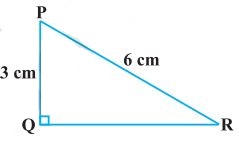
In \(\triangle PQR\), right-angles at Q, PQ = 3 cm and PR = 6 cm. Determine \(\angle QPR\) and \(\angle PRQ\).
7.
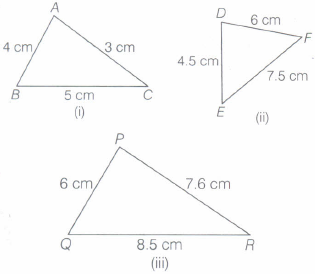
State which pairs of triangles in the given figure are similar? Also, state the similarity criterion used.
8.
Two dice are thrown simultaneously. Find the probability of getting a multiple of 2 on one die and a multiple of 3 on the other die.
9.
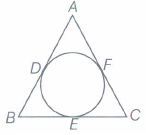
In the given figure, if AB = AC, then prove that BC = 2CE.
10.
A number x is chosen from the numbers 1,2,3 and a number y is selected from the numbers 1,4,9. Find the probability that xy=10.
11.
A box contain 100red cards, 200 yellow cards and 50blue cards.If a card is drawn at random from the box, the find the probability that it will be:
(i)A blue card
(ii)Not a yellow card
(iii)Neither yellow nor a blue card.
12.
Find the roots of the following quadratic equation (if they exist) by the method of completing square \(5x^{2} - 6x-2 = 0\) .
13.
Find the numbers of terms in A.P.: 5, 12, 19, 28, ....., 159.
14.
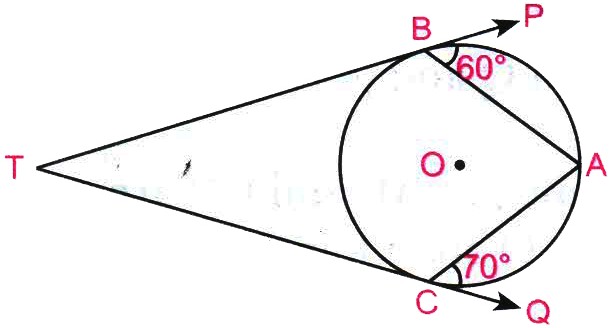
In the given figure, TBP and TCQ are tangents to the circle whose centre isO.Also \(\angle PBA=60^0\ and \ \angle ACQ=70^0.\)Determine \(\angle BAC\ and \ \angle BTC.\)
15.
Using quadratic formula, solve the following quadratic equation for x:
p2x2+(p2-q2)x-q2=0
1.
In right \(\triangle\)BAC,
\(\cot { { 30 }^{ 0 } } =\frac { AC }{ 50 } \)
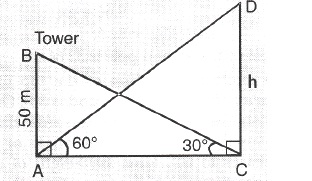
\(\Rightarrow \quad AC=50\sqrt { 3 } \)
In right \(\triangle\)ACD,
\(\tan { { 60 }^{ 0 } } =\frac { CD }{ 50\sqrt { 3 } } \)
\(\Rightarrow \quad \sqrt { 3 } =\frac { CD }{ 50\sqrt { 3 } } \)
\(\Rightarrow \quad CD=50\sqrt { 3 } \times \sqrt { 3 } =150\quad m\)
\(\Rightarrow\) So the height of hill CD =150 m.
2.
To prove \(\sum _{ i=1 }^{ n }{ \left( { x }_{ i }-\bar { x } \right) =0 } \) / algebraic sum of deviation from mean is zero
We have, \(\bar { x } =\frac { 1 }{ n } \left( \sum _{ i=1 }^{ n }{ { x }_{ i } } \right) \)
\(n\bar { x } =\sum _{ i=1 }^{ n }{ { x }_{ i } } \)
Now, \(\sum _{ i=1 }^{ n }{ \left( { x }_{ i }-\bar { x } \right) } =\left( { x }_{ 1 }-\bar { x } \right) +\left( { x }_{ 2 }-\bar { x } \right) +.........+\left( { x }_{ n }-\bar { x } \right) \)
\(\Rightarrow \quad \ \sum _{ i=1 }^{ n }{ \left( { x }_{ i }-\bar { x } \right) } =\left( { x }_{ 1 }+{ x }_{ 2 }+.........+{ x }_{ n } \right) -n\bar { x } \)
\(\Rightarrow \quad \ \sum _{ i=1 }^{ n }{ \left( { x }_{ i }-\bar { x } \right) } =\sum _{ i=1 }^{ n }{ { x }_{ i } } -n\bar { x } \)
\(\Rightarrow \quad \sum _{ i=1 }^{ n }{ \left( { x }_{ i }-\bar { x } \right) } =n\bar { x } -n\bar { x } =0\)
Hence, \(\sum _{ i=1 }^{ n }{ \left( { x }_{ i }-\bar { x } \right) } =0\)
3.
Let 50 % acids in the solution be x and 25 %of other solution be y.
Total volume in the mixture = x + Y
As per question,
x + y = 10 .....(i)
and
\(\\ \\ \frac { 50 }{ 100 } x+\frac { 25 }{ 100 } y=\frac { 40 }{ 100 } \times 10\)
\(\Rightarrow \quad 2x+y=16\) .....(ii)
Subtract equation (i) from (ii)
2x + y = 16
x + y = 10
\(\underline { -\quad -\quad - } \)
x = 6
From(i), 6 + y = 10
\(\Rightarrow\) y = 4
So, x = 6 and y = 4
4.
Steps of Construction:
1. Draw a line segment AB of 7 cm
2. Taking A and B as centre draw two circle of 3 cm and 2 cm radius
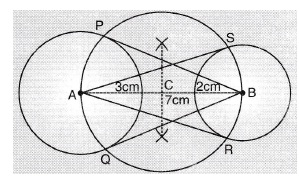
3. Bisect the line AB. Let mid-point of AB is C.
4. Taking C as centre draw a circle of radius AC which will intersect the circle at point P, Q, R and S.
5. Join BP, BQ, AS and AR. These are the required tangents.
5.
\(\triangle\)AOB~\(\triangle\)COD (AA similarity)
\(\frac { ar(\triangle COD) }{ ar(\triangle AOB) } =\frac { { CD }^{ 2 } }{ AB^{ 2 } } \)
\(=\frac { { CD }^{ 2 } }{ (3CD)^{ 2 } } =\frac { { CD }^{ 2 } }{ 9CD^{ 2 } } =\frac { 1 }{ 9 } \)
ration=1 : 9
6.
Given PQ = 3 cm and PR = 6 cm.
Therefore, \(\begin{aligned} \frac{\mathrm{PQ}}{\mathrm{PR}} & =\sin \mathrm{R} \\ \end{aligned}\)
or \(\begin{aligned} \sin \mathrm{R} & =\frac{3}{6}=\frac{1}{2} \\ \end{aligned}\)
So, \(\begin{aligned} \angle \mathrm{PRQ} & =30^{\circ} \\ \end{aligned}\)
and therefore, \(\begin{aligned} \angle \mathrm{QPR} & =60^{\circ} \end{aligned}\)
You may note that if one of the sides and any other part (either an acute angle or any side) of a right triangle is known, the remaining sides and angles of the triangle can be determined.
7.
Here, \(\frac { AB }{ DF } =\frac { 4 }{ 6 } =\frac { 2 }{ 3 } ,\frac { BC }{ EF } =\frac { 5 }{ 7.5 } =\frac { 2 }{ 3 } ,\frac { AC }{ DE } =\frac { 3 }{ 4.5 } =\frac { 2 }{ 3 } \)
As, \(\frac { AB }{ DF } =\frac { BC }{ EF } =\frac { AC }{ DE } \)
So, \(\triangle ABC\sim \triangle DFE\) [by SSS similarity criterion]
Hence, figures (i) and (ii) are similar triangles, but no other pairs of triangles in the given figure are similar.
8.
Here, two dice are thrown, so possible outcomes are
(1, 1), (1, 2), (1, 3), (1, 4), (1, 5), (1, 6)
(2, 1), (2, 2), (2, 3), (2, 4), (2, 5), (2, 6)
(3, 1), (3, 2), (3, 3), (3, 4), (3, 5), (3, 6)
(4, 1), (4, 2), (4, 3), (4, 4), (4, 5), (4, 6)
(5, 1), (5, 2), (5, 3), (5, 4), (5, 5), (5, 6)
(6, 1), (6, 2), (6, 3), (6, 4), (6, 5), (6, 6)
Total number of outcomes = 36
Let E = Event of getting a multiple of 2 on one die and a multiple of 3 on the other die.
Here, multiples of 2 are 2, 4, and 6, and multiples of 3 are 3 and 6.
So, favourable outcomes for event E are (2, 3), (4, 3), (6, 3), (2, 6), (4, 6), (6, 6), (3, 2), (3, 4), (3, 6), (6, 2) and (6, 4)
Number of favourable outcomes = 11
Required probability = P (E)
= \(\frac { Number \ of \ favourable \ outcomes \ related \ to \ E }{ Total \ number \ of \ outcomes } \)
= \(\frac{11}{36}\)
9.
Given \(\triangle ABC\)in which AB = AC.
To prove BC = 2 CE
Proof: We know that, tangents from an external point to a circle are equal in length.
\(\therefore\) AD = AF [A is an external point] ...........(i)
BD = BE [B is an external point] ...........(ii)
and CE = CF [C is an external point] ............(iii)
Now, AB = AC [given]
\(\Rightarrow\) AB - AD = AC - AD [subtracting AD from both sides]
\(\Rightarrow\) AB - AD = AC - AF [using Eq. (i)]
\(\Rightarrow\) BD = CF
\(\Rightarrow\) BE = CF [using Eq. (ii)]
\(\Rightarrow\) BE = CE [using Eq. (iii)] ........(iv)
Now, BC = CE+BE = CE+CE [from Eq. (iv)]
\(\Rightarrow\) BC = 2CE
Hence proved.
10.
0
11.
(i)Total number of cards in the box
=100+200+50=350
Number of blue cards=50
P(a blue card)\(={50\over 350}={1\over7}\)
(ii)Number of yellow cards=200
Number of non yellow cards =350-200=150
P(not a yellow card)\(={150\over350}={3\over 7}\)
(iii)Number of yellow or blue cards in the box = 200+50=250
Number of neither yellow nor blue cards = 350-250=10
P(neither a yellow nor a blue card)
\(={100\over 350}={2\over 7}\)
12.
\(\left [3\pm \sqrt {19}\over 5\right]\)
13.
23
14.
Given: T BP and TCQ are tangents to the circle whose centre is O.
Also, \(\angle \)PBA = 60°
\(\angle \)ACQ = 70°
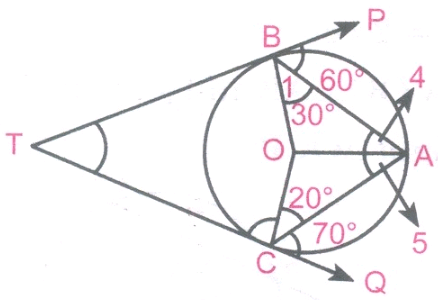
To determine: \(\angle \)BAC and \(\angle \)BTC
Sol. Join OB and OC
\(\angle \)OBP = 90°
[Tangent makes 90° angle with the radius at the point of contact]
⇒ \(\angle \)OBA + \(\angle \)ABP = 90°
⇒ \(\angle \)1 + 60° = 90° [Given ABP = 60°]
⇒ \(\angle \)1 = 30° ......(i)
Also \(\angle \)OCQ = 90°
⇒ OCA + 70° = 90° ......(i)
⇒ \(\angle \)OCA = 20° .....(ii)
In OBA , OB = OA = radii
⇒ \(\angle \)1 = \(\angle \)4 = \(\angle \)30° .....(iii)
[ Angles opposite to equal sides of a triangle are equal]
Similarly, In \(\triangle\)OCA
OC = OA
\(\angle \) 5 = 20° .....(iv)
From (iii) and (iv)
\(\angle \)BAC = 20° + 30° = 50°
⇒ \(\angle \)BOC = 2x50° = 100°
\(\angle \)BOC + BTC = 180°
100° + \(\angle \)BTC = 180°
⇒ \(\angle \)BTC = 80°
15.
\(p^{ 2 }+x^{ 2 }+(p^{ 2 }-q^{ 2 })x-q^{ 2 }=0\)
Here a=p2,b=(p2-q2),x= c=q2
D= b2-4ac=(p2-q2)2-4Xp2-4Xp2X(-q2) = (62+q2)2
Now x= \(x=\frac { -b\pm \sqrt { D } }{ 2a } ,\frac { -b-\sqrt { D } }{ 2a } \)
\(\Rightarrow x=\frac { -(p^{ 2 }-q^{ 2 })+\sqrt { (p^{ 2 }+q^{ 2 })^{ 2 } } }{ 2\times p^{ 2 } } ;x=\frac { (-p^{ 2 }-q^{ 2 })-\sqrt { (p^{ 2 }-q^{ 2 })^{ 2 } } }{ 2\times p^{ 2 } } \)
\(\Rightarrow x=\frac { q^{ 2 } }{ p^{ 2 } } ,-1\)

10th Standard CBSE Syllabus & Materials
10th Standard CBSE
CBSE 10th Social Science PS - Federalism - New Model Questions Papers Study Material - QB365 Set A
NEW10th Standard CBSE
CBSE 10th Social Science PS - Power Sharing - New Model Questions Papers Study Material - QB365 Set A
NEW10th Standard CBSE
CBSE 10th Social Science GEO - Manufacturing Industries - New Model Questions Papers Study Material - QB365 Set A
NEW10th Standard CBSE
CBSE 10th Social Science GEO - Minerals and Energy Resources - New Model Questions Papers Study Material - QB365 Set A



CBSE 10th Standard CBSE Subjects
CBSE Standards





