
 100% FREE ACCESS
10th Standard CBSE Syllabus & Materials
10th Standard CBSE
CBSE 10th Social Science ECO - Globalisation and the Indian Economy - New Model Questions Papers Study Material - QB365 Set A
NEW10th Standard CBSE
CBSE 10th Social Science ECO - Money and Credit - New Model Questions Papers Study Material - QB365 Set A
NEW10th Standard CBSE
CBSE 10th Social Science ECO - Sectors of the Indian Economy - New Model Questions Papers Study Material - QB365 Set A
NEW10th Standard CBSE
CBSE 10th Social Science ECO - Development - New Model Questions Papers Study Material - QB365 Set A
NEW10th Standard CBSE
CBSE 10th Social Science PS - Outcomes of Democracy - New Model Questions Papers Study Material - QB365 Set A
NEW10th Standard CBSE
CBSE 10th Social Science PS - Gender, Religion and Caste - New Model Questions Papers Study Material - QB365 Set A

Published on: 01/11/2019
Download CBSE Class 10th Standard CBSE Maths question papers, sample papers, important questions, and previous year solved papers in PDF format. Get free study materials, NCERT solutions, and exam preparation resources for Class 10th Standard CBSE Maths
Questions + Answers key
Take MCQ Maths Test
1.
Solve for x : \(\sqrt { 6x+7 } -(2x-7)=0\)
2.
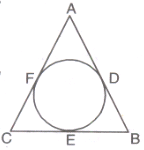
A circle is inscribed in a triangle ABC having sides AB = 8 cm, BC = 10 cm and CA = 12 cm as shon in fig. Find AD, BE and CF.
3.
Fill in the blanks a = -18.9, d = 2.5, n = ...., an=3.6
4.
Out of a group of children, \({7\over 2}\) times the square root of the number are creative, the two remaining ones are visionary. What is the total number of children ? How many persons in the group are creative?
Write one-one characteristics each of creativity and vision.
5.
A bag contains 24 balls out of which x are white. If one ball is drawn at random the probability of drawing a white ball is y. 12 more white balls are added to the bag. Now if a ball is drawn from the bag, the probability of drawing the white ball is \(\frac{5}{3}y\). Find the value of x.
6.
Find the sum of 2n terms of the series 12 - 22 + 32 - 42 + 52 - 62 +.......
7.
Two circles touch internally at a point P and from a point T the common tangent at P, tangent segments TQ, TR are drawn to the two circles. Prove that TQ = TR.
8.
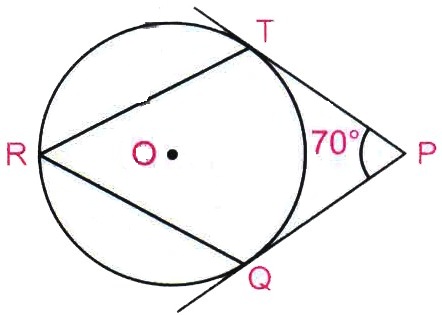
In figure O is the centre of a circle.PT and PQ are tangents to the circle from an external point P. If \(\angle TPQ=70^0, find\ \angle TRQ\)
9.
Which term of the AP 14, 11, 8, ....... is -1?
10.
Find the roots of the following quadratic equation, if they exist, by the method of completing the square: 2x2+x+4=0
11.
Check whether the following are quadratic equations: (2x – 1)(x – 3) = (x + 5)(x – 1)
12.
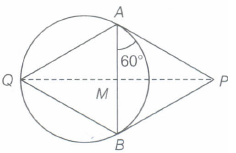
PA and PB are the tangents to a circle which circumscribes an equilateral \(\Delta\)ABQ. If \(\angle PAB=60°\), as shown in the figure, prove that QP bisects AB at right angle.
13.
A statue, 1.6 m tall, stands on the top of a pedestal. From a point on the ground, the angle of elevation of the top of the statue is 60\(\unicode{xb0} \) and from the same point the angle of elevation of the top of the pedestal is 45\(\unicode{xb0} \). Find the height of the pedestal.
14.
Prove that the angle between two tangents drawn from an external point to a circle is supplementary to the angle subtended by the line segment joining the points of contact at the centre.
15.
A jar contains 24 marbles, some are green and others are blue.If a marble is drawn at random from the jar, the probability that it is green is \(2\over3\).Find the number of blue marbles.
16.
A spherical balloon of radius 'r' subtends an angle \(\theta\) at the eye of an observer.If the angle of elevation of is \(\phi \), find the height of the centre of the balloon.
17.
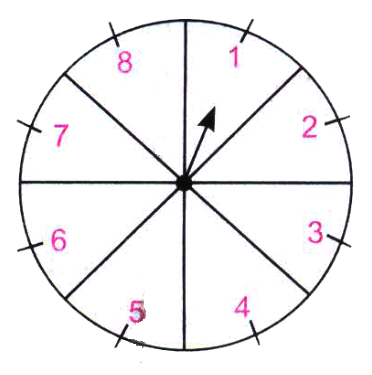
A game of chance consists of spinning an arrow which comes to rest pointing at one of the numbers 1, 2, 3, 4, 5, 6, 7, 8 (see Fig.), and these are equally likely outcomes. What is the probability that it will point at
(i) 8 ?
(ii) an odd number?
(iii) a number greater than 2?
(iv) a number less than 9?
1.
\(\sqrt { 6x+7 } -(2x-7)=0\)
\(\sqrt { 6x+7 } -(2x-7)\)
Squaring both sides
6x+7=(2x-7)2
\(\sqrt { 6x+7 } -(2x-7)\)
\(\Rightarrow 6x+7=4x^{ 2 }-28x+49\\ \Rightarrow 4x^{ 2 }-34x+42=0\\ \Rightarrow 2x^{ 2 }-14x-3x+21=0\\ \Rightarrow 2x(x-7)-3(x-7)=0\\ \Rightarrow (x-7)(2x-3)=0\\ \Rightarrow x=7\quad or\quad x=\frac { 3 }{ 2 } \)
2.
Tangents drawn from an exterior point to a circle are equal.
AD = AF = x cm (say)
BD = BE = y cm (say)
CE = CF = z cm (say)
Now AB = 8 cm
⇒ AD + BD = 8 cm
⇒ x + y = 8 .........(i)
BC = 10cm
⇒ BE + CE = 10 cm
⇒ y + z = 10 .......(ii)
CA = 12 cm
⇒ CF + AF = 12 cm
⇒ z+x = 12 .....(iii)
On adding (i), (ii) and (iii), we have
2(x + y + x) = 30
x + y + z = 15 .....(iv)
Subtracting (ii) from (iv), we have x = 15 - 10 = 5
Subtracting (iii) from (iv), we have y = 15 - 12 = 3
Subtracting (i) from (iv), we have z = 15 - 8 = 7
ஃ AD = x cm = 5 cm, BE = y cm = 3 and CF = z cm = 7 cm
3.
Here, a is the first term, d is the common difference and \({ a }_{ n }\) is the \({ n }^{ th }\) term of an A.P.
Here, \(a=-18.9,d=2.5,{ a }_{ n }=3.6,n=......\)
We know that \({ a }_{ n }=a+(n-1)d\)
\(\Rightarrow \) \(3.6 = -18.9 + (n-1)2.5\)
\(\Rightarrow \) \(3.6 = -18.9 + 2.5n - 2.5\)
\(\Rightarrow \) \(3.6 = -21.4 + 2.5n\)
\(\Rightarrow \) \(2.5n = 3.6 + 21.4\)
\(\Rightarrow \ n=\frac { 25 }{ 2.5 } =10\) Hence, \(n = 10\)
4.
16, 14 - Creativity involves in the use of skills and imagination to produce something new and innovative.
Vision - ability to think about future.
5.
Total number of ways to draw ball from bag = 24
Number of ways to draw a white ball = x
\(\therefore \) Probability of drawing a white ball = \(\frac { x }{ 24 } \)
A.T.Q., \(\frac { x }{ 24 } \)=y ....(i)
When 12 more white balls are added to the bag,
Number of balls in the bag = 24 + 12 = 36 Number of white balls in the bag = (x + 12)
\(\therefore \)Probability of drawing a white ball
=\(\frac { x+12 }{ 36 } \)
A.T.Q., \(\\ \frac { x+12 }{ 36 } =\frac { 5 }{ 3 } \times x\)
\(\Rightarrow \frac { x+12 }{ 36 } =\frac { 5 }{ 3 } \times \frac { x }{ 24 } \quad \{ using\quad (i)\} \)
\(\therefore \quad x+12=\frac { 36\times 5x }{ 72 } \)
\(\Rightarrow x+12=\frac { 35x }{ 2 } \)
\(\Rightarrow \) 2x+24=5x\(\Rightarrow \)3x=24\(\Rightarrow \)x=8
6.
-n(2n+1)
7.
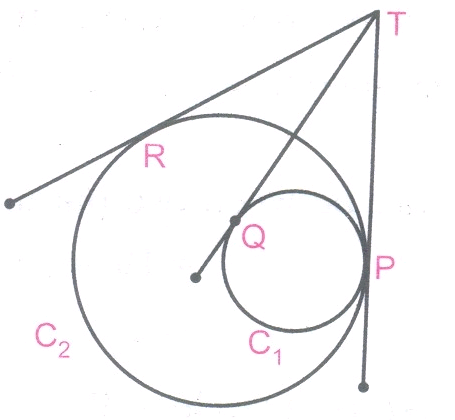
Given: Two circles C1 and C2 touch each other at P where C1 be inside of C2. T be a point on the tangent at P, where TQ and TR are the tangents, segments to the circles.
To prove: TQ = TR
Proof: In circle C1, TP and T Q are two tangents from an external point T. Then they are equal in length.
I.e., TP = TQ ...(i)
Similarly, in circle C2, TP = TR .....(ii)
From (i) and (ii), we get
TQ = TR Proved.
8.
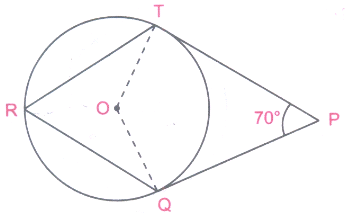
\(\angle \)TOQ + \(\angle \)TPQ = 180o
\(\angle \)TOQ = 110o
Also \(\angle \)TOQ = 2\(\angle \)TRQ
[angle subtended by an arc at centre of the circle is twice the angle subtended by it in alternate segment]
⇒ 110o = 2 \(\angle \)TRQ ⇒ \(\angle \)TRQ = 55o
9.
Here, a = 14, d = 11 - 14 = -3
Let an = -1
a + (n - 1)d = -1
14 + (n - 1)(-3) = -1
(n - 1)(-3) = -1 - 14
n - 1 = \(\frac{-15}{-3}\) = 5
n = 6
6th term of the AP is -1.
10.
2x2+x+4=0
Now adding square of (\(\frac {1}{2}\) coefficient x) on both sides, we get
\(\Rightarrow \quad { x }^{ 2 }+\frac { 1 }{ 2 } x+{ \left( \frac { 1 }{ 4 } \right) }^{ 2 }=-2+{ \left( \frac { 1 }{ 4 } \right) }^{ 2 }\quad \Rightarrow \quad { \left( x+\frac { 1 }{ 4 } \right) }^{ 2 }=-2+\frac { 1 }{ 16 } \)
\(\Rightarrow \quad { \left( x+\frac { 1 }{ 4 } \right) }^{ 2 }=\frac { -32+1 }{ 16 } \quad \Rightarrow \quad { \left( x+\frac { 1 }{ 4 } \right) }^{ 2 }=\frac { -31 }{ 16 } \)
\(\Rightarrow \quad { \left( x+\frac { 1 }{ 4 } \right) }^{ 2 }={ \left( \frac { \sqrt { -31 } }{ 16 } \right) }^{ 2 }\)
Which is impossible as square root of negative integers is not possible.
Hence, the roots do not exist.
11.
(2x-1)(x-3)=(x+5)(x-1)
2x2-6x-x+3=x2-x+5x-5
2x2-6x-x+3-x2+x-5x+5=0
x2-11x+8=0
Which is of the form ax2+bx+c=0. Hence the given equation is a quadratic equation.
12.
Clearly, \(\angle QAB=60° and QBA=60°\)
[\(\because \Delta \)ABQ is equilateral]
So, \(\angle PAQ=\angle PAB+\angle QAB=60°+60°=120°\)
Similarly, \(\angle PBQ=120°\)
\([\because PAB=PBA,\quad as\quad \angle PA=PB]\) .....(i)
Now, in \(\Delta PAQ\quad and\quad \Delta PBQ,\)
Pa = PB [tangents from external point]
\(\Rightarrow\) AQ = BQ [\(\Delta\)ABQ equilateral]
\(\Rightarrow\) \(\angle\)PAQ =\(\angle\)PBQ [each 120\(°\), shown above]
So, \(\Delta PAQ\cong \Delta PBQ\) [by SAS congruence rule]
\(\Rightarrow\)\(\angle\)APQ = \(\angle\)BPQ [by CPCT] ....(ii)
Let QP intersect AB at M.
Now, in \(\Delta\)PAM and \(\Delta\)PBM,
\(\angle\)APM = \(\angle\)BPM [from Eq. (ii)]
\(\Rightarrow\) PA = PB
\(\Rightarrow\) PM = PM
So, \(\Delta\)PAM \(\cong \) \(\Delta\)PBM [[by SAS congruence rule]
\(\Rightarrow\) AM = BM
and \(\angle\)AMP = \(\angle\) BMP [by CPCT]...(iii)
But \(\angle\) AMP + \(\angle\)BMP =180\(°\)
\(\Rightarrow\) \(\angle\)AMP + \(\angle\)AMP =180\(°\)
\(\Rightarrow\) 2 \(\angle\)AMP = 180\(°\)
\(\Rightarrow\) \(\angle\)AMP = 90 \(°\)
From Eqs. (iii) and (iv), we get that QP bisects AB at right angles.
13.
Let BC = h m be the height of the pedestal and CD = 1.6m be the length of the statue, which is standing on the pedestal.
Again, let point A be a fixed point on the ground such that the angles of elevation of the top of the statue and bottom of the statue (i.e. top of the pedestal) are
\(\angle D A B=60^{\circ} \text { and } \angle C A B=45^{\circ}\)
Also, let AB = x m.
In right angled \(\Delta\)ABD, \(\tan 60^{\circ}=\frac{P}{B}=\frac{B D}{A B}\)
\(\begin{array}{lll} \Rightarrow & \sqrt{3}=\frac{B C+C D}{x} \quad\left[\because \tan 60^{\circ}=\sqrt{3}\right] \\ \end{array}\)
\(\begin{array}{lll} \Rightarrow & \sqrt{3}=\frac{h+1.6}{x} & \\ \end{array}\)
\(\begin{array}{lll} \Rightarrow & h=\sqrt{3} x-1.6 \end{array}\) ...(i)
In right angled \(\Delta\)CBA, tan 45° \(=\frac{B C}{A B}\)
\(\begin{array}{ll} \Rightarrow & 1=\frac{h}{x} \quad\left[\because \tan 45^{\circ}=1\right] \\ \end{array}\)
\(\begin{array}{ll} \Rightarrow & x=h \end{array}\)
On putting x = h in Eq. (i), we get
\(h=\sqrt{3} h-1.6 \Rightarrow h(\sqrt{3}-1)=1.6\)
\(\Rightarrow \quad h=\frac{1.6}{(\sqrt{3}-1)} \times \frac{\sqrt{3}+1}{\sqrt{3}+1}\) [rationalising]
\(\begin{aligned} & =\frac{1.6(\sqrt{3}+1)}{(\sqrt{3})^2-(1)^2}\left[\because(a+b)(a-b)=a^2-b^2\right] \\ \end{aligned}\)
\(\begin{aligned} & =\frac{1.6}{2}(\sqrt{3}+1)=0.8(\sqrt{3}+1) \mathrm{m} \end{aligned}\)
Hence, the height of the pedestal is \(0.8(\sqrt{3}+1) \mathrm{m}\).
14.
Let PQ and PR be two tangents drawn from an external point P to a circle with centre O.
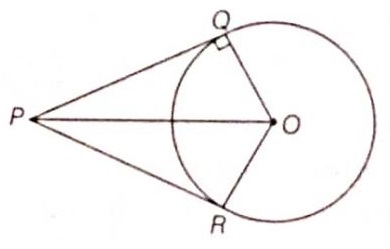
To prove \(\angle\)QOR = 180° – \(\angle\)QPR
or \(\angle\)QOR + \(\angle\)QPR = 180°
Proof In \(\Delta\)OQP and \(\Delta\)ORP,
PQ = PR [\(\because\) tangents drawn from an external point are equal in length]
OQ = OR [radii of circle]
OP = OP [common sides]
\(\therefore\) \(\Delta\)OQP \(\cong\) \(\Delta\)ORP [by SSS congruence rule]
Then, \(\angle\)QPO = \(\angle\)RPO [by CPCT]
and \(\angle\)POQ = \(\angle\)POR [by CPCT]
\(\left.\begin{array}{ll} \Rightarrow & \angle Q P R=2 \angle O P Q \\ \text { and } & \angle Q O R=2 \angle P O Q \end{array}\right\}\) ...(i)
Now, in right angled \(\Delta\)OQP, \(\angle\)QPO + \(\angle\)QOP = 90°
\(\Rightarrow\) \(\angle\)QOP = 90° - \(\angle\)QPO
\(\Rightarrow\) 2\(\angle\)QOP = 180°- 2 \(\angle\)QPO
[multiplying both sides by 2]
\(\Rightarrow\) \(\angle\)QOR = 180° - \(\angle\)QPR [from Eq. (i)]
\(\Rightarrow\) \(\angle\)QOR + \(\angle\)QPR = 180° Hence proved.
15.
Let the number of green marbles out of 24 marbles in a jar be x.
Probability of getting green marbles = \(\frac { 2 }{ 3 } \)
\(\frac { x }{ 24 } =\frac { 2 }{ 3 } \)
3x = 48
x = 16
Number of green marbles = 16
Hence, the number of blue marbles = 24 - 16
=8
16.
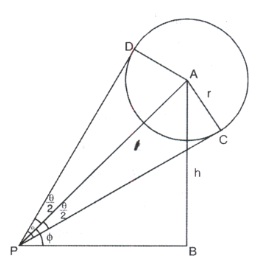
Let A be the centre of the balloon (spherical) whose radius is r.
Let AB be the height of the ballon i.e., h units, such that
ㄥDPC=ፀ, ㄥAPB-ф
Since ΔPDA and ΔPCA are congruent, therefore
ㄥAPC=ㄥAPD=ፀ/2
In rt. ㄥed ΔPCA,
\(\frac { AC }{ AP } =sin\frac { \theta }{ 2 } \)
⇒ AP=\(AC\frac { 1 }{ sin\frac { \theta }{ 2 } } =r.cosec\frac { \theta }{ 2 } \) or
Consider rt . ㄥed ΔPBA, we have
\(\frac { AB }{ AP } \)=sin ф
AB=AP.sinф
h=r.cosec\( \frac { \theta }{ 2 } \).sinф
h=r sinф.cosec\( \frac { \theta }{ 2 } \).
17.
Total number of points on the circle = 8
(i) Let E1 = Event of getting arrow at number 8
\(\therefore\) Number of outcomes favourable to E1 = 1
Probability that arrow cones at number 8,
\(P\left(E_1\right)=\frac{1}{8}\)
(ii) Let E2 = Event of getting arrow at an odd number
Here, odd numbers are 1, 3, 5 and 7.
\(\therefore\) Number of outcomes favourable to E2 = 4
Probability that arrow comes at an odd number,
\(P\left(E_2\right)=\frac{4}{8}=\frac{1}{2}\)
(iii) Let E3 = Event of getting arrow at a number greater than 2, i.e. at 3, 4, 5, 6, 7 or 8
\(\therefore\) Number of outcomes favourable to E3 = 6
Probability that arrow comes at a number greater than 2,
\(P\left(E_3\right)=\frac{6}{8}=\frac{3}{4}\)
(iv) P(a number less than 9) = \(\frac{8}{8}\)=1

10th Standard CBSE Syllabus & Materials
10th Standard CBSE
CBSE 10th Social Science PS - Federalism - New Model Questions Papers Study Material - QB365 Set A
NEW10th Standard CBSE
CBSE 10th Social Science PS - Power Sharing - New Model Questions Papers Study Material - QB365 Set A
NEW10th Standard CBSE
CBSE 10th Social Science GEO - Manufacturing Industries - New Model Questions Papers Study Material - QB365 Set A
NEW10th Standard CBSE
CBSE 10th Social Science GEO - Minerals and Energy Resources - New Model Questions Papers Study Material - QB365 Set A



CBSE 10th Standard CBSE Subjects
CBSE Standards





