
 100% FREE ACCESS
10th Standard CBSE Syllabus & Materials
10th Standard CBSE
CBSE 10th Social Science ECO - Globalisation and the Indian Economy - New Model Questions Papers Study Material - QB365 Set A
NEW10th Standard CBSE
CBSE 10th Social Science ECO - Money and Credit - New Model Questions Papers Study Material - QB365 Set A
NEW10th Standard CBSE
CBSE 10th Social Science ECO - Sectors of the Indian Economy - New Model Questions Papers Study Material - QB365 Set A
NEW10th Standard CBSE
CBSE 10th Social Science ECO - Development - New Model Questions Papers Study Material - QB365 Set A
NEW10th Standard CBSE
CBSE 10th Social Science PS - Outcomes of Democracy - New Model Questions Papers Study Material - QB365 Set A
NEW10th Standard CBSE
CBSE 10th Social Science PS - Gender, Religion and Caste - New Model Questions Papers Study Material - QB365 Set A

Published on: 18/09/2019
Introduction to Trigonometry
Download CBSE Class 10th Standard CBSE Maths question papers, sample papers, important questions, and previous year solved papers in PDF format. Get free study materials, NCERT solutions, and exam preparation resources for Class 10th Standard CBSE Maths
Questions + Answers key
Take MCQ Maths Test
1.
A player sitting on the top ofa tower of height 20m observes the angle of depression of a ball lying on the ground as 60°. Find the distance between the foot of the tower and the ball.
2.
From a point P on the ground the angle of elevation of the top of a 10 m tall building is 30°. A flag is hoisted at the top of the building and the angle of elevation of the top of the flagstaff from P is 45°. Fin~ the length of the flagstaff and distance of building form point P.
3.
From the top of light house, 40 m above the later, the angle of depression of a small boat is 60°. Find how far the boat is from the base of the light house.
4.
If \(\sin { A } =\frac { \sqrt { 3 } }{ 2 } \), find the value of \(2\cot ^{ 2 }{ A } -1\)
5.
Prove that : \(\sqrt { \frac { 1-\cos { A } }{ 1+\cos { A } } } =cosecA-\cot { A } \)
6.
Prove that : \(-1+\frac { \sin { A } \sin { \left( { 90 }^{ ° }-A \right) } }{ \cot { \left( { 90 }^{ ° }-A \right) } } =-\sin ^{ 2 }{ A } \)
7.
If 4 cos \(\theta\) = 11 sin \(\theta\), find the value of \(\frac { 11\cos { \theta } -7\sin { \theta } }{ 11\cos { \theta } +7\sin { \theta } } \)
8.
If \(\sqrt { 2 } \sin { \theta } =1\), find the value of \(\sec ^{ 2 }{ \theta } -cosec^{ 2 }\theta \)
9.
Evaluate : \(\frac { \sin { { 90 }^{ ° } } }{ \cos { { 45 }^{ ° } } } +\frac { 1 }{ cosec{ 30 }^{ ° } } \)
10.
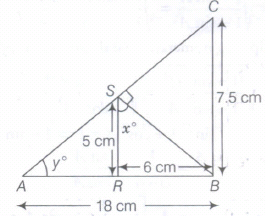
In the given figure, \(\triangle ABC,\) is the right angles at B. \(\triangle BSC\) is right angles at S and BC = 7.5 cm, RS = 5 cm, RB = 6 cm \(\angle BSR=x^0\) and \(\angle SAB=y^0.\) Find
(i) tan x0
(ii) sin y
(ii) cos y0
11.
If \(\sqrt { 3 } \cot ^{ 2 }{ \theta } -4\cot { \theta } +\sqrt { 3 } =0,\) find the value of the \(\tan ^{ 2 }{ \theta } +\cot ^{ 2 }{ \theta } .\)
12.
Using the formula, \(\cos { A } =\sqrt { \frac { 1+\cos { 2A } }{ 2 } } ,\) find the value of \(\cos { { 15 }^{ 0 } } \)
13.
Eliminate \(\theta\) from the following equation. \(x=a\sec { \theta } ,y=b\tan { \theta } \)
14.
Prove that \(\sqrt { \sec ^{ 2 }{ \theta } +{ cosec }^{ 2 }\theta } =\tan { \theta } +\cot { \theta } .\)
15.
If \(\sec ^{ 2 }{ \theta } =x+\frac { 1 }{ 4x } ,\) find the value of \(\sec { \theta } +\tan { \theta } .\)
1.
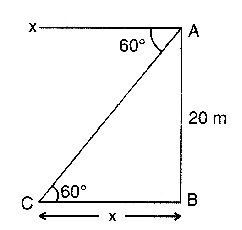
Let C be the point where the ball is
ㄥC = 60° (alternate angles)
In ΔABC, \(tan\ 60^0={AB\over BC}\)
⇒ \(\sqrt3={20\over x}\)
⇒ \(x={20\over \sqrt3}\)
\(=20\left(\sqrt3\over3 \right)\)
Hence, required distance is
1 = 11.53m
2.
Let height of flagstaff = x m
\(tan\ 30^0={AB\over AP}\)
⇒ \({1\over \sqrt3}={10\over AP}\)
AP=10√3
i.e., distance of the building
= 10 x 1.732= 17.32m
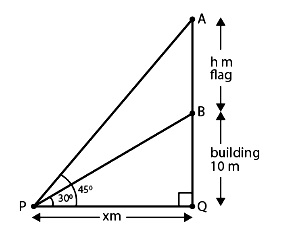
\(tan\ 45^0={AD\over Ap}\ or\ 1={10+x\over 10\sqrt3}\)
or length of flagstaff x = 10(√3 -1) = 7.32m.
3.
Let AB be the lighthouse and C be the position of the boat
Since ㄥPAC = 60. ㄥACB = 60°
Let CB = x
In ΔABC, \({AB\over Bc}=tan\ 60^0\)
\(\Rightarrow\ \ {40\over x}=\sqrt3\)
\(\Rightarrow\ \ x={40\over \sqrt3}\times{\sqrt3 \over\sqrt3}\)
\(={40\sqrt3\over3}m\)
The boat is \({40\sqrt3\over3}m\) away from the foot of lighthouse.
4.
\(2\cot ^{ 2 }{ A } -1=2\left( { cosec }^{ 2 }A-1 \right) -1\)
\(=\frac { 2 }{ \sin ^{ 2 }{ A } } -3\)
\(\left( \because \quad \cot ^{ 2 }{ \theta } =-1+{ cosec }^{ 2 }\theta \right) \)
\(=\frac { 2 }{ { \left( \frac { \sqrt { 3 } }{ 2 } \right) }^{ 2 } } -3\)
\(2\cot ^{ 2 }{ A } -1=\frac { 8 }{ 3 } -3=\frac { -1 }{ 3 } \)
5.
\(LHS=\sqrt { \frac { 1-\cos { A } }{ 1+\cos { A } } } =\sqrt { \frac { 1-\cos { A } }{ 1+\cos { A } } \times \frac { 1-\cos { A } }{ 1-\cos { A } } } \)
\(=\sqrt { \frac { { \left( 1-\cos { A } \right) }^{ 2 } }{ \left( 1-\cos ^{ 2 }{ A } \right) } } =\sqrt { \frac { { \left( 1-\cos { A } \right) }^{ 2 } }{ \sin ^{ 2 }{ A } } } \)
\(\left( \because \quad \sin ^{ 2 }{ \theta } +\cos ^{ 2 }{ \theta } =1 \right) \)
\(=\frac { 1-\cos { A } }{ \sin { A } } =\frac { 1 }{ \sin { A } } -\frac { \cos { A } }{ \sin { A } } \)
\(=cosecA-\cot { A } =RHS\)
6.
\(LHS=-1+\frac { \sin { A } \sin { \left( { 90 }^{ ° }-A \right) } }{ \cot { \left( { 90 }^{ ° }-A \right) } } \)
\(\left[ \because \quad \sin { \left( { 90 }^{ ° }-\theta \right) =\cos { \theta } } \right] \)
\(\left[ \because \quad \cot { \left( { 90 }^{ ° }-\theta \right) } =\tan { \theta } \right] \)
\(=-1+\frac { \sin { A } \cos { A } }{ \tan { A } } \)
= - 1 + sin A cos A x cot A
\(\left[ \because \quad \cot { \theta } =\frac { \sin { \theta } }{ \cos { \theta } } \right] \)
\(\left[ \because \quad \sin ^{ 2 }{ \theta } +\cos ^{ 2 }{ \theta } =1 \right] \)
\(=-1+\sin { A } \cos { A } \times \frac { \cos { A } }{ \sin { A } } \)
= - 1 + cos2 A = - (1 - cos2A)
= - sin2A = RHS
7.
Given : 4 cos \(\theta\) = 11 sin \(\theta\)
\(\Rightarrow \quad \cos { \theta } =\frac { 11 }{ 4 } \sin { \theta } \)
Now \(\frac { 11\cos { \theta } -7\sin { \theta } }{ 11\cos { \theta } +7\sin { \theta } } =\frac { 11\times \frac { 11 }{ 4 } \sin { \theta } -7\sin { \theta } }{ 11\times \frac { 11 }{ 4 } \sin { \theta } +7\sin { \theta } } \)
\(=\frac { \sin { \theta } \left( \frac { 121 }{ 4 } -7 \right) }{ \sin { \theta } \left( \frac { 121 }{ 4 } +7 \right) } \)
\(=\frac { 121-28 }{ 121+28 } =\frac { 93 }{ 149 } \)
8.
Given, \(\sqrt { 2 } \sin { \theta } =1\)
\(\sin { \theta } =\frac { 1 }{ \sqrt { 2 } } =\sin { { 45 }^{ ° } } \)
\(\therefore \quad \theta ={ 45 }^{ ° }\)
Now \(\sec ^{ 2 }{ \theta } -cosec^{ 2 }\theta \) = \(\sec ^{ 2 }{ { 45 }^{ ° } } -cosec^{ 2 }{ 45 }^{ ° }\)
\(={ \left( \sqrt { 2 } \right) }^{ 2 }-{ \left( \sqrt { 2 } \right) }^{ 2 }\)
= 2 - 2
= 0
9.
\(\frac { \sin { { 90 }^{ ° } } }{ \cos { { 45 }^{ ° } } } +\frac { 1 }{ cosec{ 30 }^{ ° } } =\frac { 1 }{ \frac { 1 }{ \sqrt { 2 } } } +\frac { 1 }{ 2 } \)
\(=\sqrt { 2 } +\frac { 1 }{ 2 } \)
\(=\frac { 2\sqrt { 2 } +1 }{ 2 } \)
10.
Given, \(\angle CBA=90^0,\angle BRS=90^0,\angle BSC=90^0,\) BC = 7.5 cm, RS = 5 cm, BR = 6 cm and AB = 18 cm
Then, AR = AB - RB = 18 - 6 = 12 cm
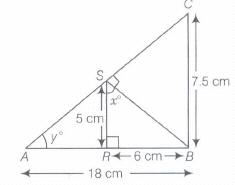
In \(\triangle ABC,\) by using Pythagoras theorem, we get
AS2 = AR2 + RS2 = (12)2 + (5)2
AS2 = 144 + 25 = 169
\(\Rightarrow\) AS = \(\sqrt 169\)
\(\therefore\) AS = 13 cm [since, side cannot be negative]
\((i)\quad In\quad \triangle BRS,\ tan{ x }^{ 0 }=\frac { P }{ B } =\frac { BR }{ RS } =\frac { 6 }{ 5 } \quad \)
\((ii)\quad In\quad \triangle ARS,\quad sin{ y }^{ 0 }=\frac { P }{ H } =\frac { SR }{ AS } =\frac { 5 }{ 13 } \)
\((iii)\quad In\quad \triangle ARS,\quad cos{ y }^{ 0 }=\frac { AR }{ AS } =\frac { 12 }{ 13 } \)
11.
So, the given equation is rewritten as
\(\sqrt{3} x^{2}-4 x+\sqrt{3}=0\)
Using quadratic formula, we get
\(x=\sqrt{3}, \frac{1}{\sqrt{3}} \text { i.e. } \cot \theta=\sqrt{3}, \frac{1}{\sqrt{3}}\) \(\text { of, } \tan \theta=\frac{1}{\sqrt{3}}, \sqrt{3} \text { . }\)
\(\frac{10}{3}\)
12.
\(\frac { \sqrt { 2+\sqrt { 3 } } }{ 2 } \)
13.
Given, \(x=a\sec { \theta } and\quad y=b\tan { \theta } \)
\(\Rightarrow \quad \frac { x }{ a } =\sec { \theta } \quad and\quad \frac { y }{ b } =\tan { \theta } \quad \quad ..(i)\)
We know that, \(\quad \sec ^{ 2 }{ \theta } =1+\tan ^{ 2 }{ \theta } \)
\(\therefore \quad { \left( \frac { x }{ a } \right) }^{ 2 }=1+{ \left( \frac { y }{ b } \right) }^{ 2 }\) [from Eq. (i)]
\(\Rightarrow \quad \frac { { x }^{ 2 } }{ { a }^{ 2 } } -\frac { { y }^{ 2 } }{ { b }^{ 2 } } =1\)
14.
LHS = \(\sqrt { \sec ^{ 2 }{ \theta } +{ cosec }^{ 2 }\theta } =\sqrt { \frac { 1 }{ \cos ^{ 2 }{ \theta } } +\frac { 1 }{ \sin ^{ 2 }{ \theta } } } \)
\(=\sqrt { \frac { \sin ^{ 2 }{ \theta } +\cos ^{ 2 }{ \theta } }{ \cos ^{ 2 }{ \theta } \sin ^{ 2 }{ \theta } } } =\sqrt { \frac { 1 }{ \cos ^{ 2 }{ \theta } \sin ^{ 2 }{ \theta } } } \)
\(=\frac { 1 }{ \sin { \theta } \cos { \theta } } \left[ \therefore \sin ^{ 2 }{ \theta } +\cos ^{ 2 }{ \theta } =1 \right] \)
\(=\frac { \sin ^{ 2 }{ \theta } +\cos ^{ 2 }{ \theta } }{ \sin { \theta } \cos { \theta } } \left[ \therefore \sin ^{ 2 }{ \theta } +\cos ^{ 2 }{ \theta } =1 \right] \)
\(=\frac { \sin ^{ 2 }{ \theta } }{ \sin { \theta } \cos { \theta } } +\frac { \cos ^{ 2 }{ \theta } }{ \sin { \theta } \cos { \theta } } =\frac { \sin { \theta } }{ \cos { \theta } } +\frac { \cos { \theta } }{ \sin { \theta } } \)
\(=\tan { \theta } +\cot { \theta } \)
= RHS
15.
Given, \(\sec ^{ 2 }{ \theta } =x+\frac { 1 }{ 4x } \)
\(\Rightarrow \sec ^{ 2 }{ \theta } ={ x }^{ 2 }+{ \left( \frac { 1 }{ 4x } \right) }^{ 2 }+2.x.\frac { 1 }{ 4x } \)
\(\Rightarrow \sec ^{ 2 }{ \theta } -1={ x }^{ 2 }+\frac { 1 }{ 16{ x }^{ 2 } } +\frac { 1 }{ 2 } -1\)
\(\\ \Rightarrow \sec ^{ 2 }{ \theta } -1={ x }^{ 2 }+\frac { 1 }{ 16{ x }^{ 2 } } +\frac { 1 }{ 2 } -1\Rightarrow \tan ^{ 2 }{ \theta } ={ \left( x-\frac { 1 }{ 4x } \right) }^{ 2 }\)
\(\left[ \because \sec ^{ 2 }{ \theta } -1=\tan ^{ 2 }{ \theta } and\quad { a }^{ 2 }+{ b }^{ 2 }-2ab={ (a-b) }^{ 2 } \right] \)
\(\Rightarrow \tan { \theta } =\pm \left( x-\frac { 1 }{ 4x } \right) \)
\(\Rightarrow \tan { \theta } =x-\frac { 1 }{ 4x } \quad or\quad \tan { \theta } =-\left( x-\frac { 1 }{ 4x } \right) \)
\(\therefore \sec { \theta } +\tan { \theta } =x-\frac { 1 }{ 4x } +x+\frac { 1 }{ 4x } =2x\quad or\quad \sec { \theta } +\tan { \theta } =x+\frac { 1 }{ 4x } -x+\frac { 1 }{ 4x } =2x\)

10th Standard CBSE Syllabus & Materials
10th Standard CBSE
CBSE 10th Social Science PS - Federalism - New Model Questions Papers Study Material - QB365 Set A
NEW10th Standard CBSE
CBSE 10th Social Science PS - Power Sharing - New Model Questions Papers Study Material - QB365 Set A
NEW10th Standard CBSE
CBSE 10th Social Science GEO - Manufacturing Industries - New Model Questions Papers Study Material - QB365 Set A
NEW10th Standard CBSE
CBSE 10th Social Science GEO - Minerals and Energy Resources - New Model Questions Papers Study Material - QB365 Set A



CBSE 10th Standard CBSE Subjects
CBSE Standards





