
 100% FREE ACCESS
10th Standard CBSE Syllabus & Materials
10th Standard CBSE
CBSE 10th Social Science ECO - Globalisation and the Indian Economy - New Model Questions Papers Study Material - QB365 Set A
NEW10th Standard CBSE
CBSE 10th Social Science ECO - Money and Credit - New Model Questions Papers Study Material - QB365 Set A
NEW10th Standard CBSE
CBSE 10th Social Science ECO - Sectors of the Indian Economy - New Model Questions Papers Study Material - QB365 Set A
NEW10th Standard CBSE
CBSE 10th Social Science ECO - Development - New Model Questions Papers Study Material - QB365 Set A
NEW10th Standard CBSE
CBSE 10th Social Science PS - Outcomes of Democracy - New Model Questions Papers Study Material - QB365 Set A
NEW10th Standard CBSE
CBSE 10th Social Science PS - Gender, Religion and Caste - New Model Questions Papers Study Material - QB365 Set A

Published on: 26/09/2019
Pair of Linear Equation in Two Variables
Download CBSE Class 10th Standard CBSE Maths question papers, sample papers, important questions, and previous year solved papers in PDF format. Get free study materials, NCERT solutions, and exam preparation resources for Class 10th Standard CBSE Maths
Questions + Answers key
Take MCQ Maths Test
1.
Which of the following pairs of linear equations are consistent/inconsistent? If consistent, obtain the solution graphically x - y = 8, 3x - 3y = 16
2.
Which of the following pairs of linear equations are consistent/inconsistent? If consistent, obtain the solution graphically.x + y = 5, 2x + 2y = 10
3.
Determine algebraically, the vertices of the triangle formed by the lines
3x-y=3, 2x-3y=2 and x+2y=8.
4.
Write an equation of a line passing through the point representing solution of the pair of linear equations x + y = 2 and 2x - y = 1. How many such lines can we find?
5.
Form a pair of linear equations in two variables using the following information and solve it graphically. Five years ago, Sagar was twice as old as Tim. Ten years later; Sagar's age will be ten years more than Tiru's age. Find their present ages.
6.
Represent the following pair of linear equations graphically. Find the points, where the lines intersect the Y-axis.
3x+y-5=0; 2x-y-5=0
7.
Solve the following pair of linear equations.
ax+by=1; bx+ay=\(\frac { 2ab }{ { a }^{ 2 }+{ b }^{ 2 } } \)
8.
Solve the following pair of linear equations.
\(\frac { x }{ 7 } +\frac { y }{ 3 } =a+b;\frac { x }{ { a }^{ 2 } } +\frac { y }{ { b }^{ 2 } } =2,\quad a,b\neq 0\)
9.
Find the point of intersection of lines 2ax-by=2a2-b2 and ax+2by=a2+2b2 by eliminating the variables. Show that the system of equations is concurrent with the line represented by equation (a-b)x+(a+b)y=a2+b2.
10.
The sum of a two-digit number and number obtained by reversing the order of digits 99. If the digits of the number differ by 3, then find the numbers.
11.
For what value of k, will the following pair of linear equations have infinitely many solutions?
2x+3y=4 and (k+2)x+6y=3k+2
12.
Find the value of 'k' for which the system of equations kx-5y=2; 6x+2y=7 has no solution.
13.
If the lines given by 2x+Ky=1 and 3x-5y=7 has unique solution, then find the value of K.
14.
Solve the following pair of linear equations.
41x+53y=135 and 53x+41y=147
15.
Given the linear equation 2x + 3y - 8 = 0, write another linear equation in two variables such that the geometrical representation of the pair so formed is:
(i) intersecting lines
(ii) parallel lines
(iii) coincident lines.
1.
The pair of linear equations is :
x - y = 8
\(\Rightarrow\) x - y - 8 = 0 ....(i)
and 3x - 3y = 16
\(\Rightarrow\) 3x - 3y - 16 = 0 ... (ii)
On comparing with ax + by + C = 0, we have
a1 = 1, b1 = - 1, c1 = - 8
a2 = 3, b2 = - 3, c2 = - 16
\(\therefore \quad \quad \frac { { a }_{ 1 } }{ { a }_{ 2 } } =\frac { 1 }{ 3 } ,\frac { { b }_{ 1 } }{ { b }_{ 2 } } =\frac { 1 }{ 3 } ,\frac { { c }_{ 1 } }{ { c }_{ 2 } } =\frac { 1 }{ 2 } \)
As \( \frac { { a }_{ 1 } }{ { a }_{ 2 } } =\frac { { b }_{ 1 } }{ { b }_{ 2 } } \neq \frac { { c }_{ 1 } }{ { c }_{ 2 } } \) the lines are parallel having no solution.
So, the pair of linear equations is inconsistent.
2.
The pair of linear equations is :
x + y = 5
\(\Rightarrow\) x + y - 5 = 0 ....(i)
and 2x + 2y = 10
\(\Rightarrow\) 2x + 2y -10 = 0 ...(ii)
On comparing with ax + by + C = 0 , we have
a1 = 1, b1 = 1,.c1 = - 5
a2 = 2, b2 = 2, c2 = -10
\(\therefore \quad \frac { { a }_{ 1 } }{ { a }_{ 2 } } =\frac { 1 }{ 2 } ,\frac { { b }_{ 1 } }{ { b }_{ 2 } } =\frac { 1 }{ 2 } \)
and \(\frac { { c }_{ 1 } }{ { c }_{ 2 } } =\frac { -5 }{ -10 } =\frac { 1 }{ 2 } \)
Since \(\frac { { a }_{ 1 } }{ { a }_{ 2 } } =\frac { { b }_{ 1 } }{ { b }_{ 2 } } =\frac { { c }_{ 1 } }{ { c }_{ 2 } } \)
So, the pair of linear equations is coincident having many solutions. Thus, the equation is consistent. Now, we need to solve it graphically.
We have x + y = 5
\(\Rightarrow\) y = 5 - x
| x | 0 | 5 |
| y | 5 | 0 |
| Points | A | B |
and 2x + 2y = 10
\(\Rightarrow \quad y=\frac { 10-2x }{ 2 } \)
| x | 0 | 2 | 5 |
| y | 5 | 3 | 0 |
| Points | C | D | E |
On plotting these points, we observe that the lines are coincident having infinite solutions.
3.
Given equation of lines are
3x - y = 3 ...(i)
2x-3y=2 ...(ii)
and x + 2y = 8 ....(iii)
Let lines (i), (ii) and (iii) represent the sides of \(\triangle\)ABC,
say AB, BC and CA, respectively.
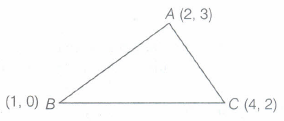
On multiplying Eq. (i) by 3 and then subtracting Eq. (ii) from Eq. (i), we get
7x=7 \(\Rightarrow\) x=1
On putting the value of x in Eq. (i), we get
3 x 1-y=3
\(\Rightarrow\) y=0
So, the coordinate of point or vertex B is (1, 6). Similarly, on solving Eq. (ii) and Eq. (iii), we get the coordinate of point or vertex Cis (4, 2).
And on solving Eq. (i) and Eq. (iii), we get the coordinate of point or vertex A is (2, 3).
Hence, the vertices of \(\triangle\)ABC formed by the given lines are A (2,3), B (1, 0) and C( 4, 2).
4.
Given, pair oflinear equations is
x+y-2=0 ..(i)
and 2x - y - 1= 0 ..(ii)
Now, table for x + y = 2
or y=2-x is
| x | 0 | 2 |
| y=2-x | 2 | 0 |
| Points | A(0,2) | B(2,0) |
Table for 2x - y -1 = 0
or y = 2x -1 is
| x | 0 | 2 |
| y=2-1 | -1 | 3 |
| Points | C(0,-1) | B(2,3) |
Plot the points A (0, 2) and B (2, 0) and join them to get the straight line AB. Similarly, plot the points C (0, - 1) and D (2, 3) and join them to get the straight line CD. The lines AB and CD intersect at E (1, 1). So, the solution of the given pair oflinear equations is (1, 1).
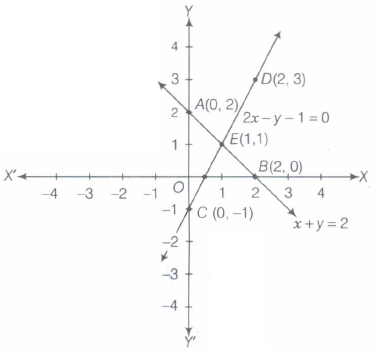
It is clear from the graph that infinite lines can pass through the intersection point of linear equations x + y = 2 and 2x - y = 1, i.e. point E (1, 1) satisfy the many linear equations such as y = x, 2x +Y = 3, x + 2y = 3 and so on.
5.
Let the present age of Sagar be x yr and the age of Tiru be y yr.
5 yr ago, Sagar's age = (x - 5) yr and Tiru's age = (y - 5) yr
According to the given condition,
(x-5)=2(y-5)
\(\Rightarrow\) x-5=2y-10
\(\Rightarrow\) x-2y+5=0
After 10 yr, Sagar's age = (x + 10) yr and Tiru's age = (y + 10) yr
According to the given condition,
x+10=(y+10)=10
\(\Rightarrow\)x+10=y+20
\(\Rightarrow\) x-y-10=0
Thus, we get the following pair of linear equations
x-2y+5=0 ..(i)
x-y-10=0 ..(ii)
Now, let us draw the graphs of Eqs.(i) and (ii), by finding at least two solutions for each of these equations: The solutions of the equations are given in tables.
Table for x-2y+5=0 or \(y=\frac { x+5 }{ 2 } \) is
| x | 5 | -5 |
| \(y=\frac { x+5 }{ 2 } \) | 5 | 0 |
| Points | A(5,5) | B(-5, 0) |
Table for x-y-10=0 or y=x-10 is
| x | 5 | 10 |
| y=x-10 | -5 | 0 |
| Points | C(5,-5) | D(10, 0) |
Plot the points A (5, 5) and B (-5,0) and join them to get the line AB. Similarly, plot the points C (5,-5) and D (10, 0) and join-them to get the line CD.
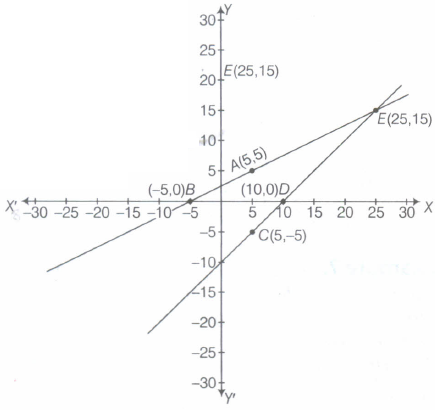
It is clear from the graph that, lines AB and CD intersect each other at point E (25,15).
So, x= 25 and y=15 is the required solution.
Hence, Sagar's present age = 25 yr and Tiru's present age = 15 yr.
6.
Table for line 3x +y - 5 = 0
or y = 5 -3xis
| x | 1 | 0 | 2 |
| y=5-3x | 2 | 5 | -1 |
| points | A(1,2) | B(0,5) | C(2,-1) |
Now, plot all these points on a graph paper and join them to get a straight line BC.
Table for line 2x - y - 5 = 0 or y = 2x - 5 is
| x | 1 | 0 | 3 |
| y=2x-5 | -3 | -5 | 1 |
| points | D(1,-3) | E(0,-5) | F(3,1) |
Now, plot all these points on a graph paper and join them to get a straight line EF. Thus, we get the following graph and it is clear from the graph that two lines intersect each other at point C(2, -1).
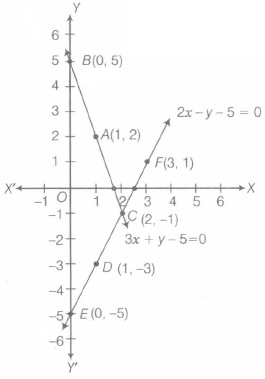
Line 3x + y - 5 = °intersects Y-axis at the point B(O,5) and line 2x - y - 5 = 0 intersects Y-axis at the point E (0, - 5).
7.
\(x=\frac { a }{ { a }^{ 2 }+{ b }^{ 2 } } ,\quad x=\frac { b }{ { a }^{ 2 }+{ b }^{ 2 } } \)
8.
x=a2, y=b2
9.
Given lines are 2ax-by=2a2-b2 ...(i)
and ax+2by=a2+2b2 ...(ii)
On multiplying Eq. (ii) by w and then subtracting from Eq. (i), we get
-5by=-5b2
\(\Rightarrow\) y=b
On putting the value of y in Eq. (i), we get
2ax-b2=2a2-b2
2ax=2a2 \(\Rightarrow\) x=a
So, the solution of the given system is x=a and y=b or the lines intersect at (a,b).
Now, we have to prove that point (a,b) lies on the line
(a-b)x+(a+b)y=a2+b2
On putting x=a and y=b in LHS, we get
LHS=(a-b)a+(a+b)b
=a2-ab+ab+b2
=a2+b2=RHS
so, the lines are concurrent.
10.
Let the unit's place digit be x and ten's place digit be y.
Original number=10y+x
Number obtained by reversing the order of digits
=10x+y
Sum of both number=99 [given]
(10y+x)+(10x+y)=99
11x+11y=99
x+y=9 .....(i) [dividing both sides by 11]
Also, given that the digits of the numbers differ by 3.
If y>x, then y=-x=3 ..(ii)
and if y
2y=12
\(\Rightarrow\) \(y= \frac {12}{2}\)=6
Then, from Eq. (i),
x=9-y=9-6=3 [\(\therefore\)y=6]
\(\therefore\)Number=10y+x=10(6)+3=63
Now, adding Eqs. (i) and (iii), we get
2x=12
x=6
Then, from Eq. (i), we get
y=9-x=9-6=3 [\(\therefore\)x=6]
\(\therefore\)Number=10y+x=10(3)+6=36
Hence, the required number 63 and 36
11.
Given pair of equations is
2x+3y-4=0
and (k+2)x+6y-(3k+2)=0
On comparing the given equations with standard form
a1x+b1y+c1=0 and a2x+b2y+c2=0, we get
a1=2, b1=3, c1=4
and a2=k+2, b2=6, c2=-(3k+2)=0
For infinitely many solutions
\(\frac { { a }_{ 1 } }{ { a }_{ 2 } } =\frac { { b }_{ 1 } }{ { b }_{ 2 } } =\frac { { c }_{ 1 } }{ { c }_{ 2 } } \)
\(\therefore \ \underset { I }{ \frac { 2 }{ k+2 } } =\underset { II }{ \frac { 3 }{ 6 } } =\underset { III }{ \frac { -4 }{ -(3k+2) } } \)
On taking I and II terms, we get
\(\frac { 2 }{ k+2 } =\frac { 3 }{ 6 } \ \Rightarrow \ \frac { 2 }{ k+2 } =\frac { 1 }{ 2 } \)
\(\Rightarrow \quad k+2=4\quad \Rightarrow \quad k=2\)
Which also satisfy the last two terms of Eq. (i)
Hence, the required value of k is 2.
12.
Given, pair of linear equations is
kx-5y-2=0 and 6x+2y-7=0
Here a1=k, b1=-5, c1=-2
and a2=6, b2=2, c2=-7
For no solution,
\(\frac { { a }_{ 1 } }{ { a }_{ 2 } } =\frac { { b }_{ 1 } }{ { b }_{ 2 } } \neq \frac { { c }_{ 1 } }{ { c }_{ 2 } } \)
\(\Rightarrow \quad \frac { k }{ 6 } =\frac { -5 }{ 2 } \neq \frac { -2 }{ -7 } \)
\(\Rightarrow \quad \frac { k }{ 6 } =\frac { -5 }{ 2 } \)
\(\Rightarrow \quad k=-15\)
13.
The given equation can be rewritten as 2x+ky-1=0 and 3x-5y-7=0
On comparing with
a1x+b1y+c1=0 and a2x+b2y+c2=0, we get
a1=2, b1=k, c1=-1
and a2=3, b2=-5, c2=-7
A pair of linear equations has unique solution, if
\(\frac { { a }_{ 1 } }{ { a }_{ 2 } } \neq \frac { { b }_{ 1 } }{ { b }_{ 2 } } \)
\(\Rightarrow \quad \frac { 2 }{ 3 } \neq \frac { k }{ -5 } \)
\(\Rightarrow \quad k\neq \frac { -10 }{ 3 } \)
So, given lines have unique solution for all real values of k, except \(\frac { -10 }{ 3 } \)
14.
Given pair of linear equations is
41x+53y=135 ..(i)
and 53x+41y=147 ...(ii)
On adding Eqs. (i) and (ii), we get
94x+94y=282
\(\Rightarrow\) x+y=3 [dividingboth sides by 94] ...(iii)
On subtracting Eq. (i) from Eq. (ii), we get
12x-12y=12
\(\Rightarrow\) x-y=1 [dividing both sides by 12] ...(iv)
Now, on adding Eqs.(iii) and (iv), we get
2x=4 \(\Rightarrow\) x=2
On substituting x=2 in Eq. (iii), we get
y=3-2=1
Hence, x=2 and y=1 is the required solution.
15.
Given, linear equation is 2x + 3y - 8 = 0 .....(i)
(i) For intersecting lines, we know that \(\frac { { a }_{ 1 } }{ { a }_{ 2 } } \neq \frac { { b }_{ 1 } }{ { b }_{ 2 } } \)
One of the possible line may be taken as
5x + 2y-9 =0
(ii) For parallel lines, \(\frac { { a }_{ 1 } }{ { a }_{ 2 } } =\frac { { b }_{ 1 } }{ { b }_{ 2 } } \neq \frac { { c }_{ 1 } }{ { c }_{ 2 } } \)
\(\therefore\) One of the possible line parallel to eqn. (i) may be taken as
6x + 9y + 7 = 0
(iii) For coincident lines, \(\frac { { a }_{ 1 } }{ { a }_{ 2 } } =\frac { { b }_{ 1 } }{ { b }_{ 2 } } =\frac { { c }_{ 1 } }{ { c }_{ 2 } } \)
One of the possible line coincident to eqn. (i) may be taken as
4x + 6y - 16 = 0

10th Standard CBSE Syllabus & Materials
10th Standard CBSE
CBSE 10th Social Science PS - Federalism - New Model Questions Papers Study Material - QB365 Set A
NEW10th Standard CBSE
CBSE 10th Social Science PS - Power Sharing - New Model Questions Papers Study Material - QB365 Set A
NEW10th Standard CBSE
CBSE 10th Social Science GEO - Manufacturing Industries - New Model Questions Papers Study Material - QB365 Set A
NEW10th Standard CBSE
CBSE 10th Social Science GEO - Minerals and Energy Resources - New Model Questions Papers Study Material - QB365 Set A



CBSE 10th Standard CBSE Subjects
CBSE Standards





