
 100% FREE ACCESS
10th Standard CBSE Syllabus & Materials
10th Standard CBSE
CBSE 10th Social Science ECO - Globalisation and the Indian Economy - New Model Questions Papers Study Material - QB365 Set A
NEW10th Standard CBSE
CBSE 10th Social Science ECO - Money and Credit - New Model Questions Papers Study Material - QB365 Set A
NEW10th Standard CBSE
CBSE 10th Social Science ECO - Sectors of the Indian Economy - New Model Questions Papers Study Material - QB365 Set A
NEW10th Standard CBSE
CBSE 10th Social Science ECO - Development - New Model Questions Papers Study Material - QB365 Set A
NEW10th Standard CBSE
CBSE 10th Social Science PS - Outcomes of Democracy - New Model Questions Papers Study Material - QB365 Set A
NEW10th Standard CBSE
CBSE 10th Social Science PS - Gender, Religion and Caste - New Model Questions Papers Study Material - QB365 Set A

Published on: 18/01/2020
Download CBSE Class 10th Standard CBSE Maths question papers, sample papers, important questions, and previous year solved papers in PDF format. Get free study materials, NCERT solutions, and exam preparation resources for Class 10th Standard CBSE Maths
Questions + Answers key
Take MCQ Maths Test
1.
Evaluate : \(\frac { \cos { { 45 }^{ ° } } }{ \sec { { 30 }^{ ° } } } +\frac { 1 }{ \sec { { 60 }^{ ° } } } \)
2.
What is the maximum number of parallel tangents a circle can have on a diameter?
3.
Which of the term of A.P.5, 2, -1, ..... is - 49 ?
4.
The ages of employees in a factory are as follows:
| Age (in years) | 17-23 | 23-29 | 29-35 | 35-41 | 41-47 | 47-53 |
|---|---|---|---|---|---|---|
| Number of employees | 2 | 5 | 6 | 4 | 2 | 1 |
Find the median age of the employees.
5.
A solid ball is exactly fitted inside the cubical box of side a. What is the volume of remaining space inside the cubical box?
6.
Construct a quadrilateral ABCD, in which AB = 2.5 cm, BC = 3.5 cm, AC = 4.2 cm, CD = 3.5 cm and AD = 2.5 cm. Construct another quadrilateral AB' C'D' with diagonal AC' = 6.3 cm such that it is similar to quadrilateral ABCD.
7.
If a point P is 17 cm from the centre of a circle of radius 8 cm, then find the length of the tangent drawn to the circle from point P.
8.
Two cones with same base radius 8 cm and height 15 cm are joined together along their bases. Find the surface area of the shape so formed.
9.
What is the degree measure of the largest angle of a right triangle?
10.
Find the distance between P(2,3) and Q(4,1).
11.
If 'a' is the length of one of the sides of an equilateral triangle ABC, base BC lies on x-axis and vertex B is at the origin, find the coordinates of the vertices of the triangle ABC.
12.
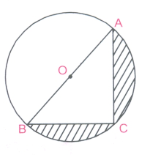
Find the area of the shaded region in figure, if AC = 24 cm, BC = 10 cm and O is the centre of the circle.
13.
If the probability of winning a game is 0.3, what is the probability of losing it?
14.
In nth term of an AP is (2n + 1), then find the sum of its first three terms.
15.
Find the next term of AP \(\sqrt{2},\sqrt{8},\sqrt{18}.\)
16.
The sum of the areas of two squares is 640m2. If the difference in their perimeters is 64m2 find the sides of the two squares.
17.
Two posts are k metre apart and the height of one is double that of the other. If from the midpoint of the line segment joining their feet, an observer finds the angles of elevation of their tops to be complementary, then find the height of the shorted post.
18.
Solve the following pair of linear equations by the elimination method and the substitution method :
x + y = 5 and 2x - 3y = 4
19.
Find HCF of SI and 237 and express it as a linear combination of SI and 237 i.e., HCF (81, 237) = 81x + 237y for some x and y.
20.
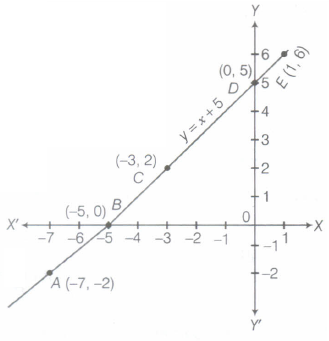
Draw the graph of the linear polynomial x + 5 and also find the zeros of the polynomial.
21.
How long will a man take to go once round a circular track of radius 4.2 m, if he runs at an average speed of 6 km/h?
22.
The shadow of a tower, when the angle of elevation of the sun is 450, is found to be 40 40m longer than when it is 600.Find the height of the tower.
23.
A child's game has 8 triangles of which 3 are blue and rest are red, and 10 squares of which 6 are blue and rest are red. One piece is lost at random. Find the probability that it is a
(i) triangle (ii) square
(iii) square of blue colour (iv) triangle of red colour
24.
A straight highway leads to the foot of a tower. A man standing at the top of the tower observes a car at an angle of depression of 30o , which is approaching the foot of the tower with a uniform speed. Six seconds later, the angle of depression of the car is found to be 60o . Find the time taken by the car to reach the foot of the tower from this point.
25.
In reduced scale-factor, the geometric figure to be constructed is .______________in size.
26.
Three points A, B and C are collinear, if any one of the following takes place:
........... + AB = CB
27.
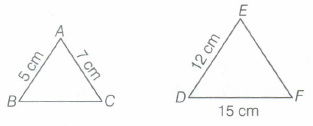
It is given that \(\triangle ABC\sim \triangle EDF\) such that AB = 5 cm, AC = 7 cm, DF = 15 cm and DE = 12 cm. Find the lengths of the remaining sides of the triangles.
28.
An aeroplane, when 3000 m high, passes vertically above another aeroplane at an instant, when the angles of elevation of the two aeroplanes from the same point on the ground are \({ 60 }^{ ° }\)and \({ 45 }^{ ° }\), respectively, Find the vertical distance between the two aeroplanes.
29.
If the difference between the circumference and the radius of a circle is 37 crn, then using \(\pi =\frac { 22 }{ 7 } \)
30.
A box contains 35blue, 25 white and 40 red marbles.If a marble is drawn at random from the box, find the probability that the drawn marble is:
(iWhite
(ii)Not blue
(iii)Neither white nor blue
31.
If PA and PB are two tangents drawn from a point P to a circle with centre O touching it at A and B, prove that OP is perpendicular bisector of AB.
32.
Draw two concentric circles of radii 3 cm and 5 cm. Construct a tangent to smaller circle from a point on the larger circle. Also measure its length.
33.
The first term of an A.P. is -5 and the last term 45. If the sum of the terms of the A.P. is 120, then find the number of terms and the common difference.
34.
Write the HCF of the smallest composite number and the smallest even number
4
1
2
0
35.
A right circular cylinder of radius r cm and height h cm (h>2r) just enclosed a sphere of diameter
r cm
h cm
2h cm
2r cm
36.
A kite is flying at a height of 75 metres from the ground level, attached to a string inclined at 60° to the horizontal. The length of the string to the nearest metre is
55 m
87 m
100 m
60 m
37.
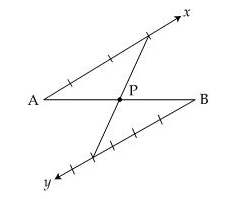
In the figure, P divides AB internally in the ratio
3 : 7
4 : 7
4 : 3
3 :4
1.
\(\frac { \cos { { 45 }^{ ° } } }{ \sec { { 30 }^{ ° } } } +\frac { 1 }{ \sec { { 60 }^{ ° } } } =\frac { \frac { 1 }{ \sqrt { 2 } } }{ \frac { 2 }{ \sqrt { 3 } } } +\frac { 1 }{ 2 } \)
\(=\frac { 1 }{ \sqrt { 2 } } \times \frac { \sqrt { 3 } }{ 2 } +\frac { 1 }{ 2 } \)
\(=\frac { \sqrt { 6 } }{ 4 } +\frac { 1 }{ 2 } \)
\(=\frac { \sqrt { 6 } +2 }{ 4 } \)
2.
On the diameter of a circle only two tangents can be drawn.
3.
Here, a = 5, d = - 3
\(\because\) l = a + (n -1)d
\(\because\)- 49 = 5 + (n -1)(- 3)
\(\Rightarrow\)-49 = 5-3n + 3
\(\Rightarrow\) 3n = 49 + 5 + 3
\(\Rightarrow\)n = 57/3 = 19th term.
4.
32
5.
Diameter of solid ball =Length of edge of cubical box = a
\(\therefore\) Volume of remaining space inside the box=Volume of cubical box-Volume of solid ball.
\(\sqrt { 3 } :\frac { a^{ 3 } }{ 6 } (6-\pi )\)
6.
1. Draw a line segment AC = 4.2 cm.
2. With A as a centre and radius 2.5 cm, draw two arcs, one above AC and one below AC.
3. With C as a centre and radius 3.5 cm, two arcs are drawn intersecting previous arcs at Band D.
4.Join AB, BC, AD and CD. Thus, ABCD is the required quadrilateral.
5. taking A as a centre and radius 6.3 cm, draw an arc' which intersects AC produced at C'.
6. Through C', draw C'B' and C'D' parallel to CB and CD, respectively.
Hence, AB'C'D' is the required quadrilateral similar to quadrilateral ABCD.
7.
We know that, radius is perpendicular to the tangent at the point of contact.
\(\therefore \ \ \ OA\ \bot \ PA\\ \Rightarrow \ \angle OAP={ 90 }^{ \circ }\)

In , \(\triangle OAP\)
PO2 = PA2 + AO2 [by Pythagoras theorem]
\(\Rightarrow \) (17)2 = (PA)2 + (8)2
\(\Rightarrow \) (PA)2 = 289 - 64 = 225
\(\Rightarrow \) PA = \(\sqrt { 225 } \) = 15 cm
Hence, the length of the tangent from point P is 15 cm.
8.
Slant height of each cone = \(\sqrt{{8}^{2}+{15}^{2}}\)
\(=\sqrt{64+225}=\sqrt{289}\)
= 17 cm
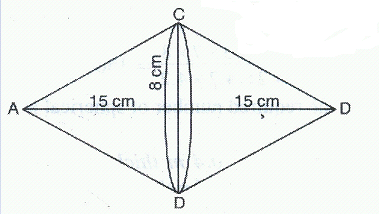
Total surface area of the shape so formed
= 2 X Curved surface area of cone|
\(=2\times{{22}\over{7}}\times8\times17=854.86\) cm2
9.
90o
10.
\(\left| PQ \right| =\sqrt { { (4-2) }^{ 2 }+{ (1-3) }^{ 2 } } =\sqrt { { 2 }^{ 2 }+{ (-2) }^{ 2 } } \)
\( =\sqrt { 4+4 } =\sqrt { 8 } =2\sqrt { 2 } units\)
11.
Given: equilateral triangle of side a units. As B is at origin, therefore, coordinates of B are (O, 0). As BC = a and C lies on x-axis, coordinates Of C are (a, O).
Let coordinates of A be (x,y)
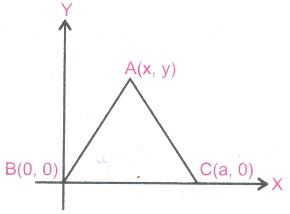
As, AB=BC=AC
\(\sqrt { { (x-0) }^{ 2 }+{ (y-0) }^{ 2 } } =a=\sqrt { { (x-a) }^{ 2 }+{ (y-0) }^{ 2 } } \)
Squaring, we get
\({ x }^{ 2 }+{ y }^{ 2 }={ a }^{ 2 }={ x }^{ 2 }+{ a }^{ 2 }-2ax+{ y }^{ 2 }\) ...(i)
\(\Rightarrow \ { x }^{ 2 }+{ y }^{ 2 }={ x }^{ 2 }+{ y }^{ 2 }+{ a }^{ 2 }-2ax\)
\(\Rightarrow \ 2ax-{ a }^{ 2 }=0\ \Rightarrow a(2x-a)=0\)
\(\therefore \ \ x=\frac { a }{ 2 } \)
Substituting \(x=\frac { a }{ 2 } \)in (i), we get
\({ \left( \frac { a }{ 2 } \right) }^{ 2 }+{ y }^{ 2 }={ a }^{ 2 }\)
\(\Rightarrow \ { y }^{ 2 }={ a }^{ 2 }-\frac { { a }^{ 2 } }{ 4 } =\frac { 3{ a }^{ 2 } }{ 4 } \)
\(\Rightarrow \ y=\frac { \sqrt { 3a } }{ 2 } \)
∴ Coordinates of A are \(\left( \frac { a }{ 2 } ,\frac { \sqrt { 3a } }{ 2 } \right) \)
∴ Coordinates of vertices are A \(\left( \frac { a }{ 2 } ,\frac { \sqrt { 3a } }{ 2 } \right) \) , B(0,0) and C(a,0)
12.
AB is diameter, AC=24cm, BC=10cm
and ㄥACB=900 [Angle insemicircle]
\(∴\ AB=\sqrt{(24)^2+(10)^2}cm\)
\(=\sqrt{576+100}cm=\sqrt{676}cm\)
=26cm
∴ Area of shaded portion = area of semicircle - area of ΔACB
\(=\left[{1\over 2}\times{22\over 7}\times169-120\right]cm^2\)
=[265.57-120]cm2=145.57cm2
13.
Probability of winning a game = 0.3
\(\therefore\) Probability of losing the game = 1 - Probability of winning the game = 1 - 0.3 = 0.7
14.
a1=2x1+1=3
a2=2x2+1=5
a3=2x3+a=7
sum=3+5+7=15
15.
\(\sqrt{2},\sqrt{8},\sqrt{18}......\) = \(\sqrt{2},2\sqrt{2},3\sqrt{2}.....\)
Next term is \(4\sqrt{2}\)
16.
Let side of bigger square be x m and side of smaller square be y m
ATQ x2+y2 = 640 ...(i)
and 4x-4y=64
\(\Rightarrow x-y=16\Rightarrow x=16+y\)
Substituting the value of x in equation (i) we get
(16+y2)+y2=640
\(\Rightarrow 256+y^{ 2 }+32y+y^{ 2 }=640\)
\(\Rightarrow 2y^{ 2 }+32y-384=0\)
\(\Rightarrow y^{ 2 }+16y-192=0\)
\(\Rightarrow (y+24)(y-8)\)
\(\Rightarrow \) y=8 or y=-24 (Rejecting)
When y=8, then x=16+8=24
\(\therefore \) Sides of squares are 8m and 24 m
17.
Let AB and CD be the two posts such that AB = 2 CD. Let M be the mid-point of CA. Let \(\angle CMD=\theta \) and \(\angle AMD=90°-\theta \)
Clearly, CM=MA=\(\frac{1}{2}\)k
Let CD = h. then AB = 2h
Now, \(\frac{AB}{AM}\)=tan(\(90°-\theta \))= cot \(\theta\)
\(\frac { h }{ \left( \frac { k }{ 2 } \right) } =cot\theta \)
cot \(\theta\)=\(\frac{4h}{k}\) ...(i)
Also in \(\Delta CMD\), \(\frac{CD}{CM}\)=tan \(\theta\)
\(\frac { h }{ \left( \frac { k }{ 2 } \right) } =tan\theta \)
tan \(\theta\)=\(\frac{2h}{k}\) ...(ii)
Multiplying (i) and (ii) \(\frac{4h}{k}\) x \(\frac{2h}{k}\)=1
h2=\(\frac { { k }^{ 2 } }{ 8 } \)
h=\(\frac { k }{ 2\sqrt { 2 } } =\frac { k\sqrt { 2 } }{ 4 } \)
18.
By elimination method:
Given, x + y = 5 .....(i)
and 2x - 3y = 4 ......(ii)
On multiplying eqn. (i) by 3 and eqn. (ii) by 1 and then adding them, we get
3(x + y) + 1(2x - 3y) = 3 \(\times\) 5 + 1\(\times\) 4
\(\Rightarrow\) 3x + 3y + 2x - 3y = 15 + 4
\(\Rightarrow\) 5x = 19
\(\therefore \quad x=\frac { 19 }{ 5 } \)
On putting \(x=\frac { 19 }{ 5 }\) in Eq. (i), we get
\(\frac { 19 }{ 5 } +y=5\)
\(\Rightarrow \quad y=5-\frac { 19 }{ 5 } \)
\(\Rightarrow \quad y=\frac { 25-19 }{ 5 } \)
\(\therefore \quad y=\frac { 6 }{ 5 } \)
Hence, \(x=\frac { 19 }{ 5 } \) and \(y=\frac { 6 }{ 5 } \)
By substitution method:
Given, x + y = 5 .....(i)
and 2x - 3y = 4 .....(ii)
From eq. (i), we have y = 5 - x .....(iii)
On substituting y from eqn. (iii) in eqn. (ii),
2x - 3 (5 - x) = 4
\(\Rightarrow\) 2x - 15 + 3x = 4
\(\Rightarrow\) 5x = 19
\(\Rightarrow \quad x=\frac { 19 }{ 5 } \)
On substituting x=\(\frac { 19 }{ 5 } \) in eqn. (iii), we get
\(y=5-\frac { 19 }{ 5 } \)
\(\Rightarrow \quad y=\frac { 6 }{ 5 } \)
Hence,\(\ x=\frac { 19 }{ 5 } \) and \(\ y=\frac { 6 }{ 5 } \)
19.
Since, 237 > SI
On applying Euclid's division algorithm, we get
237 = 81 x 2 + 75 ....(i)
81 = 75 x 1 + 6 ...(ii)
75 = 6 x 12 + 3 .. (iii)
6 = 3 x 2 + 0 ...(iv)
Hence, and HCF (81, 237) = 3
In order to write 3 in the form of 81x + 237y, we move backwards as follows:
3 = 75 - 6 x 12 [From (iii)]
= 75 - (81 - 75 x 1) x 12 [Replace 6 from (ii)]
= 75 - (81 x 12 - 75 x 1 x 12)
= 75 - 81 x 12 + 75 x 12
= 75 + 75 x 12 - 81 x 12
= 75 ( 1 + 12) - 81 x 12
=75 x 13 - 81 x 12
= 13(237 - 81 x 2) - 81 x 12 [Replace 75 from (i)]
= l3 x 237 - 81 x 2 x l3 - 81 x 12
= 237 x 13 - 81 (26 + 12)
= 237 x 13 - 81 x 38
= 81 x (-38) + 237 x (13)
= 81x + 237y
∴ Hence x = - 38 and y= 13
Note that the values of x and yare not unique.
20.
Let y = x + 5, Then, the graph of y = x + 5 is a straight line which interscts the X-axis at x = -5, so -5 is the zero of the given polynomial.
21.
15.84 seconds
22.
94.64m
23.
Total number of pieces = 8 + 10 = 18
(i) No.of triangles = 8. Hence, P(triangle is lost) = \(\frac{8}{18}=\frac{4}{9}\)
(ii) No.of squares = 10. Hence, P(square is lost) = \(\frac{10}{18}=\frac{5}{9}\)
(iii) No.of squares of blue colour = 6. So, P(square of blue colour is lost) = \(\frac{6}{18}=\frac{1}{3}\)
(iv) No.of triangles of red colour = 8 - 3 = 5. So, P(triangle of red colour is lost) = \(\frac{5}{18}\)
24.
Let CD = h m be the height of the tower. At point D of the tower, a man is standing and observes the car at an angle of depression of 30°. After six seconds, the angle of depression of the car is 60°.
i.e. \(\angle\)ODA = 30° and \(\angle\)ODB = 60°
\(\Rightarrow\) \(\angle\)DAC = \(\angle\)ODA = 30° [alternate angles]
and \(\angle\)DBC = \(\angle\)ODB = 60° [alternate angles]
Let AB = y m and BC = x m
In right angled \(\Delta\)BCD,

\(\begin{array}{rlrl} \tan 60^{\circ} & =\frac{P}{B}=\frac{C D}{B C} \\ \end{array}\)
\(\begin{array}{rlrl} \Rightarrow \quad \sqrt{3} & =\frac{h}{x} \\ \end{array}\)
\(\begin{array}{rlrl} \Rightarrow \quad h & =\sqrt{3} x & {\left[\because \tan 60^{\circ}=\sqrt{3}\right]} \end{array}\)
\(\Rightarrow \quad h = \sqrt3 x\)....(i)
In right angled \(\Delta\)ACD,
\(\begin{array}{rlrl} \tan 30^{\circ} & =\frac{C D}{A C}=\frac{C D}{A B+B C} & & {[\because A C=A B+B C]} \\ \end{array}\)
\(\begin{array}{rlrl} \Rightarrow \quad \frac{1}{\sqrt{3}} & =\frac{h}{x+y} & & {\left[\because \tan 30^{\circ}=\frac{1}{\sqrt{3}}\right]} \\ \end{array}\)
\(\begin{array}{rlrl} \Rightarrow \quad x+y & =h \sqrt{3} & \end{array}\)
\(\Rightarrow \quad x + y=\sqrt3 x(\sqrt3)\) [from Eq. (i)]
\(\Rightarrow\) x + y = 3x .....(ii)
It is given that a car moves from point A to B in six seconds. Let its speed be k km/s.
\(\therefore \quad \text { Time }=\frac{\text { Distance }}{\text { Speed }}\)
\(\Rightarrow \quad 6=\frac{y}{k} \Rightarrow y=6 k\)
On putting y = 6k in Eq. (ii), we get
x + 6k = 3x \(\Rightarrow\) 6k - 2x \(\Rightarrow\) x = 3k
\(\therefore \quad \text { Time }=\frac{\text { Distance }}{\text { Speed }}=\frac{x}{k}=\frac{3 k}{k}=3 \mathrm{~s}\)
Hence, the car moves from point B to point C in 3s.
25.
()
smaller
26.
()
CA
27.
Given, \(\triangle ABC\sim \triangle EDF\)
Also, AB = 5 cm, AC = 7 cm, DF = 15 cm
and DE = 12 cm .... (i)
Since, \(\triangle ABC\sim \triangle EDF\)
\(\therefore \frac { AB }{ ED } =\frac { AC }{ EF } =\frac { BC }{ DF } \)
[ ∵ Corresponding sides of similar triangles are proportions]
\(\Rightarrow \frac { 5 }{ 12 } =\frac { 7 }{ EF } =\frac { BC }{ 15 } \) [from Eq. (i)]
On taking first and second terms, we get
\(\frac { 5 }{ 12 } =\frac { 7 }{ EF } \Rightarrow EF=\frac { 7\times 12 }{ 5 } \) = 16.8 cm
On taking first and third terms, we get
\(\frac { 5 }{ 12 } =\frac { BC }{ 15 } \Rightarrow BC=\frac { 5\times 15 }{ 12 } \) = 6.25 cm
Hence, lengths of the remaining sides of the triangles are EF = 16.8 cm and BC = 6.25 cm.
28.
1268 m
29.
44 cm
30.
Number of blue marbles = 35
Number of white marbles = 25
Number of red marbles = 40
Total marbles in box = 35 + 25 + 40
=100
(i) Probability of a white marble = P (white)
=\(\frac{25}{100}=\frac{1}{4}\)
(ii) Number of non-blue marbles = 100-35
= 65
P (not blue) = \(\frac{65}{100}=\frac{13}{20}\)
(iii) Number of white or blue marbles= 25 + 35
= 60
Number of neither white nor blue marbles = 100-60
= 40
P (neither white nor-blue marbles) =\(\frac{40}{100}=\frac{2}{5}\)
31.
Let OP intersect AB at a point C. Here, PA and PB are the two tangents from a point P lying outside the circle, to the circle with centre O.
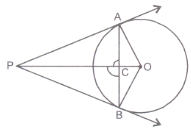
\(\angle \)APO = \(\angle \)BPO [∵ O lies on the bisector of ZAPB]
Now, in \(\triangle\)ACP and \(\triangle\)BCP, we have
AP = BP [tangents from an external pointl
PC = PC [commonl]
\(\angle \)APO = \(\angle \)BPO [proved above]
⇒ \(\triangle\)ACP ≅ \(\triangle\)BCP [by SAS congruence axiom]
⇒ AC = BC [c.p.c.t.]
and \(\angle \)ACP = \(\angle \)BCP
= \(1\over2\) x 180° = 90° [c.p.c.t.]
Hence, OP is the perpendicular bisector of AB.
32.
Given: Two concentric circles of radii 3 cm and 5 cm.
Required: A tangent from any point on the outer circle to inner circle.
Steps of Construction :
Draw two concentric circles with radii 3 cm and 5 cm, mark O as their center.
Take any point P on the outer circle join OP.
Draw AB, the perpendicular bisector of OP, let it intersect OP in M.
With M as centre and radius MP or MO, draw a semi-circle and let it intersect the inner circle in T.
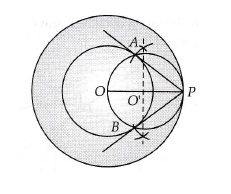
Join PT.
Thus, PT is the required tangent.
On measurement, PT 4 cm
By calculation, PT = \(\sqrt { { OP }^{ 2 }-{ OT }^{ 2 } } \)
= \(\sqrt { 25-9 } =\sqrt { 16 } \)
= 4 cm.
33.
Here, first term (a) of an A.P. is -5 and the last term (an) is 45.
Let d be the common difference and n be the number of terms.
\(\therefore\) a + ( n - 1 )d = an
\(\Rightarrow\) - 5 + ( n - 1 )d = 45
\(\Rightarrow\) ( n - 1 )d = 50 ...(i)
Also, Sn = 120
\(\Rightarrow\) \({n\over2}(a+l)=120\)
\(\Rightarrow\) n ( - 5 + 45 ) = 240
\(\Rightarrow\) n ( 40 ) = 240
\(\Rightarrow\) n = 6
From (i), we have|
( 6 - 1 )d = 50
\(\Rightarrow\) 5d = 50
\(\Rightarrow\) d = 10
Hence, the required number of terms is 6 and the common difference is 10.
34.
(c)
2
35.
(d)
2r cm
36.
(b)
87 m
37.
(d)
3 :4

10th Standard CBSE Syllabus & Materials
10th Standard CBSE
CBSE 10th Social Science PS - Federalism - New Model Questions Papers Study Material - QB365 Set A
NEW10th Standard CBSE
CBSE 10th Social Science PS - Power Sharing - New Model Questions Papers Study Material - QB365 Set A
NEW10th Standard CBSE
CBSE 10th Social Science GEO - Manufacturing Industries - New Model Questions Papers Study Material - QB365 Set A
NEW10th Standard CBSE
CBSE 10th Social Science GEO - Minerals and Energy Resources - New Model Questions Papers Study Material - QB365 Set A



CBSE 10th Standard CBSE Subjects
CBSE Standards





