
 100% FREE ACCESS
10th Standard CBSE Syllabus & Materials
10th Standard CBSE
CBSE 10th Social Science ECO - Globalisation and the Indian Economy - New Model Questions Papers Study Material - QB365 Set A
NEW10th Standard CBSE
CBSE 10th Social Science ECO - Money and Credit - New Model Questions Papers Study Material - QB365 Set A
NEW10th Standard CBSE
CBSE 10th Social Science ECO - Sectors of the Indian Economy - New Model Questions Papers Study Material - QB365 Set A
NEW10th Standard CBSE
CBSE 10th Social Science ECO - Development - New Model Questions Papers Study Material - QB365 Set A
NEW10th Standard CBSE
CBSE 10th Social Science PS - Outcomes of Democracy - New Model Questions Papers Study Material - QB365 Set A
NEW10th Standard CBSE
CBSE 10th Social Science PS - Gender, Religion and Caste - New Model Questions Papers Study Material - QB365 Set A

Published on: 06/09/2019
Real Number
Download CBSE Class 10th Standard CBSE Maths question papers, sample papers, important questions, and previous year solved papers in PDF format. Get free study materials, NCERT solutions, and exam preparation resources for Class 10th Standard CBSE Maths
Questions + Answers key
Take MCQ Maths Test
1.
Show that the cube of any positive integer is of the form 4m, 4m + 1 or 4m + 3, for some integer m.
2.
Check whether the rational number \(\frac{1}{13}\), is terminating recurring or non-terminating recurring decimal expansion.
3.
Explain, why (3 x 5 x 7) + 7 is a composite number?
4.
Can the number 6n, n being number, end with the digit 5 ? Give reasons.
5.
State Fundamental theorem fo Arithmetic. Find LCM of numbers 2520 and 10530 by prime factorization method.
6.
Find the LCM and HCF of the following pairs of integers and verify that LCM x HCF = Product of the two numbers.
26 and 91
7.
Show that \(5-\sqrt { 3 } \) is irrational.
8.
An army contingent of 104 members is to march behind an army band of 96 members in a parade. The two groups are to march in the same number of columns. What is the maximum number of columns in which they can march?
9.
Find the least number that is divisible by all numbers between 1 and 10 (both inclusive).
10.
The decimal representation of \(\\ \frac { 6 }{ 1250 } \) will terminate 1250 after how many places of decimal?
11.
Calculate \(\frac { 3 }{ 8 } \) in the decimal form.
12.
What type of decimal expansion does a rational number has? How can you distinguish it from decimal expansion of irrational numbers?
13.
Find the smallest positive rational number by which 1/7 should be multiplied so that its decimal expansion terminates after 2 places of decimal.
14.
What is the condition for the decimal expansion of a rational number to terminate? Explain with the help of an example.
15.
The length, breadth and height of a room are 8m 50 cm, 6 m 25 cm and 4 m 75 cm respectively. Find the length of the longest rod that can measure the dimensions of the room exactly.
16.
Find the HCF of 1,656 and 4,025 by Euclid's division algorithm.
17.
If HCF (a, b) = 12 and a x b = 1,800, then find LCM (a, b).
18.
Calculate the HCF of 33 x 5 and 32 x 52.
19.
What is the HCF of the smallest composite number and the smallest prime number?
20.
a and b are two positive integers such that the least prime factor of a is 3 and the least prime factor of b is 5. Then calculate the least prime factor of (a + b).
21.
Explain why 13233343563715 is a composite number?
22.
Find the HCF of 52 and 117 and also find the values of x and y, if it express in the form 52x + 117y.
23.
A rational number in its decimal expansion is 327.7081. What can you say about the prime factors of q. when this number is expressed in the form \(\frac{p}{q}\)? Give reason.
1.
Let a be an arbitrary positive integer. Then, by Euclid's division lemma, corresponding to the positive integers a and 4, there exist non-negative integers q and r such that
a = 4q + r, where \(0\le r<4\)
\(\Rightarrow \) a3 = (4q + r)3 = 64q3 + r3 + 12qr2 + 48q2r
[ \(\because \) (A + B)3 = A3 + B3 + 3AB2 + 3A2B]
\(\Rightarrow \) a3 = 64q3 + 48q2r + 12qr2 + r3
where, \(0\le r<4\) .... (i)
The possible values of r are 0, 1, 2, 3.
If r = 0, then from Eq.(i), we get
a3 = 64q3 = 4(16q3) \(\Rightarrow \) a3 = 4m
where, m = 16q3 is an integer.
If r = 1, then from Eq.(i), we get
a3 = 64q3 + 48q2 + 12q + 1
= 4(16q3 + 12q2 + 3q) + 1 = 4m + 1
where, m = (16q3 + 12q2 + 3q) is an integer.
If r = 2, then from Eq.(i), we get
a3 = (64q3 + 96q2 + 48q) + 8
\(\Rightarrow \) a3 = 4(16q3 + 12q2 + 12q + 2)
\(\Rightarrow \) a3 = 4m, where m = (16q3 + 12q2 + 12q + 2) is an integer.
If r = 3, then from Eq.(i), we get
a3 = 64q3 + 144q2 + 108q + 27
\(\Rightarrow \) a3 = 64q3 + 144q2 + 108q + 24 + 3
\(\Rightarrow \) a3 = 4(16q3 + 36q2 + 27q + 6) + 3 = 4m + 3
where, m = (16q3 + 36q2 + 27q + 6) is an integer.
Hence, the cube of any positive integer is of the form 4m, 4m + 1 or 4m + 3 for some integer m.
2.
Given, rational number is \(\frac{1}{13}\).
Here, prime factors of 13 are not of the form 2n 5m.
So, it will not have a terminating decimal expansion.
[ by using theorems 3 and 4]
Now, \(\frac { 1 }{ 13 } =0.076923076923...=\overline { 0.076923 } \)
Thus, \(\frac{1}{13}\) has non-terminating repeating decimal expansion.
3.
We have, (3 x 5 x 7) + 7 = 105 + 7 = 112
\(\therefore \) Prime factors of 112 = 2 x 2 x 2 x 2 x 7 = 24 x 7
So, it is the product of prime factors 2 and 7.
Hence, it is a composite number.
4.
If 6" ends with 0, then it must have 5 as a factor. But we know that only prime factor of 6n are 2 and 3.
∴ 6n = (2 x 3)n = 2n x 3n
From the fundamental theorem of arithmetic, we know that the prime factorization of every composite numbers is unique.
∴ 6n can never end with 0.
5.
Fundamental theorem of arithmetic: Every composite number can be expressed as the product of powers of primes and this factorization in unique.
2520 = 23 x 32 x 5 x 7
10530 = 2 x 34 x 5 x 13
LCM = 23 x 34 x 5 x 7 x 13
= 294840
6.
We have, 26 and 91
| 2 | 26 |
| 13 | 13 |
| 1 |
| 7 | 91 |
| 13 | 13 |
| 1 |
\(\therefore \) Prime factors of 26 = 2 x 13
and prime factors of 91 = 7 x 13
Now, LCM of 26 and 91 = 2 x 7 x 13 = 182
and HCF of 26 and 91 = 13
For verification
LCM x HCF = 182 x 13 = 2366
and product of two numbers = 26 x 91 = 2366
Thus, LCM x HCF = Product of two numbers.
7.
Let us assume, to the contrary, that 5 - \( \sqrt{3}\) is rational.
That is, we can find coprime a and b (b \(\neq\)0) such that 5 - \( \sqrt{3}\) = \(\frac{a}{b}\)
Therefore, 5 - \(\frac{a}{b}=\sqrt{3}\)
Rearranging this equation, we get \(\sqrt{3}\) = 5 - \(\frac{a}{b}\)=\(\frac{5b-a}{b}\)
Since a and b are integers, we get 5 - \(\frac{a}{b}\) is rational, and so \( \sqrt{3}\) is rational.
But this contradicts the fact that \(\sqrt{3}\) is irrational.
This contradiction has arisen because of our incorrect assumption that 5 - \( \sqrt{3}\) is rational.
So, we conclude that 5 - \( \sqrt{3}\) is irrational.
8.
Let the number of columns be x.
x is the largest number, which should divide both 104 and 96
104 = 96 x 1 + 8 1
96 = 8 x 12 + 0
∴ HCF of 104 and 96 is 8
Hence, 8 columns are required.
9.
The required number is the LCM of 1, 2, 3, 4, 5, 6, 7, 8,9,10
∴ LCM = 2 x 2 x 3 x 2 x 3 x 5 x 7
=2520
10.
\(\frac { 6 }{ 1250 } =\frac { 6 }{ 2\times { 5 }^{ 4 } } \)
\(=\frac { 6\times { 2 }^{ 3 } }{ 2\times { 2 }^{ 3 }\times { 5 }^{ 4 } } \)
\(=\frac { 6\times { 2 }^{ 3 } }{ { 2 }^{ 4 }\times { 5 }^{ 4 } } \)
\(=\frac { 6\times { 2 }^{ 3 } }{ (10)^{ 4 } } =0.0288\)
\(\frac { 6 }{ 1250 } \) will terminate after 4 decimal places.
11.
\(\frac { 3 }{ 8 } =\frac { 3 }{ { 2 }^{ 3 } } \)
\(=\frac { { 3\times 5 }^{ 3 } }{ { 2 }^{ 3 }\times { 5 }^{ 3 } } \)
\(=\frac { 375 }{ 10^{ 3 } } =\frac { 375 }{ 1000 } \)
\(=0.375\)
12.
A rational number is either terminating or nonterminating repeating.
An irrational number is non-terminating and non-repeating
13.
Since \(\frac { 1 }{ 7 } +\frac { 7 }{ 100 } =\frac { 1 }{ 100 } =0.01\)
Thus smallest rational number is \(\\ \frac { 7 }{ 100 } \)
14.
The decimal expansion of a rational number terminates, if the denominator of rational no p/q, when p and q are co-primes and q can be expressed as 2m5n where In and n are non-negative integers.
e.g. \(\frac { 3 }{ 10 } =\frac { 3 }{ 2^{ 1 }\times 5^{ 1 } } =0.3\)
15.
Length = 8 m 50 cm = 850 cm
breadth = 6 m 25 cm = 625 cm
height = 4 m 75 cm = 475 cm
length of the longest rod is equal to
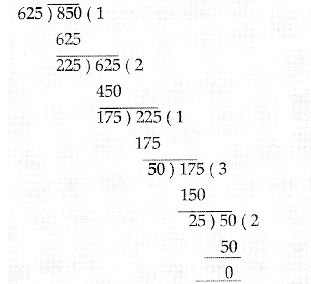
HCF (625, 850) = 25
∵ 25 divides 475
∴ HCF(62, 850, 475)=25
16.
Hence HCF (1,656,4,025)= 23
17.
We know that a x b = HCF (a, b) x LCM (a, b)
⇒ 1,800 = 12 x LCM (a, b)
⇒ LCM(a,b)=\(\frac { 1,800 }{ 12 } =150\)
18.
HCF of 33 x 5 and 32 x 52
= 32 x 5
= 9 x 5
= 45
19.
The smallest prime number is 2 and the smallest composite number is 22 Hence, required HCF (22,2) = 2.
20.
a and b are two positive integers such that the least prime factor of a is 3 and the least prime factor of b is 5. Then least prime factor of (a + b) is 2.
21.
The given number ends in 5. Hence it is a multiple of 5. Therefore it is a composite number
22.
13; x = - 2, y =1
23.
Here, 327.7081 is terminating. So, it represents a rational number.
Thus, \(327.7081=\frac { 3277081 }{ 10000 } =\frac { p }{ q } \)
Here, q = 104 = 2 x 2 x 2 x 2 x 5 x 5 x 5 x 5
= 24 x 54 = (2 x 5)4
So, the prime factors of q are 2 and 5.

10th Standard CBSE Syllabus & Materials
10th Standard CBSE
CBSE 10th Social Science PS - Federalism - New Model Questions Papers Study Material - QB365 Set A
NEW10th Standard CBSE
CBSE 10th Social Science PS - Power Sharing - New Model Questions Papers Study Material - QB365 Set A
NEW10th Standard CBSE
CBSE 10th Social Science GEO - Manufacturing Industries - New Model Questions Papers Study Material - QB365 Set A
NEW10th Standard CBSE
CBSE 10th Social Science GEO - Minerals and Energy Resources - New Model Questions Papers Study Material - QB365 Set A



CBSE 10th Standard CBSE Subjects
CBSE Standards





