
 100% FREE ACCESS
10th Standard CBSE Syllabus & Materials
10th Standard CBSE
CBSE 10th Social Science ECO - Globalisation and the Indian Economy - New Model Questions Papers Study Material - QB365 Set A
NEW10th Standard CBSE
CBSE 10th Social Science ECO - Money and Credit - New Model Questions Papers Study Material - QB365 Set A
NEW10th Standard CBSE
CBSE 10th Social Science ECO - Sectors of the Indian Economy - New Model Questions Papers Study Material - QB365 Set A
NEW10th Standard CBSE
CBSE 10th Social Science ECO - Development - New Model Questions Papers Study Material - QB365 Set A
NEW10th Standard CBSE
CBSE 10th Social Science PS - Outcomes of Democracy - New Model Questions Papers Study Material - QB365 Set A
NEW10th Standard CBSE
CBSE 10th Social Science PS - Gender, Religion and Caste - New Model Questions Papers Study Material - QB365 Set A

Published on: 24/09/2019
Real Number
Download CBSE Class 10th Standard CBSE Maths question papers, sample papers, important questions, and previous year solved papers in PDF format. Get free study materials, NCERT solutions, and exam preparation resources for Class 10th Standard CBSE Maths
Questions + Answers key
Take MCQ Maths Test
1.
144 cartons r Coke cans and 90 cartons of Pepsi cans are to be stacked in a canteen. If each stack is of the same height and if it eq contain cartons of the same drink, what would be the greatest number of cartons each stacke would have?
2.
Use Euclid division lemma to show that the square of any positive integer cannot be of the form 5m + 2 or 5m + 3 for some integer m.
3.
Find the greatest number of six digits exactly divisible by 18, 24 and 36
4.
Show that one and only one out of n, n + 4, n + 8, n + 12 and n + 16 is divisible by 5, where n is any positive integer.
5.
Show that the cube of any positive integer is of the form 4m, 4m + 1 or 4m + 3, for some integer m.
6.
If q is prime, then prove that \(\sqrt{q}\) is an irrational number.
7.
State whether \(1.2\overline { 3 } +\frac { 3 }{ 4 } \) is a rational number or not.
8.
The numbers 525 and 3000 are both divisible by 3, 5, 15, 25 and 75. What is the HCF of 525 and 3000? Justify your answer.
9.
Check whether the rational number \(\frac{1}{13}\), is terminating recurring or non-terminating recurring decimal expansion.
10.
Show that \(3\sqrt { 2 } \) is an irrational number.
11.
If the HCF of 35 and 45 is 5, LCM of 35 and 45 is 63 x a, then find the value of a.
12.
If HCF of two numbers is 2 and their product is 120, find their LCM.
13.
Find the LCM and HCF of 120 and 144 by fundamental theorem of arithmetic.
14.
Write the HCF of the smallest composite number and the smallest prime number.
15.
Show that \(5-\sqrt { 3 } \) is irrational.
1.
The greatest number of cartons is the HCF of 144 and 90
\(144={ 2 }^{ 4 }\times { 3 }^{ 2 }\)
\(90=2\times { 3 }^{ 2 }\times 5\)
\(HCF=2\times { 3 }^{ 2 }=18\)
∴ The greatest number of cartons = 18
2.
Let n be any positive integer.
By Eucild's division lemma, 11= 5q + r, \(0\le r<5\)
n = Sq, Sq + 1, Sq + 2,5q + 3 or 5q + 4, where \(q\epsilon w\) q is a whole number
now n2 = (5q)2 = 25q2 = 5(5q2) = 5m
n2= (5q + 1)2= 25q2 + 10q + 1= 5m + 1
n2 = (5q + 2)2= 25q2 + 20q + 4 = 5m+ 4
Similarly n2= (5q + 3)2 = 5m + 4
and n2 =(5q + 4)2 = 5m + 1
Thus square of any positive integer cannot be of the form 5m + 2 or 5m + 3.
3.
LCM of 18, 24 and 36 is 72
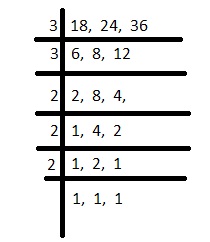
ஃ Required number = 9,99,936.
4.
Given numbers are n, (n + 4), (n + 8), (n + 12) and (n + 16), where n is any positive integer. On dividing n by 5, let q be the quotient and r be the remainder.
Then, n = 5q + r, where \(0\le r<5\)
[ by Euclid's division lemma]
\(\Rightarrow \) n = 5q + r, where r = 0, 1, 2, 3, 4
\(\Rightarrow \) n = 5q or 5q + 1 or 5q + 2 or 5q + 3 or 5q + 4
If n = 5q, then n is only divisible by 5.
If n = 5q + 1, then n + 4 = 5q + 1 + 4 = 5q + 5 = 5(q + 1) which is divisible by 5. So, (n + 4) is only divisible by 5.
If n = 5q + 2, then n + 8 = 5q + 2 + 8 = 5q + 10 = 5(q + 2) which is divisible by 5. So, (n + 8) is only divisible by 5.
If n = 5q + 3, then n + 12 = 5q + 3 + 12 = 5q + 15 = 5(q + 3) which is divisible by 5. So, (n + 12) is only divisible by 5.
If n = 5q + 4, then n + 16 = 5q + 4 + 16 = 5q + 20 = 5(q + 4) which is divisible by 5. So, (n + 16) is only divisible by 5.
Hence, one and only one out of n, n + 4, n + 8, n + 12 and n + 16 is divisible by 5, where n is any positive integer.
5.
Let a be an arbitrary positive integer. Then, by Euclid's division lemma, corresponding to the positive integers a and 4, there exist non-negative integers q and r such that
a = 4q + r, where \(0\le r<4\)
\(\Rightarrow \) a3 = (4q + r)3 = 64q3 + r3 + 12qr2 + 48q2r
[ \(\because \) (A + B)3 = A3 + B3 + 3AB2 + 3A2B]
\(\Rightarrow \) a3 = 64q3 + 48q2r + 12qr2 + r3
where, \(0\le r<4\) .... (i)
The possible values of r are 0, 1, 2, 3.
If r = 0, then from Eq.(i), we get
a3 = 64q3 = 4(16q3) \(\Rightarrow \) a3 = 4m
where, m = 16q3 is an integer.
If r = 1, then from Eq.(i), we get
a3 = 64q3 + 48q2 + 12q + 1
= 4(16q3 + 12q2 + 3q) + 1 = 4m + 1
where, m = (16q3 + 12q2 + 3q) is an integer.
If r = 2, then from Eq.(i), we get
a3 = (64q3 + 96q2 + 48q) + 8
\(\Rightarrow \) a3 = 4(16q3 + 12q2 + 12q + 2)
\(\Rightarrow \) a3 = 4m, where m = (16q3 + 12q2 + 12q + 2) is an integer.
If r = 3, then from Eq.(i), we get
a3 = 64q3 + 144q2 + 108q + 27
\(\Rightarrow \) a3 = 64q3 + 144q2 + 108q + 24 + 3
\(\Rightarrow \) a3 = 4(16q3 + 36q2 + 27q + 6) + 3 = 4m + 3
where, m = (16q3 + 36q2 + 27q + 6) is an integer.
Hence, the cube of any positive integer is of the form 4m, 4m + 1 or 4m + 3 for some integer m.
6.
Let \(\sqrt { q } \) be a rational number and its simplest form is a/b. where q is a prime, a and b are coprime integers and \(b\neq 0\).
Now, \(\sqrt { q } =\frac { a }{ b } \)
On squaring both sides, we get
\(q=\frac { { a }^{ 2 } }{ { b }^{ 2 } } \Rightarrow q{ b }^{ 2 }={ a }^{ 2 }\) .... (i) (1)
Since, qb2 is divisible by q, so a2 is also divisible by q.
\(\Rightarrow \) a is also divisible by q. [by using theorem 1] ... (ii)
Now, a can be written as a = qc for some integer c.
On substituting a = qc in Eq.(i) , we get
qb2 = (qc)2 \(\Rightarrow \) qb2 = q2c2 \(\Rightarrow \) qc2
\(\Rightarrow \) b2 is divisible by q.
\(\Rightarrow \) b is divisible by q. [ by using theorem 1] ... (iii) (1)
From Eqs.(ii) and (iii), q is a common factor of a and b. But this contradicts our assumption that a and b have no common factor. So, our assumption that \(\sqrt { q } \) is a rational number, is wrong. Hence, \(\sqrt { q } \) is an irrational number, if q is prime.
7.
Here, \(1.2\overline { 3 } \) = 1.23333... is a non-terminating repeating decimal.
So, \(1.2\overline { 3 } \) is a rational number and 3/4 is in the form of \(\frac{p}{q}\), where \(q\neq 0\). Thus, \(\frac{3}{4}\) is a rational number.
We know that, the sum of two rational numbers is a rational number.
Therefore, \(\left( 1.2\overline { 3 } +\frac { 3 }{ 4 } \right) \) is a rational number.
8.
Since, the numbers 3, 5, 15, 25 and 75 divide the numbers 525 and 3000, therefore we can write the given numbers as, 525 = 75 x 7 and 3000 = 75 x 40 = 75 x 5 x 23 .
Since, highest common factor among these is 75, therefore HCF = 75
9.
Given, rational number is \(\frac{1}{13}\).
Here, prime factors of 13 are not of the form 2n 5m.
So, it will not have a terminating decimal expansion.
[ by using theorems 3 and 4]
Now, \(\frac { 1 }{ 13 } =0.076923076923...=\overline { 0.076923 } \)
Thus, \(\frac{1}{13}\) has non-terminating repeating decimal expansion.
10.
Let \(3\sqrt { 2 } \) be a rational number. Then, it will be of the form \(\frac { p }{ q } \) , where p, q are coprime integers and \(q\neq 0\).
Now, \(\frac { p }{ q } \) = \(3\sqrt { 2 } \) \(\Rightarrow \quad \frac { p }{ 3q } =\sqrt { 2 } \)
Since, p is an integer and 3q is also an integer \(\left( 3q\neq 0 \right) \).
So, \(\frac { p }{ 3q } \) is a rational number.
\(\Rightarrow \quad \sqrt { 2 } \) is a rational number.
But this contradicts the fact that \(\sqrt { 2 } \) is an irrational number.
Hence, \(3\sqrt { 2 } \) is an irrational number.
11.
We know that,
HCF x LCM = Product of two numbers
\(\Rightarrow \) 5 x 63 x a = 35 x 45 \(\therefore \quad a=\frac { 35\times 45 }{ 5\times 63 } =5\)
12.
Let the two number are a and b.
Given, HCF(a, b) = 2
and product (a x b) = 120
We know that,
HCF (a, b) x LCM (a, b) = Product of a and b
\(\therefore \) 2 x LCM (a, b) = 120
\(\Rightarrow \) LCM (a, b) = \(\frac{120}{2}\) = 6
Hence, the required LCM is 60.
13.
The prime factorisation of 120 = 2 x 2 x 2 x 3 x 5
= 23 x 3 x 5
and prime factorisation of 144
= 2 x 2 x 2 x 2 x 3 x 3 = 24 x 32
By using fundamental theorem of arithmetic,
Now, LCM(120, 144) = 24 x 32 x 5 = 720
and HCF(120, 144) = 23 x 3 = 24
14.
Smallest composite number = 4 = 2 x 2 = 22
and smallest prime number = 2 = 21
\(\therefore \) HCF (4, 2) = 21 = 2
[since, HCF is the product of the smallest power of each common prime factor involved in the numbers].
15.
Let us assume, to the contrary, that 5 - \( \sqrt{3}\) is rational.
That is, we can find coprime a and b (b \(\neq\)0) such that 5 - \( \sqrt{3}\) = \(\frac{a}{b}\)
Therefore, 5 - \(\frac{a}{b}=\sqrt{3}\)
Rearranging this equation, we get \(\sqrt{3}\) = 5 - \(\frac{a}{b}\)=\(\frac{5b-a}{b}\)
Since a and b are integers, we get 5 - \(\frac{a}{b}\) is rational, and so \( \sqrt{3}\) is rational.
But this contradicts the fact that \(\sqrt{3}\) is irrational.
This contradiction has arisen because of our incorrect assumption that 5 - \( \sqrt{3}\) is rational.
So, we conclude that 5 - \( \sqrt{3}\) is irrational.

10th Standard CBSE Syllabus & Materials
10th Standard CBSE
CBSE 10th Social Science PS - Federalism - New Model Questions Papers Study Material - QB365 Set A
NEW10th Standard CBSE
CBSE 10th Social Science PS - Power Sharing - New Model Questions Papers Study Material - QB365 Set A
NEW10th Standard CBSE
CBSE 10th Social Science GEO - Manufacturing Industries - New Model Questions Papers Study Material - QB365 Set A
NEW10th Standard CBSE
CBSE 10th Social Science GEO - Minerals and Energy Resources - New Model Questions Papers Study Material - QB365 Set A



CBSE 10th Standard CBSE Subjects
CBSE Standards





