
 100% FREE ACCESS
10th Standard CBSE Syllabus & Materials
10th Standard CBSE
CBSE 10th Social Science ECO - Globalisation and the Indian Economy - New Model Questions Papers Study Material - QB365 Set A
NEW10th Standard CBSE
CBSE 10th Social Science ECO - Money and Credit - New Model Questions Papers Study Material - QB365 Set A
NEW10th Standard CBSE
CBSE 10th Social Science ECO - Sectors of the Indian Economy - New Model Questions Papers Study Material - QB365 Set A
NEW10th Standard CBSE
CBSE 10th Social Science ECO - Development - New Model Questions Papers Study Material - QB365 Set A
NEW10th Standard CBSE
CBSE 10th Social Science PS - Outcomes of Democracy - New Model Questions Papers Study Material - QB365 Set A
NEW10th Standard CBSE
CBSE 10th Social Science PS - Gender, Religion and Caste - New Model Questions Papers Study Material - QB365 Set A

Published on: 11/08/2026
Download CBSE Class 10th Standard CBSE Maths question papers, sample papers, important questions, and previous year solved papers in PDF format. Get free study materials, NCERT solutions, and exam preparation resources for Class 10th Standard CBSE Maths
Questions + Answers key
Take MCQ Maths Test
1.
Find HCF and LCM of 404 and 96 and verify that HCF x LCM = Product of the two given number.
2.
Find the greatest number that will divide 445, 572 and 699 leaving remainders 4, 5 and 6 respectively.
3.
Prove that \(3+\sqrt { 5 } \) is an irrational number
4.
Show that \(3\sqrt { 2 } \) is an irrational number.
5.
Express each number as a product of its prime factors.
(i) 140
(ii) 156
(iii) 3825
(iv) 5005
(v) 7429
6.
Prove that \(\sqrt { 2 } \) is an irrational .
7.
Prove that \(\sqrt { 5 } \) is irrational number.
8.
There is a circular path around a sports field. Sonia takes 18 min to drive one round of the field, while Ravi takes 12 min for the same. Suppose they both start at the same point and at the same time and go in the same direction. After how many minutes will they meet again at the starting point?
9.
If HCF (420, 189) =21, then LCM (420, 189) is
420
1890
3780
3680
10.
The (HCF x LCM) for the numbers 50 and 20 is
1000
50
100
500
11.
HCF (132, 77) is
11
77
22
44
12.
If n is a natural number, then 8n cannot end with digit
4
2
0
6
13.
HCF of (34 x 22 x 73) and (32 x 5 x 7) is
630
63
729
567
14.
A circular field has a circumference of 360 km. TWo cyclists Sumeet and John start together and can cycle at speeds of 12 km!h and 15 km/h respectively, round the circular field. They will meet again at the starting point after
40 h
30 h
180 h
120 h
15.
If two positive integers a and b are written as 0 = x 3y 2 an d b = xy 3, where x, yare prime numbers, then HCF (a, b) is
xy
xy2
x3y3
x2y2
16.
Given that HCF (26 , 91) = 13, then LCM of (26 , 91) is :
182
91
364
2366
17.
H.C.F. of two consecutive even numbers is:
1
4
2
0
18.
Find the LCM and HCF of the following integers by applying the prime factorisation method.
8, 9 and 25.
19.
Find the LCM and HCF of the following integers by applying the prime factorisation method.
17, 23 and 29
20.
Given that HCF (306, 657) = 9, find LCM (306, 657).
21.
Consider the numbers 4n , where n is a natural number. Check whether there is any value of n for which 4n ends with the digit zero.
22.
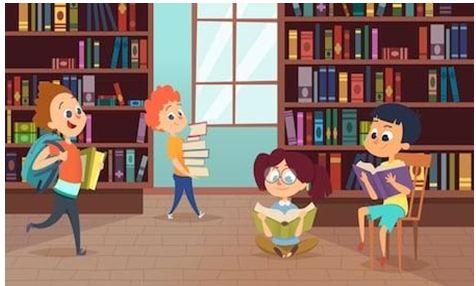
Aditya works as a librarian in Bright Children International School in Indore. He ordered for books on English, Hindi and Mathematics. He received 96 English books, 240 Hindi Books and 336 Maths books. He wishes to arrange these books in stacks such that each stack consists of the books on only one subject and the number of books in each stack is the same. He also wishes to keep the number of stacks minimum.
(a) Find the number of books in each stack.
| (i) 24 | (ii) 48 | (iii) 54 | (iv)72 |
(b) Find the total number of stacks formed.
| (i) 7 | (ii) 10 | (iii) 14 | (iv) 16 |
(c) How many stacks of Mathematics books will be formed?
| (i) 7 | (ii) 8 | (iii) 9 | (v) 10 |
(d) If the thickness of each English book is 3 cm, then the height of each stack of English books is
| (i) 120 cm | (ii) 124 cm | (iii) 136 cm | (iv) 144 cm |
(e) If each Hindi book weighs 1.5 kg, then find the weight of books in a stack of Hindi books.
| (i) 24 kg | (ii) 48 kg | (iii) 72 kg | (iv) 96 kg |
23.
Assertion: The HCF of two numbers is 5 and their product is 150. Then, their LCM is 40.
Reason: For any two positive integers a and b, HCF (a, b) x LCM (a, b) = a x b
Codes:
(a) Both Assertion and Reason are correct and Reason is the correct explanation of Assertion.
(b) Both Assertion and Reason are correct but Reason is not the correct explanation of Assertion.
(c) Assertion is correct but Reason is incorrect.
(d) Assertion is incorrect but Reason is correct.
1.
Hint Given numbers are 404 and 96. Using prime factorisation method,
404 = 2 x 2 x 101
and 96 = 2 x 2 x 2 x 2 x 2 x 3
HCF of (404. 96) = 2 x 2 = 4
and LCM (404, 96) = 2 x 2 x 2 x 2 x 2 x 3 x 101
= 9696
Verification HCF x LCM= 4 x 9696= 38784 ... (i)
and product of t'te given numbers
= 404 x 96 = 38784 ... (ii)
From Eqs. (i) and (ii), we get
HCF x LCM = Product of the given numbers.
2.
A.T.Q. greatest number will divide 445 - 4, 572 - 5 and 699 - 6
\(\Rightarrow\) greatest number will be HCF of 441, 567 and 693
Now 447 = 32 x 72
567 =34 x 7
693 = 32 x 7 x 11
\(\therefore\) HCF = 32 x 7 = 63
\(\therefore\) 63 is the required number.
3.
Let \(3+\sqrt { 5 } \) is a rational number
\(3+\sqrt { 5 } =\frac { p }{ q } ,\quad q=0\)
\(3+\sqrt { 5 } =\frac { p }{ q } \)
\(\Rightarrow \sqrt { 5 } =\frac { p }{ q } -3\)
\(\Rightarrow \quad \sqrt { 5 } =\frac { p-3q }{ q } \)
\(\sqrt { 5 } \) is irrational and \(\frac { p-3q }{ q } \) is rational
But rational number cannot be equal to an irrational number.
\(\therefore \quad 3+\sqrt { 5 } \) is an irrational number.
4.
Let \(3\sqrt { 2 } \) be a rational number. Then, it will be of the form \(\frac { p }{ q } \) , where p, q are coprime integers and \(q\neq 0\).
Now, \(\frac { p }{ q } \) = \(3\sqrt { 2 } \) \(\Rightarrow \quad \frac { p }{ 3q } =\sqrt { 2 } \)
Since, p is an integer and 3q is also an integer \(\left( 3q\neq 0 \right) \).
So, \(\frac { p }{ 3q } \) is a rational number.
\(\Rightarrow \quad \sqrt { 2 } \) is a rational number.
But this contradicts the fact that \(\sqrt { 2 } \) is an irrational number.
Hence, \(3\sqrt { 2 } \) is an irrational number.
5.
(i) We, have
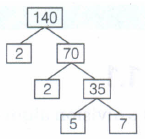
Product of prime factors of 140
= 2 x 2 x 5 x 7= 22 x 5 x 7
(ii) 22 x 3 x 13
(iii) 32 x 52 x 17
(iv) 5 x 7 x 11 x 13
(v) 17 x 19 x 23
6.
Let us assume, to the contrary, that \(\sqrt 2\) is rational.
So, we can find integers r and s (≠ 0) such that \(\sqrt 2\) =\(\frac{r}{s}\) .
Suppose r and s have a common factor other than 1. Then, we divide by the common factor to get \(\sqrt 2\) = \(\frac{a}{b}\) , where a and b are coprime.
So, b\(\sqrt 2\) = a.
Squaring on both sides and rearranging, we get 2b 2 = a 2 .Therefore, 2 divides a 2 .
Now, by it follows that 2 divides a.
So, we can write a = 2c for some integer c.
Substituting for a, we get 2b2 = 4c2 , that is, b2 = 2c2 .
This means that 2 divides b2 , and so 2 divides b (again using Theorem 1.3 with p = 2).
Therefore, a and b have at least 2 as a common factor.
But this contradicts the fact that a and b have no common factors other than 1.
This contradiction has arisen because of our incorrect assumption that \(\sqrt 2\) is rational.
So, we conclude that \(\sqrt 2\) is irrational.
7.
Suppose, \(\sqrt { 5 } \) is a rational number. Then, \(\sqrt { 5 } \) can be expressed in the form \(\frac{a}{b}\), where a and b are coprime integers and \(b\neq 0\).
\(\therefore \sqrt { 5 } =\frac { a }{ b } \)
On squaring both sides, we get
\(5=\frac { { a }^{ 2 } }{ { b }^{ 2 } } \quad \Rightarrow { a }^{ 2 }=5{ b }^{ 2 }\) ....(i)
\(\Rightarrow \) 5 divides a2.
\(\Rightarrow \) 5 divides a. [by theorem 1] ...(ii)
So, we can take a = 5m
\(\Rightarrow \) a2 = 25m2 [squaring both sides]
On putting the value of a2 in Eq. (i), we get
\(\Rightarrow \) 5 divides b2
\(\Rightarrow \) 5 divides b. [by theorem 1] ... (iii)
Thus, from Eq.(ii), 5 divides a and from Eq. (iii), 5 divides b. It means 5 is a common factor of a and b. This contradicts that there is no common factor of a and b.
This contradiction arises by assuming that \(\sqrt { 5 } \) is rational.
Hence, \(\sqrt { 5 } \) is irrational number.
8.
Time taken by Sonia to drive one round of the field = 18 min
Time taken by Ravi to drive one round of the field = 12 min
The LCM of 18 and 12 gives the exact number of minutes after which they will meet at the starting point again.
Now, 18 = 2 x 3 x 3 = 2 x 32
and 12 = 2 x 2 x 3 = 22 x 3
\(\therefore \) LCM of 18 and 12 = 22 x 32 = 2 x 2 x 3 x 3 = 36
Hence, Sonia and Ravi will meet again at the starting point after 36 min.
9.
Given, HCF (420, 189) = 21
Let LCM of 420 and 189 be x.
We know that LCMx HCF = st number x IInd number
\(\begin{aligned} x \times 21 & =420 \times 189 \\ x & =\frac{420 \times 189}{21}=3780 \end{aligned}\)
10.
(a)
1000
11.
(a)
11
12.
(c)
0
13.
(b)
63
14.
(d)
120 h
15.
(b)
xy2
16.
(a)
182
17.
(c)
2
18.
8, 9 and 25
8 = 23 x 1
9 = 32 x 1
25 = 52 x 1
From the above HCF (8, 9, 25) = 1 and LCM (8, 9, 25) = 1800
19.
17, 23 and 29
17 = 1 x 17
23 = 1 x 23
29 = 1 x 29
From the above, HCF (17, 23, 29) = 1 and LCM (17, 23, 29) = 11339
20.
Given, HCF of 306 and 657 = 9
We know that
LCM \(\times\) HCF = Product of two numbers
\(\Rightarrow\) LCM \(\times\) 9 = 306 \(\times\) 657
\(\Rightarrow\) LCM = \( \frac{306 \times 657}{9}\)
= 34 \(\times\) 657 = 22338
\(\therefore\) LCM of 306 and 657 = 22338
21.
If the number 4n , for any n, were to end with the digit zero, then it would be divisible by 5. That is, the prime factorisation of 4n would contain the prime 5. This is not possible because 4n = (2)2n ; so the only prime in the factorisation of 4n is 2. So, the uniqueness of the Fundamental Theorem of Arithmetic guarantees that there are no other primes in the factorisation of 4n . So, there is no natural number n for which 4n ends with the digit zero.
You have already learnt how to find the HCF and LCM of two positive integers using the Fundamental Theorem of Arithmetic in earlier classes, without realising it. This method is also called the prime factorisation method. Let us recall this method through an example.
22.
(a) (ii)
96 = 25 x 3
240 = 24 x3 x5
(b) (iii)
Total number of books = 96 +240+336=672
Number of books in each stack = 48
\(\therefore\) Number of stacks formed -= \(\frac{672}{48}=14\)
(c) (i)
Number of mathmatics books = 336
Number of stacks of mathematics books formed = \(\frac{336}{48}\)
= 7
(d) (iv)
Number of books in each stack of english books = 48
Thickness of each english book = 3 cm
\(\therefore\) Height of each stack of english books = (48X3) cm
= 144cm
(e) (iii)
Number of books in a stack of hindi books = 48
Weight of each hindi book = 1.5kg
\(\therefore\) The weight of books in a stack of hindi books
= (48X1.5)kg = 72kg
23.
(d) Assertion is incorrect but Reason is correct.
Explanation:
We know that
HCF (4, b) x LCM (a, b) = a x b
5 x LCM (a, b) = 150
\(\operatorname{LCM}(a, b)=\frac{150}{5}=30\)
Assertion is incorrect but Reason is correct

10th Standard CBSE Syllabus & Materials
10th Standard CBSE
CBSE 10th Social Science PS - Federalism - New Model Questions Papers Study Material - QB365 Set A
NEW10th Standard CBSE
CBSE 10th Social Science PS - Power Sharing - New Model Questions Papers Study Material - QB365 Set A
NEW10th Standard CBSE
CBSE 10th Social Science GEO - Manufacturing Industries - New Model Questions Papers Study Material - QB365 Set A
NEW10th Standard CBSE
CBSE 10th Social Science GEO - Minerals and Energy Resources - New Model Questions Papers Study Material - QB365 Set A



NCERT Books

Syllabus

Exam Pattern

Sample Question Papers

Previous year Question Papers

Important Notes

MCQ Practice test

NCERT Exemplers

Case study Questions

Image Based Questions

Passage based Questions

HOT Questions

Value Based Questions

Model Questions Papers
NCERT ( Book Back ) Questions

Assertion and Reason
Important Questions And Answers

CBSE 10th Standard CBSE Subjects
CBSE Standards



