
10th Standard CBSE Syllabus & Materials
10th Standard CBSE
CBSE 10th Social Science ECO - Globalisation and the Indian Economy - New Model Questions Papers Study Material - QB365 Set A
NEW10th Standard CBSE
CBSE 10th Social Science ECO - Money and Credit - New Model Questions Papers Study Material - QB365 Set A
NEW10th Standard CBSE
CBSE 10th Social Science ECO - Sectors of the Indian Economy - New Model Questions Papers Study Material - QB365 Set A
NEW10th Standard CBSE
CBSE 10th Social Science ECO - Development - New Model Questions Papers Study Material - QB365 Set A
NEW10th Standard CBSE
CBSE 10th Social Science PS - Outcomes of Democracy - New Model Questions Papers Study Material - QB365 Set A
NEW10th Standard CBSE
CBSE 10th Social Science PS - Gender, Religion and Caste - New Model Questions Papers Study Material - QB365 Set A

Published on: 17/08/2026
Download CBSE Class 10th Standard CBSE Maths question papers, sample papers, important questions, and previous year solved papers in PDF format. Get free study materials, NCERT solutions, and exam preparation resources for Class 10th Standard CBSE Maths
Questions + Answers key
Take MCQ Maths Test
1.
In given figure, ABC is an isosceles triangle with AC = BC. AB is produced on either side till P and Q respectively such that AP x BQ = AC2.
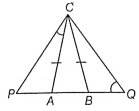
Prove that \(\angle P C A=\angle C Q B\)
2.
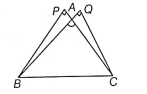
In △ ABC, \(\angle A\) is obtuse, PB⊥PC and QC⊥QB. Prove that AB x AQ = AC x AP.
3.
In the given figure, ABC is a right angled triangle, right angled at C and DE ⊥ AB.
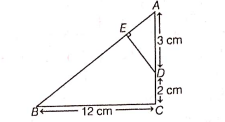
(i) Prove that △ ABC ~ △ ADE.
(ii) Find the lengths of AE and DE.
4.
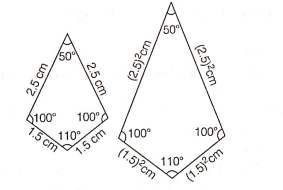
Are the two quadrilaterals shown below similar? Give a reason for your answer.
5.
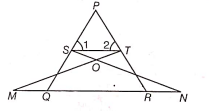
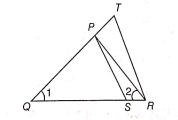
In the given figure, if \(\angle 1=\angle 2\) and △ NSQ = △ MTR, prove that △ PTS ~ △ PRQ.
6.
A vertical pole of length 6 m casts a shadow 4 m long on the ground and at the same time a tower casts a shadow 28 m long. Find the height of the tower.
Here, pole and tower both are perpendicular the ground and they cast shadow at the same time, so sun makes equal angle with ground for both the triangles. Now, use the property of similar triangles and find the height of tower.
7.
D is a point on the side BC of △ ABC such that \(\angle A D C=\angle B A C .\) Show that
CA2 CB x CD.
8.
Sides AB and BC and median AD of △ ABC are respectively proportional to sides PQ and QR and median PM of △ PQR. Show that △ ABC- △ PQR.
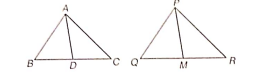
Use the result that median bisects the opposite sides, to show that the sides of △ ADB and △ PMQ are proportional and then use the criterion of similar triangles to show △ ABC ~ △ PQR
9.
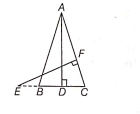
In the given figure, E is a point on side CB produced of an isosceles △ ABC with AB= AC. If AD ⟂BC and EF ⟂ AC, prove that △ ABD ~ △ ECF.
10.
In the given figure, altitudes AD and CE of △ ABC intersect each other at the point P.
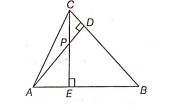
Show that
(i) △ AEP ~ △ CDP
(ii) △ ABD ~ △ CBE
(iii) △ AEP ~ △ ADB
(iv) △ PDC~ △ BEC
Use AAA similarity criterion to prove the result
11.
In the given figure, if △ ABE= △ ACD, show that △ ADE ~ △ ABC.
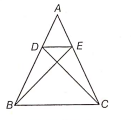
(i) Two triangles are congruent, if their corresponding angles and sides are equal.
(ii) Two triangles are similar, if their corresponding angles are equal and their corresponding sides are in the same ratio.
12.
S and T are points on sides PR and QR of \(\triangle P Q R,\) such that \(\angle P=\angle R T S .\) Show that △ RPQ ~△ RTS.
13.
In the given figure,
\(\frac{Q R}{Q S}=\frac{Q T}{P R} \text { and } \angle 1=\angle 2 .\)
Show that △ PQS ~ △ TQR.
14.
In the given figure, \(\triangle O D C \sim \triangle O B A, \angle B O C=125^{\circ}\) and \(\angle C D O=70^{\circ} .\) . Find \(\angle D O C,\) \(\angle D C O,\)and \(\angle D C O,\)and \(\angle O A B .\)
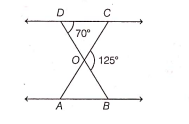
Use the result of angle sum property of a triangle and also use the criteria of similarity of triangles, to find the required angles.
15.
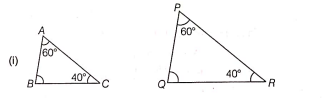
State which pair of triangles in given figures, are similar? Write the similarity criterion used by you for answering the question and also write the pair of
similar triangles in the symbolic form.
(ii)
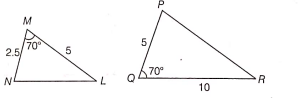
(iii)
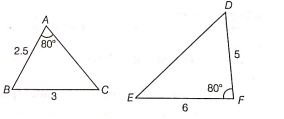
16.
A girl of height 90 cm is walking away from the base of a lamp-post at a speed of 1,2 m/s. If the lamp is 3.6 m above the ground, then find the length of her shadow after 4s.
Visualise the question carefully and draw a figure. Further, determine the distance of girl from lamp-post and show that two triangles are similar. At last, use the property of similar triangles
(i.e. ratios of corresponding sides are same) and substitute the given values and simplify it.
17.
In the given figure, CM and RN are respectively the medians △ ABC and △ PQR If △ ABC- △ PQR, then prove that
(i) △AMC-△PNR
(ii) \(\frac{C M}{R N}=\frac{A B}{P Q}\)
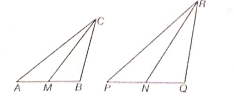
Write all the possible relations of similarity of triangles and use the result that the median bisects the opposite side. Further, prove the results.
18.
From the given figures, find \(\angle P\)
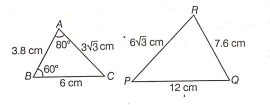
First find the ratios of the sides. If ratios are equal, then triangles are similar and then corresponding angles are also equal. Also, use the property that sum of the angles of a triangle is 180° to find the third angle.
19.
Give two examples of pair of similar and non-similar figures.
20.
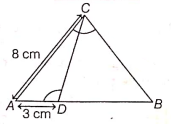
In the given figure, \(\angle A C B=\angle C D A,\) AC=8 cm and AD = 3 cm, then BD is
22/3 cm
26/3 cm
55/3 cm
64/3 cm
21.
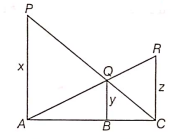
In the given figure, PA, QB and RC are each perpendicular to AC. If x = 8 cm and z = 6 cm, then y is equal to
\(\frac{56}{7} \mathrm{~cm}\)
\(\frac{7}{56} \mathrm{~cm}\)
\(\frac{25}{7} \mathrm{~cm}\)
\(\frac{24}{7} \mathrm{~cm}\)
22.
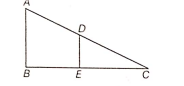
In △ ABC DE || AB. If AB= a, DE = x, BE = band EC= c. Express x in terms of a, b and C.
\(\frac{a c}{b}\)
\(\frac{a c}{b+c}\)
\(\frac{a b}{c}\)
\(\frac{a b}{b+c}\)
23.
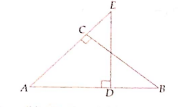
In the given figure, △ BAC is similar to
△ AED
△ EAD
△ ACB
△ BCA
24.
In two △ PQR and △ ABC it is given that \(\frac{A B}{B C}=\frac{P Q}{P R} .\)For these two triangles to be similar, which of the following should be true?
\(\angle A=\angle P\)
\(\angle B=\angle \dot{Q}\)
\(\angle B=\angle P\)
CA =QR
25.
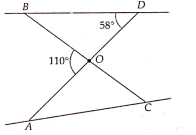
In the given figure, if △ OCA ~ △ OBD, then \(\angle O A C\) is equal to
58°
55°
128°
52°
26.
A boy is standing on the top of light house. He observed that Boat P and Boat Q are approaching the light house from opposite directions. He finds that angle of depression of Boat P is 45° and angle of depression of Boat Q is 30°. He also knows that height of the light house is 100 m.
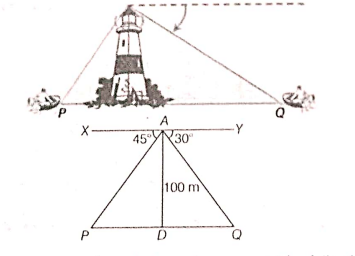
Based on the above information, answer the following questions.
(i) What is the measure of \(\angle A P D\)?
(ii) If \(\angle Y A Q=30^{\circ},\) ,then \(\angle A Q D\) is also 30°. Why?
(ii) (a) How far is Boat P from the light house?
Or (b) How far is Boat Q from the light house?
27.
Vijay is trying to find the average height of a tower near his house. He is using the properties of similar triangles. The height of Vijay's house, is 20 m when
Vijay's house casts a shadow 10m long on the ground.
At the same time, the tower casts a shadow 50m long on the ground and the house of Ajay casts 20 m shadow on the ground.
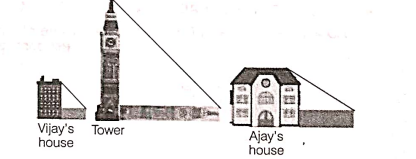
(i) What will be the length of the shadow of the tower when Vijay's house casts a shadow of 12 m?
(ii) What is the height of Ajay's house?
(iii) (a) When the tower casts a shadow of 40 m, same time what will be the length of the shadow of Ajay's house?
Or (b)When the tower casts a shadow of 40 m, same time what will be the length of the shadow of Vijay's house?
1.
Hint In △ ABC,AC= BC ⇒ \(\angle A=\angle B\)
⇒ \(180^{\circ}-\angle A=180^{\circ}-\angle B\)
⇒ \(\angle P A C=\angle Q B C\)
Also, we have AP x BQ = AC2
⇒ \(\frac{A P}{A C}=\frac{A C}{B Q} \Rightarrow \frac{A P}{B C}=\frac{A C}{B Q}\) [∵ AC= BC]
⇒ △ PAC~ △ CBQ [by SAS similarity criterion]
2.
Hint Prove that △APB-△AQC [by AA similarly criterion]
3.
(i) Hint Use AA similarity criterion to prove
△ ABC ~ △ ADE
(ii) Hint \(\frac{A B}{A D}=\frac{B C}{D E}=\frac{A C}{A E} .\)
Ans. \(A E=\frac{15}{13} \mathrm{~cm} \text { and } D E=\frac{36}{13} \mathrm{~cm}\)
4.
Hint Given the two quadrilaterals are not similar because the corresponding sides of the quadrilaterals are not in the same ratio. Ans. No
5.
Given △ NSQ ≅ △ MTR and \(\angle 1=\angle 2\)
To prove △PTS ~ △PRQ
Proof Since, △ NSQ ≅ △ MTR
∴ SQ = TR ...(i)
Also, \(\angle 1=\angle 2\)
⇒ PT = PS ...(ii)
[∵ sides opposite to equal angles are also equal]
From Eqs. (i) and (ii),
\(\frac{P S}{S Q}=\frac{P T}{T R}\)
⇒ \(S T \| Q R\)
[by converse of basic proportionality theorem]
∴ \(\angle 1=\angle P Q R\)
and \(\angle 2=\angle P R Q\) [corresponding angles]
In △ PTS and △ PRQ,
\(\angle T P S=\angle Q P R\) [common angle]
\(\angle 1=\angle P Q R\) [proved above]
and \(\angle 2=\angle P R Q\)
∴ △ PTS - △ PRQ [by AA similarity criterion]
Hence proved
6.
Let AB be a pole of length6 m, BC=4 m be the length of its shadow and0be the angle which sun makes with ground.
Also, at the same time, another tower casts shadow NM of length 28 m. Let PM =h m be the height of the tower and θ be the angle which sun ray makes with ground.
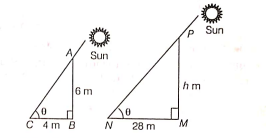
In △ ABC and △ PMN,
\(\angle A B C=\angle P M N\) [each 90°]
and \(\angle A C B=\angle P N M\) [each θ]
∴ △ ABC~△ PMN [by AA similarity criterion]
Now, \(\frac{A B}{P M}=\frac{B C}{M N}\)
⇒ \(\frac{A B}{B C}=\frac{P M}{M N}\)
⇒ \(\frac{6}{4}=\frac{h}{28}\) [∵ AB = 6m, BC= 4m and MN=28m]
⇒ \(h=\frac{6 \times 28}{4}=42 \mathrm{~m}\)
Hence, the height of the tower is 42 m.
7.
Draw △ ARC such that Dis a point on BC and join AD.
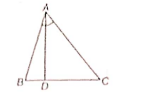
In △ ABC and △ DAC we have
\(\angle B A C=\angle A D C\) [given]
and \(\angle A C B=\angle D C A\) [common angle]
∴ △ ABC - △ DAC [by AA similarity criterion]
⇒ \(\frac{A C}{D C}=\frac{C B}{C A}\)
[∵ corresponding sides of two similar triangles are proportional]
Or \(\frac{C A}{C D}=\frac{C B}{C A}\)
⇒ CA x CA = CB × CD
⇒ CA2 = CB x CD Hence proved.
8.
Given, △ ABC and △ PQR in which AD and PM are their medians, respectively.
So, \(\frac{A B}{P Q}=\frac{B C}{Q R}=\frac{A D}{P M}\)
To prove △ ABC ~ △ PQR
Proof We have, \(\frac{A B}{P Q}=\frac{B C}{Q R}=\frac{A D}{P M}\) [given]
⇒ \(\frac{A B}{P Q}=\frac{1 / 2 B C}{1 / 2 Q R}=\frac{A D}{P M}\) [multiplying numerator and denominator of middle tern by 1/2)
⇒ \(\frac{A B}{P Q}=\frac{B D}{Q M}=\frac{A D}{P M}\) [∵ medians AD and PM bisect the lines BC and QR,
respectively, i.e. BD=1/2BCand QM = 1/2QR]
⇒ △ ADB- △ PMQ [by SSS similarity criterion]
∴ \(\angle B=\angle Q\) ...(i)
[∵ corresponding angles of similar triangles are equal]
In △ ABC and △ PQR,
\(\frac{A B}{P Q}=\frac{B C}{Q R}\) [given]
and \(\angle B=\angle Q\) [from Eq. (i)]
∴ △ ABC~ △ PQR [by SAS similarity criterion] Hence proved.
9.
Given, △ ABC is an isosceles triangle with AB = AC. Also
we have AD ⊥ BC and EF⊥AC.
To prove △ ABD ~ △ ECF
Proof In △ ABC,AB = AC
∴ \(\angle B=\angle C\) [∵ angle opposite to equal sides are equal]
Now, consider △ ABD and △ ECE : In this we have
\(\angle A B D=\angle E C F\) \(\text { ( } \because \angle B=\angle C \text { proved above }\)]
and \(\angle A D B=\angle E F C\) [each 90°]
∴ △ ABD~ △ECF (by AA similarly criterion) Hence proved
10.
Given, AD and CE are altitudes which intersect each other at the point P
(i) In △ AEP and △ CDP
\(\angle A E P=\angle C D P\) [each 90°]
and \(\angle A P E=\angle C P D\) [vertically opposite angles]
∴ △ AEP ~ △ CDP [by AA similarity criterion]
(ii) In △ ABD and △ CBE,
\(\angle A D B=\angle C E B\) [each 90°]
and \(\angle A B D=\angle C B E\) [common angle]
∴ △ ABD ~ △ CBE [by AA similarity criterion]
(iii) In △ AEP and △ ADB,
\(\angle A E P=\angle A D B\) [each 90°]
and \(\angle P A E=\angle B A D\) [common angle]
∴ △ AEP ~ △ ADB [by AA similarity criterion]
(iv) In △ PDC and △ BEC,
\(\angle P D C=\angle B E C\) [each 90°]
and \(\angle P C D=\angle B C E\) [common angle]
∴ △ PDC~ △ BEC [by AA similarity criterion]
11.
Given, △ ABE ≅ △ ACD
⇒ AB =AC and AE=AD [by CPCT]
⇒ \(\frac{A B}{A C}=1\)
and \(\frac{A D}{A E}=1\)
⇒ \(\frac{A B}{A C}=\frac{A D}{A E}\) ...(i)
In △ ADE and △ ABC, we have
\(\frac{A D}{A E}=\frac{A B}{A C}\)
⇒ \(\frac{A D}{A B}=\frac{A E}{A C}\)
and \(\angle D A E=\angle B A C\) [common angle]
∴ △ ADE ~ △ ABC [by SAS similarity criterion] Hence proved.
12.
Draw △ PQR, such that S and T are points on sides PR and QR, respectively. We join the points S and T.
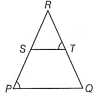
From the above figure, we have \(\triangle R P Q \text { and } \triangle R T S\) in which
\(\angle R P Q=\angle R T S\) [given]
⇒ \(\angle P R Q=\angle T R S\) [common angle]
∴ △ RPQ ~ △ RTS [by AA similarity criterion] Hence proved.
13.
In △ PQR \(\angle 1=\angle 2\) [given]
⇒ PR=PQ [since sides opposite to equal angles of a triangle are also equal]
Given that \(\frac{Q R}{Q S}=\frac{Q T}{P R} \Rightarrow \frac{Q R}{Q S}=\frac{Q T}{P Q}\) [∵ PQ= PR, proved above]
⇒ \(\frac{Q S}{Q R}=\frac{P Q}{Q T}\) [on taking reciprocal of the terms] ...(i)
In △ PQS and △ TQR, we have
\(\angle P Q S=\angle T Q R\) [common]
and \(\frac{Q S}{Q R}=\frac{Q P}{Q T}\) [from Eq. (i))
∴ △ PQS ~ △ TQR [by SAS similarity criterion]
Hence proved.
14.
From the given figure, it is clear that DOB is a straight line.
∴ \(\angle D O C+\angle C O B=180^{\circ}\) [by linear pair axiom]
⇒ \(\angle D O C+125^{\circ}=180^{\circ}\) [given, \(\left.\angle C O B=125^{\circ}\right]\)
⇒ \(\angle D O C=180^{\circ}-125^{\circ}=55^{\circ}\)
In △ DOC, \(\angle D C O+\angle C D O+\angle D O C=180^{\circ}\) [by angle sum property of a triangle]
⇒ \(\angle D C O+70^{\circ}+55^{\circ}=180^{\circ}\) \(\left[\because \angle C D O=70^{\circ} \text { and } \angle D O C=55^{\circ}\right]\)
⇒ \(\angle D C O+125^{\circ}=180^{\circ}\)
⇒ \(\angle D C O=180^{\circ}-125^{\circ}=55^{\circ}\) ...(i)
Also, △ ODC ~ △ OBA [given]
⇒ \(\angle O A B=\angle O C D=\angle D C O\)
⇒ \(\angle O A B=55^{\circ}\) [from Eq. (i)]
Hence, \(\angle D O C=55^{\circ}, \angle D C O=55^{\circ} \text { and } \angle O A B=55^{\circ}\)
15.
(i) Yes; The pair of triangles is similar.
In △ ABC and △ PQR,
\(\angle A=\angle P=60^{\circ} \text { and } \angle C=\angle R=40^{\circ}\) [given]
Then, \(\angle B=\angle Q=180^{\circ}-60^{\circ}-40^{\circ}=80^{\circ}\)
∴ △ ABC~△PQR [by AAA similarity criterion]
(ii) Yes, the pair of triangles is similar.
In △ MNL and △ QPR,
\(\angle N M L=\angle P Q R=70^{\circ}\)
\(\frac{M N}{P Q}=\frac{2.5}{5}=\frac{1}{2}\)
and \(\frac{M L}{Q R}=\frac{5}{10}=\frac{1}{2}\)
Then, \(\frac{M N}{P Q}=\frac{M L}{Q R}\)
∴ △ MNL~ △ QPR [by SAS similarity criterion]
(iii) No, because in △ ABC, \(\angle B A C\) is given but the measure of included side AC is not given.
16.
Let AB be the lamp-post, CD be the girl
and D be the position of girl after 4 s.
Again, let DE = x m be the length of shadow of the girl.
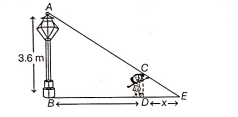
Given, CD = 90cm= 0.9 m and AB =3.6 m
and speed of the girl = 1.2m/s
∴ Distance of the girl from lamp-post after 4 s,
BD = 1.2 x 4= 4.8 m [∵ distance = speed x time]
In △ ABE and △ CDE,
\(\angle B=\angle D\) [each 90°]
\(\angle E=\angle E\) [common angle]
∴ \(\triangle A B E \sim \triangle C D E\) [by AA similarity criterion]
⇒ \(\frac{B E}{D E}=\frac{A B}{C D}\) ...(i)
[since corresponding sides of similar triangles are proportional)
On substituting all the values in Eq. (i),we get
\(\frac{4.8+x}{x}=\frac{3.6}{0.9}\) [∵ BE= BD + DE= 4.8 + x]
⇒ \(\frac{4.8+x}{x}=4\)
⇒ 48 +x =4 ⇒ 3x = 4.8
⇒ \(x=\frac{4.8}{3}=16 \mathrm{~m}\)
Hence, the length of her shadow after 4 s is 1.6 m.
17.
(i) △ ABC~ △ PQR [given]
⇒ \(\frac{A B}{P Q}=\frac{B C}{Q R}=\frac{A C}{P R}\) ..(i)
and \(\angle A=\angle P, \angle B=\angle Q \text { and } \angle C=\angle R\) ...(ii)
In △ AMC and △ PNR,
2AM = AB and 2PN= PQ
(∵ CM and RN are medians)
⇒ \(\frac{2 A M}{2 P N}=\frac{C A}{R P}\) [from Eq. (i)
⇒ \(\frac{A M}{P N}=\frac{C A}{R P}\)
Also, \(\angle M A C=\angle N P R\) [from Eq. (ii)]
∴ \(\triangle M A C \sim \triangle N P R\) [SAS similarity criterion] Hence proved.
(ii) We have, △ AMC~ △ PNR
⇒ \(\frac{A M}{P N}=\frac{A C}{P R}=\frac{C M}{R N}\)
[since triangles are similar, hence corresponding sides will be proportional]
∴ \(\frac{C M}{R N}=\frac{A C}{P R}\)
⇒ \(\frac{C M}{R N}=\frac{A B}{P Q}\) [from Eq. (i)] Hence proved.
18.
In △ ABC and △ RQP,
\(\frac{A B}{R Q}=\frac{3.8}{7.6}=\frac{1}{2},\)
\(\frac{B C}{Q P}=\frac{6}{12}=\frac{1}{2}\)
and \(\frac{C A}{P R}=\frac{3 \sqrt{3}}{6 \sqrt{3}}=\frac{1}{2}\)
Since, \(\frac{A B}{R Q}=\frac{B C}{Q P}=\frac{C A}{P R}=\frac{1}{2}\)
∴ △ ABC - △ RQP [by SSS similarity criterion]
So, \(\angle P=\angle C\) ...(i)
[since corresponding angles of similar triangles are equal]
In △ ABC
\(\angle A+\angle B+\angle C=180^{\circ}\) [by angle sum property of a triangle]
⇒ 80°+ 60° + \(\angle C=180^{\circ}\) [∵ \(\angle A=\) 80° and \(\angle B =\) 60°, given]
⇒ \(\angle C=180^{\circ}-140^{\circ}=40^{\circ}\)
From Eq. (i) \(\angle P=40^{\circ}\)
19.
(i) Examples of similar figures:
(a) Two squares of different sizes.
(b) Two regular hexagons of different sizes.
(ii) Examples of non-similar figures:
(a) Two isosceles triangles with different angle measures.
(b) Two rhombus with different angle measures.
20.
Hint △ ACD ~ △ ABC [by AA similarity criterion]
∴ \(\frac{A C}{A B}=\frac{A D}{A C}\)
[∵ corresponding sides of similar triangles are proportional]
21.
(d)
\(\frac{24}{7} \mathrm{~cm}\)
22.
Hint △ CED ~ △ CBA [by AA similarity criterion]
⇒ \(\frac{C E}{C B}=\frac{E D}{B A}\)
23.
In the given figure, we have
\(\angle B C A=90^{\circ}\)
and \(\angle A D E=90^{\circ}\)
Since, \(\angle A i\)s common.
So, it is clear that △ BAC is similar to △ EAD by AA similarity criterion.
24.
Hint If \(\angle B=\angle P,\) then
△ ABC~△ QPR [by SAS similarity criterion]
25.
Given, △ OCA ~△ OBD
Also, given \(\angle A O B=110^{\circ} \text { and } \angle B D O=58^{\circ}\)
∵ \(\angle A O B=\angle C O D\) [vertically opposite angles]
⇒ 110° = \(\angle C O D\)
Now, \(\angle A O C=180^{\circ}-\angle C O D\) [linear pair]
= 180° - 110° = 70°
\(\angle A O C=\angle B O D=70^{\circ}\)
In △ BOD,
\(\angle B O D+\angle B D O+\angle D B O=180^{\circ}\)
⇒ 70°+ 58° + \(\angle D B O=180^{\circ}\)
⇒ \(\angle D B O=180^{\circ}-128^{\circ}=52^{\circ}\)
∵ △ OCA ~ △ OBD
∴ \(\angle D B O=\angle O A C=52^{\circ}\)
26.
(i) XY || PQ
∴ \(\angle X A P=\angle A P Q=45^{\circ}=\angle A P D\)
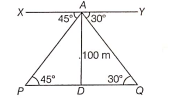
(ii) \(\angle Y A Q=\angle A Q D=30^{\circ}\) [alternate angles]
(iii) (a) In right angled △ ADP,
tan 45°\(=\frac{A D}{P D}\)
⇒ \(1=\frac{100}{P D} \Rightarrow P D=100 \mathrm{~m}\)
Hence, the Boat P is at a distance of 100 m from the light house.
Or
(b) In right angled △ ADQ,
\(\tan 30^{\circ}=\frac{A D}{D Q}\)
⇒ \(\frac{1}{\sqrt{3}}=\frac{A D}{D Q}\)
⇒ \(D Q=100 \sqrt{3} \mathrm{~m}\)
Hence, the Boat Q is at a distance of 100\(\sqrt{3}\) from the light house
27.
Let CD = h m be the height of the tower, BE = 20 m be the height of Vijay's house and GF be the height of Ajay's house.
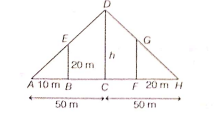
△ ACD ~ △ ABE
∴ \(\frac{A C}{A B}=\frac{C D}{E B}\)
⇒ \(\frac{50}{10}=\frac{h}{20}\)
⇒ h= 100 m
(i) Given, AB = 12 m, let AC = x
In similar △ ABE and △ ACD,
\(\frac{A B}{A C}=\frac{B E}{C D}\)
⇒ \(\frac{12}{x}=\frac{20}{100}\)
⇒ \(x=\frac{12 \times 100}{20}=12 \times 5=60 \mathrm{~m}\)
(ii) Let the height of Ajay's house be GF= h1
Since, △ HFG ~ △ HCD
∴ \(\frac{H F}{H C}=\frac{F G}{C D}\)
⇒ \(\frac{20}{50}=\frac{h_1}{100} \Rightarrow h_1=\frac{20 \times 100}{50}=40 \mathrm{~m}\)
(iii) (a) Given, HC = 40 m
Let length of the shadow of Ajay's house be HF = l m
Since, △ HFG ~ △ HCD
∴ \(\frac{H F}{H C}=\frac{F G}{C D}\)
⇒ \(\frac{l}{40}=\frac{40}{100} \Rightarrow l=\frac{40 \times 40}{100}=16 \mathrm{~m}\)
Or
(b) Given, AC = 40 m
Let length of the shadow of Vijay's house be AB =l m
Since, △ ABE ~ △ ACD
∴ \(\frac{A B}{A C}=\frac{E B}{C D}\)
⇒ \(\frac{l}{40}=\frac{20}{100} \Rightarrow l=\frac{20 \times 40}{100}=8 \mathrm{~m}\)

10th Standard CBSE Syllabus & Materials
10th Standard CBSE
CBSE 10th Social Science PS - Federalism - New Model Questions Papers Study Material - QB365 Set A
NEW10th Standard CBSE
CBSE 10th Social Science PS - Power Sharing - New Model Questions Papers Study Material - QB365 Set A
NEW10th Standard CBSE
CBSE 10th Social Science GEO - Manufacturing Industries - New Model Questions Papers Study Material - QB365 Set A
NEW10th Standard CBSE
CBSE 10th Social Science GEO - Minerals and Energy Resources - New Model Questions Papers Study Material - QB365 Set A



NCERT Books

Syllabus

Exam Pattern

Sample Question Papers

Previous year Question Papers

Important Notes

MCQ Practice test

NCERT Exemplers

Case study Questions

Image Based Questions

Passage based Questions

HOT Questions

Value Based Questions

Model Questions Papers
NCERT ( Book Back ) Questions

Assertion and Reason
Important Questions And Answers

CBSE 10th Standard CBSE Subjects
CBSE Standards



