
10th Standard CBSE Syllabus & Materials
10th Standard CBSE
CBSE 10th Social Science ECO - Globalisation and the Indian Economy - New Model Questions Papers Study Material - QB365 Set A
NEW10th Standard CBSE
CBSE 10th Social Science ECO - Money and Credit - New Model Questions Papers Study Material - QB365 Set A
NEW10th Standard CBSE
CBSE 10th Social Science ECO - Sectors of the Indian Economy - New Model Questions Papers Study Material - QB365 Set A
NEW10th Standard CBSE
CBSE 10th Social Science ECO - Development - New Model Questions Papers Study Material - QB365 Set A
NEW10th Standard CBSE
CBSE 10th Social Science PS - Outcomes of Democracy - New Model Questions Papers Study Material - QB365 Set A
NEW10th Standard CBSE
CBSE 10th Social Science PS - Gender, Religion and Caste - New Model Questions Papers Study Material - QB365 Set A

Published on: 17/08/2026
Download CBSE Class 10th Standard CBSE Maths question papers, sample papers, important questions, and previous year solved papers in PDF format. Get free study materials, NCERT solutions, and exam preparation resources for Class 10th Standard CBSE Maths
Questions + Answers key
Take MCQ Maths Test
1.
From the first floor of Qutab Minar which is at a height of 25 m from the level ground, a man observes the top of a building at an angle of elevation of \({ 30 }^{ ° }\) and the angle of depression of the base of the building to be \({60 }^{ ° }.\)Calculate the height of the building.
2.
A 1m tall boy is standing at some distance from a 21m tall building.The angle of elevation from his eyes to the top of the building increases from 300 to 450 as he walks towards the building.Find the distance he walked towards the building
3.
From the top of a tower h m high, the angles of depression of two objects, which are in line with the foot of the tower, are \(\alpha\) and \(\beta\) \((\beta > \alpha)\) .Find the distance between the two objects.
4.
From a balloon vertically above a straight road, the angles of depression of two cars at an instant is found o be 450 and 600 .If the cars are 100m apart, find the height of the balloon.
5.
A ladder 15 metres long just reaches the top of a vertical wall.If the ladder makes an angle of 600 with the wall, find the height of the wall.
6.
A man on the deck of a ship, 12 m above water level, observes that the angle of elevation of the top of a cliff is 60o and the angle of depression of the base of the cliff is 30o. Find the distance of the cliff from the ship and the height of the cliff. \((Use\sqrt { 3 } =1.732)\)
7.
As observed from the top of a lighthouse, 100 m high above sea level, the angle of depression of a ship sailing directly towards it,changes from 30° to 60°. Determine the distance travelled by the ship during the period of observation. [take (√3 =1.732)]
8.
An aeroplane, when flying at a height of 400m from the ground, passes vertically above another aeroplane at an instant when the angles of elevation of two plans from the same point on the ground are \({ 60 }^{ \circ }\)and \({ 45 }^{ \circ }\), respectively. Find the vertical distance between the aeroplanes at that instant.
9.
The angles of elevation and depression of the top and bottom of a light - house from the top of a 60 m high building are 30o and 60o respectively. Find
(i) the difference between the heights of the light - house and the building.
(ii) the distance between the light - house and the building.
10.
An observer, 1.5 m tall is 20.5 away from a tower 22 m high, then the angle of elevation of the top of the tower from the eye of the observer is
30°
45°
60°
90°
11.
If the height of the tower is equal to the length of its shadow, then the angle of elevation of the Sun is
30°
45°
60°
90°
12.
Seaweed is found under 80 m deep seafloor. To reach it, a diver makes a 45° dive from a boat. What is the distance travelled by the diver to reach the seafloor?
80 m
80.2 m
80√2 m
80√3 m
13.
A spherical balloon of radius r subtends an angle eat the eye of the observer. If the angle of elevation of its centre is Φ, then the height of the centre of balloon is
r sin Φ/2 cos θ
r sin Φ cosec θ
r sin Φ cosec θ/2
None of these
14.
A tree 6 m tall cast a 4m long shadow. At the same time, a flag pole cast a shadow 50 m long. How long is the flag pole?
75 m
100 m
150 m
50 m
15.
An observer, 1.5 m tall is 20.5 away from a tower 22 m high, then the angle of elevation of the top of the tower from the eye of the observer is
30°
45°
60°
90°
16.
From a point on a bridge across a river, the angles of depression of the banks on opposite sides of the river are 30° and 45°, respectively. If the bridge is at a height of 3 m from the banks, find the width of the river.
17.
Due to short circuit, a fire has broken out in New Home Complex. Two buildings, namely X and Y have mainly been affected. The fire engine has arrived and it has been stationed at a point which is between two buildings. A ladder at point O is fixed in front of the fire engine.
The ladder inclined at an angle 60° to the horizontal is leaning against the wall of the terrace (top) of the building Y. The foot of the ladder is kept fixed and after sometime it is made to lean against the terrace (top) of the opposite building X at an angle of 45° with the ground. Both the buildings along with the foot of the ladder, fixed at O are in a straight line.
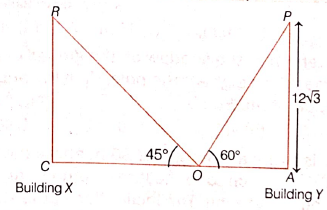
Based on the above information, answer the following questions.
(i) Find the length of the ladder.
(ii) Find the distance of the building Y from point O, i.e. OA.
(iii) (a) Find the horizontal distance between both buildings.
Or
(b) Find the height of the building X.
1.
33.33 m
2.
\(20(\sqrt{3}-1)m\)
3.
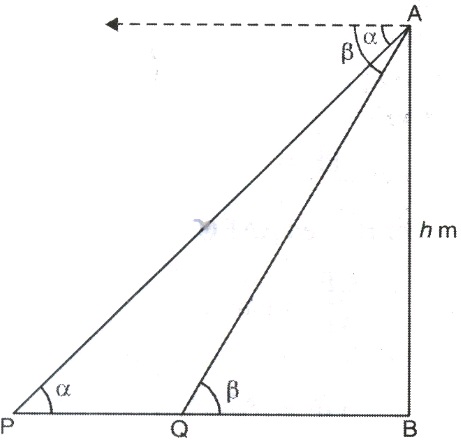
Let AB be the tower of height h m, P and Q be the two points in line with the foot of the tower AB, such that
ㄥAPB=∝ and ㄥAQB=β
Consider rt. ㄥed ΔQBA,
\(\frac { AB }{ QB } \)=tan β
QB=AB.\(\frac { 1 }{ tan\beta } \)
=AB cot β....(i)
Again consider rt ㄥed ΔPBA,
\(\frac { AB }{ PB } \)=tan α
\(\frac { AB }{ PQ+QB } \)=tan α
⇒ PQ+QB=AB.\(\frac { 1 }{ tan\alpha } \)
=AB cot α....(ii)
Subtracting (i) from (ii), we obtain
PQ=AB cot α - AB cot β
PQ=AB (cot α - cot β)
PQ=h(cot α - cot β)
4.
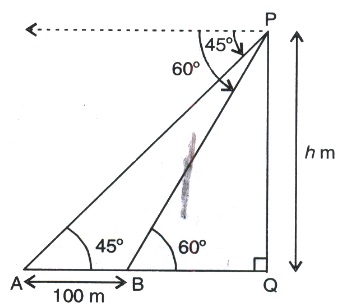
Let the height of the ballon at P be h meters. Let A and B be the two cars. Thus, AB=100 m
ㄥPAQ=45o and ㄥPBQ=60o
Consider right-angled ΔAQP
\(\frac { PQ }{ AQ } \)=tano
⇒ \(\frac { PQ }{ AQ } \)=1
⇒ PQ=AQ= h m
Now, consider right-angled ΔPBQ, we have
\(\frac { PQ }{ BQ } \)=tan 60o
\(\frac { PQ }{ BQ } \)=\(\\ \\ \\ \\ \\ \\ \\ \sqrt { 3 } \\ \)
\(\frac { h }{ h-100 } =\sqrt { 3 } \)
⇒ h=\(\frac { \sqrt { 3 } (100) }{ \sqrt { 3 } -1 } \)
⇒ h=\(\frac { \sqrt { 3 } (100) }{ \sqrt { 3 } -1 } \times \frac { \sqrt { 3 } +1 }{ \sqrt { 3 } +1 } \)
⇒ h=\(\frac { \sqrt { 3 } (100)(\sqrt { 3 } +1) }{ 2 } \)
=50(3+\(\sqrt { 3 } \))
Hence, the height of the ballon is 50(3+\(\sqrt { 3 } \)) m.
5.
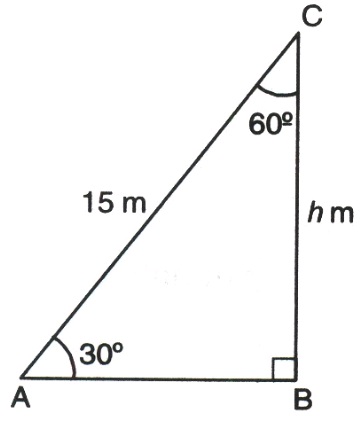
Here, length of the ladder is 15 m and angle of elevation is 90o - 60o i.e., 30o
Let h m be the height of the wall Consider right-angled ΔABC
\(\frac { BC }{ AC } \)=sin 30o
\(\frac { h }{ 12 } =\frac { 1 }{ 2 } \)
h=\(\frac { 15 }{ 2 } \)m
Hence, the height of the wall is 15/2 m or 7.5 m.
6.
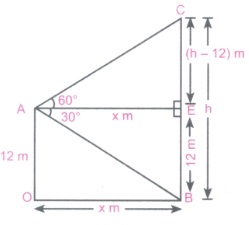
A is the position of the man, OA = 12m, BC is cliff.
Let height of the cliff
BC = h m and CE = (h - 12)m
Let AE = OB = x m
In right angled triangle AEB,
\(\frac { AE }{ BE } \) = cot30o ⇒ AE = 12 x \(\sqrt { 3 } \)
=12 x 1.732 m = 20.78 m
∴ Distance of ship from cliff = 20.78 m
In right angled triangle AEC,
\(\frac { CE }{ AE } =tan{ 60 }^{ 0 }\Rightarrow \frac { h-12 }{ 12\sqrt { 3 } } \) = \(\sqrt { 3 } \)
h - 12 = 36 ⇒ h = 48 m
∴. Height of the cliff = 48 m
7.
To solve the problem, we need to determine the distance traveled by the ship as observed from the top of the lighthouse. The lighthouse is 100 meters above sea level, and the angles of depression change from 30∘ to 60∘.
1. Understanding the Problem:
The height of the lighthouse (h) = 100 m.
Angle of depression from the lighthouse to the ship initially = 30∘.
Angle of depression from the lighthouse to the ship finally = 60∘.
2. Setting Up the Diagram:
Let point A be the top of the lighthouse, point B be the position of the ship when the angle of depression is 30∘, and point C be the position of the ship when the angle of depression is 60∘.
The distances from the base of the lighthouse to the ship at points B and C can be denoted as x and y respectively.
3. Using Trigonometric Ratios:
For the angle of depression of 30∘:
\(\tan \left(30^{\circ}\right)=\frac{\text { height }}{\text { distance from lighthouse }}=\frac{100}{x} \)
\( \tan \left(30^{\circ}\right)=\frac{1}{\sqrt{3}} \Longrightarrow \frac{1}{\sqrt{3}}=\frac{100}{x} \Longrightarrow x=100 \sqrt{3}\)
For the angle of depression of 60∘ :
\( \tan \left(60^{\circ}\right)=\frac{\text { height }}{\text { distance from lighthouse }}=\frac{100}{y} \)
\(\tan \left(60^{\circ}\right)=\sqrt{3} \Longrightarrow \sqrt{3}=\frac{100}{y} \Longrightarrow y=\frac{100}{\sqrt{3}}\)
4. Calculating the Distance Traveled by the Ship:
The distance traveled by the ship is the difference between the two distances:
Distance traveled \(=x-y=100 \sqrt{3}-\frac{100}{\sqrt{3}}\)
To simplify this, we need a common denominator:
\(=\frac{100 \sqrt{3} \cdot \sqrt{3}}{\sqrt{3}}-\frac{100}{\sqrt{3}}=\frac{300-100}{\sqrt{3}}=\frac{200}{\sqrt{3}}\)
5. Substituting the Value of √3 :
Now, substituting \(\sqrt{3}=1.732\) :
Distance traveled \(=\frac{200}{1.732} \approx 115.47 \mathrm{~m}\)
Final Answer: √3
The distance traveled by the ship during the period of observation is approximately 115.47 meters.
8.
Let P and Q be the positions of two aeroplanes when Q is vertically below P and OP=4000m
Given, the angles of elevation of P and Q from a point An on the ground be \({ 60 }^{ \circ }\) and \({ 45 }^{ \circ }\), respectively.
In right angled \(\Delta AOP,\)
\(\tan { { 60 }^{ \circ } } =\frac { OP }{ AO }\)
\( \\ \Rightarrow \sqrt { 3 } =\frac { 4000 }{ \sqrt { 3 } }\)
\(\Rightarrow AO=\frac { 4000 }{ \sqrt { 3 } } ...(i)\)
In right angled \(\Delta AOQ, \tan { { 45 }^{ \circ } } =\frac { 4000 }{ \sqrt { 3 } } m\)
\(\Rightarrow 1=\frac { OQ }{ OA } \)
\(\\ \Rightarrow OA=OQ...(ii)\)
From Eqs. (i) and (ii), we get \(OQ=\frac { 4000 }{ \sqrt { 3 } } m\)
∴ Vertical distance between the aeroplanes,
\(PQ=OP-OQ\)
\(=4000-\frac { 4000 }{ \sqrt { 3 } }\)
\(=4000\left( 1-\frac { 1 }{ \sqrt { 3 } } \right) =4000\left( \frac { \sqrt { 3 } -1 }{ \sqrt { 3 } } \right)\)
\( =4000\left( \frac { \sqrt { 3 } -1 }{ \sqrt { 3 } } \times \frac { \sqrt { 3 } }{ \sqrt { 3 } } \right)\)
\(=4000\left( \frac { 3-\sqrt { 3 } }{ 3 } \right)\)
\(=4000\left( \frac { 3-1.732 }{ 3 } \right) [\because \sqrt { 3 } =1.732]\)
9.
Let AB is the building
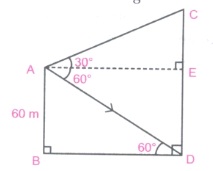
∴ AB=60 m and CD is the light house.
ㄥEAC=30o
and ㄥEAD=60o
∴ ㄥADB=60o
∴ AE||BD
In right ΔABD,
\(\frac { BD }{ AB } \)=cot 600⇒ \(\frac { BD }{ 60 } =\frac { 1 }{ \sqrt { 3 } } \)
⇒ BD=\(\frac { 60 }{ \sqrt { 3 } } \) m=20\(\sqrt { 3 } \) m.
∵ BD=AE
∴ AE=20\(\sqrt { 3 } \) m
Now in right ΔCEA, tan 300=\(\frac { CE }{ AE } \)
⇒ \(\frac { 1 }{ \sqrt { 3 } } =\frac { CE }{ 20\sqrt { 3 } } \)⇒ CE=20 m
(i) Difference between the heights of the light house and the building=CE=20 m
(ii) The distance between the light house and the building =BD=20\(\sqrt { 3 } \) m
10.
Let BE = 22 m be the height of the tower and AD = 1.5 m be the height of the observer. The point D be the observer's eye. Draw DC ∥ AB.
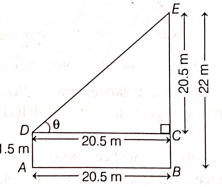
Then, AB = 20.5 m = DC and EC = BE - BC
= BE - AD = 22 - 1.5 = 20.5 m [∵ BC = AD]
Let 0 be the angle of elevation make by observer's eye to θ the top of the tower i.e. \(\angle E D C=\theta .\)
In right angled △DCE,
\(\tan \theta=\frac{P}{B}=\frac{C E}{D C}=\frac{20.5}{20.5}\)
⇒ tan θ = 1 ⇒ tan = tan 45° ⇒ 0 = 45°
11.
Let AB be the tower and BC be its shadow.
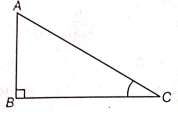
Given, AB = BC
In right angled △ABC,
\(\tan C=\frac{\text { Perpendicular }}{\text { Base }}=\frac{A B}{B C}=1\)
⇒ tan C = tan45° [∵ tan45° = 1]
∴ C = 45°
12.
(c)
80√2 m
13.
(c)
r sin Φ cosec θ/2
14.
(a)
75 m
15.
(b)
45°
16.
In Figure, A and B represent points on the bank on opposite sides of the river, so that AB is the width of the river. P is a point on the bridge at a height of 3 m, i.e., DP = 3 m. We are interested to determine the width of the river, which is the length of the side AB of the D APB.
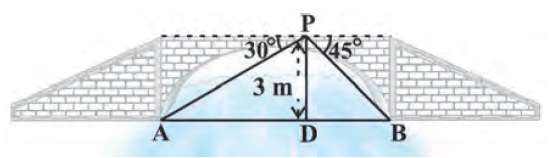
Now, AB = AD + DB
In right Δ APD, ∠ A = 30°.
So, tan 30°\(=\frac{P D}{A D}\)
i.e., \(\frac{1}{\sqrt{3}}=\frac{3}{\mathrm{AD}} \text { or } \mathrm{AD}=3 \sqrt{3} \mathrm{~m}\)
Also, in right Δ PBD, ∠ B = 45°. So, BD = PD = 3 m.
Now, AB = BD + AD = 3 + 3\(\sqrt3\) = 3 (1 + \(\sqrt3\) ) m.
Therefore, the width of the river is 3 ( \(\sqrt3\) + 1) m.
17.
Let the length of the ladder be l m
i.e. OP = OR = l m and OA = x m, OC = y m
(i) In right angled △OAP,
\(\begin{aligned} \sin 60^{\circ} & =\frac{A P}{O P} \\ \Rightarrow \quad \frac{\sqrt{3}}{2} & =\frac{12 \sqrt{3}}{O P} \Rightarrow l=O P=24 \mathrm{~m} \end{aligned}\)
Hence, the length of the ladder = 24 m
(ii) Again, in right angled △OAP,
\(\begin{array}{rlrl} & & \tan 60^{\circ} & =\frac{A P}{O A} \\ \Rightarrow & \sqrt{3} & =\frac{12 \sqrt{3}}{x} \Rightarrow x=12 \mathrm{~m} \end{array}\)
Hence, the distance of the building Y from point O is 12 m.
(iii) (a) In right angled △OCR,
\(\begin{aligned} & & \cos 45^{\circ} & =\frac{O C}{O R} \\ \Rightarrow & & \frac{1}{\sqrt{2}} & =\frac{O C}{24} \\ \Rightarrow & & y & =O C=12 \sqrt{2} \mathrm{~m} \end{aligned}\)
Horizontal distance between the buildings \(=(x+y)=12(\sqrt{2}+1) \mathrm{m}\)
Or
(b) Again, in right angled △OCR,
\(\begin{aligned} & & \tan 45^{\circ} & =\frac{R C}{O C} \\ \Rightarrow & & 1 & =\frac{R C}{12 \sqrt{2}} \\ \Rightarrow & & x & =R C=12 \sqrt{2} \mathrm{~m} \end{aligned}\)
Height of building x is \(12 \sqrt{2} \mathrm{~m} .\)

10th Standard CBSE Syllabus & Materials
10th Standard CBSE
CBSE 10th Social Science PS - Federalism - New Model Questions Papers Study Material - QB365 Set A
NEW10th Standard CBSE
CBSE 10th Social Science PS - Power Sharing - New Model Questions Papers Study Material - QB365 Set A
NEW10th Standard CBSE
CBSE 10th Social Science GEO - Manufacturing Industries - New Model Questions Papers Study Material - QB365 Set A
NEW10th Standard CBSE
CBSE 10th Social Science GEO - Minerals and Energy Resources - New Model Questions Papers Study Material - QB365 Set A



NCERT Books

Syllabus

Exam Pattern

Sample Question Papers

Previous year Question Papers

Important Notes

MCQ Practice test

NCERT Exemplers

Case study Questions

Image Based Questions

Passage based Questions

HOT Questions

Value Based Questions

Model Questions Papers
NCERT ( Book Back ) Questions

Assertion and Reason
Important Questions And Answers

CBSE 10th Standard CBSE Subjects
CBSE Standards



