
10th Standard CBSE Syllabus & Materials
10th Standard CBSE
CBSE 10th Social Science ECO - Globalisation and the Indian Economy - New Model Questions Papers Study Material - QB365 Set A
NEW10th Standard CBSE
CBSE 10th Social Science ECO - Money and Credit - New Model Questions Papers Study Material - QB365 Set A
NEW10th Standard CBSE
CBSE 10th Social Science ECO - Sectors of the Indian Economy - New Model Questions Papers Study Material - QB365 Set A
NEW10th Standard CBSE
CBSE 10th Social Science ECO - Development - New Model Questions Papers Study Material - QB365 Set A
NEW10th Standard CBSE
CBSE 10th Social Science PS - Outcomes of Democracy - New Model Questions Papers Study Material - QB365 Set A
NEW10th Standard CBSE
CBSE 10th Social Science PS - Gender, Religion and Caste - New Model Questions Papers Study Material - QB365 Set A

Published on: 17/08/2026
Download CBSE Class 10th Standard CBSE Maths question papers, sample papers, important questions, and previous year solved papers in PDF format. Get free study materials, NCERT solutions, and exam preparation resources for Class 10th Standard CBSE Maths
Questions + Answers key
Take MCQ Maths Test
1.
If 1+sin2θ = 3sinθ cosθ, prove that \(\tan \theta=1 \text { or } \frac{1}{2}\).
2.
Prove that \(\frac{\sin A-\cos A+1}{\sin A+\cos A-1}=\frac{1}{\sec A-\tan A}\)
3.
Prove that \(\frac{\sin \theta}{\cot \theta+\operatorname{cosec} \theta}=2+\frac{\sin \theta}{\cot \theta-\operatorname{cosec} \theta}\)
4.
\(\text { If } \sec \theta=x+\frac{1}{4 x}\),then find the value of secθ+ tanθ,
5.
If sin6A+ cos6A+3sin2A-cos2A+4=k, then find the value of k.
6.
Prove that \(\frac{\cot \theta+\operatorname{cosec} \theta-1}{\cot \theta-\operatorname{cosec} \theta+1}=\frac{1+\cos \theta}{\sin \theta}\)
7.
If a secθ + btanθ = m and bsecθ + atanθ = n, prove that a2 +n² =b² +m².
8.
If cos θ + sinθ =1, then prove that cosθ - sinθ =±1.
9.
Prove that
\(\sqrt{\frac{\sec A-1}{\sec A+1}}+\sqrt{\frac{\sec A+1}{\sec A-1}}=2 \operatorname{cosec} A\)
10.
Prove that \(\frac{1+\sec A}{\sec A}=\frac{\sin ^2 A}{1-\cos A}\)
11.
Find acute angles A and B, if \(\sin (A+2 B)=\frac{\sqrt{3}}{2}\) and cos (A +4B) =0°, A> B.
12.
Evaluate \(8 \sqrt{3} \operatorname{cosec}^2 30^{\circ} \sin 60^{\circ} \cos 60^{\circ}\) cos2 45°sin 45° tan 30° cosec345°.
13.
If m cot A =n, then find the value of \(\frac{m \sin A-n \cos A}{n \cos A+m \sin A} .\)
14.
In △ PQR right angled at Q, QR=3 cm and PR- PQ=1 cm. Determine the values of sin R, cos R and tan R.

15.
In a △ ABC, right angled at B, if tan A=1, verify that 2 sin A cos A =1.
16.
If cosecθ +cotθ = p, then prove that cosθ = \(\frac{p^2-1}{p^2+1} .\)
17.
If cosecθ - sinθ =m and secθ - cosθ = n, then prove that(m2n)2/3(mn2)2/3 =1
18.
Prove that \(\frac{(1+\cot \theta+\tan \theta)(\sin \theta-\cos \theta)}{\sec ^3 \theta-\operatorname{cosec}^3 \theta}=\sin ^2 \theta \cos ^2 \theta .\)
19.
\(\text { If } \frac{1}{\sin \theta-\cos \theta}=\frac{\operatorname{cosec} \theta}{\sqrt{2}}\), prove that \(\left(\frac{1}{\sin \theta+\cos \theta}\right)^2=\frac{\sec ^2 \theta}{2} .\)
20.
Prove that \(\frac{\sin A-2 \sin ^3 A}{2 \cos ^3 A-\cos A}=\tan A\)
21.
If tanθ + sinθ = m and tanθ-sinθ = n, then
show that (m²-n2)² =16 mn or (m²n2)=\(=4 \sqrt{m n} .\)
22.
(cos4 A-sin4 A) on simplified form, gives
2sin2 A-1
2sin2A+1
2 cos2 A+1
2 cos2 A-1
23.
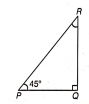
In a right-angled △ PQR, \(\angle Q=90^{\circ} .\) If \(\angle P=45^{\circ}\)then value of tan P- cos2R is
0
1
1/2
3/2
24.
\(\text { If } \tan ^2 \theta+\cot ^2 \alpha=2 \text {, where } \theta=45^{\circ} \text { and } 0^{\circ} \leq \alpha \leq 90^{\circ} \text {, }\)then the value of ∝ is
30°
45°
60°
90°
25.
If θ is an acute angle and tanθ+ cotθ =2, then the value of sin3 θ +cos3θ is
1
\(\frac{1}{2}\)
\(\frac{\sqrt{2}}{2}\)
\(\sqrt{2}\)
26.
If cos (∝ + β) = 0, then value of cos \(\left(\frac{\alpha+\beta}{2}\right)\) is equal to
\(\frac{1}{\sqrt{2}}\)
\(\frac{1}{2}\)
0
\(\sqrt{2}\)
27.
In a right △ ABC, right angled at A If sin B = \(\frac{1}{4}\) then the value of sec B is
4
\(\frac{\sqrt{15}}{4}\)
\(\sqrt{15}\)
\(\frac{4}{\sqrt{15}}\)
28.
If tan A \(=\frac{3}{4},\) then \(\frac{\sin ^2 A+\cos ^2 A}{\sec A}\) is equal to
\(\frac{4}{3}\)
\(\frac{4}{5}\)
\(\frac{3}{5}\)
\(\frac{5}{4}\)
29.
\(\frac{1+\tan ^2 A}{1+\cot ^2 A} \text { is equal to }\)
sec2A
-1
cot2 A
tan² A
30.
(sec A+ tan A) (1-sin A) is equal to
sec A
sin A
cosec A
cos A
\(\)
31.
(1+tanθ+secθ)(1 + cot θ - cosecθ) is equal to
0
1
2
-1
1.
Hint Given, 1+ sin2θ 3sinθcosθ [dividing both sides by cos2θ)
⇒ sec2θ + tan2θ = 3 tanθ
⇒ 2tan2θ-3tanθ+1=0 [∵ sec2θ = 1+ tan2θ]
Let, tanθ = x, so above equation becomes 2x2- 3x + 1
Solve for x= tanθ using quadratic formula.
2.
Hint Divide numerator and denominator by cosA and use the identity sec2A-tan2A=1 to get the desired result.
3.
Hint Simplify LHS and RHS separately and use sin2θ+ cos2θ =1
4.
Hint \(\sec \theta=x+\frac{1}{4 x}\)
\(\Rightarrow \sec ^2 \theta=x^2+\left(\frac{1}{4 x}\right)^2+2 \cdot x \cdot \frac{1}{4 x}\)
\(\Rightarrow \sec ^2 \theta-1=x^2+\frac{1}{16 x^2}-\frac{1}{2}\)
\(\Rightarrow \tan ^2 \theta=\left(x-\frac{1}{4 x}\right)^2\)
\(\Rightarrow \quad \tan \theta= \pm\left(x-\frac{1}{4 x}\right)\)
Ans. 2x, 1/2x
5.
Hint Given, sin6A+cos6A+ 3sin2 Acos2 A+ 4 =k
\(\left[\because a^3+b^3=(a+b)^3-3 a b(a+b)\right]\)
(sin2A3) +(cos2 A)3 +3sin2 Acos2 A+ 4
= (sin2A+cos2A)3 – 3sin2 Acos2 A(sin2A+ cos2A) + 3sin2 Acos2 A+4
=1-3sin2Acos2A + 3sin2 Acos2 A+4=5 \(\left[\because \sin ^2 A+\cos ^2 A=1\right]\)
Ans. k=5
6.
\(\mathrm{LHS}=\frac{\cot \theta+\operatorname{cosec} \theta-1}{\cot \theta-\operatorname{cosec} \theta+1}\)
\(=\frac{(\cot \theta+\operatorname{cosec} \theta)-\left(\operatorname{cosec}^2 \theta-\cot ^2 \theta\right)}{\cot \theta-\operatorname{cosec} \theta+1}\) \(\left[\because \operatorname{cosec}^2 A-\cot ^2 A=1\right]\)
\(=\frac{(\operatorname{cosec} \theta+\cot \theta)\{1-(\operatorname{cosec} \theta-\cot \theta)\}}{\cot \theta-\operatorname{cosec} \theta+1}\)
\(=\frac{(\operatorname{cosec} \theta+\cot \theta)(1-\operatorname{cosec} \theta+\cot \theta)}{\cot \theta-\operatorname{cosec} \theta+1}\)
\(=\operatorname{cosec} \theta+\cot \theta=\frac{1}{\sin \theta}+\frac{\cos \theta}{\sin \theta}=\frac{1+\cos \theta}{\sin \theta}=\mathrm{RHS}\)
7.
Given, asecθ + btanθ = m ..(i)
and bsecθ +atanθ =n ..(ii)
On squaring and subtracting Eqs. (1) and (ii), we get
(asecθ+btanθ)2 -(bsecθ + atanθ)2 =m2-n2
⇒ a2sec2 θ+b2 tan2θ +2absecθ tanθ - b²sec2 θ-a2tan2θ-2absecθ tanθ =m2-n2
⇒ a2(sec2θ - tan2θ)-b2 (sec θ - tan² θ)=m²-n2
⇒ a2-b2 =m² - n2\(\left[\because \sec ^2-\tan ^2 \theta=1\right]\)
⇒ \(a^2+n^2=m^2+b^2\) Hence proved.
8.
Given, cosθ + sinθ = 1
(cosθ + sinθ)2 + (cosθ - sinθ)2
⇒ (1)2 +(cos θ -sinθ)2=2 [∵ cosθ + sinθ = 1(given)]
⇒ (cos θ -sinθ) =2-1
⇒ (cos θ -sinθ) = 1
⇒ (cos θ -sinθ) = ±1
Hence proved.
9.
\(\mathrm{LHS}=\sqrt{\frac{\sec A-1}{\sec A+1}}+\sqrt{\frac{\sec A+1}{\sec A-1}}\)
\(=\frac{\sec A-1+\sec A+1}{\sqrt{(\sec A+1)(\sec A-1)}}\)
\(=\frac{2 \sec A}{\sqrt{\sec ^2 A-1}}\)
\(=\frac{2 \sec A}{\sqrt{\tan ^2 A}}\) \(\left[\because \sec ^2 \theta-\tan ^2 \theta=1\right]\)
\(=\frac{2 \sec A}{\tan A}=2 \times \frac{1}{\cos A} \times \frac{\cos A}{\sin A}\)
=2 cosecA
=RHS
Hence proved.
10.
\(\mathrm{LHS}=\frac{1+\sec A}{\sec A}=\frac{1+\frac{1}{\cos A}}{\frac{1}{\cos A}}\)
= \(\frac{\cos A+1}{\cos A} \times \cos A=\cos A+1\)
\(\mathrm{RHS}=\frac{\sin ^2 A}{1-\cos A}=\frac{1-\cos ^2 A}{1-\cos A}\) [∵ sin2θ+ cos2 θ=1]
\(=\frac{(1+\cos A)(1-\cos A)}{1-\cos A}=1+\cos A\)
∴ LHS=RHS Hence proved.
11.
We have, sin \((A+2 B)=\frac{\sqrt{3}}{2}=\sin 60^{\circ}\) \(\left[\because \sin 60^{\circ}=\frac{\sqrt{3}}{2}\right]\)
⇒ A+2B = 60° ...(i)
Again, cos(A + 4B) = 0°= cos 90° [∵ cos 90°= 0]
⇒ A+ 4B = 90° ...(ii)
On subtracting Eq. (i)from Eq. (ii), we get
A+4B-A-2B = 90°-60°⇒2B=30°⇒B= 15°
On substituting B = 15° in Eq. (i), we get
A+2 x 15° = 60°⇒A+30°=60°⇒A=60° -30°=30°
Hence, A=30° and B= 15°
12.
We have,
\(8 \sqrt{3} \operatorname{cosec}^2 30^{\circ}\) sin 60° cos 60° cos 45° sin 45° tan 30° cosec3 45°
\(=8 \sqrt{3}\) (cosec 30°)2sin60°-cos 60°(cos45°)2sin45° tan30° (cosec 45°)3
\(=8 \sqrt{3}(2)^2 \times \frac{\sqrt{3}}{2} \cdot \frac{1}{2} \times\left(\frac{1}{\sqrt{2}}\right)^2 \times\left(\frac{1}{\sqrt{2}}\right) \times \frac{1}{\sqrt{3}} \times(\sqrt{2})^3\)
\(\begin{array}{r} \because \operatorname{cosec} 30^{\circ}=2, \sin 60^{\circ}=\frac{\sqrt{3}}{2}, \cos 60^{\circ}=\frac{1}{2}, \\ \left.\sin 45^{\circ}=\cos 45^{\circ}=\frac{1}{\sqrt{2}}, \tan 30^{\circ}=\frac{1}{\sqrt{3}} \text { and } \operatorname{cosec} 45^{\circ}=\sqrt{2}\right] \end{array}\)
\(=8 \sqrt{3} \times \sqrt{3} \times \frac{1}{2} \times \frac{1}{\sqrt{2}} \times \frac{1}{\sqrt{3}} \times 2 \sqrt{2}=8 \sqrt{3}\)
13.
Given, mcot A = n
⇒ \(m \cdot \frac{1}{\tan A}=n\) \(\left[\because \cot \theta=\frac{1}{\tan \theta}\right]\)
⇒ \(\tan A=\frac{m}{n}\) ...(i)
Now, \(\frac{m \sin A-n \cos A}{n \cos A+m \sin A}=\frac{m \cdot \frac{\sin A}{\cos A}-n}{n+m \cdot \frac{\sin A}{\cos A}}\)
[dividing numerator and denominator by cos A]
\(=\frac{m \tan A-n}{n+m \tan A}=\frac{m \cdot \frac{m}{n}-n}{n+m \cdot \frac{m}{n}}\) [from Eq. (i)]
\(=\frac{\frac{m^2-n^2}{n}}{\frac{n^2+m^2}{n}}\)
\(=\frac{m^2-n^2}{m^2+n^2}\)
14.
Given, a △ PQR in which 2Q=90° and QR=3 cm.
Also, PR-PQ =1
On applying Pythagoras theorem in △ PQR, we get
PR2 PQ2 + QR2
⇒ QR2 = PR2-PQ2
⇒ (3)2 = PR2- PQ2 [given QR =3cm]
⇒ PR2-PQ2 =9
⇒ (PR+PQ) (PR-PQ)=9 [∵ a2 - b2 = (a +b) (a - b)]
⇒ (PR+ PQ) (1)=9 [from Eq. (1)]
⇒ PR+ PQ=9 ...(ii)
On adding Eqs. (i) and (ii), we get
PR-PQ+PR+PQ=1+9
⇒ 2PR= 10 ⇒ R=5 cm
On substituting PR =5 cm in Eq. (i), we get
5-PQ= 1 ⇒ Q= 4 cm
∴ PR=5 cm and PQ= 4 cm
Now, sinR = \(=\frac{P Q}{P R}=\frac{4}{5}, \cos R=\frac{Q R}{P R}=\frac{3}{5} \text { and } \tan R=\frac{P Q}{Q R}=\frac{4}{3}\)
15.
Given, a △ ABC in which \(\angle B\)=90°.
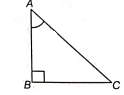
\(\text { In } \triangle A B C, \tan A=\frac{\text { Perpendicular }}{\text { Base }}=\frac{B C}{A B}=1\) [given]
⇒ BC=AB
Let AB= BC= k, where k is a positive number.
Now, \(A C=\sqrt{A B^2+B C^2}\) [by Pythagoras theorem]
\(=\sqrt{(k)^2+(k)^2}=k \sqrt{2}\)
∴ \(\sin A=\frac{\text { Perpendicular }}{\text { Hypotenuse }}=\frac{B C}{A C}=\frac{k}{\sqrt{2 k}}=\frac{1}{\sqrt{2}}\)
and \(\cos A=\frac{\text { Base }}{\text { Hypotenuse }}=\frac{A B}{A C}\)
\(=\frac{k}{\sqrt{2} k}=\frac{1}{\sqrt{2}}\)
Now, 2sinAcosA = \(\left(\frac{1}{\sqrt{2}}\right)\left(\frac{1}{\sqrt{2}}\right)=1\) Hence proved,
16.
Hint Put the value of p in RHS of given equality and simplify to obtain it equal to LHS.
17.
Hint Given, cosecθ - sinθ = m
and secθ - cosθ = n
⇒ \(\frac{1}{\sin \theta}-\sin \theta=m \text { and } \frac{1}{\cos \theta}-\cos \theta=n\)
⇒ \(\frac{1-\sin ^2 \theta}{\sin \theta}=m \text { and } \frac{1-\cos ^2 \theta}{\cos \theta}=n\)
⇒ \(\frac{\cos ^2 \theta}{\sin \theta}=m \text { and } \frac{\sin ^2 \theta}{\cos \theta}=n\)
Now, put the values of m and n in LHS of given equation.
18.
Hint Let LHS= \(\frac{\left[1+\frac{\cos \theta}{\sin \theta}+\frac{\sin \theta}{\cos \theta}\right](\sin \theta-\cos \theta)}{\frac{1}{\cos ^3 \theta}-\frac{1}{\sin ^3 \theta}}\)
\(=\frac{(\sin \theta \cos \theta+1) \sin ^3 \theta \cdot \cos ^3 \theta}{\sin \theta \cos \theta \cdot\left(\sin ^3 \theta-\cos ^3 \theta\right)}(\sin \theta-\cos \theta)\)
19.
Given, \(\frac{1}{\sin \theta-\cos \theta}=\frac{\operatorname{cosec} \theta}{\sqrt{2}}\)
On squaring both sides, we get
\(\frac{1}{\sin ^2 \theta+\cos ^2 \theta-2 \sin \theta \cos \theta}=\frac{\operatorname{cosec}^2 \theta}{2}\) [∵ (a-b)2=a2+b2 - 2ab]
⇒ \(\frac{1}{1-2 \sin \theta \cos \theta}=\frac{\operatorname{cosec}^2 \theta}{-1}\) [∵ sin²θ++cos²θ= 1]
⇒ \(\frac{2}{\operatorname{cosec}^2 \theta}=1-2 \sin \theta \cos \theta\)
⇒ 2cosθsinθ = 1-2sin2θ
⇒ 2cosθsinθ = sin2θ+ cos2θ - 2sin2θ
⇒ 2cosθsinθ = cos2θ - 2sin2θ [∵ sin2θ = 1 - cos2θ]
=2cos2θ-1
⇒ 2cos2θ=1+2sinθcosθ
⇒ \(\frac{2}{\sec ^2 \theta}=1+2 \sin \theta \cos \theta\)
⇒ \(\frac{\sec ^2 \theta}{2}=\frac{1}{\sin ^2 \theta+\cos ^2 \theta+2 \sin \theta \cos \theta}\)
⇒ \(\frac{\sec ^2 \theta}{2}=\frac{1}{(\sin \theta+\cos \theta)^2}\) Hence proved.
20.
To prove \(\frac{\sin A-2 \sin ^3 A}{2 \cos ^3 A-\cos A}=\tan A\)
\(\text { Let LHS }=\frac{\sin A-2 \sin ^3 A}{2 \cos ^3 A-\cos A}=\frac{\sin A\left(1-2 \sin ^2 A\right)}{\cos A\left(2 \cos ^2 A-1\right)}\)
\(=\frac{\sin A\left(\sin ^2 A+\cos ^2 A-2 \sin ^2 A\right)}{\cos A\left(2 \cos ^2 A-\left(\sin ^2 A+\cos ^2 A\right)\right)}\) [∵ sin2A+ cos2A= 1]
\(=\frac{\sin A\left(\cos ^2 A-\sin ^2 A\right)}{\cos A\left(\cos ^2 A-\sin ^2 A\right)}\)
= tanA= RHS Hence proved
21.
Given, tanθ+sinθ =m ...(i)
and tanθ-sinθ =n ...(ii)
On adding Eqs. (i) and (ii), we get
\(2 \tan \theta=m+n \Rightarrow \tan \theta=\frac{m+n}{2}\)
∴ \(\cot \theta=\frac{1}{\tan \theta}=\frac{2}{m+n}\) ...(iii)
On subtracting Eq. (ii) from Eq. (i), we get
2sinθ = m-n
⇒ \(\sin \theta=\frac{m-n}{2}\)
∴ \(\operatorname{cosec} \theta=\frac{1}{\sin \theta}=\frac{2}{m-n}\) ...(iv)
We know that cosec2θ- cot2θ =1
⇒ \(\left(\frac{2}{m-n}\right)^2-\left(\frac{2}{m+n}\right)^2=1\) [from Eqs. (ii) and (iv)]
⇒ \(\frac{4}{(m-n)^2}-\frac{4}{(m+n)^2}=1\)
⇒ \(4\left[\frac{1}{(m-n)^2}-\frac{1}{(m+n)^2}\right]=1\)
⇒ \(4\left[\frac{(m+n)^2-(m-n)^2}{(m-n)^2(m+n)^2}\right]=1\)
⇒ \(4\left[\frac{\left(m^2+n^2+2 m n\right)-\left(m^2+n^2-2 m n\right)}{(m-n)^2(m+n)^2}\right]=1\) \(\left[\because(A \pm B)^2=A^2+B^2 \pm 2 A B\right]\)
⇒ \(4\left[\frac{2 m n+2 m n}{(m-n)^2(m+n)^2}\right]=1\)
⇒ \(\frac{16 m n}{[(m-n)(m+n)]^2}=1\)
⇒ \(\frac{16 m n}{\left(m^2-n^2\right)^2}=1\)
⇒ (m2-n2)2 = 16mn
∴ \(\left(m^2-n^2\right)=4 \sqrt{m n}\) [taking positive square root]
Hence proved.
22.
We have, cos4A-sin4A
=(cos2 A + sin2 A)(cos²A- sin2 A)
=(cos2A- sin2A) (∵ sin²θ+ cos2θ = 1]
= cos2A -(l- cos2A) =2cos2A-1
23.
Given, in △ PQR,
\(\angle Q=90^{\circ}\)
and \(\angle P=45^{\circ}\)
So, \(\angle R=180^{\circ}-(P+Q),\)
\(\angle R=180^{\circ}-\left(90^{\circ}+45^{\circ}\right)\)
\(\text { and } \angle R=45^{\circ}\) \(\text { So, } \tan P-\cos ^2 R=\tan 45^{\circ}-\cos ^2 45^{\circ}\left[\begin{array}{l} \because \tan 45^{\circ}=1 \text { and } \\ \cos 45^{\circ}=1 / \sqrt{2} \end{array}\right]\)
\(=1-\left(\frac{1}{\sqrt{2}}\right)^2\)
∴ tanP- cos² R = 1/2
24.
Given, 0 = 45° and 0° \(\leq \alpha \leq 90^{\circ}\)
Now, we have
tan20+ cot2∝=2
⇒ tan2 45°+ cot2∝=2 [putting 0=45°]
⇒ 1+cot2∝=2
⇒ cot2∝=2-1
⇒ cot∝=1
⇒ cot∝ = cot 45°
⇒ ∝ = 45° \(\left[\because 0^{\circ} \leq \alpha \leq 90^{\circ}\right]\)
25.
If θ = 45°, then tanθ+ cotθ = 2
Now, sin3 45°+ cos3 45° [∵θ = 45°]
\(=\left(\frac{1}{\sqrt{2}}\right)^3+\left(\frac{1}{\sqrt{2}}\right)^3\)
\(=\frac{1}{2 \sqrt{2}}+\frac{1}{2 \sqrt{2}}=\frac{2}{2 \sqrt{2}}=\frac{1}{\sqrt{2}} \times \frac{\sqrt{2}}{\sqrt{2}}=\frac{\sqrt{2}}{2}\)
26.
Given, cos(∝+β) = 0
⇒ cos(∝+β) = cos90° [ cos90°= 0]
⇒ ∝+β = 90°
∴ \(\cos \left(\frac{\alpha+\beta}{2}\right)=\cos \left(\frac{90^{\circ}}{2}\right)\)
= cos 45°
\(=\frac{1}{\sqrt{2}}\)
27.
Hint sin B = \(\frac{1}{4}=\frac{\text { Perpendicular }}{\text { Hypotenuse }}\)
Use Pythagoras theorem and find base
Base = \(\sqrt{15}\)

\(\text { Now, } \sec B=\frac{\text { Hypotenuse }}{\text { Base }}=\frac{4}{\sqrt{15}}\)
28.
\(\text { Given, } \tan A=\frac{3}{4}\)
In right angled △ ABC
AB = 4 and BC=3
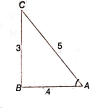
By Pythagoras theorem
AC2 = AC2 + BC2
⇒ AC2 = (4)2 + (3)2
⇒ AC2 =16+9
⇒ AC=5 [neglecting-ve sign]
∴ \(\sec A=\frac{A C}{A B}=\frac{5}{4}\)
\(\text { Now, } \frac{\left(\sin ^2 A+\cos ^2 A\right)}{\sec A}=\frac{1}{5}=\frac{4}{5}\)
[∵ sin2 A+ cos2A =1]
29.
\(\frac{1+\tan ^2 A}{1+\cot ^2 A}=\frac{\sec ^2 A}{\operatorname{cosec}^2 A}\) \(\left[\begin{array}{l} \because 1+\tan ^2 \theta=\sec ^2 \theta \\ \text { and } 1+\cot ^2 \theta=\operatorname{cosec}^2 \theta \end{array}\right]\)
\(=\frac{\frac{1}{\cos ^2 A}}{\frac{1}{\sin ^2 A}}\) \(\left[\begin{array}{l} \because \sec \theta=\frac{1}{\cos \theta} \\ \text { and } \operatorname{cosec} \theta=\frac{1}{\sin \theta} \end{array}\right]\)
\(=\frac{1}{\cos ^2 A} \times \frac{\sin ^2 A}{1}=\tan ^2 A\)
\(\left[\because \tan \theta=\frac{\sin \theta}{\cos \theta}\right]\)
30.
(sec A + tan A) (1- sin A)
\(=\left(\frac{1}{\cos A}+\frac{\sin A}{\cos A}\right)(1-\sin A)\) \(\left[\begin{array}{l} \because \sec \theta=\frac{1}{\cos \theta} \\ \text { and } \tan \theta=\frac{\sin \theta}{\cos \theta} \end{array}\right]\)
\(=\frac{(1+\sin A)(1-\sin A)}{\cos A}=\frac{1-\sin ^2 A}{\cos A}\) [∵ (a + b) ( a - b) = a2-b2]
\(=\frac{\cos ^2 A}{\cos A}=\cos A\)
[∵sin2θ +cos2θ = 1 ⇒ 1 ⇒ cos2θ = 1-sin2θ]
31.
(1+ tanθ + secθ ) (1+ cot θ- cosec θ)
\(=\left(1+\frac{\sin \theta}{\cos \theta}+\frac{1}{\cos \theta}\right)\left(1+\frac{\cos \theta}{\sin \theta}-\frac{1}{\sin \theta}\right)\)
\(\left[\begin{array}{r} \because \tan A=\frac{\sin A}{\cos A}, \sec A \equiv \frac{1}{\cos A}, \cot A=\frac{\cos A}{\sin A} \\ \text { and } \operatorname{cosec} A=\frac{1}{\sin A} \end{array}\right]\)
\(=\left[\frac{(\cos \theta+\sin \theta)+1}{\cos \theta}\right] \times\left[\frac{(\sin \theta+\cos \theta)-1}{\sin \theta}\right]\)
\(=\frac{(\cos \theta+\sin \theta)^2-1^2}{\cos \theta \sin \theta}\) [∵(a + b) (a - b) =a2 - b2]
\(=\frac{\cos ^2 \theta+\sin ^2 \theta+2 \cos \theta \sin \theta-1}{\cos \theta \sin \theta}\)
[∵ (a+ b)²=a2+b² + 2ab]
\(=\frac{1+2 \cos \theta \sin \theta-1}{\cos \theta \sin \theta}\) [∵cos2A+sin2 A= 1]
\(=\frac{2 \cos \theta \sin \theta}{\cos \theta \sin \theta}=2\)

10th Standard CBSE Syllabus & Materials
10th Standard CBSE
CBSE 10th Social Science PS - Federalism - New Model Questions Papers Study Material - QB365 Set A
NEW10th Standard CBSE
CBSE 10th Social Science PS - Power Sharing - New Model Questions Papers Study Material - QB365 Set A
NEW10th Standard CBSE
CBSE 10th Social Science GEO - Manufacturing Industries - New Model Questions Papers Study Material - QB365 Set A
NEW10th Standard CBSE
CBSE 10th Social Science GEO - Minerals and Energy Resources - New Model Questions Papers Study Material - QB365 Set A



NCERT Books

Syllabus

Exam Pattern

Sample Question Papers

Previous year Question Papers

Important Notes

MCQ Practice test

NCERT Exemplers

Case study Questions

Image Based Questions

Passage based Questions

HOT Questions

Value Based Questions

Model Questions Papers
NCERT ( Book Back ) Questions

Assertion and Reason
Important Questions And Answers

CBSE 10th Standard CBSE Subjects
CBSE Standards



