
 100% FREE ACCESS
10th Standard CBSE Syllabus & Materials
10th Standard CBSE
CBSE 10th Social Science ECO - Globalisation and the Indian Economy - New Model Questions Papers Study Material - QB365 Set A
NEW10th Standard CBSE
CBSE 10th Social Science ECO - Money and Credit - New Model Questions Papers Study Material - QB365 Set A
NEW10th Standard CBSE
CBSE 10th Social Science ECO - Sectors of the Indian Economy - New Model Questions Papers Study Material - QB365 Set A
NEW10th Standard CBSE
CBSE 10th Social Science ECO - Development - New Model Questions Papers Study Material - QB365 Set A
NEW10th Standard CBSE
CBSE 10th Social Science PS - Outcomes of Democracy - New Model Questions Papers Study Material - QB365 Set A
NEW10th Standard CBSE
CBSE 10th Social Science PS - Gender, Religion and Caste - New Model Questions Papers Study Material - QB365 Set A

Published on: 17/08/2026
Download CBSE Class 10th Standard CBSE Science question papers, sample papers, important questions, and previous year solved papers in PDF format. Get free study materials, NCERT solutions, and exam preparation resources for Class 10th Standard CBSE Science
Questions + Answers key
Take MCQ Science Test
1.
Describe the structure and functioning of nephrons
2.
(a) Explain, how urine is produced in human body?
(b) What are the excretory wastes in plants?
3.
(a) Draw a diagram to show open stomatal pore and label on it:
(i) guard cells (ii) chloroplast
(b) State two functions of stomata.
(c) How do guard cells regulate the opening and closing of stomatal pore?
4.
What are the methods used by plants to get rid of excretory products?
5.
Explain in brief two ways by which leaves of a plant help in excretion.
6.
Why is it said that kidneys help in the process of osmoregulation? Explain.
7.
Name the substances other than water, that are reabsorbed during urine formation. What are the two parameters that decide the amount of water that is reabsorbed in the kidney?
8.
The left kidney is placed a little higher than the right kidney. Give suitable reason for this statement.
9.
What is the advantage of having four- chambered heart?
10.
What will happen if
(i) Xylem tissue in plants is removed.
(ii) we are Injured and start bleeding.
11.
List the three kinds of blood vessels of human circulatory system and write their functions in tabular form.
12.
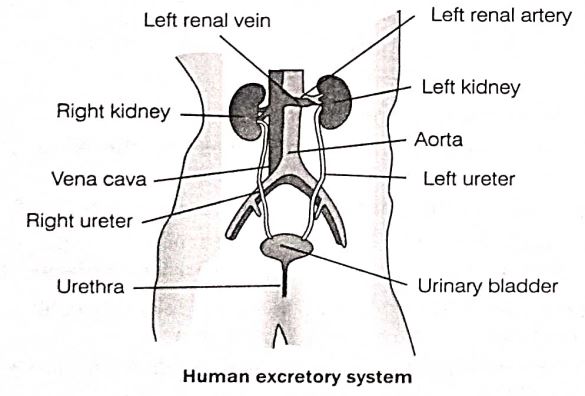
Draw a diagram of human excretory system and label the followlng.
(i) Urinary bladder
(ii) Left kidney
(iii) Left ureter
13.
In birds and mammals, the left and right side of the heart are separated. Give reasons.
14.
What is double circulation?
15.
What are the differences between the transport of materials in xylem and phloem?
16.
How is food transported in plants?
17.

 (i) Using only the information given in the tables, deduce the functions of the kidney.
18.
Our body needs to remove the wastes that build up from cell activities and from digestion. It these wastes are not removed, then our cells can stop working and we can get very sick. The organs of our excretory system help to release wastes from our body. The excretory system consists of a pair of kidney, a pair of ureters, a urinary bladder and a urethra. Each kidney is made up of nearly one million complex tubular structures called nephrons. The formation of urine involves various processes that takes place in the different parts of the nephron. Each nephron consists of a cup-shaped upper end called Bowman's capsule containing a bunch of capillaries called glomerulus. Bowman's capsule leads to tubular structure-proximal convoluted tubule, loop of Henle and distal convoluted tubule which ultimately joins the collecting tubule.
(i) The following substances are the excretory products in animals. Choose the least toxic form.
| (a) Urea | (b) Uric acid | (c) Ammonia | (d) CO2 |
(ii) The outline of principal events of urination is given below in random manner.
(I) Stretch receptors on the wall of urinary bladder send signals to the CNS.
(II) The bladder fills with urine and becomes distended.
(III) Micturition
(IV) CNS passes on motor messages to initiate the contraction of smooth muscles of bladder and simultaneous relaxation of urethral sphincter.
The correct sequence of the events is
| (a) (I) \(\rightarrow\)(II) \(\rightarrow\) (III) \(\rightarrow\) (IV) | (c) (II) \(\rightarrow\)(I) \(\rightarrow\) (IV) \(\rightarrow\) (III) |
| (b) (IV)\(\rightarrow\) (III) \(\rightarrow\) (II) \(\rightarrow\) (I) | (d) (III) \(\rightarrow\) (II)\(\rightarrow\) (I) \(\rightarrow\) (IV) |
(iii) A person who is not taking food or beverages will have ___________ in urine.
| (a) little glucose | (b) less urea | (c) excess urea | (d) little fat |
(iv) Glomerular filtrate is first collected by
| (a) distal convoluted tubule | (b) proximal convoluted tubule |
| (c) Bowman's capsule | (d) loop of Henle |
(v) The given figure represents a single nephron from a mammalian kidney. Identify the labelled parts, match them with the options (i-iv) and select the correct answer.
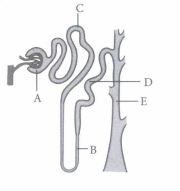
(I) The site of ultrafiltration
(II) Collect the urine and make it more concentrated
(III) The main site for the reabsorption of glucose and amino acids
(IV) Largely responsible for the maintenance of blood pH
| (a) (I)-A, (II)-E, (lII)-C, (IV)-D | (b) (I)-A, (lI)-B, (lII)-C, (lV)-D |
| (c) (I)-B, (II)-A, (lII)-C, (IV)-E | (d) (I)-E, (lI)-B, (lII)-D, (lV)-A |
19.
20.

21.
22.
23.
24.
25.
26.
1.
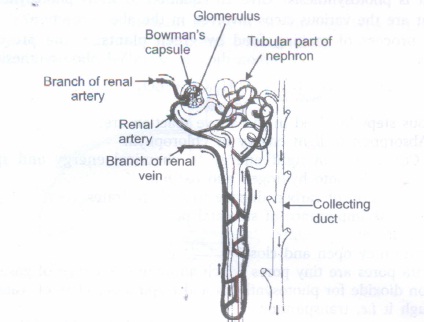
Structure of nephron Nephron is the basic filtering unit found in kidney. It is a long coiled tubule whose one end is connected to the double walled cup-shaped structure called Bowman's capsule and the other end to a urine collecting duct. Bowiman's capsule contains a bundle of blood capillaries, known as glomerulus that is followed by the tubular part of nephron, which forms loops at some places. For figure refer to "Structure of a nephron" on.
Functioning of nephron
(i) Glomerulus filters the blood passing through it.
(ii) It also ensures to remove only harmful substances from the body that includes nitrogenous materials.
(iii) The useful substances like glucose, amino acids, salts and a major amount of water are selectively reabsorbed by the tubular part of nephron.
(iv) Some substances like K+ are actively secreted into the urine through the tubule.
(v) The collecting duct collects the urine and passes it to the ureter.
2.
(a) Renal artery carrying all the impurities in blood reaches kidney. In kidney, there are small functional units called nephron which receives this blood and the impurities along with water is squeezed out in Bowman's capsule. It is due to the glomerulus i.e., the coiled structure of afferent renal artery. The water and impurities are collected in a tubule which enters the ureter. After filtration, reabsorbtion of required, useful products takes place before it enters the ureter. Finally ureter receives the urine, with lot of urea in water and is collected in urinary bladder.
Excretory wastes in plants:
(i) The waste product of photosynthesis is oxygen and the waste product of respiration is carbon dioxide.
(ii) Excess of water is lost by transpiration.
(iii) Plants store waste material in leaves which are then shed.
(iv) Plants have tissues made up of dead cells where waste products can be stored, e.g. gums, resin in old xylem.
(v) Waste products can also be stored in cellular vacuoles.
(vi) Plants also excrete some waste substances into the soil around them.
3.
(a) Open stomatal
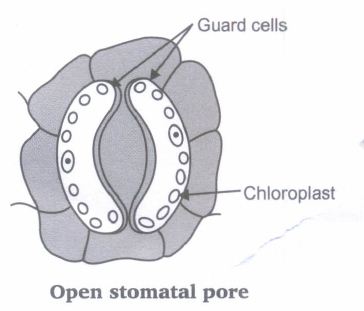
(b) (i) It helps in the exchange of gases like carbon dioxide and oxygen as per the requirement for the photosynthesis and respiration of the plants.
(ii) It also helps in the loss of water in the form of water vapour called transpiration.
(c) Guard cells swell when water enters into it by the process of osmosis and thereby opens the stomata pore for the loss of the water. When the water is lost it shrinks and closes the stomata pore.
4.
Some of the methods employed by plants to get rid of excretory products are as follows
(i) Gaseous wastes (i.e. carbon dioxide and oxygen) are removed through stomata in leaves and lenticels in stems into the atmosphere.
(ii) Plants get rid of excess water by transpiration.
(iii) Some waste products are stored as resins and gums.
(iv) Plants also excrete some waste substances into the soil around them.
(v) Waste products may be stored in leaves, bark or any other plant part, which fall off.
5.
Leaves of plants helps in excretion in many ways :
(i) Excess of water in plants is removed by the process of transpiration and guttation .
(ii) Carbon dioxide and oxygen that can be considered as waste products of respiration and photosynthesis respectively are excreted out with the help of stomata present on leaves .
(iii) Leaves help in excretion through a process abscission that is falling off and yellow of leaves. By the help of this process, plants get rid off toxins etc .
6.
Osmoregulation is the phenomenon of maintenance of optimum concentration of water and salts in the body fluids. Since, the reabsorption of water from filtrate occurs in the kidney tubule which maintains the water balance and thus, it helps in osmoregulation.
7.
Glucose, amino acids, salts and a major amount of water are selectively reabsorbed as the urine flows along the tube.
The amount of water reabsorbed depends on how much excess water there is in the body and on how much of dissolved waste there is to be excreted.
8.
Left kidney is positioned a little higher than right kidney due to the presence of liver just above it.
9.
The four-chambered heart are meant to prevent the mixing of oxygenated or oxygen rich and deoxygenated or carbon dioxide rich blood.
10.
(i) Xylem tissue forms a continuous system of water conducting channels which reaches all parts of the plants. If xylem tissue in plants is removed, then water conduction will not takes place.
(ii) Maintenance by platelets
In case of any injury when bleeding occurs, loss of blood from the system has to be minimised. Leakage leads to a loss of pressure which reduces the efficiency of pumping system.
To prevent this, blood has platelet cells which circulate around the body and form a mesh-like network or a clot at the site of injury.
Hence, blood clotting is a mechanism that prevents the loss of blood from the site of an injury or wound by forming a blood clot.
11.
| Arteries | veins | Capillaries |
| It carries oxygenated blood away from the heart to all the parts of the body |
It carries de-oxygenated bloodfrom the different parts of thebody to the heart | The single walled tubeshelps in the exchange of materials within the cell and the blood by diffusion |
12.
13.
(i) The blood circulation in human heart is called double circulation because the blood passes through the heart twice during one complete cardiac cycle of the body. Once through the right ventricle to the left auricle of the heart, i.e. pulmonary circulation. Second through the left ventricle to the right auricle of the heart viz., body tissues, i.e. systemic circulation.
(ii) Heart of mammals and birds is four-chambered. It helps them in various ways as these are warm blooded animals and their metabolism is complez. The body temperature is to be maintained throughout and for all above the energy is constantly required. The separation keeps oxygenated and deoxygenated blood from mixing allowing a highly efficient supply of oxygen to the body.
14.
(i) The blood circulation in human heart is called double circulation because the blood passes through the heart twice during one complete cardiac cycle of the body. Once through the right ventricle to the left auricle of the heart, i.e. pulmonary circulation. Second through the left ventricle to the right auricle of the heart viz., body tissues, i.e. systemic circulation.
(ii) Heart of mammals and birds is four-chambered. It helps them in various ways as these are warm blooded animals and their metabolism is complez. The body temperature is to be maintained throughout and for all above the energy is constantly required. The separation keeps oxygenated and deoxygenated blood from mixing allowing a highly efficient supply of oxygen to the body.
15.
The differences between transport of materials in xylem and phloem are as follows:
| Transport in Xylem | Transport In Phloem |
| Xylem transports water and minerals in plants | Phloem transports the products of photosynthesis, amino acids and other organic substances in plants. |
| The movement of water is unidirectional in xylem. | The movement of substances can be multidirectional. |
| Major operating forces are diffusion and transpirational pull. | Energy (ATP) is required for translocation. |
| It is not influenced by metabolic inhibitors. | Phloem transport is inhibited by metabolic inhibitors. |
| It is carried out by xylem vessels and tracheids. | It is carried out by sieve tubes with the help of adjacent Companion cells. |
16.
The transportation of food is carried by phloem in plants by utilising energy (ATP). This helps in increasing the osmotic pressure of the tissue causing water to move into it
Thus, the generated pressure allows the movement of materials from phloem to the tissue, which have less pressure.
17.
18.
(i) (b):Nitrogenous waste substances such as ammonia, urea or uric acid are produced during protein metabolism. Ammonia is the most toxic, followed by urea and uric acid. Uric acid is least toxic.
(ii) (c)
(iii) (b): Urea is a nitrogenous waste formed as a result of metabolism of various food/beverages in the body and is excreted in the urine. So,if a person is not taking food/beverages he will have less urea in his urine.
(iv) (c)
(v) (a): Malpighian corpuscle (A) is the site of ultrafiltration. A considerable amount of water is reabsorbed in the collecting duct (E) under the influence of ADH. Proximal convoluted tubule (C) is the main site for the reabsorption of glucose and amino acids. In distal convoluted tubule (D), bothhydrogen ions and ammonium ions are secreted, thus it maintains blood pH.
19.
20.
21.
22.
23.
(c)
24.
25.
26.

10th Standard CBSE Syllabus & Materials
10th Standard CBSE
CBSE 10th Social Science PS - Federalism - New Model Questions Papers Study Material - QB365 Set A
NEW10th Standard CBSE
CBSE 10th Social Science PS - Power Sharing - New Model Questions Papers Study Material - QB365 Set A
NEW10th Standard CBSE
CBSE 10th Social Science GEO - Manufacturing Industries - New Model Questions Papers Study Material - QB365 Set A
NEW10th Standard CBSE
CBSE 10th Social Science GEO - Minerals and Energy Resources - New Model Questions Papers Study Material - QB365 Set A



NCERT Books

Syllabus

Exam Pattern

Sample Question Papers

Previous year Question Papers

Important Notes

MCQ Practice test

NCERT Exemplers

Case study Questions

Image Based Questions

Passage based Questions

HOT Questions

Value Based Questions

Model Questions Papers
NCERT ( Book Back ) Questions

Assertion and Reason
Important Questions And Answers

CBSE 10th Standard CBSE Subjects
CBSE Standards



