
 100% FREE ACCESS
10th Standard CBSE Syllabus & Materials
10th Standard CBSE
CBSE 10th Social Science ECO - Globalisation and the Indian Economy - New Model Questions Papers Study Material - QB365 Set A
NEW10th Standard CBSE
CBSE 10th Social Science ECO - Money and Credit - New Model Questions Papers Study Material - QB365 Set A
NEW10th Standard CBSE
CBSE 10th Social Science ECO - Sectors of the Indian Economy - New Model Questions Papers Study Material - QB365 Set A
NEW10th Standard CBSE
CBSE 10th Social Science ECO - Development - New Model Questions Papers Study Material - QB365 Set A
NEW10th Standard CBSE
CBSE 10th Social Science PS - Outcomes of Democracy - New Model Questions Papers Study Material - QB365 Set A
NEW10th Standard CBSE
CBSE 10th Social Science PS - Gender, Religion and Caste - New Model Questions Papers Study Material - QB365 Set A

Published on: 17/08/2026
Download CBSE Class 10th Standard CBSE Science question papers, sample papers, important questions, and previous year solved papers in PDF format. Get free study materials, NCERT solutions, and exam preparation resources for Class 10th Standard CBSE Science
Questions + Answers key
Take MCQ Science Test
1.
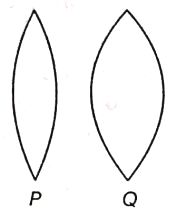
Manju has two convex lenses P and Q made of the same material as shown in the figure.
She is looking at printed text on a page using lens P. She notices that when she slowly takes the lens away from the page, the text turns upside down when the lens crosses a distance of 10 cm from the page.
(i) Which characteristic of lens P does the distance 10 cm signify?
(ii) If Manju does the same with lens Q, at what distance will the inversion of the image happen-less than, equal to or more than 10 cm? Justify your answer.
2.
The magnetic field associated with a current-carrying straight conductor is in anticlockwise direction. If the conductor was held along the east-west direction, what will be the direction of current through it? Name and state the rule applied to determine the direction of current.
3.
What is an electromagnet? Draw a circuit diagram to show how a soft iron piece can be transformed into an electromagnet.
4.
A current carrying wire produces magnetic field around it. The phenomena in which an electromotive force and current (if the conductor is in the form of a closed circuit) is induced by changing magnetic field (or by passing magnetic field lines) through it is called electromagnetic induction. The emf so developed is called induced emf and current made to flow is called induced current. The cause of induced emf carried out by Faraday and Henry. It can be concluded that the induced current flows in a conductor as long as the magnetic lines of force change within the conductor. In case of relative motion i.e., motion of coil w.r.t to magnet or vice versa, the direction of the current flowing in the conductor is determined by the direction of the relative motion of the conductor with respect to the magnetic field. The induced emf or current is directly proportional to the rate of change in magnetic field.
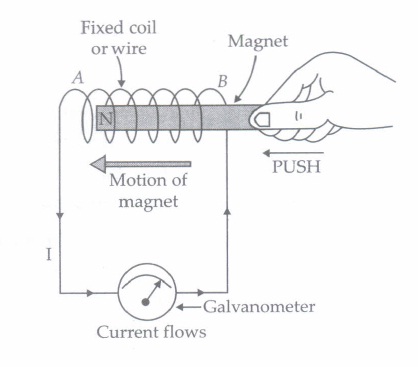
(i) A student connects a coil of wire with a sensitive galvanometer as shown in figure. He will observe the deflection in the galvanometer if bar magnet is
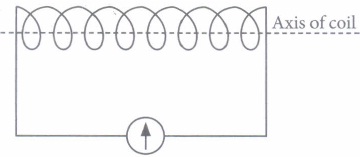
(a) placed near one of the faces of the coil and parallel to the axis of the coil
(b) placed near one of the faces of the coil and perpendicular to the axis of the coil
(c) placed inside the coil
(d) moved towards or away from the coil parallel to the axis of the coil.
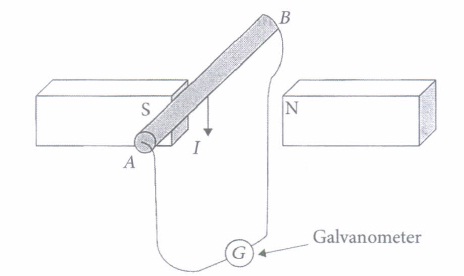
(ii) A conducting rod AB moves across two magnets as shown in figure and the needle in the galvanometer deflects momentarily. What is the name of this physical phenomenon?
| (a) Electromagnetism | (b) Induced magnetism |
| (c) Electromagnetic induction | (d) Static induction |
(iii) A bar magnet is pushed steadily into a long solenoid connected to a sensitive meter.
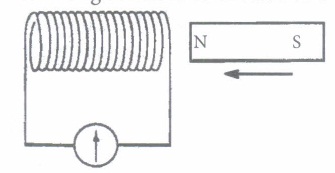
Which of the following would affect the magnitude of the deflection of the meter?
(a) How fast the magnet is pushed into the coil.
(b) The direction in which the coil is wound.
(c) The end of the solenoid the magnet enters.
(d) The pole of the magnet enters the coil first.
(iv) What is the condition of an electromagnetic induction?
(a) There must be a relative motion between galvanometer and coil of wire.
(b) There must be a relative motion between galvanometer and a magnet.
(c) There must be a relative motion between galvanometer and electric motor.
(d) There must be a relative motion between the coil of wire and a magnet.
(v) An induced emf is produced when a magnet is plunged into a coil. The magnitude of induced emf does not depend on
| (a) the number of turns in the coil | (b) the speed with which the magnet is moved |
| (c) the strength of the magnet | (d) the resistivity of the material of the coil |
5.
6.


7.
8.
9.
10.
11.

12.

13.
1.
(i) Focal length / half the radius of curvature.
(ii) The inversion will happen at a distance less than 10 cm. A thicker lens a smaller focal length.
2.
Right hand thumb rule -Imagine holding the current carrying straight conductor in your right hand such that the thumb points towards the direction of current. Then the fingers of right hand wrap around the conductor and shows the direction of the magnetic field formed around it.
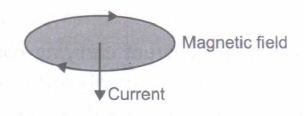
The direction of the current would be east-west, this can be determined by the right hand thumb rule.
3.
When a material is placed inside a coil carrying current (may be solenoid) it will get magnetised. A bunch of nails or an iron rod placed along the axis of the coil can be magnetised by the current allowed to pass through the coil.
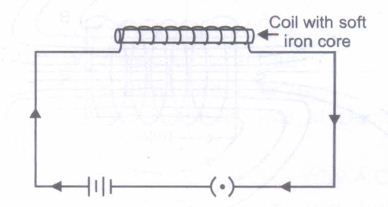
Once the current is put-off the magnetic field will also be lost. Such magnets are called electromagnets.
4.
(i) (d) : The deflection in galvanometer can be seen if bar magnet moved towards or away from coil parallel to the axis of the coil.
(ii) (c): If the needle of the galvanometer deflects it means there is change in magnetic field and current is induced.
(iii) (a): By Faraday's law of electromagnetic induction, the e.m.f. induced in a conductor is proportional to the rate of change of magnetic lines of force linking the circuit. Hence, by pushing in the magnet faster, the rate of change of magnetic lines will increase. This results in a larger induced e.m.f. and hence, larger deflection of the meter.
(iv) (d)
(v) (d): Resistivity of coil will determine the resistance of the coil and induced current through it, as induced
\(\text { current }=\frac{\mathrm{emf}}{\text { resistance }}\)
5.
6.
7.
8.
9.
 Given, object size, ho=5 cm; Image size, h, =?
10.
11.

12.
13.

10th Standard CBSE Syllabus & Materials
10th Standard CBSE
CBSE 10th Social Science PS - Federalism - New Model Questions Papers Study Material - QB365 Set A
NEW10th Standard CBSE
CBSE 10th Social Science PS - Power Sharing - New Model Questions Papers Study Material - QB365 Set A
NEW10th Standard CBSE
CBSE 10th Social Science GEO - Manufacturing Industries - New Model Questions Papers Study Material - QB365 Set A
NEW10th Standard CBSE
CBSE 10th Social Science GEO - Minerals and Energy Resources - New Model Questions Papers Study Material - QB365 Set A



NCERT Books

Syllabus

Exam Pattern

Sample Question Papers

Previous year Question Papers

Important Notes

MCQ Practice test

NCERT Exemplers

Case study Questions

Image Based Questions

Passage based Questions

HOT Questions

Value Based Questions

Model Questions Papers
NCERT ( Book Back ) Questions

Assertion and Reason
Important Questions And Answers

CBSE 10th Standard CBSE Subjects
CBSE Standards



