
 100% FREE ACCESS
10th Standard CBSE Syllabus & Materials
10th Standard CBSE
CBSE 10th Social Science ECO - Globalisation and the Indian Economy - New Model Questions Papers Study Material - QB365 Set A
NEW10th Standard CBSE
CBSE 10th Social Science ECO - Money and Credit - New Model Questions Papers Study Material - QB365 Set A
NEW10th Standard CBSE
CBSE 10th Social Science ECO - Sectors of the Indian Economy - New Model Questions Papers Study Material - QB365 Set A
NEW10th Standard CBSE
CBSE 10th Social Science ECO - Development - New Model Questions Papers Study Material - QB365 Set A
NEW10th Standard CBSE
CBSE 10th Social Science PS - Outcomes of Democracy - New Model Questions Papers Study Material - QB365 Set A
NEW10th Standard CBSE
CBSE 10th Social Science PS - Gender, Religion and Caste - New Model Questions Papers Study Material - QB365 Set A

Published on: 16/09/2019
Carbon and Its Compounds
Download CBSE Class 10th Standard CBSE Science question papers, sample papers, important questions, and previous year solved papers in PDF format. Get free study materials, NCERT solutions, and exam preparation resources for Class 10th Standard CBSE Science
Questions + Answers key
Take MCQ Science Test
1.
State the meaning of functional group in a carbon compound. Write the functional group present in (i) ethanol and (ii) ethanoic acid and also draw their structures.
2.
Write the name and the structural formula of the compound formed when ethanol is heated at 443 K with excess of conc. H2SO4 . State the role of conc. H2SO4 in this reaction. Write chemical equation for this reaction.
3.
Distinguish between esterification and saponification reactions of organic compounds with the help of the chemical equation for each. What is the use of
(i) esters and
(ii) saponification process?
4.
Name the oxidizing agent used for the conversion of ethanol to ethanoic acid. Distinguish between ethanol and ethanoic on the basis of
(i) litmus test.
(ii) reaction with sodium hydrogen carbonate.
5.
What are isomers? Draw the structures of two isomers of butane, C4H10. Why can't we have isomers of first three members of alkane series?
6.
Describe two examples of different oxidation of ethanol. Name the products obtained each case.
7.
An organic compound 'A' is an essential constituent of wine and beer. Oxidation of 'A' yields an organic acid 'B' which is present in vinegar. Name the compounds 'A' and 'B' and write their structural formula. What happens when 'A' and 'B' react in the presence of an acid catalyst? Write the chemical equation for the reaction.
8.
What is a homologous series? Which two of the following organic compounds belong to the same homologous?
9.
Write the name and molecular formula of an organic compound having its name suffixed with '-ol and having two carbon atoms in the molecule. Write the help of a balanced chemical equation indicate what happens when it is heated with excess of conc. H2SO4
10.
(a) What is meant by a functional group in an organic compound? Name the functional group present in
(i) CH3CH2OH
(ii) CH3COOH
(b) State one point of difference between soap and synthetic detergent.
11.
Draw the electron dot structure of ethyne and also draw its structural formula.
12.
Explain the formation of scum when hard water is treated with soap.
13.
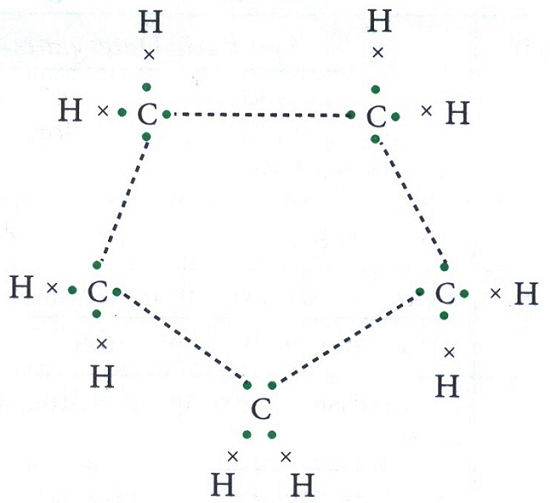
What will be the formula and electron dot structure of cyclopentane?
14.
How would you distinguish experimentally between an alcohol and a carboxylic acid?
15.
A mixture of oxygen and ethyne is burnt for welding. Can you tell why a mixture of ethyne and air is not used?
1.
-s.jpg)
-s.jpg)
2.
(i) When ethanol is heated with excess of concentrated sulphuric acid at 443K, it gets dehydrated to form ethene.
\(\underset { Ethanol }{ { CH }_{ 3 }-{ CH }_{ 2 } } OH\xrightarrow [(Dehydration) ]{ conc. H_2SO_4;443K } \underset { Ethene }{ { CH }_{ 2 }={ CH }_{ 2 } } +H_2O\)
In this reaction, concentrated sulphuric acid acts as a dehydrating agent which removes water molecules from the ethanol molecule.
3.
Esterification: It is a process in which alcohol and carboxylic acid combine in the presence of cone. H2SO4 to form ester.
\(\underset{Ethanoic\ acid}{CH_3COOH}+\underset{Ethanol}{C_2H_5OH}\xrightarrow{conc.H_2SO_4}\underset{Ethyl\ ethanoate}{CH_3COOC_2H_5}+H_2O\)
Saponification: When an ester reacts with sodium hydroxide, sodium salt of acid and alcohol is formed.
\(\underset{Ethyl\ ethanoate}{CH_3COOC_2H_5}+\underset{Sodium\\ hydroxide}{NaOH}\rightarrow \underset{Sodium\\ ethanoate}{CH_3COONa}+\underset{Ethanol}{C_2H_5OH}\)
Uses:
(i) Esters are used in cold drinks, ice creams, perfumes and as artificial flavouring agents.
(ii) Saponification process is used in the manufacture' of soaps.
4.
Alkaline potassium permanganate of acidified potassium dichromate.
(i) Ethanol will not affect litmus paper Ethanoic acid will turn blue litmus paper red.
(ii) Ethanol will not react with sodium hydrogen carbonate. Ethanoic acid will give brisk effervescence due to colourless, odourless carbon dioxide gas.
5.
Those compounds, which have same molecular formula but different structural formulae are called isomers.
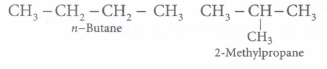
In first three members of alkane series, branching is not possible. Therefore, we cannot have isomers.
6.
(i) When ethanol is heated with copper at 573K, ethanal is formed.
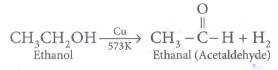
(ii) When ethanol is oxidised with alkaline potassium permanganate solution, ethanoic acid is formed.
\(\underset{Ethanol}{CH_3CH_2OH}+2[O]\xrightarrow[KMnO_4]{Alkaline}\underset{Ethnoic\ acid}{CH_3COOH}\)
7.
A is ethanol (C2H5OH) which is essential constituent of wine and beer and 'B' is acetic acid (CH3COOH) which is present in vinegar.
\(\underset{(Present\ in\ wine\ and\ beer)\\ 'A'}{CH_3CH_2OH}+2[O]\xrightarrow[Oxidation]{Alkaline\ KMnO_4}\underset{Acid\\ (Present\ in\ vinegar)\\ 'B'}{CH_3COOH}+H_2O\)
When 'A' and 'B' react in the presence of an acid catalyst, ethyl ethanoate is formed.
\(\underset{'A'}{CH_3COOH(l)}+\underset{'A'}{C_2H_5OH(l)}\xrightarrow{Conc. H_2SO_4} CH_3COOC_2H_5(l)+H_2O(l)\)
8.
Homologous series is a series of organic compounds which have same functional group and similar chemical properties. Each member of this series differs by - CH2 - in its molecular formula and 14 u in its molecular mass.
C2H6O(C2H5OH) and CH4O(CH3OH) belong to same homologous series.
9.
It is ethanol, its molecular formula is C2H6O.
Ethanol forms ethene, when heated with conc. H2SO4.
\(CH_3 \underset { Ethanol }{CH_2 }OH \xrightarrow [heat ]{ Conc.H_2SO_4 } \underset { Ethene }{CH_2= CH_2 }+H_2O \)
10.
(a) Functional group is an atom or group of atoms or reactive part of compound, which determines chemical properties of compounds.
(i) -OH (Alcohol)
(ii) -COOH (Carboxylic acid)
(b) Soaps do not work well with hard water, detergents work well with hard water.
11.
Molecular Formula of Ethyne: C2H2
Electron dot structure of Ethyne:

Structural formula of Ethyne
HC≡CH
12.
Hard water contains calcium and magnesium ions. Soap is basically sodium or potassium salt of higher fatty acids. When soap is added to hard water, corresponding calcium and magnesium salts are formed, which being insoluble gets precipitated. These precipitates are called scum. Reactions taking place are shown as:
Ca2+ + 2RCOONa \(\rightarrow\) (RCOO)2 Ca\(\downarrow\) + 2Na+
Hard water Soap Calcium salt precipitate
Mg2+ + 2R COONa \(\rightarrow\) (RCOO)2Mg \(\downarrow\) + 2Na+
Hard water Soap Magnesium salt precipitate
13.
The formula for cyclopentane is C5H10. Its electron dot structure is
14.
Alcohol and carboxylic acid can be distinguished experimentally by two reactions:
(i) Reaction with Base
Alcohols do not react with base like NaOH, KOH while carboxylic acids react with base to form salt and water.
e.g. CH3COOH + NaOH \(\rightarrow\) CH3CO\(\bar{O}\)\(\overset{+}{N}\)a + H2O
CH3CH2OH + NaOH \(\rightarrow\) No reaction
(ii) Reaction with Sodium bicarbonate
Carboxylic acids react with sodium bicarbonate rapidly to give brisk effervescence of CO2 gas while alcohols do not react.
e.g. CH3COOH + NaHCO3 \(\rightarrow\) CH3COONa + H2O + CO2\(\uparrow\)
CH3CH2OH + NaHCO3 \(\rightarrow\) No reaction
15.
We need a high temperature for welding but when ethyne is burnt in air, it undergoes incomplete combustion and releases a lot of smoke and the temperature is also not very high. In order to ensure complete oxidation and to obtain the high temperature needed for welding, a mixture of ethyne and oxygen is used.
2CH \(\equiv\) CH + 5O2 \(\rightarrow\) 4CO2 + 2H2O + Heat + Light

10th Standard CBSE Syllabus & Materials
10th Standard CBSE
CBSE 10th Social Science PS - Federalism - New Model Questions Papers Study Material - QB365 Set A
NEW10th Standard CBSE
CBSE 10th Social Science PS - Power Sharing - New Model Questions Papers Study Material - QB365 Set A
NEW10th Standard CBSE
CBSE 10th Social Science GEO - Manufacturing Industries - New Model Questions Papers Study Material - QB365 Set A
NEW10th Standard CBSE
CBSE 10th Social Science GEO - Minerals and Energy Resources - New Model Questions Papers Study Material - QB365 Set A



CBSE 10th Standard CBSE Subjects
CBSE Standards





