
10th Standard CBSE Syllabus & Materials
10th Standard CBSE
CBSE 10th Social Science ECO - Globalisation and the Indian Economy - New Model Questions Papers Study Material - QB365 Set A
NEW10th Standard CBSE
CBSE 10th Social Science ECO - Money and Credit - New Model Questions Papers Study Material - QB365 Set A
NEW10th Standard CBSE
CBSE 10th Social Science ECO - Sectors of the Indian Economy - New Model Questions Papers Study Material - QB365 Set A
NEW10th Standard CBSE
CBSE 10th Social Science ECO - Development - New Model Questions Papers Study Material - QB365 Set A
NEW10th Standard CBSE
CBSE 10th Social Science PS - Outcomes of Democracy - New Model Questions Papers Study Material - QB365 Set A
NEW10th Standard CBSE
CBSE 10th Social Science PS - Gender, Religion and Caste - New Model Questions Papers Study Material - QB365 Set A

Published on: 01/11/2019
Download CBSE Class 10th Standard CBSE Science question papers, sample papers, important questions, and previous year solved papers in PDF format. Get free study materials, NCERT solutions, and exam preparation resources for Class 10th Standard CBSE Science
Questions + Answers key
Take MCQ Science Test
1.
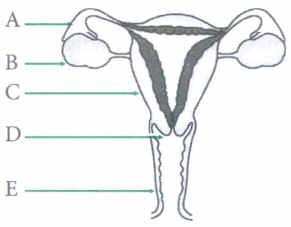
(a)Name the parts labelled A, B, C, D and E.
(b)Where do the following functions occur?
(i) Production of an egg
(ii) Fertilisation
(iii) Implantation of the zygote.
(c) What happens to the lining of uterus:
(i) before release of a fertilised egg?
(ii) if no fertilisation occurs?
2.
Look at the below figure and answer the following questions:
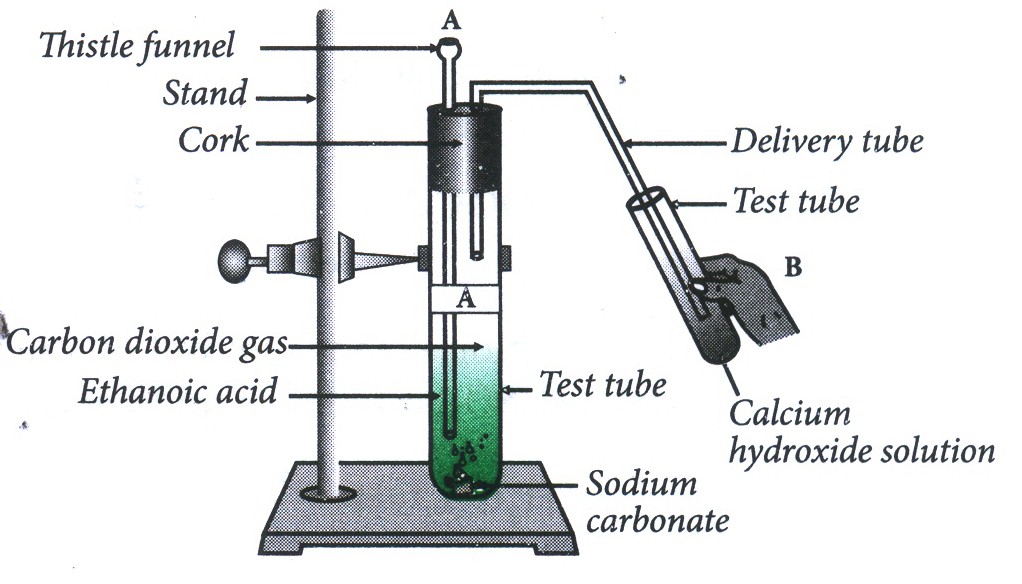
a) What change would you observe in the calcium hydroxide solution taken in tube B?
b) Write the reaction involved in test tubes A and B respectively.
c) If ethanol is given instead of ethanoic acid, would you expect the same change?
d) How can a solution of lime water be prepared in the laboratory?
3.
(a)List the parts of the human eye that control the amount of light entering into it. Explain how they perform this function.
(b)Write the function of retina human eye.
(c)Do you know that the corneal impairment can be cured by replacing the defective cornea with the cornea of the donated eyes? How and why should we organise groups to motivate the community members to donate their eye after death?
4.
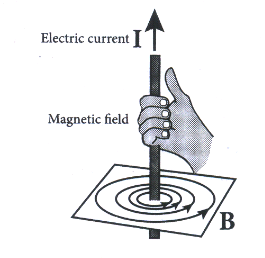
With the help of a labelled circuit diagram illustrate the pattern of field lines of the magnetic field around a current carrying straight long conducting wire. How is the right hand thumb rule useful to find direction of magnetic field associated with a current carrying conductor?
5.
Explain the following
(a) Reactivity of Al decreases if it is dipped in HNO3.
(b) Carbon cannot reduce the oxides of Na or Mg
(c) NaCl is not a conductor of electricity in solid state whereas it does conduct electricity in aqueous solution as well as in molten state.
(d) Iron articles are galvanised
(e) Metals like Na, K, Ca and Mg are never found in their free state in nature.
6.
Explain the mechanism of photosymthesis.
7.
For making cake, baking powder is taken. If at home your mother uses baking soda instead of baking powder in cake,
(a) How will it affect the taste of the cake and why?
(b) How can baking soda be converted into baking powder?
(c) What is the role of tartaric acid added to baking soda?
8.
On heating blue coloured powder of copper (II) nitrate in a boiling tube, copper oxide (black), oxygen gas and a brown gas X is formed.
(a) Write a balanced chemical equation of the reaction.
(b) Identify the brown gas X evolved.
(c) Identify the type of reaction.
(d) What could be the pH range of aqueous solution of the gas X?
9.
How does chemical coordination take place in animals?
10.
Explain giving example where active involvement of local people lead to efficient management of forest.
1.
(a) A\(\rightarrow \) Oviduct or Fallopian tube;
B\(\rightarrow \) Ovary;
C\(\rightarrow \) Uterus;
D\(\rightarrow \) Cervix;
E\(\rightarrow \) Vagina.
(b) (i) Ovaries;
(ii) Fallopian tube;
(iii) Lining of the uterus.
(c) (i) The lining of the uterus becomes
(ii) The lining of the uterus slowly breaks and comes out through the vagina as blood and mucous, if no fertilisation occurs.
2.
a) When carbon dioxide is passed through the calcium hydroxide solution, it turns milky due to the formation of insoluble calcium carbonate.
b) Reaction in Test tube A:
\(\underset{Acetic\ or\ ethnoic\ acid}{2CH_3COOH(1)}+\underset{Sodium\ carbonate}{Na_2CO_3(s)}\rightarrow\underset{Sodium\ acetate}{2CH_3COONa}+\underset{Water}{H_2O}+\underset{Carbon\ ioxide}{CO_2(g)}\)
Reaction in Test tube B:
\(\underset{Calciumhydroxide\\ (Lime\ water)}{Ca(OH)_2(aq)}+\underset{Carbondioxide}{CO_2(g)}\rightarrow\underset{Calcium\ carbonate\\ (White\ ppt)}{CaCO_3(s)\downarrow}\underset{Water}{H_2O}\)
c) No with ethanol no reaction takes place.
d) When a quick lime i.e., calcium oxide is added to water in a test tube, it forms calcium hydroxide which is lime water. This solution is filtered and the clear solution is obtained
\(CaO(s)+H_2O(l)\rightarrow Ca(OH)_2\)
3.
(a) (i) The iris and pupil control the amount of light entering the eyes. If the amount of light received by the eye is large, then the iris contracts the pupil and reduces the amount of light entering the eye.
(ii) If the amount of light received by the eye is small, the iris expands the pupil so that more light may enter the eyes.
(b) The screen on which the image is formed in the eye is called retina. Retina is a delicate membrane having a large number of light sensitive cells called 'rods' and 'cone' which respond to the 'intensity of light' and 'colors of object' respectively.
(c) Reasons for donating eyes:
(1) A person's corneal blindness can only be elevated by a human donor's cornea.
(2) It is opportunity to restore someone's sight.
Methods for supporting this cause:
(1) Make it a family tradition of donating the eyes.
(2) Motivate and educating others about eye donation.
(3) Help removing all the myths about eye donation.
4.
The following diagram depicts the pattern and direction of magnetic field lines around a straight current-carrying conductor.
Right Hand Thumb Rule: If a current carrying conductor is held by right hand, keeping the thumb straight and if the direction of electric current is in the direction of thumb, then the direction of wrapping of other fingers will show the direction of magnetic field.
5.
(a) Due to the formation of a layer of oxide i.e., Al2O3
(b) Na or Mg is more reactive metals as compared to carbon.
(c) In solid NaCI, the movement of ions is not possible due to its rigid structure but in aqueous solution or molten state, the ions can move freely.
(d) To protect from corrosion.
(e) They are highly reactive.
6.
Food is prepared in the green leaves of the plant by combining carbon dioxide and water in presence of sunlight and chlorophyll. The carbon dioxide required for photosynthesis is taken by the plants from air. The carbon dioxide enters the leaves through tiny pores called stomata. The water required is taken from soil. The sunlight provides the energy required to carry out the preparation of food. The green pigment called chlorophyll present in green leaves help to absorb energy from sunlight. The oxygen produced as a by-product goes into the air.
The food prepared by the green leaves is in the form of glucose. This glucose is sent to different parts of the plant. The excess glucose is changed into starch and is stored in the leaves of the plant. The food prepared by photosynthesis provides all the energy to a plant which it needs to grow. Thus, it is clear that the green plants convert sunlight energy into chemical energy. by making food. When we eat plant foods such as fruits, vegetables, food grains etc., the chemical energy stored in them is released in our body during respiration.
During the process of photosynthesis, the following three steps take place:
(i) Absorption of sunlight energy by chlorophyll.
(ii) Conversion of sunlight energy into chemical energy and splitting of water into hydrogen and oxygen using sunlight energy.
(iii) Reduction of carbon dioxide to form carbohydrates using the chemical energy.
7.
(a) Baking soda is sodium hydrogen carbonate. On heating, it is converted carbonate. On heating, it is converted into sodium carbonate which is bitter to taste.
\(2NaHCO_3\xrightarrow{Heat}Na_2CO_3+H_2O+CO_2\)
(b) Baking soda can be converted into baking powder by the addition of appropriate acid to it.
(c) The role of tartaric acid is to neutralise sodium carbonate and cake will not taste bitter.
8.
(a) \(2Cu(NO_3)_2\xrightarrow{Heat}2CuO+4NO_2+O_2\)
The brown gas so formed in this reaction is nitrogen dioxide.
(b)Thus, the brown gas 'X' is nitrogen dioxide
(c)This is a Decomposition reaction
(d)Nitrogen dioxide forms nitric acid when reacts with water. The pH value of an acid is less than 7 to 0. Thus the pH range of the aqueous solution of gas 'X' i.e. Nitrogen dioxide may be from 0 to less than 7.
The reaction between nitrogen dioxide and water can be written as follows:-
\(2NO_2 + H_2O\rightarrow HNO_2 + HNO_3\)
9.
Chemical coordination is performed by hormones, which are chemical messengers secreted by endocrine glands.
These hormones coordinate the activities of living organisms and also their growth.
The timing and the amount of hormones released are regulated by the feedback mechanism.
10.
(1) People participation in the management of forests can help in increasingly forest produces as well as in their conservation.
(2) in 1972, the West Bengal Forest Department formulated a novel scheme to revive the degraded Sal forests by involving the local people.
(3) A far-sighted forest officer A.K. Banerjee involved the villages of the area around the forest in the protection of 1272 hectares of badly degraded Sal forest.
(4) In return for help in protecting the forest, the villagers were given employment in both silviculture and harvesting operations of the forest, 25% of the final harvest produce, and were allowed to collect firewood and fodder from the forest area on nominal payment.
(5) With the active and willing participation of local people living around the forest, the degraded Sal forest of Arabari became thick and green within ten years.

10th Standard CBSE Syllabus & Materials
10th Standard CBSE
CBSE 10th Social Science PS - Federalism - New Model Questions Papers Study Material - QB365 Set A
NEW10th Standard CBSE
CBSE 10th Social Science PS - Power Sharing - New Model Questions Papers Study Material - QB365 Set A
NEW10th Standard CBSE
CBSE 10th Social Science GEO - Manufacturing Industries - New Model Questions Papers Study Material - QB365 Set A
NEW10th Standard CBSE
CBSE 10th Social Science GEO - Minerals and Energy Resources - New Model Questions Papers Study Material - QB365 Set A



CBSE 10th Standard CBSE Subjects
CBSE Standards





