
 100% FREE ACCESS
10th Standard CBSE Syllabus & Materials
10th Standard CBSE
CBSE 10th Social Science ECO - Globalisation and the Indian Economy - New Model Questions Papers Study Material - QB365 Set A
NEW10th Standard CBSE
CBSE 10th Social Science ECO - Money and Credit - New Model Questions Papers Study Material - QB365 Set A
NEW10th Standard CBSE
CBSE 10th Social Science ECO - Sectors of the Indian Economy - New Model Questions Papers Study Material - QB365 Set A
NEW10th Standard CBSE
CBSE 10th Social Science ECO - Development - New Model Questions Papers Study Material - QB365 Set A
NEW10th Standard CBSE
CBSE 10th Social Science PS - Outcomes of Democracy - New Model Questions Papers Study Material - QB365 Set A
NEW10th Standard CBSE
CBSE 10th Social Science PS - Gender, Religion and Caste - New Model Questions Papers Study Material - QB365 Set A

Published on: 01/11/2019
Download CBSE Class 10th Standard CBSE Science question papers, sample papers, important questions, and previous year solved papers in PDF format. Get free study materials, NCERT solutions, and exam preparation resources for Class 10th Standard CBSE Science
Questions + Answers key
Take MCQ Science Test
1.
Write the chemical equation of the reaction with an example each in which the following change has taken place:
(i) Change in colour
(ii)Change in temperature
(iii) Formation of precipitate.
2.
After drinking an excess of cold drink, a person suffered from acidity. Explain
3.
Define the term decomposition reaction. Give one example each of thermal decomposition and electrolytic decomposition.
4.
Explain the action of dilute hydrochloric acid on the following with chemical equation:
(i) magnesium ribbon
(ii) sodium hydroxide
(iii) crushed egg shells
5.
You are given samples of three metals: Sodium, magnesium and copper. Suggest any two activities to arrange them in order to their decreasing reactivity
6.
A sanitary worker uses a white chemical having strong smell of chlorine gas to disinfect the water tank.
(i) Identify the chemical compound, write its chemical formula.
(ii) Give chemical equation for its preparation.
(iii) Write its two uses other than disinfection.
7.
List three properties of sodium in which it differs from the general physical properties of most metals.
8.
State five points of differences between ionic compound and covalent compound.
9.
Distinguish between an electric motor and generator?
10.
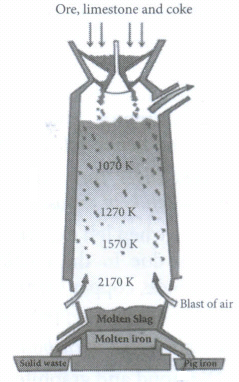
Name a major ore from which iron is extracted. Write chemical equations for the reactions that take place in the blast furnace for the extraction of iron from this ore.
11.
(a) State one limitation of solar energy available from solar cells.
(b) What is the minimum wind velocity required to obtain useful energy with a windmill?
(c) Define the term 'nuclear fission'.
12.
How do neurons transmit information?
13.
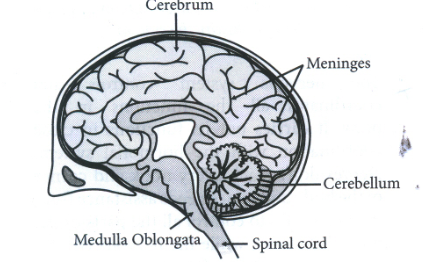
Draw a diagram of human brain and label on it the following of its parts:
(i) Cerebrum
(ii) Meninges
(iii) Medulla Oblongata
(iv) Cerebellum
14.
A touch bulb is rated 2.5 V and 750 mA. Calculate (i) its power, (ii) its resistance and (iii) the energy consumed if this bulb is lighted for four hours.
1.
(i) Change in colour: Reaction between lead nitrate solution and potassium iodide solution.
Pb(NO3)2(aq) + 2KI \(\longrightarrow \) PbI2(s) + 2KNO3(aq)
In this reaction, colour changes from colourless to yellow.
(ii) Change in temperature: Action of dilute sulphuric acid on zinc.
Zn(s) + H2SO4(aq) \(\longrightarrow \) ZnSO4(aq) + H2
In this reaction, heat is evolved
(iii) Formation of precipitate : Action of barium chloride on sodium sulphate.
BaCl2(aq)+ Na2SO4(aq) \(\longrightarrow \) BaSO4(s) + 2NaCl(aq)
2.
Cold drinks contain carbon dioxide dissolved in them under pressure. Some amount of the gas escapes when a bottle of cold drink is opened while a portion of it remains dissolved. Carbon dioxide dissolved in water forms a weak acid, carbonic acid. Consumption of excess of cold drink causes accumulation of carbonic acid in the stomach which is responsible for the development of acidity.
3.
Reaction in which a single reactant breaks down to give simpler products.
Thermal decomposition-
\(CaCO_{ 2 }\overset { \triangle }{ \longrightarrow } CaO+C{ O }_{ 2 }\)
(Or any other)
Electrolytic decomposition-
2H2O\(\overset { Electric\quad current }{ \rightarrow } \) 2H2+O2
(or)
In a decomposition reaction, a single reactant breaks down into two or more simpler products.
When a decomposition reaction is carried out by heating, it is called thermal decomposition reaction.
\(\underset { (Calucium\quad carbonate) }{ CaCO_{ 3 }(s) } \overset { Heat }{ \rightarrow } \underset { Calcium\quad oxide) }{ CaO(s) } +\underset { (Carbon\quad dioxide) }{ { CO }_{ 2 }(g) } \)
When a decomposition reaction is carried out with the help of electric current, the process is called electrolysis.
\(\underset { Water }{ 2{ H }_{ 2 }O(I) } \overset { Electric\quad current }{ \longrightarrow } \underset { (Hydrogen\quad gas) }{ 2{ H }_{ 2 }(g) } +\underset { (Oxygen\quad gas) }{ { O }_{ 2 }(g) } \)
4.
(i) Mg + 2HCl\(\rightarrow\)MgCl2+H2
Hydrogen gas is produced
(ii) HCl + NaOH\(\rightarrow\) NaCl+H2O
Neutralisation reaction
(iii) 2HCI(aq)+ CaCO3(aq)\(\rightarrow\)CaCl2(aq)+H2O+CO2
Calcium chloride is formed.
5.
Different metals react with oxygen at different rates. e.g., Sodium (Na) and potassium (K) catch fire, if left in open. Hence, these are the most reactive metals. To prevent accidental fires, these metals are kept immersed in kerosene oil. Magnesium burns in air only by heating. So, it is less reactive than sodium and potassium. Copper (Cu) does not burn on heating but blister copper burns. Hence the order of reactivity of these metals with oxygen is :
Na >Mg> Cu.
Metals react with water to produce a metal oxide and hydrogen gas. Sodium (Na) and potassium (K) react violently with cold water. So the reaction is violent and exothermic. Magnesium (Mg) does not react with cold water. It reacts with hot water. Metals like lead, copper, silver do not react with water at all. The reactivity series of metals towards water is:
Na > Mg > Cu.
6.
(i) Bleaching powder - CaOCI2
(ii) C(OH)2 + Cl2➝ CaOCI2 + H2O
(iii) Two uses other than disinfection are:
(a) Paper industries (b) Chemical Industries
7.
Three properties of sodium are:
(i) Sodium is so soft that it can be cut with a knife.
(ii) It has low density.
(iii) It has low melting point.
8.
| Ionic Compound | Covalent Compound | ||
| 1. | Ionic compounds contain ionic bond made up of ions. | 1. | Covalent compounds contain covalent bond made up of no ions. |
| 2. | Loss and gain of electrons takes place. | 2. | Sharing of electrons takes places. |
| 3 | Can conduct electricity. | 3. | Cannot conduct electricity. |
| 4. | Has high melting point. | 4. | Has low melting point. |
| 5. | Are soluble in water. | 5. | Are insoluble in water. |
9.
The major differences between an electric motor and generator are stated below:
Electric Motor:
1. It converts electrical energy into mechanical energy.
2. It needs electrical energy for its works.
3. They are used as water pumps, marble grinders etc.
Generator:
1. It converts mechanical energy into electrical energy
2. It needs mechanical energy for its working.
3. They are used as water pumps, marble grinders etc.
4. diesel generator, hydro-electric generator are the examples of it.
10.
Haematite (Fe2O3) is an important ore of iron.
In the upper part of the blast furnace, carbon monoxide reduces iron (III) oxide to iron metal.
\(\underset { Iron(III)oxide }{ { Fe }_{ 2 }{ O }_{ 3 } } +\underset { Carbonmonoxide }{ 3CO(g) } \rightarrow \underset { Ironmetal }{ 2Fe(I) } +\underset { Carbondioxide }{ { 3CO }_{ 2 }(g) } \)
Following reactions are involved in the blast furnace:
(i) Formation of carbon monoxide
\(\underset { Carbon }{ C(s) } +\underset { Oxygen }{ { O }_{ 2 }(g) } \rightarrow \underset { Carbondioxide }{ { CO }_{ 2 }(g) } +Heat\\ \underset { Carbondioxide }{ { CO }_{ 2 }(g) } +\underset { Coke }{ C(s) } \rightarrow \underset { Carbonmonoxide }{ 2CO(g) } \)
(ii) Reduction of iron (III) oxide or haematite to iron
\(\underset { Iron(III)oxide }{ { Fe }_{ 2 }{ O }_{ 3 } } +\underset { Carbonmonoxide }{ 3CO(g) } \rightarrow \underset { Ironmetal }{ 2Fe(I) } +\underset { Carbondioxide }{ { 3CO }_{ 2 }(g) } \)
11.
(a) The solar cells are costly and hence the energy available from them expensive.
(b) 15 km/h is the minimum wind velocity required to obtain useful energy with a windmill.
(c) Nuclear fission is the process in which a radioactive atom splits up into smaller nuclei when struck with low energy neutrons.
12.
Information passes through neuron in the form of electro-chemical signals. These signals are called impulse.
When an impulse reaches the end of the axon it sets off the release of some chemicals. These chemicals cross the gap or the synapse and start a similar electrical impulse in a dendrite of the next neuron. A similar synapse allows the delivery of impulses from the neurons to other cells, like muscle cells or glands.
13.
14.
It is given that: Voltage (V) = 2.50 V
Current (I) = 750 mA = 0.75 A
The bulb is lighted for 4 hours.
Thus,
(i) Power generated (P) = VI = 2.50\(\times\) 0.75 = 1.87 W
(ii) Resistance (R) = \(\frac { V }{ I } =\frac { 2.5 }{ 0.75 } =3.33\Omega \)
(iii) Energy consumed in 4 hours = Power\(\times\)Time = P\(\times\)t =1.87\(\times\)4 = 7.48 Wh

10th Standard CBSE Syllabus & Materials
10th Standard CBSE
CBSE 10th Social Science PS - Federalism - New Model Questions Papers Study Material - QB365 Set A
NEW10th Standard CBSE
CBSE 10th Social Science PS - Power Sharing - New Model Questions Papers Study Material - QB365 Set A
NEW10th Standard CBSE
CBSE 10th Social Science GEO - Manufacturing Industries - New Model Questions Papers Study Material - QB365 Set A
NEW10th Standard CBSE
CBSE 10th Social Science GEO - Minerals and Energy Resources - New Model Questions Papers Study Material - QB365 Set A



CBSE 10th Standard CBSE Subjects
CBSE Standards





