
 100% FREE ACCESS
10th Standard CBSE Syllabus & Materials
10th Standard CBSE
CBSE 10th Social Science ECO - Globalisation and the Indian Economy - New Model Questions Papers Study Material - QB365 Set A
NEW10th Standard CBSE
CBSE 10th Social Science ECO - Money and Credit - New Model Questions Papers Study Material - QB365 Set A
NEW10th Standard CBSE
CBSE 10th Social Science ECO - Sectors of the Indian Economy - New Model Questions Papers Study Material - QB365 Set A
NEW10th Standard CBSE
CBSE 10th Social Science ECO - Development - New Model Questions Papers Study Material - QB365 Set A
NEW10th Standard CBSE
CBSE 10th Social Science PS - Outcomes of Democracy - New Model Questions Papers Study Material - QB365 Set A
NEW10th Standard CBSE
CBSE 10th Social Science PS - Gender, Religion and Caste - New Model Questions Papers Study Material - QB365 Set A

Published on: 20/09/2019
Metals and Non-Metals
Download CBSE Class 10th Standard CBSE Science question papers, sample papers, important questions, and previous year solved papers in PDF format. Get free study materials, NCERT solutions, and exam preparation resources for Class 10th Standard CBSE Science
Questions + Answers key
Take MCQ Science Test
1.
You are given samples of three metals: Sodium, magnesium and copper. Suggest any two activities to arrange them in order to their decreasing reactivity
2.
Describe an activity to show that the rusting of iron occurs in the presence of air and moisture.
3.
Write the balanced chemical equation for the following reactions:
(i) When copper is heated in air.
(ii) When aluminum is heated in air.
(iii) Aluminium oxide reacts with sodium hydroxide.
4.
State reason for the following:
(i) Non-metals cannot displace hydrogen from the acids.
(ii) Hydrogen is not a metal, yet it is placed in the activity series of metals.
(iii) Aluminium is more reactive than iron, yet its corrosion is less than that of iron
5.
Write three differences between metals and non-metals on the basis of chemical properties.
6.
(i) A non-metal X exists in two different forms Y and Z. Y is the hardest natural substance whereas Z is a good conductor of electricity. Identity X, Y, Z.
(ii) A element, X, on reaction with oxygen forms an oxide XO2. The oxide when dissolved in water turns blue litmus red. State whether element X is a metal or a non-metal.
(iii) Name the metal which is alloyed with copper to make bronze.
7.
Point out any 3 differences between calcination and roasting.
8.
State five points of differences between ionic compound and covalent compound.
9.
What are 'mineral' and 'ore'?
10.
Why do ionic compounds conduct electricity?
11.
From amongst the metals sodium, calcium, aluminium, copper and magnesium, name the metal.
(i) which reacts with water only on boiling and
(ii) another which does not react even with steam.
12.
Give reasons for the following :
(i) Metals are regarded as electro-positive elements
(ii) When a piece of copper metal is added to a solution of zinc sulphate, no change takes place, but the blue colour of copper sulphate fades away when a piece of zinc is placed in its solution.
(iii) Articles made of alimunium do not corrode even though aluminium is an active metal.
13.
(i) Name an important oxide ore of iron.
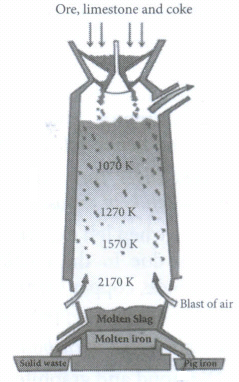
(ii) Describe the extraction of iron from those ore under the following heads:
(a) Reduction of the concentrated ore
(b) Diagram of the furnace used
(c) Chemical equations for the reactions involved
14.
Name a major ore from which iron is extracted. Write chemical equations for the reactions that take place in the blast furnace for the extraction of iron from this ore.
15.
On adding dilute HCl acid to copper oxide powder, the solution formed is blue-green. Predict the new compound formed which imparts a blue-green colour to the solution.
1.
Different metals react with oxygen at different rates. e.g., Sodium (Na) and potassium (K) catch fire, if left in open. Hence, these are the most reactive metals. To prevent accidental fires, these metals are kept immersed in kerosene oil. Magnesium burns in air only by heating. So, it is less reactive than sodium and potassium. Copper (Cu) does not burn on heating but blister copper burns. Hence the order of reactivity of these metals with oxygen is :
Na >Mg> Cu.
Metals react with water to produce a metal oxide and hydrogen gas. Sodium (Na) and potassium (K) react violently with cold water. So the reaction is violent and exothermic. Magnesium (Mg) does not react with cold water. It reacts with hot water. Metals like lead, copper, silver do not react with water at all. The reactivity series of metals towards water is:
Na > Mg > Cu.
2.
Take three test-tubes. Place clean iron nails in each test-tube.
(i) Pour some water in test-tube-1, cork it.
(ii) Pour water (boiled/distilled) in test-tube-2, add some oil and cork it.
(iii) Put some anhydrous calcium chloride in test-tube-3 and cork it.
(iv) After 2-3 days, we observe that the nails in test-tube 1 rust because they are exposed to air and water both, while nail in test-tube 2 and 3 do not rust. This shows that rusting of iron takes place in the presence of air and moisture both.
3.
(i) 2Cu + O2 \(\longrightarrow \) 2CuO
(ii) 4A1 + 3O2 \(\longrightarrow \) 2A12O3
(iii) A12O3 + 2NaOH\(\longrightarrow \)2NaA1O2 + H2O
4.
(i) Non-metals are electron accepters, they cannot supply electrons so as to convert H+ ion to H2(g).
(ii) Like metals, hydrogen can lose an electron to form positive H+ ion.
(iii) Aluminium is covered with a strong protective layer of oxide which protects the metal from further corrosion.
5.
Three differences between metals and non-metals on the basis of chemical properties:
| S.No. | Basis | Metals | Non-metals |
| 1 | Reaction with oxygen |
Almost all metals react with oxygen to form metal oxide. |
Non-metals react with oxygen to form acidic oxides. C + O2 \(\longrightarrow \) CO2 |
| 2 | Reaction With water | Only reactive metals react with water to form oxides or hydroxides and liberate hydrogen gas. 2K(s) + 2H2 O(l)\(\longrightarrow \)2KOH(aq) + H2(g) |
Non-metals do not displace hydrogen from water too. |
| 3 | Reaction with diluted acid | All metals react with diluted acids to produce salt and hydrogen gas. Zn + 2HCI(dil)\(\longrightarrow \)ZnCL2 + H2 |
Non-metals also displace hydrogen from water too. |
6.
(i) X - Carbon, Y - Diamond, Z - Graphite
(ii) Non-metal
(iii) Tin.
7.
| Calcination | Roasting | ||
| 1. | Heating the carbonate ore in the absence of oxygen is called calcination. | 1. | Heating the sulphide ores in the presence of oxygen is called roasting. |
| 2 | CO2 gas is evolved. | 2. | SO2 gas is evolved. |
| 3. | \({ ZnCO }_{ 3 }\underrightarrow { Heat } ZnO+{ CO }_{ 2 }\) | 3. | \(2ZnS+{ 3O }_{ 2 }\rightarrow ZnO+{ SO }_{ 2 }\) |
8.
| Ionic Compound | Covalent Compound | ||
| 1. | Ionic compounds contain ionic bond made up of ions. | 1. | Covalent compounds contain covalent bond made up of no ions. |
| 2. | Loss and gain of electrons takes place. | 2. | Sharing of electrons takes places. |
| 3 | Can conduct electricity. | 3. | Cannot conduct electricity. |
| 4. | Has high melting point. | 4. | Has low melting point. |
| 5. | Are soluble in water. | 5. | Are insoluble in water. |
9.
Mineral :
It is a naturally occurring substance which contains elements or compounds.
Ores :
Those minerals which contain a very large percentage of a particular metal and the metal can be extracted economically are called ores.
10.
Ionic compounds when in molten state allow the electricity to flow through it because it ionises to form positive and negative ions.
11.
(i) Magnesium reacts with water only on boiling.
(ii) Copper metal does not react even with steam.
12.
(i) Metals are regarded as electropositive elements because they lose electrons to form metal cations.
(ii) When a piece of copper metal is added to .a solution of zinc sulphate, no change takes place since copper is less reactive than zinc and hence will not displace it from zinc sulphate solution. When some zinc is put into blue copper sulphate solution, the blue colour of the copper sulphate solution fades gradually due to the formation of colourless zinc sulphate and red-brown copper metal is deposited on the zinc strip. The reaction takes place as zinc is more reactive than copper.
\(\underset { Copersulphate\\ \quad (Blue) }{ { CuSO }_{ 4 }(aq) } +\underset { Zinc }{ Zn } \rightarrow \underset { ZincSulphate\\ (Colourless) }{ { ZnSO }_{ 4 }(aq) } +\underset { Copper\\ (Red-brown) }{ Cu(s) } \)
(iii) Articles made of aluminium do not corrode even though aluminium is an active metal as a protective layer of aluminium oxide is formed over the aluminium metal.
13.
Haematite (Fe2O3) is an important ore of iron.
In the upper part of the blast furnace, carbon monoxide reduces iron (III) oxide to iron metal.
\(\underset { Iron(III)oxide }{ { Fe }_{ 2 }{ O }_{ 3 } } +\underset { Carbonmonoxide }{ 3CO(g) } \rightarrow \underset { Ironmetal }{ 2Fe(I) } +\underset { Carbondioxide }{ { 3CO }_{ 2 }(g) } \)
Following reactions are involved in the blast furnace:
(i) Formation of carbon monoxide
\(\underset { Carbon }{ C(s) } +\underset { Oxygen }{ { O }_{ 2 }(g) } \rightarrow \underset { Carbondioxide }{ { CO }_{ 2 }(g) } +Heat\\ \underset { Carbondioxide }{ { CO }_{ 2 }(g) } +\underset { Coke }{ C(s) } \rightarrow \underset { Carbonmonoxide }{ 2CO(g) } \)
(ii) Reduction of iron (III) oxide or haematite to iron
\(\underset { Iron(III)oxide }{ { Fe }_{ 2 }{ O }_{ 3 } } +\underset { Carbonmonoxide }{ 3CO(g) } \rightarrow \underset { Ironmetal }{ 2Fe(I) } +\underset { Carbondioxide }{ { 3CO }_{ 2 }(g) } \)
14.
Haematite (Fe2O3) is an important ore of iron.
In the upper part of the blast furnace, carbon monoxide reduces iron (III) oxide to iron metal.
\(\underset { Iron(III)oxide }{ { Fe }_{ 2 }{ O }_{ 3 } } +\underset { Carbonmonoxide }{ 3CO(g) } \rightarrow \underset { Ironmetal }{ 2Fe(I) } +\underset { Carbondioxide }{ { 3CO }_{ 2 }(g) } \)
Following reactions are involved in the blast furnace:
(i) Formation of carbon monoxide
\(\underset { Carbon }{ C(s) } +\underset { Oxygen }{ { O }_{ 2 }(g) } \rightarrow \underset { Carbondioxide }{ { CO }_{ 2 }(g) } +Heat\\ \underset { Carbondioxide }{ { CO }_{ 2 }(g) } +\underset { Coke }{ C(s) } \rightarrow \underset { Carbonmonoxide }{ 2CO(g) } \)
(ii) Reduction of iron (III) oxide or haematite to iron
\(\underset { Iron(III)oxide }{ { Fe }_{ 2 }{ O }_{ 3 } } +\underset { Carbonmonoxide }{ 3CO(g) } \rightarrow \underset { Ironmetal }{ 2Fe(I) } +\underset { Carbondioxide }{ { 3CO }_{ 2 }(g) } \)
15.
The name of the compound is cupric chloride which gives blue-green colour to the solution.
\(CuO+2HCI\rightarrow { CuCI }_{ 2 }+{ H }_{ 2 }O\)

10th Standard CBSE Syllabus & Materials
10th Standard CBSE
CBSE 10th Social Science PS - Federalism - New Model Questions Papers Study Material - QB365 Set A
NEW10th Standard CBSE
CBSE 10th Social Science PS - Power Sharing - New Model Questions Papers Study Material - QB365 Set A
NEW10th Standard CBSE
CBSE 10th Social Science GEO - Manufacturing Industries - New Model Questions Papers Study Material - QB365 Set A
NEW10th Standard CBSE
CBSE 10th Social Science GEO - Minerals and Energy Resources - New Model Questions Papers Study Material - QB365 Set A



CBSE 10th Standard CBSE Subjects
CBSE Standards





