
 100% FREE ACCESS
10th Standard CBSE Syllabus & Materials
10th Standard CBSE
CBSE 10th Social Science ECO - Globalisation and the Indian Economy - New Model Questions Papers Study Material - QB365 Set A
NEW10th Standard CBSE
CBSE 10th Social Science ECO - Money and Credit - New Model Questions Papers Study Material - QB365 Set A
NEW10th Standard CBSE
CBSE 10th Social Science ECO - Sectors of the Indian Economy - New Model Questions Papers Study Material - QB365 Set A
NEW10th Standard CBSE
CBSE 10th Social Science ECO - Development - New Model Questions Papers Study Material - QB365 Set A
NEW10th Standard CBSE
CBSE 10th Social Science PS - Outcomes of Democracy - New Model Questions Papers Study Material - QB365 Set A
NEW10th Standard CBSE
CBSE 10th Social Science PS - Gender, Religion and Caste - New Model Questions Papers Study Material - QB365 Set A

Published on: 30/09/2019
Periodic Classification of Elements
Download CBSE Class 10th Standard CBSE Science question papers, sample papers, important questions, and previous year solved papers in PDF format. Get free study materials, NCERT solutions, and exam preparation resources for Class 10th Standard CBSE Science
Questions + Answers key
Take MCQ Science Test
1.
(a) In this ladder (Figure) symbols of elements are jumbled up. Rearrange these symbols of elements in the increasing order of their atomic number in the Periodic Table.
(b) Arrange them in the order of their group also.
-q.png)
2.
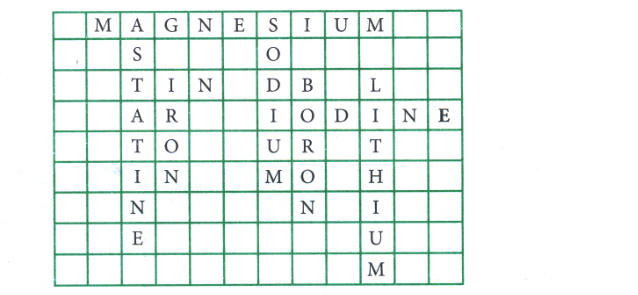
Complete the following cross word puzzle shown in the below Figure
Across:
(1) An element with atomic number 12.
(3) Metal used in making cans and member of Group 14.
(4) A lustrous non-metal which has 7 electrons in its outermost shell.
Down:
(2) Highly reactive and soft metal which imparts yellow colour when subjected to flame and is kept in kerosene.
(5) The first element of second Period.
(6) An element which is used in making fluorescent bulbs and is second member of Group 18 in the Modern Periodic Table.
(7) A radioactive element which is the last member of halogen family.
(8) Metal which is an important constituent of steel and forms' rust when exposed to moist air.
(9) The first metalloid in Modern Periodic Table whose fibres are used in making bullet-proof vests.
 image.png)
3.
Give an account of the process adopted by Mendeleev for the classification of elements. How did he arrive at "Periodic Law"?
4.
Which group of elements could be placed in Mendeleev's Periodic Table without disturbing the original order? Give reason
5.
An element X of group 15 exists as diatomic molecule and combines with hydrogen at 773 K in presence of the catalyst to form a compound, ammonia which has a characteristic pungent smell.
(a) Identify the element X. How many valence electrons does it have?
(b) Draw the electron dot structure of the diatomic molecule of X. What type of bond is formed in it?
(c) Draw the electron dot structure for ammonia and what type of bond is formed in it?
6.
An element A which is a yellow solid at room temperature shows catenation and allotropy. A forms two oxides which are also formed during the thermal decomposition of ferrous sulphate crystals and are the major air pollutants.
(a) Identify the element A
(b) Write the electronic configuration of A
(c) Write the balanced chemical equation for the thermal decomposition of ferrous sulphate crystals?
(d) What would be the nature (acidic/ basic ) of oxides formed?
(e) Locate the Position of the element in the Modern Periodic Table.
7.
(a) Electropositive nature of the element(s) increases down the group and decreases across the period
(b) Electronegativity of the element decreases down the group and increases across the period
(c) Atomic size increases down the group and decreases across a period (left to right)
(d) Metallic character increases down the group and decreases across a period.
On the basis of the above trends of the Periodic Table, answer the following about the elements with atomic numbers 3 to 9.
(a) Name the most electropositive element among them.
(b) name the most electronegative element.
(c) Name the element with smallest atomic size.
(d) Name the element which shows maximum valency.
8.
Mendeleev' predicted the existence of certain elements not known at that time and named two of them as Eka-silicon and Eka-aluminium.
(a) Name the elements which have taken the place of these elements.
(b) Mention the group and the period of these elements in the Modern Periodic Table.
(c) Classify these elements as metals, non-metals or metalloid.
(d) How many valence electrons are present in each one of them?
9.
Atomic number of a few elements are given below 10, 20, 7, 14
(a) Identify the elements.
(b) Identify the Group number of these elements in the Periodic Table.
(c) Identify the Periods of these elements in the Periodic Table.
(d) What would be the electronic configuration for each of these elements?
(e) Determine the valency of these elements.
10.
An element is placed in 2nd Group and 3rd Period of the Periodic Table, burns in presence of oxygen to form a basic oxide.
(a) Identify the element.
(b) Write the electronic configuration.
(c) Write the balanced equation when it burns in the presence of air.
(d) Write a balanced equation when this oxide is dissolved in water.
(e) Draw the electron dot structure for the formation of this oxide.
1.
(i) The symbols of elements are arranged in increasing order of their atomic number as shown in the below figure
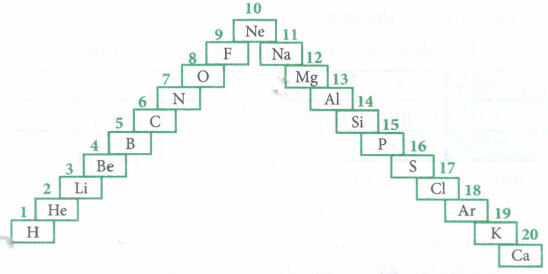
(ii) The symbols of elements are arranged in increasing order of their group numbers as follows:
| 1 | 2 | 13 | 14 | 15 | 16 | 17 | 18 |
| H | He | ||||||
| Li | Be | B | C | N | O | F | Ne |
| Na | Mg | A1 | Si | P | S | C1 | Ne |
| K | Ca |
2.
3.
When the various elements were arranged in order of their increasing atomic masses, elements having similar properties fell under on another in the same vertical column called the group. He further observed that repetition of elements with similar physical and chemical properties occurred after certain regular intervals. On the basis of these observations, Mendeleev proposed his periodic law which states that the physical and chemical properties of elements are a periodic function of their atomic masses.
4.
At the time when Mendeleev's gave his periodic table, noble gases such as helium (He), neon (Ne), argon (Ar), krypton (Kr), xenon (Xe) and radon (Rn) were not known. When these gases were discovered much later, these were placed in a new group called the zero group without disturbing the original order.
5.
(a) Since the element X of group 15 exists as a diatomic molecule, combines with hydrogen at 773 K in presence of a catalyst to form ammonia which has a characteristic smell, therefore the element X is nitrogen (N).
\(\underset { \quad Nitrogen\\ (diatomicmolecule) }{ { N }_{ 2 } } +\underset { Hydrogen }{ { 3H }_{ 2 } } \underrightarrow { 773k/Catalyst } \underset { Ammonia\\ (pungentsmell) }{ { 2NH }_{ 3 } } \)
The atomic number of element X is 7, so its electronic configuration i 2,5. Thus it has five valence electrons.
(b) Nitrogen has 5 valence electrons. Therefore, it needs 3 more electrons to complete its octet. To do so, it shares three of its electrons with three electrons of the other nitrogen atom to form a diatomic molecule of N2 gas. Thus, three covalent bonds are formed between two nitrogen atoms and each nitrogen atom is left with one
lone pair of electrons.
 image.png)
(c) Nitrogen atom has 5 valence electrons. Therefore it needs 3 more electrons to complete its octet. To do so, it shares three of its electrons with one electron each of three hydrogen atoms to form a molecule of ammonia .
 image.png)
In NH3 molecule, there are three N - H single covalent bond and one lone pair of electrons on the nitrogen atom.
6.
(a) The element A which is a yellow solid at room temperature and shows catenation and allotropy is sulphur (S).
(b) The atomic number of sulphur is 16. Therefore, its electronic configuration is 2, 8, 6.
(c) \(\underset { Ferroussulphate }{ { 2FeSO }_{ 4 } } \underrightarrow { Heat } \underset { Ferricoxide }{ { Fe }_{ 2 }{ O }_{ 3 } } +\underset { Sulphurdioxide }{ { SO }_{ 2 } } +\underset { Sulphurtrioxide }{ { SO }_{ 3 } } \)
Both SO2 and SO3 are major air pollutions.
(d) Since sulphur is a non-metal, therefore both S02 and S03 are acidic oxide since they dissolve in water to form the corresponding acids.
\(\underset { Sulphurdioxide }{ { SO }_{ 2 } } +\underset { Water }{ { H }_{ 2 }O } \rightarrow \underset { Sulphurousacid }{ { H }_{ 2 }{ SO }_{ 3 } } \\ \underset { Ferroustrioxide }{ { SO }_{ 3 } } +\underset { Water }{ { H }_{ 2 }O } \rightarrow \underset { Sulphuricacid }{ { H }_{ 2 }{ SO }_{ 4 } } \)
(e) Since sulphur contains six valence electrons, therefore it lies in group 6 + 10 = 16.Further, since atomic number of sulphur (S) is 16. It lies in the 3rd period.
7.
The names and symbols of elements having atomic numbers 3 - 9 are :
| Atomic number | 3 | 4 | 5 | 6 | 7 | 8 | 9 |
| Name | Lithium | Beryllium | Boron | Carbon | Nitrogen | Oxygen | Fluorine |
| Symbol | Li | Be | B | C | N | O | F |
a) Lithium (Li)
b) Fluorine (F)
c) Fluorine (F)
d) Boron (B)
e) Carbon (C)
8.
(a) Eka-silicon for germanium (Ge) and eka-aluminium for gallium(Ga).
(b) Group number of Ga is 13 and its period is 4th and group number of Ge is 14 and its period is also 4th.
(c) Both Ga and Ge are metalloids.
(d) Ga lies in group 13, therefore, it has 13 - 10 = 3 valence electrons. Similarly, Ge lies in group 14 and hence it has 14 - 10 = 4 valence electrons.
9.
| Atomic No. | Electronic Configuration | Group No. | Period No. | Valency | Element |
| 10 | 2,8 | 18 | 2nd | Zero | Neon |
| 20 | 2,8,8,2 | 2 | 4th | 2 | Calcium |
| 7 | 2,54 | 15 | 2nd | 3 | Nitrogen |
| 14 | 2,8,4 | 14 | 3rd | 4 | Silicon |
10.
(a) Since the element lies in group 2, it must be an alkaline earth metalj Since it lies in the third period, it must be magnesium (Mg).
(b) Atomic number of Mg is 12, therefore, its electronic configuration is
KLM
282
(c) \(\underset { Magnesium }{ 2Mg(s) } +\underset { Oxygen }{ { O }_{ 2 }(g) } \underrightarrow { Heat } \underset { Magnesiumoxide }{ 2MgO(s) } \)
(d) \(\underset { Magnesiumoxide }{ MgO(s) } +\underset { Water }{ { H }_{ 2 }O(1) } \rightarrow \underset { Magnesiumhydroxide }{ { Mg(OH) }_{ 2 }(aq) } \)
(e) 

10th Standard CBSE Syllabus & Materials
10th Standard CBSE
CBSE 10th Social Science PS - Federalism - New Model Questions Papers Study Material - QB365 Set A
NEW10th Standard CBSE
CBSE 10th Social Science PS - Power Sharing - New Model Questions Papers Study Material - QB365 Set A
NEW10th Standard CBSE
CBSE 10th Social Science GEO - Manufacturing Industries - New Model Questions Papers Study Material - QB365 Set A
NEW10th Standard CBSE
CBSE 10th Social Science GEO - Minerals and Energy Resources - New Model Questions Papers Study Material - QB365 Set A



CBSE 10th Standard CBSE Subjects
CBSE Standards





