
 100% FREE ACCESS
10th Standard CBSE Syllabus & Materials
10th Standard CBSE
CBSE 10th Social Science ECO - Globalisation and the Indian Economy - New Model Questions Papers Study Material - QB365 Set A
NEW10th Standard CBSE
CBSE 10th Social Science ECO - Money and Credit - New Model Questions Papers Study Material - QB365 Set A
NEW10th Standard CBSE
CBSE 10th Social Science ECO - Sectors of the Indian Economy - New Model Questions Papers Study Material - QB365 Set A
NEW10th Standard CBSE
CBSE 10th Social Science ECO - Development - New Model Questions Papers Study Material - QB365 Set A
NEW10th Standard CBSE
CBSE 10th Social Science PS - Outcomes of Democracy - New Model Questions Papers Study Material - QB365 Set A
NEW10th Standard CBSE
CBSE 10th Social Science PS - Gender, Religion and Caste - New Model Questions Papers Study Material - QB365 Set A

Published on: 07/09/2019
The Human Eye and the Colourful World
Download CBSE Class 10th Standard CBSE Science question papers, sample papers, important questions, and previous year solved papers in PDF format. Get free study materials, NCERT solutions, and exam preparation resources for Class 10th Standard CBSE Science
Questions + Answers key
Take MCQ Science Test
1.
Which of the following statement is correct?
A person with myopia can see distant objects clearly
A person with hypermetropia can see nearby objects clearly
A person with myopia can see nearby objects clearly
A person with hypermetropia cannot see distant objects clearly
2.
The danger signals installed at the top of tall buildings are red in colour. These can be easily seen from a distance because among all other colours, the red light
is scattered the most by smoke or fog
is scattered the least by smoke or fog
is absorbed the most by smoke or fog
moves faster in air
3.
The clear sky appears blue because
blue light gets absorbed in the atmosphere
ultraviolet radiations are absorbed in the atmosphere
violet and blue lights get scattered more than lights of all other colours by the atmosphere
light of all other colours is scattered more than the violet and blue colour lights by the atmosphere
4.
Twinkling of stars is due to atmospheric
dispersion of light by water droplets
refraction of light by different layers of varying refractive indices
scattering of light by dust particles
internal reflection of light by clouds
5.
A person cannot see distinctly objects kept beyond 2m.This defect can be corrected by using a lens of power
+0.5 D
-0.5 D
+0.2 D
-0.2 D
6.
The change in focal length of eye lens is caused by action of
Pupil
Retina
Ciliary muscles
Iris
7.
The least distance of distinct vision for a young adult with normal vision is about
25 m
2.5 cm
25 cm
2.5 m
8.
The human eye forms the image of an object at its
Cornea
Iris
Pupil
Retina
9.
The human eye can focus objects at different distances by adjusting the focal length of the eye lens. This is due to
Presbyopia
Accommodation
Near sightedness
Far sightedness
10.
What is the difference in colours of the Sun observed during sunrise/sunset and noon? Give explanation for each
11.
Why is the colour of the clear sky blue?
12.
Is the position of a star as seen by us its true position? Justify your answer.
13.
Draw a ray diagram showing through a prism when a narrow beam of white light is incident on one of its refracting surfaces. Also indicate the order of the colours of the spectrum obtained.
14.
How are we able to see nearby and also the distant object clearly?
15.
Does myopia or hypermetropia imply necessary that the eye has partially lost its ability of accommodation? If not, what cause these defect of vision?
16.
Explain why the planets do not twinkle.
17.
What happens to the image distance in the eye when we increase the distance of an object from the eye?
18.
Why is a normal eye not able to see clearly the objects placed closer than 25 cm?
19.
The far point of a myopic person is 80 cm in front of the eye. What is the nature and power of the lens required to correct the problem?
1.
(c)
A person with myopia can see nearby objects clearly
2.
(b)
is scattered the least by smoke or fog
3.
(b)
ultraviolet radiations are absorbed in the atmosphere
4.
(b)
refraction of light by different layers of varying refractive indices
5.
(b)
-0.5 D
6.
(c)
Ciliary muscles
7.
(c)
25 cm
8.
(d)
Retina
9.
(b)
Accommodation
10.
During sunrise/sunset, the looks reddish. This is because at this because at this stage, rays from the sun have to travel a much larger part of atmosphere. The red colour having largest wavelength is scattered the least.
At noon, the sun is nearly overhead. The sunlight has to pass through much smaller portion of earth's atmosphere the scattering is much less and the sun looks white.
11.
When sunlight passes through the atmosphere, most of the light having longer wavelengths do not get scattered much. But the light of shorter wavelength scattered all around the sky by air molecules present in the atmosphere. Some of this scattered blue light enters our eyes and so in whichever direction we look, the sky looks blue.
Thus, we can say that the sky appears blue due to the molecules in air which scatter the blue part of the sunlight much more easily than the red light or other shades.
12.
No, what is seen by us is not the true position of the star. Infact, starts seem higher than they actually are on account of atmospheric refraction.
13.
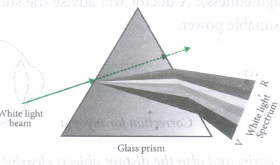
14.
Human eye can see clearly the nearby object as well as the distant objects by changing the focal length/power of accommodation of the human eye.
15.
No, a person may have normal of accommodation and yet he may be myopic or hypermetropic. Infact. Myopia may arise when length of eye ball elongated and hypermetropia may arise when length of eye ball gets shortened.
16.
Planets are very close to the earth as compared to the stars. They also act as extended source of light. The total variation in the amount of light entering our eyes from all the individual point sized sources will average out to zero, which nullify the twinkling effect of each other. So, planets do not twinkle.
17.
The image distance remains the same because the focal length of the eye lens gradually changes to maintain the position of image on the retina of the eye.
18.
As our eye cannot focus the objects placed closer than 25 cm on the retina. we are unable to see the objects clearly.
19.
For correcting myopia, concave lens is required.
The image of a distant object should be formed at 80 cm by the concave lens.
\(\therefore\) u = -\(\infty\), v = -80 cm
By lens formula, \(\begin{aligned} \frac{1}{f} & =\frac{1}{v}-\frac{1}{u} \\ \end{aligned}\)
\(\begin{aligned} & =\frac{1}{-80}-\frac{1}{\infty}=\frac{-1}{80} \end{aligned}\)
\(\text { Power }=\frac{1}{f(\text { in metre })}=\frac{-100}{80}\)
= - 1.25D

10th Standard CBSE Syllabus & Materials
10th Standard CBSE
CBSE 10th Social Science PS - Federalism - New Model Questions Papers Study Material - QB365 Set A
NEW10th Standard CBSE
CBSE 10th Social Science PS - Power Sharing - New Model Questions Papers Study Material - QB365 Set A
NEW10th Standard CBSE
CBSE 10th Social Science GEO - Manufacturing Industries - New Model Questions Papers Study Material - QB365 Set A
NEW10th Standard CBSE
CBSE 10th Social Science GEO - Minerals and Energy Resources - New Model Questions Papers Study Material - QB365 Set A



CBSE 10th Standard CBSE Subjects
CBSE Standards





