
 100% FREE ACCESS
10th Standard CBSE Syllabus & Materials
10th Standard CBSE
CBSE 10th Social Science ECO - Globalisation and the Indian Economy - New Model Questions Papers Study Material - QB365 Set A
NEW10th Standard CBSE
CBSE 10th Social Science ECO - Money and Credit - New Model Questions Papers Study Material - QB365 Set A
NEW10th Standard CBSE
CBSE 10th Social Science ECO - Sectors of the Indian Economy - New Model Questions Papers Study Material - QB365 Set A
NEW10th Standard CBSE
CBSE 10th Social Science ECO - Development - New Model Questions Papers Study Material - QB365 Set A
NEW10th Standard CBSE
CBSE 10th Social Science PS - Outcomes of Democracy - New Model Questions Papers Study Material - QB365 Set A
NEW10th Standard CBSE
CBSE 10th Social Science PS - Gender, Religion and Caste - New Model Questions Papers Study Material - QB365 Set A

Published on: 07/09/2019
How do Organisms Reproduce
Download CBSE Class 10th Standard CBSE Science question papers, sample papers, important questions, and previous year solved papers in PDF format. Get free study materials, NCERT solutions, and exam preparation resources for Class 10th Standard CBSE Science
Questions + Answers key
Take MCQ Science Test
1.
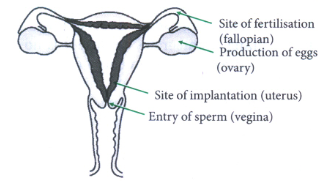
In the given figure, label and identify the parts.
(a) Site of fertilisation
(b) Production of eggs
(c) Site of implantation
(d) Entry of sperm
2.
What changes are observed in the uterus subsequent to implantation of young embryo?
3.
Colonies of yeast fail to multiply in water, but multiple in sugar solution. Give one reason for this.
4.
What is the role of the seminal vesicles and the prostate gland?
5.
What is the importance of DNA copying in reproduction?
6.
InRhizopus, tubular thread-like structures bearing sporangia at their tips are called
filaments
hyphae
rhizoids
roots
7.
The number of chromosomes in parents and offspring of a particular species remains constant due to
doubling of chromosomes after zygote formation
halving of chromosomes during gamete formation
doubling of chromosomes after gamete formation
halving of chromosomes after gamete formation
8.
The correct sequence of reproductive stages seen in flowering plants is
gametes, zygote, embryo, seedling
zygote, gametes, embryo, seedling
seedling, embryo, zygote, gametes
gametes, embryo, zygote, seedling
9.
The ability of a cell to divide into several cells during reproduction in Plasmodium is called
budding
reduction division
binary fission
multiple fission
10.
In Spirogyra, asexual reproduction takes place by
breaking up of filaments into smaller bits
division of a cell into two cells
division of a cell into many cells
formation of Young cells from older cells
11.
A feature of reproduction that is common Amoeba, Spirogyra and Yeast is that
they reproduce asexually
they are all unicellular
they reproduce only sexually
they are all multicellular
12.
Characters transmitted from parents to offspring are present in
cytoplasm
ribosome
golgi bodies
genes
13.
In a flower, the parts that produce male and female gametes (germ cells) are
stamen and anther
filament
anther and ovary
stamen and style
14.
Which of the following is not a part of the female reproductive system in human beings?
Ovary
Uterus
Vas deferens
Fallopian
15.
Asexual reproduction takes place through budding in
amoeba
yeast
plasmodium
leishmania
16.
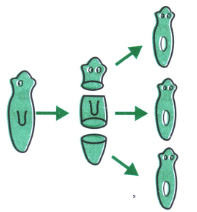
Why are budding, fragmentation and regeneration all considered as asexual types of reproduction? With neat diagrams explain the process of regeneration in Planaria.
17.
Reproduction is essentially a phenomenon that is not survival of an individual but for the stability of a species. Justify.
18.
Describe sexually transmitted diseases and mention the ways to prevent them.
19.
What are various ways to avoid pregnancy? Elaborate any one method.
20.
Distinguish between a gamete and zygote. Explain their roles in sexual reproduction.
21.
Write two points of difference between asexual and sexual types of reproduction. Describe why variations are observed in the offspring formed by sexual reproduction.
1.
2.
Mechanical barriers during sexual act provide two benefits. The first benefit is avoidance of unwanted pregnancy and the second benefit is prevention of sexually transmitted diseases.
3.
When the colony of yeast is in water, it does not get nutrition, because water does not have nutrients. Sugar, on the other hand, provides nutrition. Once the yeast gets nutrition, it grows and begins producing buds. That is why, colonies of yeast fail to multiply in water, but multiply in sugar solution.
4.
Secretions from seminal vesicles and prostate gland provide nutrition to the sperms. This makes transportation of sperms easier by providing them a fluid medium.
5.
The importance of DNA copying during reproduction are:
(i) It is responsible for the transmission of parental characteristics to the offsprings.
(ii) During DNA copying in reproduction, the changes occur due to the inheritance of traits from both the parents. This lead to certain genetic variations, which are useful for the evolution of species over a period of time.
6.
(b)
hyphae
7.
(b)
halving of chromosomes during gamete formation
8.
(a)
gametes, zygote, embryo, seedling
9.
(d)
multiple fission
10.
(a)
breaking up of filaments into smaller bits
11.
(a)
they reproduce asexually
12.
(d)
genes
13.
(c)
anther and ovary
14.
(c)
Vas deferens
15.
(b)
yeast
16.
Budding, fragmentation and regeneration are considered as asexual types of reproduction because gamete formation does not happen during these modes of reproduction and a single parent carries out the process of reproduction.
The above figures shows regeneration in planaria:
When the body of planaria is cut off into several part, each part regenerates its complementary part to develop into a new individual.
17.
(a) Organisms need energy for survival which they obtain from life processes such as nutrition and respiration.
(b) reproduction needs a lot of energy
(c) Genetic material is transferred from one generation to the next as a result of reproduction through DNA copying.
(d) DNA copying takes place with high constancy and considerable variations, that is, advantages to the species for stability in the changing environment.
18.
A disease which can be transmitted through sexual contact is called sexually transmitted disease or STD. Lack of hygiene is usually a major factor in providing conditions for spread of STDs. But unprotected sex with multiple and unknown partners is the biggest reason for the spread of STDs. Some of the ways to prevents STDs are as follows
(a) Being faithful to one's life partner
(b) Avoiding sexual contact with unknown person.
(c) Using condom during sexual intercourse
(d) Maintain personal hygiene.
19.
There are various methods to avoid pregnancy. The physical barrier methods prevent the entry of sperm into the uterus. The hormonal pills prevent transfer of egg to the uterus. Copper-T is a method which prevents entry of sperms in the fallopian tube and thus prevents fertilization. Surgical methods are permanent methods to stop the chances of pregnancy.
Copper-T : Copper-T is in the shape of 'T' and is made of copper. Copper is known to have contraceptive properties. Moreover, copper-T makes a barrier in the at the opening of the fallopian tubes in the uterus and thus prevents sperms from entering the fallopian tubes to prevent fertilization.
20.
Gamete is formed as a result of meiosis in gametogenic cells. Zygote is formed after fusion of two different kinds of gametes. Different types of gametes are formed by different parents. Zygote is formed in the female reproductive part only.
Role of gamete in sexual reproduction: Gamete formation results in halving of number of chromosomes which is necessary to maintain the number of chromosomes in an organism which reproduces sexually.
Role of zygote in sexual reproduction: Zygote formation makes the number of chromosome equal to the somatic cells. further, it is the zygote which undergoes mitosis to develop into an embryo and subsequently into a new individual.
21.
Two points of difference between asexual and sexual reproduction are as follows:
(a) A single parent is involved in asexual reproduction, while two parents are involved in sexual reproduction.
(b) Meiosis does not happen in asexual reproduction during gamete formation.
reason of variations in offspring produced by sexual reproduction: Two sets of genes are contributed by different parents, which bring different sets of characters in the offspring.

10th Standard CBSE Syllabus & Materials
10th Standard CBSE
CBSE 10th Social Science PS - Federalism - New Model Questions Papers Study Material - QB365 Set A
NEW10th Standard CBSE
CBSE 10th Social Science PS - Power Sharing - New Model Questions Papers Study Material - QB365 Set A
NEW10th Standard CBSE
CBSE 10th Social Science GEO - Manufacturing Industries - New Model Questions Papers Study Material - QB365 Set A
NEW10th Standard CBSE
CBSE 10th Social Science GEO - Minerals and Energy Resources - New Model Questions Papers Study Material - QB365 Set A



CBSE 10th Standard CBSE Subjects
CBSE Standards





