
 100% FREE ACCESS
10th Standard CBSE Syllabus & Materials
10th Standard CBSE
CBSE 10th Social Science ECO - Globalisation and the Indian Economy - New Model Questions Papers Study Material - QB365 Set A
NEW10th Standard CBSE
CBSE 10th Social Science ECO - Money and Credit - New Model Questions Papers Study Material - QB365 Set A
NEW10th Standard CBSE
CBSE 10th Social Science ECO - Sectors of the Indian Economy - New Model Questions Papers Study Material - QB365 Set A
NEW10th Standard CBSE
CBSE 10th Social Science ECO - Development - New Model Questions Papers Study Material - QB365 Set A
NEW10th Standard CBSE
CBSE 10th Social Science PS - Outcomes of Democracy - New Model Questions Papers Study Material - QB365 Set A
NEW10th Standard CBSE
CBSE 10th Social Science PS - Gender, Religion and Caste - New Model Questions Papers Study Material - QB365 Set A

Published on: 07/09/2019
Light Reflection and Refraction
Download CBSE Class 10th Standard CBSE Science question papers, sample papers, important questions, and previous year solved papers in PDF format. Get free study materials, NCERT solutions, and exam preparation resources for Class 10th Standard CBSE Science
Questions + Answers key
Take MCQ Science Test
1.
A concave mirror produces three times magnified (enlarged) real image of object placed at 10 cm in front of it. Where is the image located?
2.
Rays from Sun converge at a point 15 cm in front of a concave mirror. Where an object should be placed so that size of its image is equal to the size of the object?
30 cm in front of the mirror
15 cm in front of the mirror
between 15 cm and 30 cm in front of the mirror
more than 30 cm in front of the mirror.
3.
Under which of the following conditions a concave mirror can form an image larger than the actual object?
When the object is kept at a distance equal to its radius of curvature
When object is kept at a distance less than its focal length
When object is placed between the focus and centre of curvature
When object is kept at a distance greater than its radius of curvature
4.
Which of the following can make a parallel beam of light when light from a point source is incident on it?
Concave mirror as well as convex lens
Convex mirror as well as concave lens
Two plane mirrors placed at 90o to each other
Concave mirror as well as concave lens
5.
Where should an object be placed in front of a convex lens to get a real image of the size of the object?
At the principal focus of the lens
At twice the focal length
At infinity
Between the optical centre of the lens and its principal focus
6.
Which one of the following materials cannot be used to make a lens?
Water
Glass
Plastic
Clay
7.
Explain the following terms related to spherical lenses :
(a) (i) optical centre
(ii) Centres of curvature
(iii) principal axis
(iv) aperture
(v) principal focus
(vi) focal length
(b) A converging lens has focal length of 12 cm. Calculate at what distance should the object be placed from the lens so that it forms an image at 48 cm on the other side of the lens.
8.
List the sign conventions for reflection of light by spherical mirrors. Draw a diagram and apply these conventions in the determination of focal length of a spherical mirror which forms a three times magnified real image of an object placed 16 cm in front of it.
9.
(a) State the laws of refraction of light. Give an expression to relate the absolute refractive index of a medium with speed of light in vacuum.
(b) The refractive indices of water and glass with respect to air are 4/3 and 3/2 respectively. If the speed of light in glass is \({ 2\times 10 }^{ 8 }\) ms-1, find the speed of light in (i) air, (ii) water.
10.
(a) Define optical centre of a spherical lens.
(b) A divergent lens has a focal length of 20 cm At what distance should an object of height 4 cm from the optical centre of the lens be placed so that its image is formed 10 cm away from the lens. Find the size of the image also.
(c) Draw a ray diagram to show the formation of image in above situation.
11.
(i) One half of a convex lens of focal length 10 cm is converted with a black paper. Can such a lens produce an image of a complete object placed at a distance of 30 cm from the lens? Draw ray diagram to justify your answer.
(ii) A 4 cm tall object is placed perpendicular to the principal axis of a convex lens of focal length 20 cm. The distance of the object from the lens is 15 cm. Find nature, position and size of the image.
12.
Write laws of refraction. Explain the same with the help of ray diagram, when a ray of light passes through a rectangular glass slab.
13.
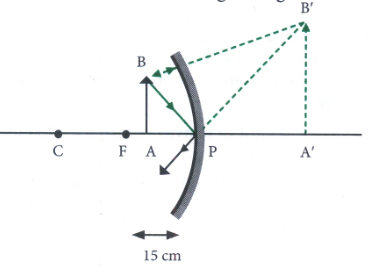
We wish to obtain an erect image of an object, using a concave mirror of focal length 15 cm. What should be the range of distance of the object from the mirror? What is the nature of image? Is the image larger or smaller than the object? Draw a ray diagram to show the image formation in this case.
14.
Give uses of concave mirror.
15.
A girl was playing with a thin beam of light from her laser torch by directing it from different directions on a convex lens held vertically. She was surprised to see that in a particular direction the beam of light continues to move along the same direction after passing through the lens. State the reason for this observation.
16.
An image formed in a spherical mirror has magnification -2. Is the image real or virtual?
17.
Between which two points of a concave mirror should an object be placed to obtain a magnification of - 3?
18.
What does negative sign in the value of magnification of a mirror indicate?
19.
How do you find the rough focal length of a convex lens? Is the same method applicable to a concave lens?
20.
A doctor has prescribed a corrective lens of power + 1.5 D. Find the focal length of the lens. Is the prescribed lens diverging or converging?
1.
Real image is inverted. So, magnification is negative
Thus, m=-3=\(\frac{Image \quad size}{Object \quad size}\)
\(=\frac{h_{i}}{h_{o}}=-\frac{v}{u}\)
[where, v = image distance and u = object distance]
\(\Rightarrow -3=\frac{-(v)}{(-10)}\) [\(\because\) object is placed in front of mirror]
\(\Rightarrow -3=\frac{v}{10}\)
Image distance, v = -30 cm
Negative sign shows that image is real, so it will be formed in front of the mirror.
2.
(a)
30 cm in front of the mirror
3.
(c)
When object is placed between the focus and centre of curvature
4.
(a)
Concave mirror as well as convex lens
5.
(b)
At twice the focal length
6.
(d)
Clay
7.
(a) (i) Optical centre: It is a point within the lens that lies on the principal axis through which a ray of light passes undeflected.
(ii) Centre of curvature: The centre of curvature of the surface of a lens is the centre of the sphere of which it forms a part. A lens has two centres of curvature because it has two surfaces.
(iii) Principal axis: It is a line through the centres of curvatures of the lens.
(iv) Aperture: The diameter of the circular boundary of the lens is called the aperture of the lens.
(v) Principal focus: A beam of light parallel to the principal axis either converges to a point or appears to diverge from a point on the principal axis after refraction through the lens, is called the principal focus. All lenses have two principal focuses.
(vi) Focal length: The distance between the optical centre and the principal focus of the lens is called its focal length.
(b) A converging lens is a convex lens.
f = + 12 cm
u=?
v = +48 cm (+ve as it is formed on other side of the object)
According to the lens formula,
\(\frac { 1 }{ f } =\frac { 1 }{ v } -\frac { 1 }{ u } \)
\(\Rightarrow \frac { 1 }{ 12 } =\frac { 1 }{ 48 } -\frac { 1 }{ u } \)
\(\frac { 1 }{ u } =\frac { 1 }{ 48 } -\frac { 1 }{ 12 } =\frac { 1-4 }{ 48 } =\frac { -3 }{ 48 } =\frac { 1 }{ 16 } \)
∴ u=-16cm
∴ The object should be placed 16 cm away from the lens.
8.
(a) Sign conventions
1. The object is always placed to the left of the mirror.
2. All the distances parallel to the principal axis are always measured from the pole of the spherical mirror.
3. All the distances measured along the direction of incident light (along +ve x-axis), are considered to be positive.
4. Those distances measured opposite to the direction of incidence light (i.e. along -ve x-axis), are taken as negative.
5. The distances measured in upward direction, i.e. perpendicular to and above the principal axis (along +ve y-axis), are taken as positive.
6. The distances measured in the downward direction, (along -ve y-axis), i.e. perpendicular to and below the principal axis are taken as negative.
(b) u=-16cm, m=-3 for real But \(m=-\frac { v }{ u } =-3\)
v = 3u = 3 (-16) = -48 cm.
Using mirror formula
\(\frac { 1 }{ f } =\frac { 1 }{ v } +\frac { 1 }{ u } \)
We get, \(\frac { 1 }{ f } =\frac { 1 }{ -48 } +\frac { 1 }{ -16 } \)
\(=\frac { 1 }{ -48 } -\frac { 1 }{ 16 } =\frac { -1-3 }{ 48 } =\frac { -4 }{ 48 } =\frac { -1 }{ 12 } \)
f=-12cm
(c) Negative sign of focal length indicated that mirror is concave in nature.
-S.png)
9.
(a) Laws of Refraction:
(i) The first law of refraction of light states that the incident ray, the refracted ray and the normal at the point of incidence, all lie in the same plane.
(ii) The second law of refraction of light is the Snell's Law of Refraction. It state that the ratio of sine of the angle of incidence to the sine of angle of refraction is a constant for a given pair of medium.
\(\frac { sin\quad i }{ sin\quad r } =Constant(n)\)
This constant (n) is called refractive index of the medium.
(i) When the light is going from vacuum to another medium, then the value of refractive index is called the absolute refractive index.
(ii) The ratio of speed of light in vacuum to the speed of light in a medium is called the absolute refractive index of that medium,
i.e.
Absolute refractive index (of a medium)
\(=\frac { Speed\quad of\quad light\quad in\quad vacuum(c) }{ Speed\quad of\quad light\quad in\quad medium(v) } \)
(b) \(_{ a }{ { n }_{ w } }=\frac { 4 }{ 3 } ,_{ a }{ { n }_{ g } }=\frac { 3 }{ 2 } \)
Speed of light in glass, vg= 2 x 10⁸ m/s
Speed of light in air, vg= ?
Speed of light in water, vw =?
\(_{ a }{ { n }_{ w } }=\frac { { v }_{ a } }{ { v }_{ w } } \)
\(\Rightarrow \frac { 4 }{ 3 } =\frac { { v }_{ a } }{ { v }_{ w } } \) ...(i)
\(_{ a }{ { n }_{ g } }=\frac { { v }_{ a } }{ { v }_{ g } } \)
\(\Rightarrow \frac { 3 }{ 2 } =\frac { { v }_{ a } }{ 2\times { 10 }^{ 8 } } \)
-S.png)
Putting the value of va in equation (i),
\(\frac { 4 }{ 2 } =\frac { 3\times { 10 }^{ 8 } }{ { v }_{ w } } \)
\(\Rightarrow { v }_{ w }=3\times { 10 }^{ 8 }\times \frac { 3 }{ 4 } =\frac { 9 }{ 4 } \times { 10 }^{ 8 }\)
=2.25x10⁸ m/s.
10.
(a) Optical centre of the lens. It is a point within the lens that lies on the principal axis through which away of light passes undeflected.
= f=-20cm h1 = 4 cm
v = -10 cm u=?
h2=?
\(\frac { 1 }{ f } =\frac { 1 }{ v } -\frac { 1 }{ u } \)
\(\Rightarrow \frac { 1 }{ -20 } -\frac { 1 }{ 10 } -\frac { 1 }{ u } \)
\(\Rightarrow \frac { 1 }{ u } =\frac { 1 }{ 10 } +\frac { 1 }{ 20 } \)
\(\Rightarrow \frac { 1 }{ u } -\frac { 1 }{ 10 } +\frac { 1 }{ 20 } \)
\(\Rightarrow \frac { 1 }{ u } =\frac { -2+1 }{ 20 } \)
\(\Rightarrow \frac { 1 }{ u } =\frac { -1 }{ 20 } \)
Now,
\(\frac { { h }_{ 2 } }{ { h }_{ 1 } } =\frac { v }{ u } \)
\(\Rightarrow \frac { { h }_{ 2 } }{ 4 } =\frac { -10 }{ -20 } \)
\(\Rightarrow { h }_{ 2 }=\frac { 10 }{ 20 } \times 4=2cm\)
h2=2cm
-S.png)
11.
(i) Yes.If a convex lens of focal length 10cm is covered one half with a black paper, it can produce an image of the complete object between F2 and 2F2.The rays of light coming from the object get refracted by the upper half of the lens. The image formed will be real, inverted and diminished.
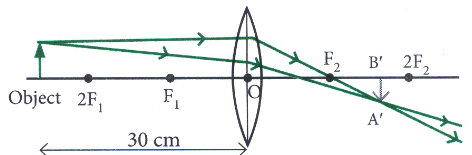
(ii)Object height, h1=4cm
Focal length, f=+20cm
Object distance, u=-15cm
Image distance, v=?
Image height, h2=?
By lens formula,
\({1\over f}={1\over v}-{1\over u}\)
\(\Rightarrow\ {1\over v}={1\over f}+{1\over u}={1\over +20}+{1\over -15}={1\over 20}-{1\over 15}\)
\(\Rightarrow\ {1\over V}={3-4\over 60}={-1\over 60}\)
v=-60cm
Negative sign of v shows that the image is virtual.
12.
The following are the laws of refraction of light.
(i)The incident ray, the refracted ray and the normal to the interface of two transparent media at the point of incidence, all lie in the same plane.
(ii)The ratio of sine of angle of incidence to the sine of angle of refraction is a constant, for the light of a given pair of media. This law is also known as Snell's law of refraction. The ray diagram is as shown. As seen in the refracted ray are in the same plane.
-S.png)
13.
Since the focal length = 15 cm, the range of object distance - 0cm to 15 cm
A concave mirror gives an erect image when an object is placed between its pole (P) and the principal focus (F). Hence, to obtain an erect image of an object from a concave mirror of focal length 15 cm, the object must be placed anywhere between the pole and the focus. The image formed will be virtual, erect, and magnified in nature, as shown in the given figure.
14.
(a) Used in torches, search lights and vehicle headlights.
(b) Used as shaving mirror.
(c) Used by dentist.
(d) Used in solar furnance
15.
A ray of light passing through the optical centre of the convex lens will continue to move along the same direction after refracting through the lens.
16.
Real
17.
The negative sign of magnification shows that the image is real and inverted. Hence, the object must be positioned between F and 2F.
18.
Image is real
19.
The rough focal length of a convex lens is obtained by forming sharp image of a very distant object on a screen. The distance of the screen from the lens gives us the rough focal length of the lens.
This method is not applicable to a concave lens, as image formed by a concave lens is virtual and it cannot be taken on the screen.
20.
Given, power of lens, P = + 1.5 D
It means the lens is convex
As power. \(P=\frac{1}{f(in \quad m)}\)
So, \(f=\frac{1}{p}=\frac{1}{1.5}=\frac{10}{15}=0.66 \quad m\)
\(\Rightarrow\) f = 0.66 \(\times\) 100 = 66 cm
[It is a converging lens because its focal length is positive.]

10th Standard CBSE Syllabus & Materials
10th Standard CBSE
CBSE 10th Social Science PS - Federalism - New Model Questions Papers Study Material - QB365 Set A
NEW10th Standard CBSE
CBSE 10th Social Science PS - Power Sharing - New Model Questions Papers Study Material - QB365 Set A
NEW10th Standard CBSE
CBSE 10th Social Science GEO - Manufacturing Industries - New Model Questions Papers Study Material - QB365 Set A
NEW10th Standard CBSE
CBSE 10th Social Science GEO - Minerals and Energy Resources - New Model Questions Papers Study Material - QB365 Set A



CBSE 10th Standard CBSE Subjects
CBSE Standards





