
 100% FREE ACCESS
10th Standard CBSE Syllabus & Materials
10th Standard CBSE
CBSE 10th Social Science ECO - Globalisation and the Indian Economy - New Model Questions Papers Study Material - QB365 Set A
NEW10th Standard CBSE
CBSE 10th Social Science ECO - Money and Credit - New Model Questions Papers Study Material - QB365 Set A
NEW10th Standard CBSE
CBSE 10th Social Science ECO - Sectors of the Indian Economy - New Model Questions Papers Study Material - QB365 Set A
NEW10th Standard CBSE
CBSE 10th Social Science ECO - Development - New Model Questions Papers Study Material - QB365 Set A
NEW10th Standard CBSE
CBSE 10th Social Science PS - Outcomes of Democracy - New Model Questions Papers Study Material - QB365 Set A
NEW10th Standard CBSE
CBSE 10th Social Science PS - Gender, Religion and Caste - New Model Questions Papers Study Material - QB365 Set A

Published on: 06/09/2019
Carbon and Its Compounds
Download CBSE Class 10th Standard CBSE Science question papers, sample papers, important questions, and previous year solved papers in PDF format. Get free study materials, NCERT solutions, and exam preparation resources for Class 10th Standard CBSE Science
Questions + Answers key
Take MCQ Science Test
1.
Write the formula of functional group:
(i) aldehyde, (ii) alcohol
2.
Name the functional group present in CH3COCH3 and state the name of this compound
3.
Name the process by which unsaturated fats are changed to saturated fats.
4.
Write the name and structure of an alcohol with four carbon atoms in its molecule.
5.
Write next two members of the homologous series
6.
What change will you observe if you test soap with litmus paper (red and blue)?
7.
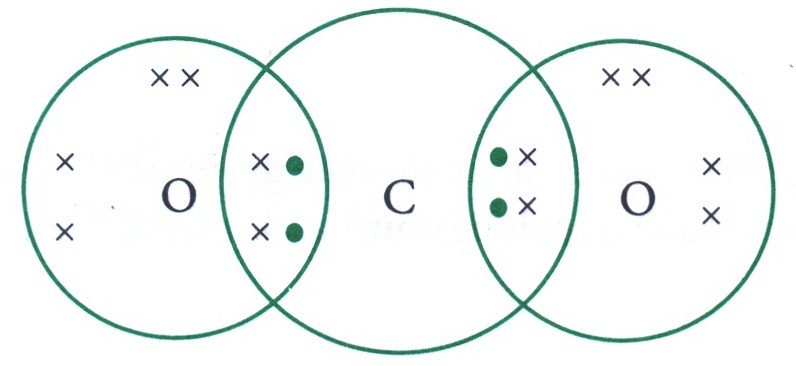
What would be the electron dot structure of carbon dioxide which has the formula CO2 ?
8.
How would you distinguish experimentally between an alcohol and a carboxylic acid?
9.
A mixture of oxygen and ethyne is burnt for welding. Can you tell why a mixture of ethyne and air is not used?
10.
What are the two properties of carbon which lead to the huge number of carbon compounds we see around us?
11.
What is an homologous series? Explain with an example.
12.
What are oxidising agents?
13.
Look at the below figure and answer the following questions:
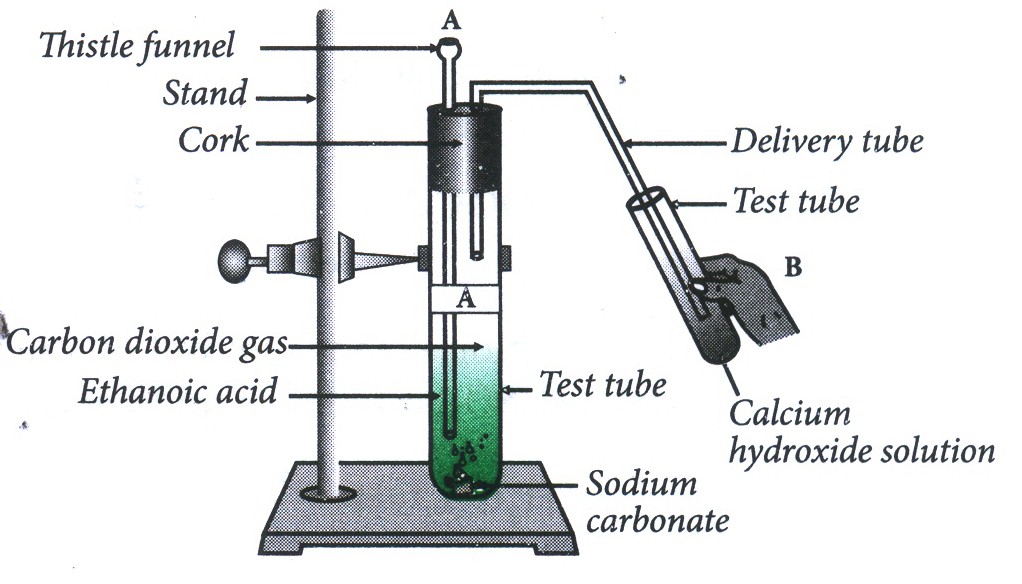
a) What change would you observe in the calcium hydroxide solution taken in tube B?
b) Write the reaction involved in test tubes A and B respectively.
c) If ethanol is given instead of ethanoic acid, would you expect the same change?
d) How can a solution of lime water be prepared in the laboratory?
14.
An organic compound A on heating with concentrated H2SO4 forms a compound B which on addition of one mole of hydrogen in presence of Ni forms a compound C. One mole of compound C on combustion forms two moles of CO2 and 3 moles of H2O. Identify the compounds A, B and C and write the chemical equations of the reactions involved.
15.
Esters are sweet-smelling substances and are used in making perfumes. Suggest some activity and the reaction involved for the preparation of an ester with well labeled diagram.
16.
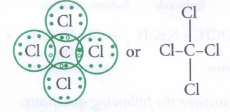
a) Write the formula and draw electron dot structure of carbon tetrachloride?
b) What is saponification? Write the reaction involved in this process.
17.
Why does micelle formation take place when soap is added to water? Will a micelle be formed in other solvents such as ethanol also?
18.
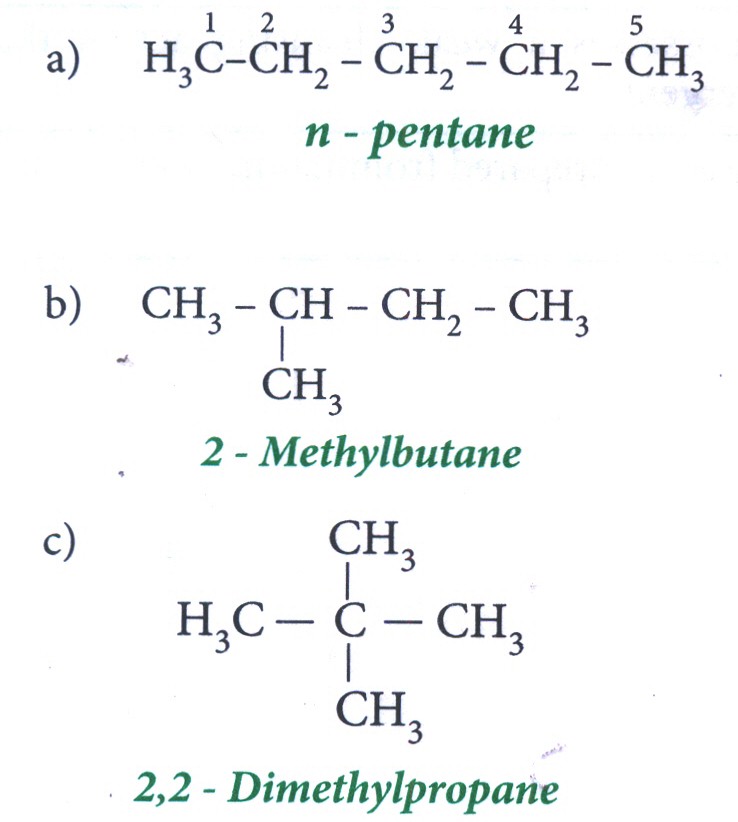
How many structural isomers can you draw for pentane?
19.
Which of the following does not belong to the same homologous series?
CH4
C2H6
C3H8
C4H8
20.
Oils on treating with hydrogen in the presence of palladium or nickel catalyst form fats. This is an example of
Addition reaction
Substitution reaction
Displacement reaction
Oxidation reaction
21.
A molecule of ammonia (NH3) has
only single bonds
only double bonds
only triple bonds
two double bonds and one single bond
22.
Butanone is a four-carbon compound with the functional group
carboxylic acid
aldehyde
ketone
alcohol
23.
Ethane, with the molecular formula C2H6 has
6 covalent bonds
7 covalent bonds
8 covalent bonds
9 covalent bonds
1.
(i) Aldehyde : \(\underset{\\\\ \ -\mathrm{C}-\mathrm{H}}{\overset{\mathrm{O}}{||}}\)
(ii) Alcohol: -OH
2.
Functional group: Ketone, name of the compound: Propanone.
3.
Hydrogenation.
4.
Butanol
5.
C2H6C3H6
6.
Soap is alkaline in nature. Hence, it turns red litmus paper blue and have no effect on the blue litmus paper.
7.
8.
Alcohol and carboxylic acid can be distinguished experimentally by two reactions:
(i) Reaction with Base
Alcohols do not react with base like NaOH, KOH while carboxylic acids react with base to form salt and water.
e.g. CH3COOH + NaOH \(\rightarrow\) CH3CO\(\bar{O}\)\(\overset{+}{N}\)a + H2O
CH3CH2OH + NaOH \(\rightarrow\) No reaction
(ii) Reaction with Sodium bicarbonate
Carboxylic acids react with sodium bicarbonate rapidly to give brisk effervescence of CO2 gas while alcohols do not react.
e.g. CH3COOH + NaHCO3 \(\rightarrow\) CH3COONa + H2O + CO2\(\uparrow\)
CH3CH2OH + NaHCO3 \(\rightarrow\) No reaction
9.
We need a high temperature for welding but when ethyne is burnt in air, it undergoes incomplete combustion and releases a lot of smoke and the temperature is also not very high. In order to ensure complete oxidation and to obtain the high temperature needed for welding, a mixture of ethyne and oxygen is used.
2CH \(\equiv\) CH + 5O2 \(\rightarrow\) 4CO2 + 2H2O + Heat + Light
10.
Two main properties which led the carbon to form a huge. number of carbon compounds are:
(i) catenation
(ii) tetravalency of carbon
11.
A series of similarly constituted compounds in which the members present have the same functional group and similar chemical properties and any two successive members in a particular series differ in their molecular formula by ( - CH2) unit, is called a homologous series.
e.g. alkane series CnH2n+2
| CH4 C3H8 C5H12 |
Methane Propane Pentane |
C2H6 C4H10 |
Ethane Butane |
12.
Substances that are capable of providing oxygen to other substances are called oxidising agents. Alkaline potassium permanganate (KMnO4) or acidified potassium dichromate (K2Cr2O7) act as an oxidising agent in oxidising alcohols into acids.
13.
a) When carbon dioxide is passed through the calcium hydroxide solution, it turns milky due to the formation of insoluble calcium carbonate.
b) Reaction in Test tube A:
\(\underset{Acetic\ or\ ethnoic\ acid}{2CH_3COOH(1)}+\underset{Sodium\ carbonate}{Na_2CO_3(s)}\rightarrow\underset{Sodium\ acetate}{2CH_3COONa}+\underset{Water}{H_2O}+\underset{Carbon\ ioxide}{CO_2(g)}\)
Reaction in Test tube B:
\(\underset{Calciumhydroxide\\ (Lime\ water)}{Ca(OH)_2(aq)}+\underset{Carbondioxide}{CO_2(g)}\rightarrow\underset{Calcium\ carbonate\\ (White\ ppt)}{CaCO_3(s)\downarrow}\underset{Water}{H_2O}\)
c) No with ethanol no reaction takes place.
d) When a quick lime i.e., calcium oxide is added to water in a test tube, it forms calcium hydroxide which is lime water. This solution is filtered and the clear solution is obtained
\(CaO(s)+H_2O(l)\rightarrow Ca(OH)_2\)
14.
i) Since compound C on combustion forms two moles of CO2 and 3 moles of H2 O, therefore compound C must contain two carbon atoms and six hydrogen atmos. Thus compound C must be C2H6 (ethane)
\(\underset{Ethene(C)}{2C_2H_6}+\underset{Oxygen}{7O_2}\xrightarrow{Heat}\underset{Carbon\ dioxide}{4CO_2}+\underset{Water}{6H_2O}\)
ii) Since compound (C) is obtained by addition of 1 mole of H2 in presence of Ni to compound (B), therefore (B) must be ethane.
\(\underset{Ethene(B)}{CH2}=CH_2+H_2\xrightarrow{Ni/Heat}\underset{Ethene(C)}{CH_3-CH_3}\)
iii) Since compound (B) is formed by heating compound (A) with cone. H2SO4 therefore compound (A) must be ethanol.
\(\underset{Ethanol(A)}{CH_3CH_2OH}\xrightarrow{Conc. H_2SO_4,443K}CH_2=CH_2+\underset{Ethene(B)}{H_2O}\)
15.
Carboxylic acid reacts with alcohols to form ester. For example, when ethanoic acid is warmed with ethanol in presence of a few drops of concentrated sulphuric acid as catalyst, an ester (ethyl ethanoate, commonly called ethyl acetate) and water are formed.
\(\underset{Acetic\ or\ ethanoic\ acid}{CH_COOH}+\underset{Ethanol}{C_2H_5OH}\xrightarrow{Conc. H_2SO_4}\underset{Ethyl\ ethanoate}{CH_3COOC_2H_5}+\underset{Water}{H_2O)}\)
Ester are sweet -smelling substances. So they are widely used in making perfumes and flavoring agents. Further, the reaction between a carboxylic acid and an alcohol to form a sweet ester is used as a test for alcohols as well as carboxylic acids.
16.
\(\underset{Carbon}{C}+\underset{Chlorine}{2Cl_2}\xrightarrow{Heat}\underset{Carbon\ tetrachloridse}{CCl_4}\)
Its electron dot structure and structural formulae are:
b) Saponification - Alkaline hydrolysis of an ester to give the salt of the corresponding
acid and the alcohol is called saponification. It is reverse of esterification reaction.
For example.
\(\underset{Ester}{CH_3COOC_2H_5}+\underset{sodium\ hydroxide}{NaOH}\xrightarrow{Heat}\underset{Sodium\ acetate}{CH_3COONa}+\underset{Ethanol}{CH_3CH_2OH}\)
Dehydration means removal of a molecule of water. When ethanol is heated with
conc. H2SO4 at 443 K, it undergoes dehydration to form ethene.
\(\underset{Ethanol}{CH_3CH_2OH}\xrightarrow{Conc. H_2SO_4,443K}\underset{Ethene}{CH_2=CH_2+H_2O}\)
17.
When soap is at the surface of water, the hydrophobic 'tail' of soap will not be soluble in water and the soap will align along the surface of water with the ionic end in water and the hydrocarbon 'tail' protruding out of water. Inside water, these molecules have a unique orientation that keeps the hydrocarbon portion out of the water. This is achieved by forming clusters of molecules in which the hydrophobic tails are in the interior of the cluster and the ionic ends are on the surface of the cluster. This formation is called micelle.
Micelle will not form in all types of solvents. It will form in such type of solvent in which soap is soluble. e.g. soap is insoluble in ethanol, hence, no micelle formation takes place.
18.
19.
(d)
C4H8
20.
(a)
Addition reaction
21.
(a)
only single bonds
22.
(c)
ketone
23.
(b)
7 covalent bonds

10th Standard CBSE Syllabus & Materials
10th Standard CBSE
CBSE 10th Social Science PS - Federalism - New Model Questions Papers Study Material - QB365 Set A
NEW10th Standard CBSE
CBSE 10th Social Science PS - Power Sharing - New Model Questions Papers Study Material - QB365 Set A
NEW10th Standard CBSE
CBSE 10th Social Science GEO - Manufacturing Industries - New Model Questions Papers Study Material - QB365 Set A
NEW10th Standard CBSE
CBSE 10th Social Science GEO - Minerals and Energy Resources - New Model Questions Papers Study Material - QB365 Set A



CBSE 10th Standard CBSE Subjects
CBSE Standards





