
 100% FREE ACCESS
10th Standard CBSE Syllabus & Materials
10th Standard CBSE
CBSE 10th Social Science ECO - Globalisation and the Indian Economy - New Model Questions Papers Study Material - QB365 Set A
NEW10th Standard CBSE
CBSE 10th Social Science ECO - Money and Credit - New Model Questions Papers Study Material - QB365 Set A
NEW10th Standard CBSE
CBSE 10th Social Science ECO - Sectors of the Indian Economy - New Model Questions Papers Study Material - QB365 Set A
NEW10th Standard CBSE
CBSE 10th Social Science ECO - Development - New Model Questions Papers Study Material - QB365 Set A
NEW10th Standard CBSE
CBSE 10th Social Science PS - Outcomes of Democracy - New Model Questions Papers Study Material - QB365 Set A
NEW10th Standard CBSE
CBSE 10th Social Science PS - Gender, Religion and Caste - New Model Questions Papers Study Material - QB365 Set A

Published on: 11/09/2019
Agriculture
Download CBSE Class 10th Standard CBSE Social Science question papers, sample papers, important questions, and previous year solved papers in PDF format. Get free study materials, NCERT solutions, and exam preparation resources for Class 10th Standard CBSE Social Science
Questions + Answers key
Take MCQ Social Science Test
1.
India is the larger producer as well as the consumer of the world in
Wheat
Maize
Pulses
Millets
2.
Which one of the following is 'Kharif' crop?
Wheat
Mustard
Maize
None of these
3.
A type of agriculture where a single crop is grown on large area is
Shifting Agriculture
Plantation agriculture
Horticulture
Extensive Agriculture
4.
It is a type of agriculture where farmers clear a patch of and produce rereads and other food crops to sustain that family that is:
Commercial farming
Extensive farming
Modern farming
Slash and burn farming
5.
Which one of following is not Agro-based industry?
Cement Industry
Jute Industry
Cotton textile Industry
Sugar Industry
6.
What part of Total population of India is engaged in agriculture activities?
2/3
1/3
2/5
1/4
7.
Cultivation of fruits and vegetables called
Floriculture
Sericulture
Horticulture
Agriculture
8.
Yellow revolution refers to
Increased production of eggs
Increased production of oilseeds
Increased production of fish
Increased production of pulses.
9.
Rearing of silkworms is called as
Pisciculture
Agriculture
Silviculture
Sericulture
10.
India is the leading producer exporter of .............in the world.
Rubber
Sugar cane
Tea
Rice
11.
Bhoodan-Gramdan movement was initiated by
Mahatma Gandhi
Jawaharlal Nehru
Vinobha Bhave
Bal Gangadhar Tilak
12.
Jhumming refers to
Primitive subsistence farming in Brazil
'Slash and burn' agriculture in North-eastern states of India.
Primitive farming in Malaysia
Commercial farming in Punjab.
13.
Which one of the following is announced by the government in support of a crop?
Maximum support price
Minimum support price
Moderate support price
Influential support price
14.
Which one of the following is a rabi crop?
Rice
Gram
Millets
Cotton
15.
Which one of the following describes a system of agriculture where a single crop is grown on a large area?
Shifting Agriculture
Plantation Agriculture
Horticulture
Intensive Agriculture
16.
Which are the two most important cereal crops of India? Mention the geographical conditions required for the growth of any one of these two crops?
17.
(i) Suggest the initiative taken by the government to ensure the increase in agricultural production.
(ii) Describe the geographical conditions required for the growth of rice.
18.
Name two leading producers of the following crops.
(a) Mangoes
(b) Oranges
(c) Apple
(d) Bananas.
19.
Name the main oilseeds produced in India. State their two importances. Which states are the leading producers of groundnut in India?
20.
Name three maize producing states of India.
21.
Describe three geographical requirements for maize cultivation-temperature, rainfall and soil.
22.
Mention in brief, the various limitations from which the Indian agriculture suffers presently.
23.
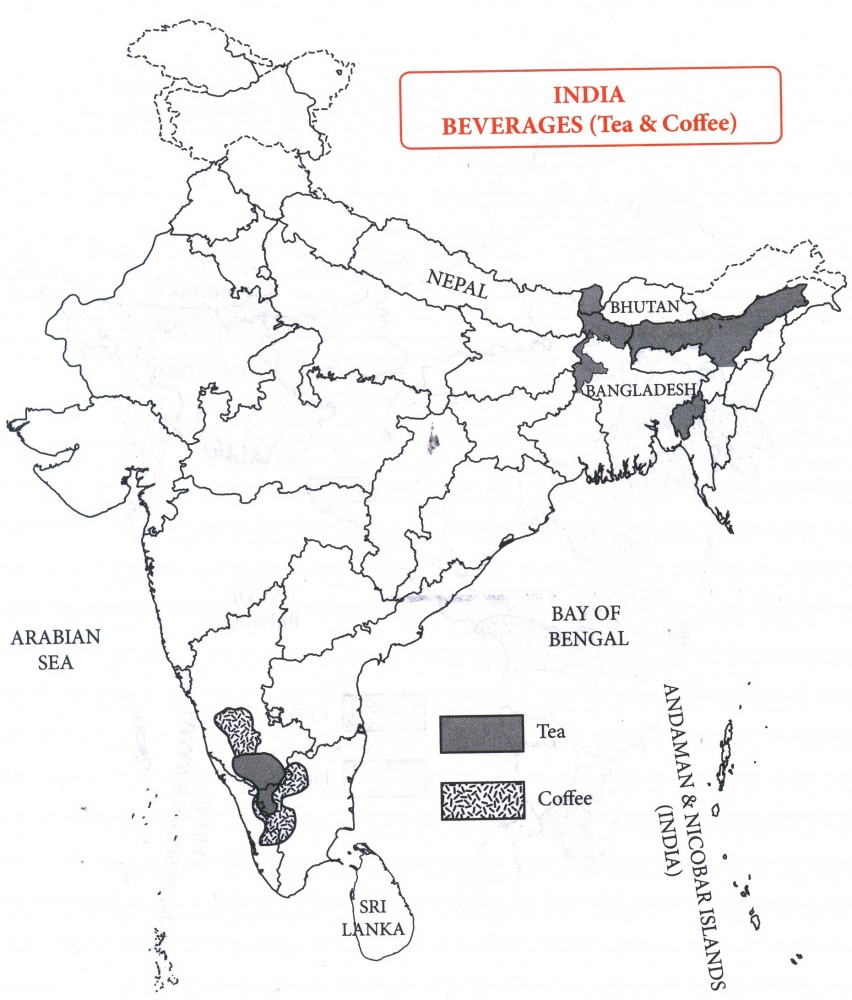
In the outline map of India, identify tea and coffee producing states.
(a) Karnataka
(b) Kerala
(c) Assam
(d) West Bengal
1.
(c)
Pulses
2.
(c)
Maize
3.
(b)
Plantation agriculture
4.
(d)
Slash and burn farming
5.
(a)
Cement Industry
6.
(a)
2/3
7.
(c)
Horticulture
8.
(b)
Increased production of oilseeds
9.
(d)
Sericulture
10.
(c)
Tea
11.
(c)
Vinobha Bhave
12.
(b)
'Slash and burn' agriculture in North-eastern states of India.
13.
(b)
Minimum support price
14.
(b)
Gram
15.
(b)
Plantation Agriculture
16.
(i) To ensure increase in agricultural. production, the government prioritized collectivization, consolidation of holdings, cooperation and abolition of zamindari system. 'Land reform' was the main focus of the First Five Year Plans. In the 1960s and 1970s, agricultural reforms were the order of the day. The Green Revolution and the White Revolution (Operation Flood) were aimed at improving Indian agricultural productivity. During the 1980s and 1990s, a comprehensive land development programme was initiated. Under this, various technical and institutional reforms were introduced by the government for the benefit of farmers, e.g., Minimum Support Price policy, provision for crop insurance, subsidy on agricultural inputs and resources such as power and fertilisers, Grameen banks, Kissan Credit Card, Personal Accident Insurance Scheme, and special weather bulletins and agricultural programmes like 'Krishi Darshan' on national television.
(ii) The impact of globalisation on Indian agriculture has been felt since colonial times. Raw cotton and spices were important export items from India. In 1917, Indian farmers revolted in Champaran against being forced to grow indigo in place of food grains, in order to supply dye to Britain's flourishing textile industry. Thus, globalisation has had its boons. and banes for Indian agriculture. Post liberalisation, Indian farmers face new challenges in the form of competition from highly subsidised agriculture of developed nations. This prompts the need for making Indian agriculture successful and profitable by improving the conditions of small and marginal farmers, countering the negative effects of Green Revolution, developing and promoting organic farming, and diversifying cropping pattern from cereals to high-value crops.
(iii) Rice is the most important staple crop in India. It is a tropical plant. It requires high temperature and high humidity for its successful growth. The mean monthly temperature of about 25°C, with minor variations during, sowing, growing and harvesting seasons, is ideal for its cultivation. It grows well in areas of 100 cm of rainfall. In the areas of less rainfall, it is grown with the help of irrigation.
17.
(i) Government has initiated many institutional and technological reforms for increasing production and productivity in agriculture sector.
Among technological reforms,major initiatives are
Promotion of Green Revolution, White Revolution, etc.
Promotion of High Yielding Variety (HYV) seeds, chemical fertilisers pesticides, etc.
Promotion of drip irrigation or other irrigation techniques for better production.
Power supply for irrigation, etc.
Among institutional reforms, major initiatives are
Land reform including collectivisation, consolidation of land holding etc.
Financial assistance to farmers like subsidies, insurance against crop failure and personal harm, Kisan Credit Card (KCC), Personal Accident Insurance Scheme (PAIS) and so on.
Establishment of advanced research institutions for further progress, i.e., Indian Council of Agricultural Research (ICAR agricultural universities, meteorological research unit, agriculture specific satellite launch etc.
Minimum Support Price for buying of surplus crops in protection from marker, exploitation.
(ii) Geographical conditions (climatic suitability) required for the growth of rice are
It requires high temperature and high humidity.
The mean monthly temperature of about 25°C or above.
Rice needs abundant rainfall, i.e. more than 100 cm. It can grow in areas with less rainfall but with proper irrigation.
Rice can grow in a variety of soils including silts, loans and gravels. But it is grown best in alluvial soil with a sub-soil of impervious clay.
18.
(a) Mangoes - Maharashtra, Andhra Pradesh
(b) Oranges - Nagpur, Maghalaya
(c) Apples - Jammu Kashmir, Himachal Pradesh
(d) Bananas - Kerela, Mizoram.
19.
The main oilseeds grown in India are groundnut, coconut, sesame, castor, soyabean, linseed and sunflower. Most of them are edible oil used for cooking. Some oilseeds are used as a raw material in the manufacture of soaps, cosmetics and ointments. Leading producers of groundnut are Andhra Pradesh, Tamil Nadu, Karnataka, Gujarat and Maharashtra.
20.
(a) Maize is a coarse grain and used as both food and folder.
(b) It is grown under varied soil and climatic conditions.
(c) It grows well in areas of 50 to 100cm o rain and in areas of less rain it is grown under irrigation.
(d) It grows well under temperature between \({ 21 }^{ \circ }C\ and\ { 27 }^{ \circ }C\)grows well in old alluvial soil.
(e) It requires well-drained fertile soil.
(f) It is cultivated mainly as a kharif crop.
(g) Major maize producing states are Karnataka, Uttar Pradesh, Madhya Pradesh, Bihar and Andhra Pradesh.
21.
(a) Maize is a coarse grain and used as both food and folder.
(b) It is grown under varied soil and climatic conditions.
(c) It grows well in areas of 50 to 100cm o rain and in areas of less rain it is grown under irrigation.
(d) It grows well under temperature between \({ 21 }^{ \circ }C\ and\ { 27 }^{ \circ }C\)grows well in old alluvial soil.
(e) It requires well-drained fertile soil.
(f) It is cultivated mainly as a kharif crop.
(g) Major maize producing states are Karnataka, Uttar Pradesh, Madhya Pradesh, Bihar and Andhra Pradesh.
22.
(a) Agricultural is not generating sufficient employment opportunities in the country.
(b) The growth rate in agriculture is decelerating which is an alarming situation.
(c) Today, Indian farmers are facing a big challenge from international competition and our government is going ahead with reduction in the public investment in agriculture sector particularly in irrigation, power, rural roads, market and mechanization.
23.

10th Standard CBSE Syllabus & Materials
10th Standard CBSE
CBSE 10th Social Science PS - Federalism - New Model Questions Papers Study Material - QB365 Set A
NEW10th Standard CBSE
CBSE 10th Social Science PS - Power Sharing - New Model Questions Papers Study Material - QB365 Set A
NEW10th Standard CBSE
CBSE 10th Social Science GEO - Manufacturing Industries - New Model Questions Papers Study Material - QB365 Set A
NEW10th Standard CBSE
CBSE 10th Social Science GEO - Minerals and Energy Resources - New Model Questions Papers Study Material - QB365 Set A



CBSE 10th Standard CBSE Subjects
CBSE Standards





