
 100% FREE ACCESS
10th Standard CBSE Syllabus & Materials
10th Standard CBSE
CBSE 10th Social Science ECO - Globalisation and the Indian Economy - New Model Questions Papers Study Material - QB365 Set A
NEW10th Standard CBSE
CBSE 10th Social Science ECO - Money and Credit - New Model Questions Papers Study Material - QB365 Set A
NEW10th Standard CBSE
CBSE 10th Social Science ECO - Sectors of the Indian Economy - New Model Questions Papers Study Material - QB365 Set A
NEW10th Standard CBSE
CBSE 10th Social Science ECO - Development - New Model Questions Papers Study Material - QB365 Set A
NEW10th Standard CBSE
CBSE 10th Social Science PS - Outcomes of Democracy - New Model Questions Papers Study Material - QB365 Set A
NEW10th Standard CBSE
CBSE 10th Social Science PS - Gender, Religion and Caste - New Model Questions Papers Study Material - QB365 Set A

Published on: 09/10/2019
Challenges to Democracy
Download CBSE Class 10th Standard CBSE Social Science question papers, sample papers, important questions, and previous year solved papers in PDF format. Get free study materials, NCERT solutions, and exam preparation resources for Class 10th Standard CBSE Social Science
Questions + Answers key
Take MCQ Social Science Test
1.
Examine the features of democracy in its expanded form.
2.
What is a challenge? Explain the three major challenges before the countries of the world regarding democracy?
3.
'Most of the democracies of the world face the challenge of expansion and challenge of deepening of democracy'? Justify the statement.
4.
What must not take place in a democracy if it is a good democracy?
5.
What are the major challenges to democracy in India? Explain.
6.
Explain the three major challenges faced by modern democracies.
7.
What is the meaning of democracy reform? Give two examples of democratic reforms in India.
8.
Suggest any three ways in which political reforms can be made in India?
9.
Explain briefly the foundational challenge of making transition to democracy set up a democratic government? Suggest any three measures.
10.
The challenge of deepening of democracy is faced by every democracy in one form or another. Support the statement with three suitable arguments.
1.
The features of democracy can be categorised in the form of questions followed by classification of features like:
(a) Who are the rulers in the democracy?
People are the rulers in the democracy who ruled with the help of its elected representatives of the people.
(b) What kind of election constitutes a democratic election?
Free and fair election constitutes a democratic election. But the elections must offer a real choice between political alternatives. And it should be possible for people to use this choice to remove the existing rulers if they wish so.
(c) Who are the people who can elect the rulers?
Citizens above 18 years of age elect the rulers on the basis of one person, one vote, one value, i.e. universal adult franchise. As democracy is based on the fundamental principles of political equality in a good democracy, each adult citizen must have one vote and each vote must have one value.
(d) What kind of government is democracy?
Good democracy is based on the rule of law ans respect for rights. A democratic government cannot do whatever it likes simply because it has won an election. It has to respect basic rules.
(e) As democracy is based on deliberation and negotiation, every major decision has to go through a series of consultations and every office-bearer has certain rights and responsibilities assigned by the constitution and the law.
Thus, a good democratic government rules within limits set by constitutional law and citizens' rights.
2.
A challenge refers to a difficulty which carries within it an opportunity for further progress and can be overcome
The following are the major challenges to democracy in India.
(a) Foundational challenge: This challenge involves:
(i) making transition to democracy and then instituting democratic government.
(ii) bringing down the existing non-democratic regime.
(iii) keeping military away from controlling government.
(iv) establishing a sovereign and functional state.
(b) Challenge of expansion of democracy: This challenge signifies:
(i) extension of democratic power to local governments.
(ii) expansion of federal principles to all the federal units.
(iii) political empowerment to women and minorities.
(c) Challenge of deepening of democracy: This challenge ensures:
(i) strengthening of democratic institutions and democratic principles.
(ii) to check the influence of the wealthy and powerful people in democratic decisions.
(iii) empowering the general section of people through democratic institutions.
3.
The challenge of expansion is a very common challenge faced by an established democracy.
(a) The challenge of expansion involves applying the basic principles of democracy across all the regions, different social groups and various institutions.
(b) It involves ensuring greater power to local governments, extension of federal principle to all the units of the federation and inclusion of women and minority groups.
(c) It also implies that less and less decisions should remain outside the arena of democratic control. Most countries including India and other. democracies, like the United States, face this challenge.
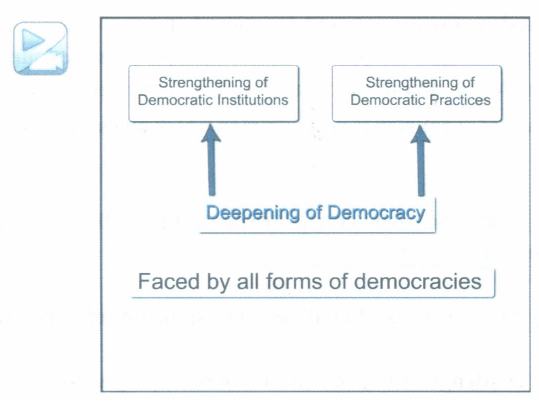
The challenge of deepening of democracy is faced by every democracy in one way or the other. This challenge ensures:
(a) strengthening of democratic institutions and principles.
(b) to check the influence of the wealthy and powerful people in the democratic decisions.
(c) empowering the general section of people through democratic institutions
4.
The following factors must not take place in a democracy, if it is a good democracy.
(a) Corruption in any form
(b) Decision-making based only on the interests of the majority group.
(c) Rigging election results.
(d) Concentration of power in few hands
(e) Overlooking of interest of people at large
(f) Electing candidates with corrupt and criminal backgrounds
(g) Improper governance
5.
The following are the major challenges to democracy in India.
(a) Foundational Challenge: This challenge involves:
(i) making transition to democracy and then instituting democratic government.
(ii) bringing down the existing non-democratic regime.
(iii) keeping military away from controlling government.
(iv) establishing a sovereign and functional state.
(b) Challenge of expansion of democracy: This challenge signifies:
(i) extension of democratic power to local governments
(ii) expansion of federal principles to all the federal units
(iii) political empowerment to women and minorities.
(c) Challenge of deepening of democracy: This challenge ensures:
(i) strengthening of democratic institutions and democratic principles.
(ii) to check the influence of the wealthy and powerful people in democratic decisions.
(iii) empowering the general section of people through democratic institutions.
6.
The following are the major challenges to democracy in India.
(a) Foundational Challenge: This challenge involves:
(i) making transition to democracy and then instituting democratic government.
(ii) bringing down the existing non-democratic regime.
(iii) keeping military away from controlling government.
(iv) establishing a sovereign and functional state.
(b) Challenge of expansion of democracy: This challenge signifies:
(i) extension of democratic power to local governments
(ii) expansion of federal principles to all the federal units
(iii) political empowerment to women and minorities.
(c) Challenge of deepening of democracy: This challenge ensures:
(i) strengthening of democratic institutions and democratic principles.
(ii) to check the influence of the wealthy and powerful people in democratic decisions.
(iii) empowering the general section of people through democratic institutions.
7.
(i) Carefully devised changes in law can help to discourage wrong political practices and encourage good ones. At the same time, legal-constitutional changes by themselves cannot overcome challenges to democracy. They are to be carried out mainly by political activities, parties movements and politically conscious citizens.
(ii) Legal changes can sometimes be counter-productive. Generally, laws that seek to ban something are not very successful. Rather laws that give political actors incentives to do good things have more chances of working. For, example, the `Right to Information Act' empowers people to act as watchdogs of democracy.
(iii) The main focus of political reforms should be on ways to strengthen democratic practice. The most important concern should be to increase and improve the quality of political participation by ordinary citizens.
(iv) Any proposal for political reforms should think not only about what is a good solution but also about who will implement it and how measures that rely or democratic movements, citizens' organisations and the media are likely to succeed.
8.
(i) Carefully devised changes in law can help to discourage wrong political practices and encourage good ones. At the same time, legal-constitutional changes by themselves cannot overcome challenges to democracy. They are to be carried out mainly by political activities, parties movements and politically conscious citizens.
(ii) Legal changes can sometimes be counter-productive. Generally, laws that seek to ban something are not very successful. Rather laws that give political actors incentives to do good things have more chances of working. For, example, the `Right to Information Act' empowers people to act as watchdogs of democracy.
(iii) The main focus of political reforms should be on ways to strengthen democratic practice. The most important concern should be to increase and improve the quality of political participation by ordinary citizens.
(iv) Any proposal for political reforms should think not only about what is a good solution but also about who will implement it and how measures that rely or democratic movements, citizens' organisations and the media are likely to succeed.
9.
A 'challenge' is a difficulty which carries within it an opportunity for progress. Three major challenge are :
(i) Foundational challenge is about making the transition to democracy and then instituting a democratic government. This involves bringing down the existing non-democratic regime, keeping military away from controlling the government and establishing a sovereign and functional state. Example : Myanmar, Chile, Nepal
(ii) Challenge of Expansion is faced (by most of the established democracies. This involves applying the basic principle of democratic government across all the regions, different social groups and various institutions. Most countries including India and other democracies like the U.S. face this challenge.
(iii) Deepening of democracy : This involves strengthening of the institutions and practices of democracy, especially those that help people's participation and control. This attempts to bring down the control and influence of the rich and powerful people in making governmental decision.
10.
A 'challenge' is a difficulty which carries within it an opportunity for progress. Three major challenge are :
(i) Foundational challenge is about making the transition to democracy and then instituting a democratic government. This involves bringing down the existing non-democratic regime, keeping military away from controlling the government and establishing a sovereign and functional state. Example : Myanmar, Chile, Nepal
(ii) Challenge of Expansion is faced (by most of the established democracies. This involves applying the basic principle of democratic government across all the regions, different social groups and various institutions. Most countries including India and other democracies like the U.S. face this challenge.
(iii) Deepening of democracy : This involves strengthening of the institutions and practices of democracy, especially those that help people's participation and control. This attempts to bring down the control and influence of the rich and powerful people in making governmental decision.

10th Standard CBSE Syllabus & Materials
10th Standard CBSE
CBSE 10th Social Science PS - Federalism - New Model Questions Papers Study Material - QB365 Set A
NEW10th Standard CBSE
CBSE 10th Social Science PS - Power Sharing - New Model Questions Papers Study Material - QB365 Set A
NEW10th Standard CBSE
CBSE 10th Social Science GEO - Manufacturing Industries - New Model Questions Papers Study Material - QB365 Set A
NEW10th Standard CBSE
CBSE 10th Social Science GEO - Minerals and Energy Resources - New Model Questions Papers Study Material - QB365 Set A



CBSE 10th Standard CBSE Subjects
CBSE Standards





