
 100% FREE ACCESS
10th Standard CBSE Syllabus & Materials
10th Standard CBSE
CBSE 10th Social Science ECO - Globalisation and the Indian Economy - New Model Questions Papers Study Material - QB365 Set A
NEW10th Standard CBSE
CBSE 10th Social Science ECO - Money and Credit - New Model Questions Papers Study Material - QB365 Set A
NEW10th Standard CBSE
CBSE 10th Social Science ECO - Sectors of the Indian Economy - New Model Questions Papers Study Material - QB365 Set A
NEW10th Standard CBSE
CBSE 10th Social Science ECO - Development - New Model Questions Papers Study Material - QB365 Set A
NEW10th Standard CBSE
CBSE 10th Social Science PS - Outcomes of Democracy - New Model Questions Papers Study Material - QB365 Set A
NEW10th Standard CBSE
CBSE 10th Social Science PS - Gender, Religion and Caste - New Model Questions Papers Study Material - QB365 Set A

Published on: 10/09/2019
Forest and Wildlife Resources
Download CBSE Class 10th Standard CBSE Social Science question papers, sample papers, important questions, and previous year solved papers in PDF format. Get free study materials, NCERT solutions, and exam preparation resources for Class 10th Standard CBSE Social Science
Questions + Answers key
Take MCQ Social Science Test
1.
The number of Tiger reserves in India is
19
11
23
27
2.
'Chipko movement' is programme started towards conservation of ..........
Soil
Water
Minerals
Forests
3.
The total forest cover in the country is about
18.1%
22.1%
19.3%
11.5%
4.
Which of the following conservation strategies do not directly involve community participation.
Joint forest management
Beej Bachao Andolan
Chipko Movement
Demarcation of Wildlife Sanctuaries
5.
Which of these statements is not a valid reason for depletion of flora and fauna?
Agricultural expansion.
Large scale developmental projects.
Grazing and fuelwood collection.
Rapid industrialization and urbanization.
6.
Himalayan brown bear
7.
Andaman wild pig
8.
Asiatic elephant
9.
Describe different categories of existing plants and animal species.
10.
Describe the distribution of different types of forests in India.
11.
What are the effects of the destruction of bio-diversity in India?
12.
What is biodiversity?
13.
What is biodiversity? Why is biodiversity important for human lives?
14.
"Nature worship is an old age belief." Explain how has it helped in the conservation of forests and wildlife.
15.
Explain with three examples, how communities have carried out conservation of flora and fauna in India?
16.
(i) Describe how communities have conserved and protected forests and wildlife in India?
(ii) Write a note on good practices towards conserving forest and wildlife.
17.
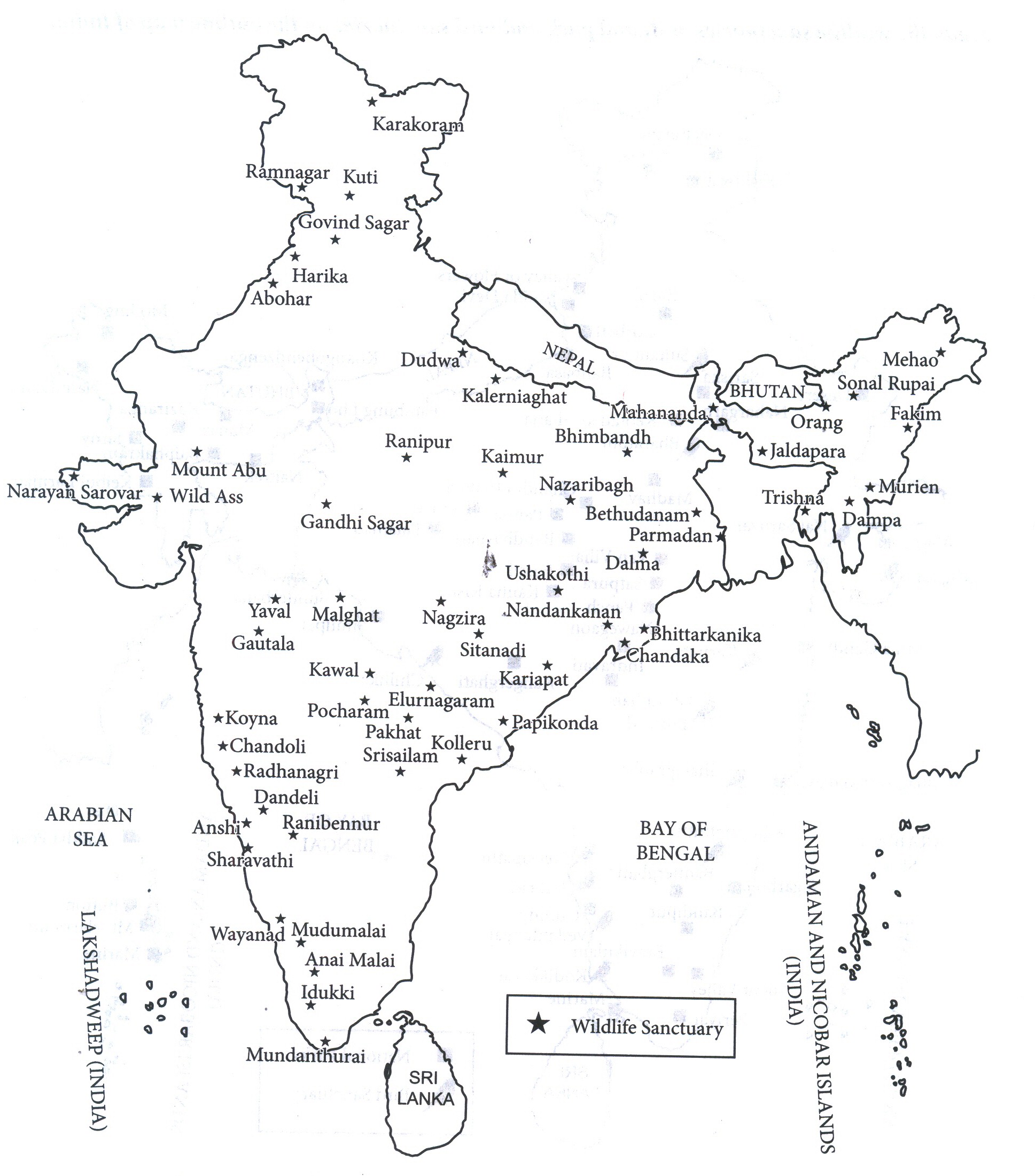
In the map of India, few wildlife Sanctuaries.
1.
(a)
19
2.
(d)
Forests
3.
(c)
19.3%
4.
(d)
Demarcation of Wildlife Sanctuaries
5.
(c)
Grazing and fuelwood collection.
6.
()
Rare
7.
()
Endemic
8.
()
Vulnerable
9.
Based on the International Union for Conservation of Nature and Natural Resources (IUCN), we can classify as follows -
(a) Normal Species: Their population levels are normal for their survival. E.g. Cattle, sal, pine, rodents, etc.
(b) Endangered Species: They are in danger of extinction as their population is fast dwindling. E.g. Black buck, crocodile, Indian wild ass, Indian rhino, lion tailed macaque, sangai (brow-antlered in Manipur), etc.
(c) Vulnerable Species: Their population has decreased to the level into endangered category in the near future. E.g. Asiatic elephant, blue sheep, Gangetic dolphin etc.
(d) Rare Species: Species those are very small in number which may become endangered or vulnerable in future. E.g. Hornbill, Himalayan brown bear, wild Asiatic buffalo, desert fox etc.
(e) Endemic Species: The species that are found only in a particular region and are isolated by natural barriers are called endemic species. E.g. Andaman teal, Nicobar pigeon, Andaman wild pig etc.
(f) Extinct Species: These species no longer exist on Earth. The species may be extinct from a local area, region, country, continent or the whole earth. E.g. Asiatic cheetah, pink headed duck etc.
10.
(a) Jammu and Kashmir, Andhra Pradesh, Uttaranchal, Kerala, Tail Nadu, West Bengal and Maharashtra have large percentage of reserved forests.
(b) Madhya Pradesh has the largest area under permanent forests - 75%
(c) Bihar, Haryana, Punjab, Himachal Pradesh, Orissa, and Rajasthan have the large areas of protected forests.
(d) All north-eastern states and parts of Gujarat have a very high % of unclassed forests.
11.
Direct effects:
i. Many tribal communities or forest dependent communities are impoverished due to the destruction of forests and wildlife.
ii. Many species of plants and animals became endangered or extinct.
Indirect effects:
i. It destroyed the ecological balance.
ii. It leads to severe droughts in some parts and floods in other areas.
iii. It affected the health of women and negligence of home and children because of their increased hours of work to collect their requirements.
12.
(i) The variety of flora and fauna in a given geographical area is called biodiversity of that area. Each species on this earth lives in a system of interdependencies on various biotic and abiotic factors. Human beings also depend on several biotic and abiotic factors for their survival. We may be directly taking some resources from certain species, but we indirectly depend on many other species, Hence, biodiversity is important for human lives.
(ii) Various human activities have resulted in a decline of forest cover. Vast tracts of forest had been cleared to make way for farmland and for making new houses, factories, and infrastructure. Mining is another human activity which has destroyed forest in a vast area. Thus, human activities have resulted in significant depletion of flora and fauna.
13.
Biodiversity:
Biodiversity refers to rich flora and wildlife. In this diversity, species with diverse forms and functions live together.
Importance of Biodiversity for Human:
Biodiversity is important for human lives because the human being, along with the biodiversity, form a complete ecological system in which we are a part and are dependent on this system for our own existence.
14.
(i) Many local communities have recognized the significance of conservation for their long term survival. Local communities are contributing significantly in conservation at many places. For example - the Bishnois of Rajasthan protects black buck, Chinkara, and Peacocks quite zealously. Nature worship is an age old tradition of many tribes. By doing so, they help in conservation of forest. Chipko movement is another example of a community initiative in conservation. Joint Forest Management has been practiced in Orissa since 1988 and has borne fruits for conservation.
(ii) All the good practices towards conservation of forest and wildlife should include an active participation from all the stakeholders. Government agencies, local inhabitants, industrialists and wildlife enthusiasts are the important stakeholders in forest management. The government should formulate rules and regulations and provide system and machinery to implement conservation programmes . The local inhabitants should always be included in the conservation programme, because their survival depends on it. Industrialists and wildlife enthusiasts should also be taken under the fold of conservation programmes . A coordinated effort by all the stakeholders will give better results.
15.
(i) Many local communities have recognized the significance of conservation for their long term survival. Local communities are contributing significantly in conservation at many places. For example - the Bishnois of Rajasthan protects black buck, Chinkara, and Peacocks quite zealously. Nature worship is an age old tradition of many tribes. By doing so, they help in conservation of forest. Chipko movement is another example of a community initiative in conservation. Joint Forest Management has been practiced in Orissa since 1988 and has borne fruits for conservation.
(ii) All the good practices towards conservation of forest and wildlife should include an active participation from all the stakeholders. Government agencies, local inhabitants, industrialists and wildlife enthusiasts are the important stakeholders in forest management. The government should formulate rules and regulations and provide system and machinery to implement conservation programmes . The local inhabitants should always be included in the conservation programme, because their survival depends on it. Industrialists and wildlife enthusiasts should also be taken under the fold of conservation programmes . A coordinated effort by all the stakeholders will give better results.
16.
(I) Communities have conserved and protected forests and wildlife in India. This can be seen through the following points
(i) The Chipko Movement which was conducted in the Himalayas, has successfully resisted deforestation in several areas. It showed community afforestation with indigenous species to be successful.
(ii) The Beej Bachao Andolan in Tehri district of Utarakhand conserved local seed diversity and forests, while defending small farmers and promoting traditional agriculture and knowledge systems.
(iii) In the Sariska wildlife sanctuary in Rajasthan, villagers have fought against mining activities taking place nearby by citing the Wildlife Protection Act.
(II) Conservation of forest and wildlife was prevalent as nature worship is common among tribal communities and in villages e.g. tulsi plants and banana leaves. Such cultural beliefs helped preserve the plant and animal species. Large-scale people's movement like che Chipko Movement in Uttarakhand and the Narmada Bachao Andolan in Madhya Pradesh indicate involvement of local communities in conserving forests and wildlife.
Thus, all conservation practices and programmes should be eco-friendly, people friendly and economically acceptable.
Developmental projects undertaken by the government should not be at the cost of destruction of forests and loss of people's livelihoods
17.

10th Standard CBSE Syllabus & Materials
10th Standard CBSE
CBSE 10th Social Science PS - Federalism - New Model Questions Papers Study Material - QB365 Set A
NEW10th Standard CBSE
CBSE 10th Social Science PS - Power Sharing - New Model Questions Papers Study Material - QB365 Set A
NEW10th Standard CBSE
CBSE 10th Social Science GEO - Manufacturing Industries - New Model Questions Papers Study Material - QB365 Set A
NEW10th Standard CBSE
CBSE 10th Social Science GEO - Minerals and Energy Resources - New Model Questions Papers Study Material - QB365 Set A



CBSE 10th Standard CBSE Subjects
CBSE Standards





