
 100% FREE ACCESS
10th Standard CBSE Syllabus & Materials
10th Standard CBSE
CBSE 10th Social Science ECO - Globalisation and the Indian Economy - New Model Questions Papers Study Material - QB365 Set A
NEW10th Standard CBSE
CBSE 10th Social Science ECO - Money and Credit - New Model Questions Papers Study Material - QB365 Set A
NEW10th Standard CBSE
CBSE 10th Social Science ECO - Sectors of the Indian Economy - New Model Questions Papers Study Material - QB365 Set A
NEW10th Standard CBSE
CBSE 10th Social Science ECO - Development - New Model Questions Papers Study Material - QB365 Set A
NEW10th Standard CBSE
CBSE 10th Social Science PS - Outcomes of Democracy - New Model Questions Papers Study Material - QB365 Set A
NEW10th Standard CBSE
CBSE 10th Social Science PS - Gender, Religion and Caste - New Model Questions Papers Study Material - QB365 Set A

Published on: 24/09/2019
Outcomes of Democracy
Download CBSE Class 10th Standard CBSE Social Science question papers, sample papers, important questions, and previous year solved papers in PDF format. Get free study materials, NCERT solutions, and exam preparation resources for Class 10th Standard CBSE Social Science
Questions + Answers key
Take MCQ Social Science Test
1.
Discuss the economic outcomes of democracy.
2.
The ideals, principles and norms of democracy require certain conditions to be implemented. Justify the Statement.
3.
How is democracy a better form of government in comparison with other forms of governments? Explain.
4.
Examine any three features on the basis of which maximum number of countries claims to practise democratic politics?
5.
What are the differences between democratic and non-democratic governments in the decision making process?
6.
What do you understand by the term 'majority' in a democracy?
7.
"The fact that people are complaining itself is a testimony of the success of democracy". Justify the statement with three appropriate points.
8.
What are the practices and institutions to measure democracies on the basis of the expected outcome?
9.
How do we feel that democracy is better than any form of government? explain.
10.
Identify the challenges to democracy in the following descriptions. Also suggest policy/institutional mechanism to deepen democracy in the given situations:
(i) Following a High Court directive a temple in Odisha that had separate entry doors for dalits and non-dalits allowed entry for all from the same door.
(ii) A large number of farmers are committing suicide in different states of India.
(ii) Following allegation of killing of three civilians in Gandwara in a fake encounter by Jammu and Kashmir police, an Kashmir police, an enquiry has been ordered.
11.
What are the conditions under which democracies accommodate social diversities?
1.
The following are the economic outcomes of democracy.
(a) Rather than economic growth and development, democracies can reduce economic disparities. This is because when a country achieves economic growth, wealth is equitably distributed among all citizens for leading a better life.
(b) Eradication of poverty by government through programmes and policies is possible only in democracy and not in any other forms of non-democracy governments.
(c) Though economic growth and development is slow in democracy, it cannot be considered the worst form of government as it has its own positive aspects.
2.
The ideals, principles and norms of democracy require certain condition to be implemented. This statement can be justified giving the following arguments.
(a) Democracy is not simply rule by majority opinion. The majority always needs to work with the minority.
(b) It is also necessary that rule by majority does not become rule by majorite community in terms of religion, race, etc.
3.
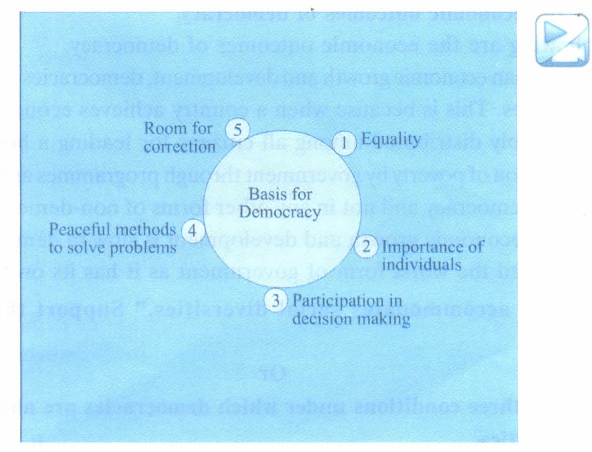
Democracy is considered a better form of government than other forms because:
(a) it enhances dignity of the individual by giving every person equal treatment.
(b) it involves every citizen in the decision-making, thereby improving the quality of decision-making process. Every citizen has the right to vote and choose his representatives in the government.
(c) it is an effective form of government as it provides room to correct its own mistakes and resolves conflicts amicably. And above all democratic government is people's own government
4.
When any country follows this pattern, then they are able to claim to practise democratic politics.
(i) Elections are held at regular intervals and are fair and free.
(ii) Freedom of speech, expression and thought is another feature of democracy.
(iii) The dignity of the individuals is recognised.
5.
The decision making process of the non-democratic rulers is very quick. They are also efficient in decision making and even in the implementation of the decisions. This all happens because non-democratic rulers do not have to bother about deliberation in assemblies or about the public opinion. On the other hand, democratic form of government is based on deliberation and negotiation. This cause the process slow. They followed procedures and their decisions may be more acceptable to the people and are more effective.
6.
Democracy does not rule simply by majority opinion. 'Majority' does not mean a community in terms of religion, race or linguistic group. Rule by majority means that in case of every decision, or in case of every election, different people and groups can form a majority.
7.
(i) As people get some benefits of democracy, they ask for more and want to make democracy even better. That is why when we ask people about the way democracy functions, they will always come up with more expectations, and many complaints.
(ii) The fact that people are complaining itself is a testimony to the success of democracy, it shows that people have developed awareness and the ability to expect and to look critically at power holders and the high and the mighty.
(iii) A public expression of dissatisfaction with democracy shows the success of the democratic project: it transforms people from the status of a subject under a King into that of a citizen.
(iv) Most individuals today believe that their vote makes a difference to the way the government is run and to their own self-interest.
8.
Regular, free and fair elections, open public debate on major policies and legislation, and citizens' right to information about the government and its functioning are the practices and institutions to measure democracies on the basis of the expected outcome.
9.
Democracy is considered to be the best form of government and most of the countries in the world have adopted it.
Arguments in favour of democracy
1. It safeguards the interest of the people
2. Based on the principle of equality
3. Possibility in administration
4. Political education to the people
5. Little chance of revolution
6. Based on public opinion
7. Helps people to become good citizens
8. Accommodate all diversities and differences.
10.
(a) Challenge Involved Challenges of social inequality and untouchability.
Suggestion To check this challenge, a law has been passed to declare untouchability a legal offence.
Efforts have been made to promote social equality. Central Government has directed the State Government not to practice untouchability in any form. If anyone tries to do so, he will be punished under the law of Untouchability Offence Act, 1955.
(b) Challenge Involved Challenges of poverty and economic inequalities.
Suggestion To look into grievance of the poor farmers, loan should be provided to them at low rates of interest, that could be easily returned.
For this purpose, cooperative societies should come forward to help the poor farmers. Crop Insurance Policy should be implemented for any eventuality of crop failure.
(c) Challenge Involved Challenge to preserve the people trust in government agencies, like the police.
Suggestion To check such challenges in a democratic government, the law should be amended. So that, the police do not take law and order in their hands and should have a reasonable behaviour towards the civilians.
11.
Almost every country in the world has social diversities in respect to caste, race, religion, language, etc. Democracy is considered to be the most suitable form of government to accommodate these diversities.
It aims at giving equal rights and opportunities to all the citizens irrespective of caste, religion, colour, sex, race, etc.
Democracy is not simply ruled by majority opinion. The majority always needs to work for minority. Democracy does not believe in any kind of discrimination among citizens. Thus, it accommodates all social diversities.

10th Standard CBSE Syllabus & Materials
10th Standard CBSE
CBSE 10th Social Science PS - Federalism - New Model Questions Papers Study Material - QB365 Set A
NEW10th Standard CBSE
CBSE 10th Social Science PS - Power Sharing - New Model Questions Papers Study Material - QB365 Set A
NEW10th Standard CBSE
CBSE 10th Social Science GEO - Manufacturing Industries - New Model Questions Papers Study Material - QB365 Set A
NEW10th Standard CBSE
CBSE 10th Social Science GEO - Minerals and Energy Resources - New Model Questions Papers Study Material - QB365 Set A



CBSE 10th Standard CBSE Subjects
CBSE Standards





