
 100% FREE ACCESS
10th Standard CBSE Syllabus & Materials
10th Standard CBSE
CBSE 10th Social Science ECO - Globalisation and the Indian Economy - New Model Questions Papers Study Material - QB365 Set A
NEW10th Standard CBSE
CBSE 10th Social Science ECO - Money and Credit - New Model Questions Papers Study Material - QB365 Set A
NEW10th Standard CBSE
CBSE 10th Social Science ECO - Sectors of the Indian Economy - New Model Questions Papers Study Material - QB365 Set A
NEW10th Standard CBSE
CBSE 10th Social Science ECO - Development - New Model Questions Papers Study Material - QB365 Set A
NEW10th Standard CBSE
CBSE 10th Social Science PS - Outcomes of Democracy - New Model Questions Papers Study Material - QB365 Set A
NEW10th Standard CBSE
CBSE 10th Social Science PS - Gender, Religion and Caste - New Model Questions Papers Study Material - QB365 Set A

Published on: 11/09/2019
Power Sharing
Download CBSE Class 10th Standard CBSE Social Science question papers, sample papers, important questions, and previous year solved papers in PDF format. Get free study materials, NCERT solutions, and exam preparation resources for Class 10th Standard CBSE Social Science
Questions + Answers key
Take MCQ Social Science Test
1.
What were the demands of Sri Lankan Tamils? How they struggled for their demands?
2.
State one prudential reason and one moral reason for power sharing with an example from the Indian context.
3.
Describe any three forms of power sharing in modern democracies with examples.
4.
In Modern democracies, power is often shared among different organs of the government. Explain.
5.
Explain four forms of participation in government under modern democratic system.
6.
Explain the major forms of power sharing in modern democracies.
7.
Describe the horizontal and vertical power sharing in modern democracies.
8.
What are the different forms of power sharing in modern democracies? Give an example of each of these.
9.
Which was the only official language of Sri Lanka?
Tamil
Malayalam
Sinhala
None of the above
10.
How many times leaders of Belgium amended their constitution?
Two times
Three times
Four times
Since time
11.
A belief that the majority community should be able to rule a country in whichever way it wants is:
Community Government
Federal Government
Majoritarian
Prudential
12.
Prudential reasons of power sharing stress on.
A. the stability of political order
B. to reduce the possibility of conflict between social groups
C. a fair share to minority
D. the intrinsic worth of power sharing.
Consider the statement:
All are appropriate
Only A, C and D are appropriate
Only B and D are appropriate
A, B and C are appropriate.
13.
Consider the statement on Ethnic Composition and mark the answer.
A. The Ethnic Composition of Belgium is very complex because of diverse language speaking.
B. French speaking community was in minority and more powerful.
C. Dutch speaking community was in majority and less powerful.
D. There was conflicts between the French and Dutch communities.
Which of the statements given above are correct?
Both B and C are true
Only A is true
Both A and D are true
All are false.
14.
Consider the following statements about power sharing arrangements in Belgium and Sri Lanka.
A. In Belgium, the Dutch-speaking majority people tried to impose their domination on the minority French-speaking community.
B. In Sri Lanka, the policies of the government sought to ensure the dominance of the Sinhala-speaking majority.
C. The Tamils in Sri Lanka demanded a federal arrangement of power sharing to protect their culture, language and equality of opportunity in education and jobs.
D. The transformation of Belgium from unitary government to a federal one prevented a possible division of the country on linguistic lines. Which of the statement given above are correct?
A, B, C and D
A, Band D
C and D
B, C and D
1.
A feeling of alienation was seen among the Sri Lankan Tamils.
(a) The Sri Lankan Tamils launched parties and struggles for the recognition of Tamil as an official language.
(b) For regional autonomy.
(c) Equality of opportunity in securing education and jobs.
This was denied by the Sinhala dominated government.
By 1980s, several political organisations were formed demanding an independent Tamil Eelam (state) in northern and eastern parts of Sri Lanka.
These differences in the two different communities pushed Sri Lanka into the state of civil war.
2.
The prudential reason for power sharing helps to reduce the possibility of conflict between social groups. An example is the reservation of constituencies for SC, ST, minorities in India. In this way, the power sharing tries to reduce the possibility of conflicts.
Power sharing for moral reason is based on moral considerations. An example of power sharing for a moral reason is decentralisation of powers in India through formation of local, state and central governments operating at different levels. Here power is morally shared between different governments.
3.
Different forms of power sharing in modern democracies:
(a) Horizontal division of power:
It is the sharing of power among the different organs of government. The division of government into the executive, the legislature and the judiciary is an example of horizontal division of power. In such a power sharing arrangement, different organs of government, placed at the same level, exercise different powers. This separation of powers ensures that no organ exercises unlimited power. Each organ checks the others, thereby putting in place a system of checks and balances. The division of power between the Council of Ministers headed by the Indian Prime Minister, the Parliament of India and the Indian Supreme Court is an example of this kind of power sharing.
(b) Vertical division of power:
It is the sharing of power among governments at different levels - a general government for the entire country and governments at the provincial or regional level. For example, in India, the Constitution defines the way power is to be shared between the Central or Union government and the various State governments. There are certain matters on which only the Central government can take decisions, while there are others on which only an individual state government has an exclusive right for decision making.
(c) Division of power among social groups:
Power can also be shared among different groups which differ socially. The system of 'community government' in Belgium is an example of this type of power division. This government is elected by people belonging to one language community (Dutch, French and German speaking) and has the power to take decisions regarding cultural, educational and language related issues. The system of reserved constituencies in India is another example.
(d) Division of power between political parties, pressure groups and movements:
Political parties are the organisations which aim to control power by contesting elections. In a democracy, citizens have the freedom to choose among the various contenders for power (the different political parties or the different alliances comprising political parties). Such a freedom of choice entails competition among the different parties, which in turn ensures that power does not remain in one hand, and is shared among different political parties representing different ideologies and social groups. Pressure groups and movements also share governmental power, either through participation in governmental committees or by influencing the decision making process.
4.
Different forms of power sharing in modern democracies:
(a) Horizontal division of power:
It is the sharing of power among the different organs of government. The division of government into the executive, the legislature and the judiciary is an example of horizontal division of power. In such a power sharing arrangement, different organs of government, placed at the same level, exercise different powers. This separation of powers ensures that no organ exercises unlimited power. Each organ checks the others, thereby putting in place a system of checks and balances. The division of power between the Council of Ministers headed by the Indian Prime Minister, the Parliament of India and the Indian Supreme Court is an example of this kind of power sharing.
(b) Vertical division of power:
It is the sharing of power among governments at different levels - a general government for the entire country and governments at the provincial or regional level. For example, in India, the Constitution defines the way power is to be shared between the Central or Union government and the various State governments. There are certain matters on which only the Central government can take decisions, while there are others on which only an individual state government has an exclusive right for decision making.
(c) Division of power among social groups:
Power can also be shared among different groups which differ socially. The system of 'community government' in Belgium is an example of this type of power division. This government is elected by people belonging to one language community (Dutch, French and German speaking) and has the power to take decisions regarding cultural, educational and language related issues. The system of reserved constituencies in India is another example.
(d) Division of power between political parties, pressure groups and movements:
Political parties are the organisations which aim to control power by contesting elections. In a democracy, citizens have the freedom to choose among the various contenders for power (the different political parties or the different alliances comprising political parties). Such a freedom of choice entails competition among the different parties, which in turn ensures that power does not remain in one hand, and is shared among different political parties representing different ideologies and social groups. Pressure groups and movements also share governmental power, either through participation in governmental committees or by influencing the decision making process.
5.
Different forms of power sharing in modern democracies:
(a) Horizontal division of power:
It is the sharing of power among the different organs of government. The division of government into the executive, the legislature and the judiciary is an example of horizontal division of power. In such a power sharing arrangement, different organs of government, placed at the same level, exercise different powers. This separation of powers ensures that no organ exercises unlimited power. Each organ checks the others, thereby putting in place a system of checks and balances. The division of power between the Council of Ministers headed by the Indian Prime Minister, the Parliament of India and the Indian Supreme Court is an example of this kind of power sharing.
(b) Vertical division of power:
It is the sharing of power among governments at different levels - a general government for the entire country and governments at the provincial or regional level. For example, in India, the Constitution defines the way power is to be shared between the Central or Union government and the various State governments. There are certain matters on which only the Central government can take decisions, while there are others on which only an individual state government has an exclusive right for decision making.
(c) Division of power among social groups:
Power can also be shared among different groups which differ socially. The system of 'community government' in Belgium is an example of this type of power division. This government is elected by people belonging to one language community (Dutch, French and German speaking) and has the power to take decisions regarding cultural, educational and language related issues. The system of reserved constituencies in India is another example.
(d) Division of power between political parties, pressure groups and movements:
Political parties are the organisations which aim to control power by contesting elections. In a democracy, citizens have the freedom to choose among the various contenders for power (the different political parties or the different alliances comprising political parties). Such a freedom of choice entails competition among the different parties, which in turn ensures that power does not remain in one hand, and is shared among different political parties representing different ideologies and social groups. Pressure groups and movements also share governmental power, either through participation in governmental committees or by influencing the decision making process.
6.
Different forms of power sharing in modern democracies:
(a) Horizontal division of power:
It is the sharing of power among the different organs of government. The division of government into the executive, the legislature and the judiciary is an example of horizontal division of power. In such a power sharing arrangement, different organs of government, placed at the same level, exercise different powers. This separation of powers ensures that no organ exercises unlimited power. Each organ checks the others, thereby putting in place a system of checks and balances. The division of power between the Council of Ministers headed by the Indian Prime Minister, the Parliament of India and the Indian Supreme Court is an example of this kind of power sharing.
(b) Vertical division of power:
It is the sharing of power among governments at different levels - a general government for the entire country and governments at the provincial or regional level. For example, in India, the Constitution defines the way power is to be shared between the Central or Union government and the various State governments. There are certain matters on which only the Central government can take decisions, while there are others on which only an individual state government has an exclusive right for decision making.
(c) Division of power among social groups:
Power can also be shared among different groups which differ socially. The system of 'community government' in Belgium is an example of this type of power division. This government is elected by people belonging to one language community (Dutch, French and German speaking) and has the power to take decisions regarding cultural, educational and language related issues. The system of reserved constituencies in India is another example.
(d) Division of power between political parties, pressure groups and movements:
Political parties are the organisations which aim to control power by contesting elections. In a democracy, citizens have the freedom to choose among the various contenders for power (the different political parties or the different alliances comprising political parties). Such a freedom of choice entails competition among the different parties, which in turn ensures that power does not remain in one hand, and is shared among different political parties representing different ideologies and social groups. Pressure groups and movements also share governmental power, either through participation in governmental committees or by influencing the decision making process.
7.
Different forms of power sharing in modern democracies:
(a) Horizontal division of power:
It is the sharing of power among the different organs of government. The division of government into the executive, the legislature and the judiciary is an example of horizontal division of power. In such a power sharing arrangement, different organs of government, placed at the same level, exercise different powers. This separation of powers ensures that no organ exercises unlimited power. Each organ checks the others, thereby putting in place a system of checks and balances. The division of power between the Council of Ministers headed by the Indian Prime Minister, the Parliament of India and the Indian Supreme Court is an example of this kind of power sharing.
(b) Vertical division of power:
It is the sharing of power among governments at different levels - a general government for the entire country and governments at the provincial or regional level. For example, in India, the Constitution defines the way power is to be shared between the Central or Union government and the various State governments. There are certain matters on which only the Central government can take decisions, while there are others on which only an individual state government has an exclusive right for decision making.
(c) Division of power among social groups:
Power can also be shared among different groups which differ socially. The system of 'community government' in Belgium is an example of this type of power division. This government is elected by people belonging to one language community (Dutch, French and German speaking) and has the power to take decisions regarding cultural, educational and language related issues. The system of reserved constituencies in India is another example.
(d) Division of power between political parties, pressure groups and movements:
Political parties are the organisations which aim to control power by contesting elections. In a democracy, citizens have the freedom to choose among the various contenders for power (the different political parties or the different alliances comprising political parties). Such a freedom of choice entails competition among the different parties, which in turn ensures that power does not remain in one hand, and is shared among different political parties representing different ideologies and social groups. Pressure groups and movements also share governmental power, either through participation in governmental committees or by influencing the decision making process.
8.
In modern democracies, the following are some of the important forms of power sharing
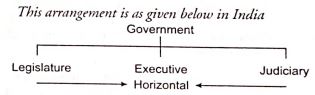
(i) Power Sharing among the Different Organs of Government (i.e. Horizontal distribution of power) In this form of power sharing, power is assigned by the Constitution among different organs of government such as the Legislature, Executive and Judiciary. This type of distribution ensures separation of powers among the organs at the same level, so that none of the organs can exercise unlimited power. Each organ puts a check on the others in order to maintain balance of power under the system of checks and balances. This arrangement is as given below in India
(ii) Power Sharing among Governments at Different Levels (ie. Vertical distribution of power sharing) In this form of power sharing, power is shared at the different levels of government. The overall governing body for the country is known as 'Union Government' or 'Federal Government' and the government at the Constituent units is known as State Government. The third or lowest level is Local Government, e.g. Municipalities and Panchayats in India.
(iii) Power Sharing among Political Partics, Pressure Groups and Movements In a democracy, power is shared among different political parties that represent different ideologies and social groups. Sometimes, this kind of sharing can be direct, when two or more parties form an alliance to contest elections. If their alliance is elected, they form a Coalition Government and thus share power. An example is the NDA government in India, which is a Coalition government.
In a democracy, various pressure groups and movements have an indirect share in government power, either through participation in government committees or bringing influence on the decision-making process.
(iv) Power Sharing Among Different Social Groups In a democracy, especially, in multi-ethnic society, power is also shared among social groups such as religious and linguistic groups. 'Community government in Belgium is a good example of this arrangement.
9.
(c)
Sinhala
10.
(c)
Four times
11.
(c)
Majoritarian
12.
(d)
A, B and C are appropriate.
13.
(b)
Only A is true
14.
(d)
B, C and D

10th Standard CBSE Syllabus & Materials
10th Standard CBSE
CBSE 10th Social Science PS - Federalism - New Model Questions Papers Study Material - QB365 Set A
NEW10th Standard CBSE
CBSE 10th Social Science PS - Power Sharing - New Model Questions Papers Study Material - QB365 Set A
NEW10th Standard CBSE
CBSE 10th Social Science GEO - Manufacturing Industries - New Model Questions Papers Study Material - QB365 Set A
NEW10th Standard CBSE
CBSE 10th Social Science GEO - Minerals and Energy Resources - New Model Questions Papers Study Material - QB365 Set A



CBSE 10th Standard CBSE Subjects
CBSE Standards





