
 100% FREE ACCESS
10th Standard CBSE Syllabus & Materials
10th Standard CBSE
CBSE 10th Social Science ECO - Globalisation and the Indian Economy - New Model Questions Papers Study Material - QB365 Set A
NEW10th Standard CBSE
CBSE 10th Social Science ECO - Money and Credit - New Model Questions Papers Study Material - QB365 Set A
NEW10th Standard CBSE
CBSE 10th Social Science ECO - Sectors of the Indian Economy - New Model Questions Papers Study Material - QB365 Set A
NEW10th Standard CBSE
CBSE 10th Social Science ECO - Development - New Model Questions Papers Study Material - QB365 Set A
NEW10th Standard CBSE
CBSE 10th Social Science PS - Outcomes of Democracy - New Model Questions Papers Study Material - QB365 Set A
NEW10th Standard CBSE
CBSE 10th Social Science PS - Gender, Religion and Caste - New Model Questions Papers Study Material - QB365 Set A

Published on: 10/09/2019
Resources and Development
Download CBSE Class 10th Standard CBSE Social Science question papers, sample papers, important questions, and previous year solved papers in PDF format. Get free study materials, NCERT solutions, and exam preparation resources for Class 10th Standard CBSE Social Science
Questions + Answers key
Take MCQ Social Science Test
1.
Which one of the following is the main cause of land degradation in Madhya Pradesh?
Mining
Overgrazing
Deforestation
Over Irrigation
2.
Which one of the following method is used to break up the force wind?
Shelter belt
Strip Cropping
Contour ploughing
Terrace farming
3.
Which one of the following is responsible for sheet erosion?
Underground water
Wind
Glacier
Water
4.
Which one of the following resources can be acquired by the Nation?
Potential resources
International resources
National resources
Public resources
5.
How much percentage of forest area in the country according to the national Forest Policy.
33%
37%
27%
31%
6.
Which one of the following soil is the best for cotton cultivation?
Red soil
Black soil
Laterite soil
Alluvial soil
7.
Which one of the following term is used to identify the old and new alluvial respectively?
Khadas&Tarai
Tarai&Tarai&Bangar
Bangar&Khadar
Tarai&Dvars
8.
Coal, iron ore, petroleum, diesel etc. are the examples of
Biotic resources
Abiotic resources
Renewable resources
Non Renewable resources
9.
Which one of the following is the main cause of land degradation in Punjab?
Intensive cultivation
Deforestation
Over irrigation
Overgrazing
10.
Under which of the following type of resource can tidal energy be put?
Replenishable
Human-made
Abiotic
Non-recyclable
11.
Which one of the following types of resource is iron ore?
Renewable
Biotic
Flow
Non-renewable
12.
Examine the three major problems that have been created due to the indiscriminate use of resources by human beings.
13.
Write brief note on first earth summit.
14.
(i) Name three states having black soil and the crop which is mainly grown in it.
(ii) What type of soil is found in the river deltas of the eastern coast? Give three main features of this type of soil.
(iii) what steps can be taken to control soil erosion in the hilly areas?
15.
(i) Explain land use pattern in India and why has the land under forest not increased much since 1960-61?
(ii) How have technical and economic development led to more consumption of resources?
16.
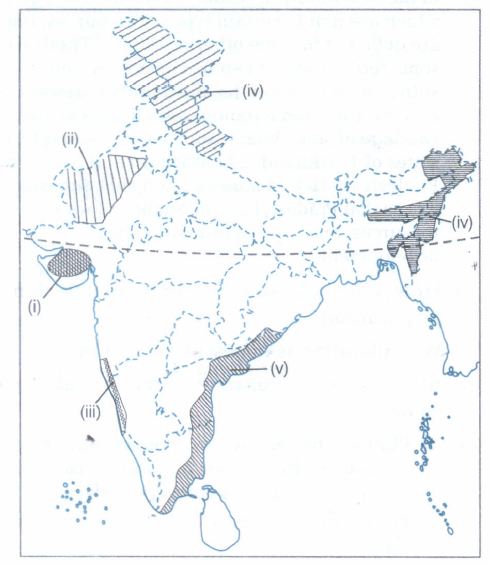
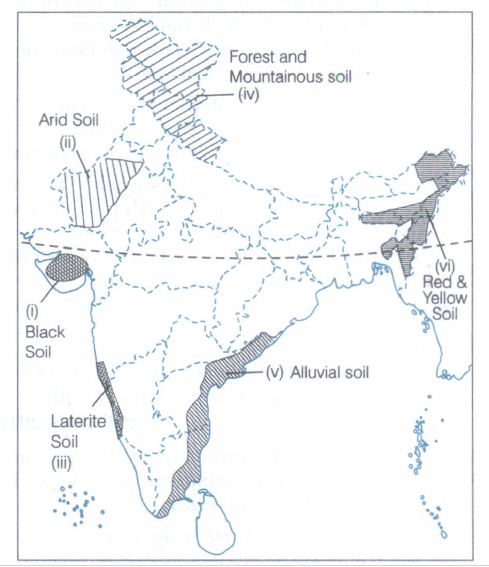
On the physical outline map of India given below, identify any four soil types of India.
1.
(c)
Deforestation
2.
(a)
Shelter belt
3.
(d)
Water
4.
(c)
National resources
5.
(a)
33%
6.
(b)
Black soil
7.
(c)
Bangar&Khadar
8.
(d)
Non Renewable resources
9.
(c)
Over irrigation
10.
(a)
Replenishable
11.
(d)
Non-renewable
12.
(a) Depletion of resources for satisfying the greed of few individuals.
(b) Accumulation of resources in few hands, which, in turn, divided the society into two segments as haves and have notes or rich and poor.
(c) Indiscriminate exploitation of resources has led to global ecological crises such as global warming, ozone layer depletion, environmental pollution and land degradation.
13.
It held at Rio de Janerio in Brazil.
It is the first ever International Earth Summit.
It is United Nations Conference on Environment and Development [UNCED].
The Summit was aimed at the urgent problems of environmental protection and socioeconomic development at the global level.
The assembled leaders signed the Declaration on Global Climatic Change and Biological Diversity. The Rio Convention recognised 21 for achieving Sustainable Development in the 21st century.
14.
(i) The three states having black soil are Madhya Pradesh, Chhattisgarh and Maharashtra. The crops, which mainly grown are cotton, tobacco and sugarcane.
(ii) Alluvial soil is found in the river deltas of the Eastern coast. Three main features of this type of soil are
(a) It is very fertile.
(b) It contains adequate proportion of potash, phosphoric acid and lime.
(c) It is more alkaline in the drier areas.
(iii) Following steps should be taken to control soil erosion in the hilly areas
(a) Afforestation This is done by planting trees.
(b) Terrace farming and contour ploughing This is done across the hill slopes.
(c) Restricted grazing of animals Animals should be moved over different pastures so as to avoid erosion of soil.
(d) Plugging of gullies By this method, gully erosion can be prevented
15.
(i) Land resources in India are primarily divided into agricultural land, forest land, land meant for pasture and grazing, land for other non-agricultural use (such as housing, roads and industry) and waste land (rocky,arid and desert areas). According to recent data available, (2014-15) the percentage of Net Sown Area (NSA) in India is about 45.5% of the total reporting area 23.3% is covered by forests and 3.38% is used for grazing. The rest is waste land with traces of miscellaneous cultivation.
Land under forest has increased by only above 5 per cent since 1960-61 due to following reasons
Improper use of forest land has degraded the available land area and made conservation of forests difficult.
Human activities such as deforestation, mining and quarrying have contributed to the slow growth rate of forests.
(ii) The following technical and economic development have led to more consumption of resources
(a) Technological development has led to industrialisation which has increased the use of natural resources.
(b) Technological development has converted the subsistence agriculture to commercial agriculture and this has led to the over-utilisation of soil.
(c) Technological development has also improved the process of mining.
(d) The development of technology contributed to increase in production of quality goods and provision of better services to the people.
(e) Economic development has led to increasing urbanisation and modernisation which demand more resources.
16.
(I) Black soil (ii) Arid soil
(iii) Laterite soil (iv) Forest and Mountainous soil
(v) Alluvial soil (vi) Red and Yellow soil

10th Standard CBSE Syllabus & Materials
10th Standard CBSE
CBSE 10th Social Science PS - Federalism - New Model Questions Papers Study Material - QB365 Set A
NEW10th Standard CBSE
CBSE 10th Social Science PS - Power Sharing - New Model Questions Papers Study Material - QB365 Set A
NEW10th Standard CBSE
CBSE 10th Social Science GEO - Manufacturing Industries - New Model Questions Papers Study Material - QB365 Set A
NEW10th Standard CBSE
CBSE 10th Social Science GEO - Minerals and Energy Resources - New Model Questions Papers Study Material - QB365 Set A



CBSE 10th Standard CBSE Subjects
CBSE Standards





