
 100% FREE ACCESS
10th Standard CBSE Syllabus & Materials
10th Standard CBSE
CBSE 10th Social Science ECO - Globalisation and the Indian Economy - New Model Questions Papers Study Material - QB365 Set A
NEW10th Standard CBSE
CBSE 10th Social Science ECO - Money and Credit - New Model Questions Papers Study Material - QB365 Set A
NEW10th Standard CBSE
CBSE 10th Social Science ECO - Sectors of the Indian Economy - New Model Questions Papers Study Material - QB365 Set A
NEW10th Standard CBSE
CBSE 10th Social Science ECO - Development - New Model Questions Papers Study Material - QB365 Set A
NEW10th Standard CBSE
CBSE 10th Social Science PS - Outcomes of Democracy - New Model Questions Papers Study Material - QB365 Set A
NEW10th Standard CBSE
CBSE 10th Social Science PS - Gender, Religion and Caste - New Model Questions Papers Study Material - QB365 Set A

Published on: 11/09/2019
Water Resources
Download CBSE Class 10th Standard CBSE Social Science question papers, sample papers, important questions, and previous year solved papers in PDF format. Get free study materials, NCERT solutions, and exam preparation resources for Class 10th Standard CBSE Social Science
Questions + Answers key
Take MCQ Social Science Test
1.
The largest artificial lake built in 11 th century was century was
Bhopal lake
Kalinga lake
Kolhapur lake
Bennur lake
2.
Bamboo drip irrigation is common in the state of
Rajasthan
Madhya Pradesh
Meghalaya
Karnataka
3.
Rooftop rainwater harvesting system in Rajasthan is known as
Guls
Tankas
Johads
Baolis
4.
Sardar Sarovar Dam is constructed on
River Krishna
River Mahanadi
River Cauvery
River Narmada
5.
The first multi-purpose project of India was
Sivasamudram
Damodar Vally
Hirakud
Rajasthan Canal
6.
The first of the only state in India which has made roof top rainwater harvesting structured compulsory to all the across the state is
Karnataka
Tamil Nadu
Kerala
none of these
7.
It is predicated that nearly 2 billion people will live in absolute water scarcity in the year of
2015
2020
2025
2030
8.
What is the rank of India in the world countries in the terms of Water availability per person p.a.?
129 th
130 th
131st
133rd
9.
How much % of the Earth's Surface is covered with water?
About 70%
About 90%
About 60%
None of these
10.
On which river has Nagarjuna Sagar Dam been constructed?
River Cauvery
River Krishna
River Godavari
River Tapti
11.
Roof top rainwater harvesting is the most common practice in
Shillong
Guwahati
Imphal
Patna
12.
The total volume of the world's water is estimated to exist as ocean
75.5%
85.5%
95.5%
65.5%
13.
Here are some false statements. Identify the mistakes and rewrite them correctly.
Multiplying urban centres with large and dense populations and urban lifestyles have helped in proper utilisation of water resources.
Regulating and damming of rivers does not affect the river's natural flow and its sediment flow.
Today in Rajasthan, the practice of rooftop rainwater water harvesting has gained popularity despite high water availability due to the Indira Gandhi Canal.
14.
Which one of the following statements is not an argument in favour of multi-purpose river projects?
Multi-purpose projects bring water to those areas which suffer from water scarcity.
Multi-purpose projects by regulating water flow help to control floods.
Multi-purpose projects lead to large scale displacements and loss of livelihood.
Multi-purpose projects generate electricity for our industries and our homes.
15.
Based on the information given below classify each of the situations as 'suffering from water scarcity' or 'not suffering from water scarcity'.
Region with high annual rainfall
Region having high annual rainfall and large population
Region having high annual rainfall but water is highly polluted
Region having low rainfall and low population.
16.
Prove by giving examples that river valley projects fail to achieve the purpose for which they were built.
17.
How does water threaten human welfare?
18.
Explain any three disadvantages of multipurpose projects.
19.
Explain any three reasons responsible for water scarcity in India.
20.
Explain how water becomes a renewable resource.
21.
Discuss how rainwater harvesting in semi-arid regions of Rajasthan is carried out.
22.
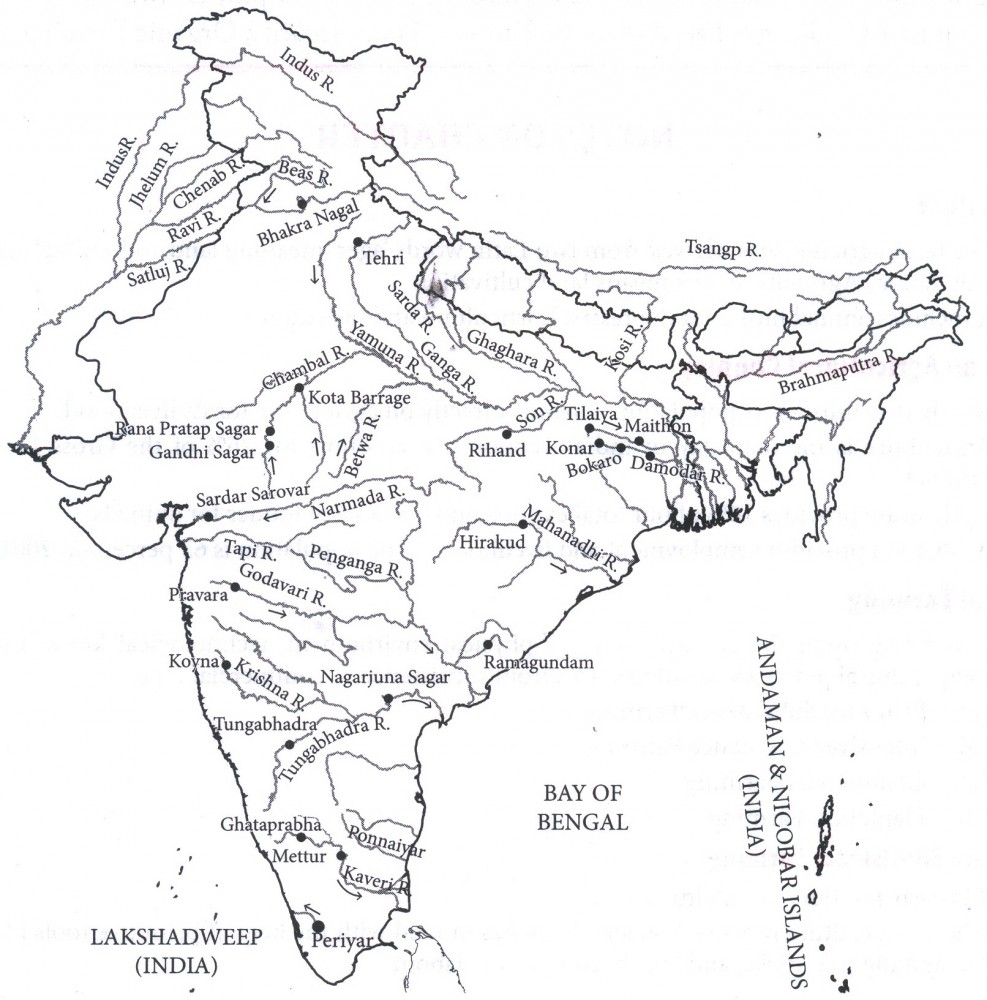
In the outline map of the India, show the following multi-purpose projects or dams.
(a) Bhakra
(b) Damodar Valley
(c) Nagarjuna Sagar
(d) Hirakud
(e) Chambal
1.
(a)
Bhopal lake
2.
(c)
Meghalaya
3.
(b)
Tankas
4.
(d)
River Narmada
5.
(b)
Damodar Vally
6.
(b)
Tamil Nadu
7.
(c)
2025
8.
(d)
133rd
9.
(a)
About 70%
10.
(b)
River Krishna
11.
(a)
Shillong
12.
(c)
95.5%
13.
(a)
Multiplying urban centres with large and dense populations and urban lifestyles have helped in proper utilisation of water resources.
14.
(c)
Multi-purpose projects lead to large scale displacements and loss of livelihood.
15.
(b)
Region having high annual rainfall and large population
16.
(i) The dams were constructed to control floods but it has triggered floods due to sedimentation in the reservoir and due to dam failure. Release of water from dams during heavy rains aggravated the flood situation in Maharashtra and Gujarat in 2006.
(ii) Multi-purpose projects induced earthquakes, caused waterborne diseases and pollution resulting from excessive use of water.
17.
(a) Scarcity of water: Due to high population, increasing urbanization and rising standard of living, there is a growing scarcity of water felt all over India.
(b) Use of degraded water: In many areas, people are forced to drink and use polluted water which causes various water borne diseases.
(c) Lowering the water table: Increased use of tube wells in recent years has lowered the water table and has caused depletion of underground water resources.
(d) Inadequate supply water for irrigation, Two third of the cropped area in India is still rain-fed, which is uncertain and irregular which affects agriculture.
18.
(i) All water that is used primarily ends up in the sea. From there, it enters the hydrological cycle in the form of water vapour. Freshwater is renewed by this cycle when precipitation occurs. Hence, water is a renewable resource.
(ii) Water scarcity or water stress occurs when availability is not enough to match the demand for water. It is caused by an increase in population, growing demand for water, and unequal access to it.
(iii) Multipurpose river projects help in irrigation, electricity production, flood control, inland navigation and fish breeding. However, the reservoirs destroy local flora and fauna. Many native villages are submerged, and people lose their livelihood, with little or no hope of rehabilitation.
19.
(i) All water that is used primarily ends up in the sea. From there, it enters the hydrological cycle in the form of water vapour. Freshwater is renewed by this cycle when precipitation occurs. Hence, water is a renewable resource.
(ii) Water scarcity or water stress occurs when availability is not enough to match the demand for water. It is caused by an increase in population, growing demand for water, and unequal access to it.
(iii) Multipurpose river projects help in irrigation, electricity production, flood control, inland navigation and fish breeding. However, the reservoirs destroy local flora and fauna. Many native villages are submerged, and people lose their livelihood, with little or no hope of rehabilitation.
20.
Water becomes a renewable resource through the hydrological cycle. Freshwater is mainly obtained from the surface runoff and groundwater is continually being renewed and recharged through the hydrological cycle.
21.
Rainwater harvesting in semi-arid regions of Rajasthan is carried out in the following ways
In arid and semi-arid regions of Rajasthan, agricultural fields were converted into rained Storage structures.
These allowed the rainwater to stand and moisture the soil like the Khadins in Jaisalmer and Johads in other parts of Rajasthan.
Rooftop rainwater harvesting was commonly practised or store drinking water in semi-arid and arid regions of Rajasthan, particularly in Bikaner, Phalodi, Barmer and across the towns and villages of the Thar desert.
Every house in these regions had underground tankas to store the water for drinking purposes.
These tankas are large and deep tanks which were built inside the main house. They were linked to the sloping roofs of the houses through a pipe. Rainwater falling on the rooftops would a pipe. Rainwater falling on the rooftops would run down through the pipe and collect in the underground tankas.
The collected rainwater was stored in the underground tankas providing drinking water till the next seasons. When all other sources have dried up, these tankas were beneficial to beat the summer heat as they kept the rooms cool.
22.

10th Standard CBSE Syllabus & Materials
10th Standard CBSE
CBSE 10th Social Science PS - Federalism - New Model Questions Papers Study Material - QB365 Set A
NEW10th Standard CBSE
CBSE 10th Social Science PS - Power Sharing - New Model Questions Papers Study Material - QB365 Set A
NEW10th Standard CBSE
CBSE 10th Social Science GEO - Manufacturing Industries - New Model Questions Papers Study Material - QB365 Set A
NEW10th Standard CBSE
CBSE 10th Social Science GEO - Minerals and Energy Resources - New Model Questions Papers Study Material - QB365 Set A



CBSE 10th Standard CBSE Subjects
CBSE Standards





