
 100% FREE ACCESS
10th Standard CBSE Syllabus & Materials
10th Standard CBSE
CBSE 10th Social Science ECO - Globalisation and the Indian Economy - New Model Questions Papers Study Material - QB365 Set A
NEW10th Standard CBSE
CBSE 10th Social Science ECO - Money and Credit - New Model Questions Papers Study Material - QB365 Set A
NEW10th Standard CBSE
CBSE 10th Social Science ECO - Sectors of the Indian Economy - New Model Questions Papers Study Material - QB365 Set A
NEW10th Standard CBSE
CBSE 10th Social Science ECO - Development - New Model Questions Papers Study Material - QB365 Set A
NEW10th Standard CBSE
CBSE 10th Social Science PS - Outcomes of Democracy - New Model Questions Papers Study Material - QB365 Set A
NEW10th Standard CBSE
CBSE 10th Social Science PS - Gender, Religion and Caste - New Model Questions Papers Study Material - QB365 Set A

Published on: 28/09/2019
Areas Related to Circles
Download CBSE Class 10th Standard CBSE Maths question papers, sample papers, important questions, and previous year solved papers in PDF format. Get free study materials, NCERT solutions, and exam preparation resources for Class 10th Standard CBSE Maths
Questions + Answers key
Take MCQ Maths Test
1.
A farmer has field of length 20 m and breadth 14 m. By the farmer a well of diameter 7 mis dug 10 m deep for villagers. The earth taken out is spread in the field. Find the level rise in the field. Write the value depicted.
2.
The diameters of the front and rear wheels of a tractor are 80 cm and 200 cm respectively. Find the number of revolutions of rear wheel to cover the distance which the front wheel covers in 800 revolutions.
3.
Four equal circles are described at the four corners of a square so that each touches two of the others. The shaded area enclosed between the circles is \(\\ \frac { 24 }{ 7 } \) cm2.Find the radius of each circle.
4.
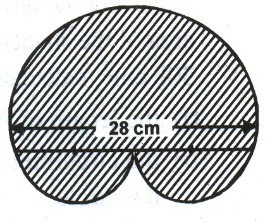
Find the area of the shaded region in the adjoining figure.
5.
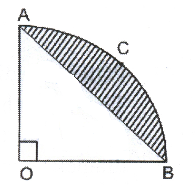
AOBC is a quadrant of a circle of radius 10 m. Calculate the area of the shaded portion. [Take \(\pi=3.14\)]
6.
A chord AB of a circle of radius 10 cm makes a right angle at the centre of the circle. Find the area of the major and minor segments. [Take \(\pi=3.14\)]
7.
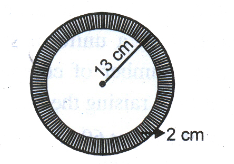
Calculate the area of the shaded portion in the given figure.
8.
The length of the minute hand of a clock is 5 cm. Find the area swept by the minute hand during the time period 6 : 05 am and 6 : 40 am.
9.
The wheel of a car has diameter 56 cm.
(i) How much times does it rotate when the car has travelled 11 km?
(ii) If the wheel has rotated 25000 times when the car has travelled for 45 minutes, calculate speed in km/h.
10.
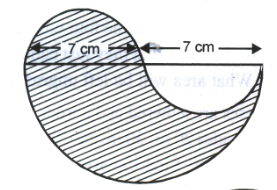
From the given figure, calculate:
(i) the area of the shaded region and
(ii) the length of the boundary
11.
Find the diameter of the circle, which has circumference equal to the sum of the circumference of two circles with radii 7 cm and 14 cm.
12.
The long and short hands of a clock are 6 cm and 3 cm respectively. Find the sum of distance travelled by their tips in a day.
13.
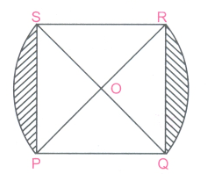
In fig., PQRS is a square lawn with side PQ = 42 metres. Two circular flower beds are there on the sides PS and QR with centre at O, the intersection of its diagonals. Find the total area of the two flowers beds (shaped parts).
14.
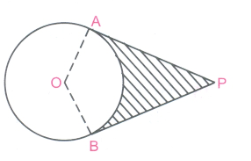
An elastic belt is placed round the rim of a pulley of radius 5 cm. One point on the belt is pulled directly away from the centre O of the pulley until it is at P, 10 cm away from O. Find the length of the belt that is in contact with the rim of the pulley. Also find the shaded area . ( Use \(\pi =3.14,\sqrt { 3 } =1.73)\)
15.
The diameters of the front and rear wheels of tractor are 80 cm and 2 m respectively. Find the number of revolutions that rear wheel will make to cover the distance which the front wheel covers in 1400 revolutions. [Use \(\pi={22\over 7}\)]
1.
Radius of the well = \(\frac { 7 }{ 2 } m=3.5\quad m\)
Volume of the earth taken out \(=\pi { \left( \frac { 7 }{ 2 } \right) }^{ 2 }\times 10\)
\(=\frac { 22 }{ 7 } \times \frac { 7 }{ 2 } \times \frac { 7 }{ 2 } \times 10\)
= 385 m3
Area of the rectangular field = 20 \(\times\) 14
= 280 m2
Area of the top of the well = \(\\ \pi { \left( \frac { 7 }{ 2 } \right) }^{ 2 }\)
\(=\frac { 77 }{ 2 } { m }^{ 2 }\)
Area of the remaining field = \(280-\frac { 77 }{ 2 } \)
\(=\frac { 483 }{ 2 } { m }^{ 2 }\)
Let 'h' is the rise in the level of the field
\(h=\frac { 385 }{ \frac { 483 }{ 2 } } =1.6m\) (approx)
2.
Circumference of front wheel \(=2\times \frac { 22 }{ 7 } \times \frac { 80 }{ 2 } =\frac { 3520 }{ 14 } cm\)
Distance covered by front wheel in 800 revolutions \(=800\times \frac { 3520 }{ 14 } cm\)
Circumference of rear wheel = 2 \(\times\) \(\frac {22} {7}\) \(\times\) 100 cm
\(\therefore\) No. of revolutions made by rear wheel \(\\ =\frac { 800\times 3520\times 7 }{ 14\times 2\times 22\times 100 } =320\)
3.
Let r cm be the radius of each circle.
Area of square - Area of 4 sectors = \(\frac { 24 }{ 7 } \)cm2
\(\Rightarrow \ { (2r) }^{ 2 }-4\left( \frac { 90° }{ 360° } \times \pi { r }^{ 2 } \right) =\frac { 24 }{ 7 } \)
\(\Rightarrow \ 4{ r }^{ 2 }-\frac { 22 }{ 7 } { r }^{ 2 }=\frac { 24 }{ 7 } \)
\(\Rightarrow \ \frac { 28{ r }^{ 2 }-22{ r }^{ 2 } }{ 7 } =\frac { 24 }{ 7 } \)
\(\Rightarrow\) 6r2 = 24
\(\Rightarrow\) r2 = 4
\(\Rightarrow\) r = \(\pm \)2
\(\Rightarrow\) Radius of each circle is 2cm (r cannot be negative)
4.
462 cm2
5.
28.5 cm2
6.
285.5 cm2 , 28.5 cm2
7.
150.9 cm2
8.
\(45\frac { 5 }{ 6 } { cm }^{ 2 }\)
9.
(i) 6250 (ii) 58.67 km/h
10.
(i) 77 cm2
(ii) 44 cm
11.
42 cm
12.
\(\frac{6600}{7} cm\)
13.
Here PR2 = PQ2 + QR2
⇒ PR2 = (42)2 + (42)2
⇒PR=42√2m
⇒\(PO={42\sqrt2\over 2}=21\sqrt2m\)
Area of sector
\(={90^0\over 360^0}\times\pi(21\sqrt2)^2\)
\(={1\over4}\times{22\over 7}\times21\times21\times2\)
=693m2
Area of ΔPOS
\(={1\over 1}PO\times OS(∵ \ PO⊥OS)\)
\(={1\over 1}\times 21\sqrt2\times21\sqrt2=441m^2\)
∴ Area of one flower bed
=693-441=252m2
⇒ Area of two flower beds
=2 x 252 = 504m2
14.
In right-angled triangle OAP,
\({OA\over OP}=cos\angle AOP\)
-s.png)
\(⇒\ \ {5\over 10}= cosㄥAOP\)
⇒ ㄥAOP=600
Similarly, ㄥAOP=600
ㄥAOB=600+600=1200
Length of arc (AB)=\({\theta\over 360^0}\times2\pi r\)
\(={120^0\over 360^0}\times2\times\pi\times5\)
\(={10\pi\over 3}cm\)
Length of the belt that is in the contact with the rim of pulley
= circumference of circle - length of arc AB
\(=2\pi\times5-{10\pi\over 3}={20\pi\over 3}cm\)
Area of sector
OAQB=\(={\theta\over 360^0}\times\pi r^2\)
\(={120^0\over 360^0}\times\pi5\times\times5cm^2={25\over 3}\pi cm^2\)
Area of quadrilateral OAPB
= 2 x area of triangle OAP
\(2\times{1\over 2}\times OA\times AP\)
\(=5\times5\sqrt3cm=25\sqrt3cm^2\)
Area of shaded region
\(=\left(25\sqrt3-{25\pi\over 3}\right)cm^2\)
15.
Diameter of front wheel=80cm
∴ Radius=40cm
Distance covered in 1 revolution=\(2\pi r={2\times22\over 7}\times40={1760\over 7}cm\)
∴ Distance covered in 1400 revolution
\(={1400\times1760\over 7}=352000cm=3520m\)
Diameter of rear wheel=2m
∴ Radius of rear wheel=1m
Distance covered in 1 revolution=\(2\pi r={2\times\over 7}\times1m={44\over 7}m\)
∴ No. of revolutions to cover 3520m=\({3520\times7\over44}=560\)

10th Standard CBSE Syllabus & Materials
10th Standard CBSE
CBSE 10th Social Science PS - Federalism - New Model Questions Papers Study Material - QB365 Set A
NEW10th Standard CBSE
CBSE 10th Social Science PS - Power Sharing - New Model Questions Papers Study Material - QB365 Set A
NEW10th Standard CBSE
CBSE 10th Social Science GEO - Manufacturing Industries - New Model Questions Papers Study Material - QB365 Set A
NEW10th Standard CBSE
CBSE 10th Social Science GEO - Minerals and Energy Resources - New Model Questions Papers Study Material - QB365 Set A



CBSE 10th Standard CBSE Subjects
CBSE Standards





