
 100% FREE ACCESS
10th Standard CBSE Syllabus & Materials
10th Standard CBSE
CBSE 10th Social Science ECO - Globalisation and the Indian Economy - New Model Questions Papers Study Material - QB365 Set A
NEW10th Standard CBSE
CBSE 10th Social Science ECO - Money and Credit - New Model Questions Papers Study Material - QB365 Set A
NEW10th Standard CBSE
CBSE 10th Social Science ECO - Sectors of the Indian Economy - New Model Questions Papers Study Material - QB365 Set A
NEW10th Standard CBSE
CBSE 10th Social Science ECO - Development - New Model Questions Papers Study Material - QB365 Set A
NEW10th Standard CBSE
CBSE 10th Social Science PS - Outcomes of Democracy - New Model Questions Papers Study Material - QB365 Set A
NEW10th Standard CBSE
CBSE 10th Social Science PS - Gender, Religion and Caste - New Model Questions Papers Study Material - QB365 Set A

Published on: 22/05/2021
QB365 Provides the updated CASE Study Questions for Class 10 Maths, and also provide the detail solution for each and every case study questions . Case study questions are latest updated question pattern from NCERT, QB365 will helps to get more marks in Exams
Download CBSE Class 10th Standard CBSE Maths question papers, sample papers, important questions, and previous year solved papers in PDF format. Get free study materials, NCERT solutions, and exam preparation resources for Class 10th Standard CBSE Maths
Questions + Answers key
Take MCQ Maths Test
1.
A farmer has a rectangular field oflength 30 m and breadth 15 m. By the farmer a pit of diameter 7 m is dug 12 m deep for rain water harvesting. The earth taken out is spread in the field.
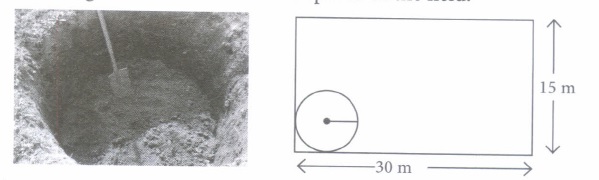
Based on the above information, answer the following questions.
(I) Find the volume of the earth taken out.
| (a) 460 m3 | (b) 462 m3 | (c) 465 m3 | (d) 468 m3 |
(ii) The area of the rectangular field is
| (a) 420 m2 | (b) 430 m2 | (c) 440 m2 | (d) 450m2 |
(iii) Find'the area of the top of the pit.
| (a) 38.5 m2 | (b) 40.5 m2 | (c) 41.5 m2 | (d) None of these |
(iv) The area of the remaining field is
| (a) 402.3 m2 | (b) 405 m2 | (c) 410 m2 | (d) 411.5 m2 |
(v) Find the level rise in the field
| (a) 0.5 m | (b) 3 m | (c) 1.12 m | (d) 2.12 m |
2.
Makar Sankranti is a fun and delightful occasion. Like many other festivals, the kite flying competition also has a historical and cultural significance attached to it. The following figure shows a kite in which BCD is the shape of quadrant of a circle of radius 42 cm, ABCD is a square and \(\Delta\)CEF is an isosceles right angled triangle whose equal sides are 7 cm long.
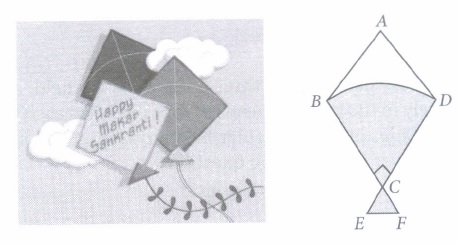
Based on the above information, answer the following questions.
(i) Find the area of the square
| (a) 1700 cm2 | (b) 1764 cm2 | (c) 1800 cm2 | (d) 1864 cm2 |
(ii) Area of quadrant BCD is
| (a) 1290 cm2 | (b) 1380 cm2 | (c) 1386 cm2 | (d) 1390 cm2 |
(iii) Find the area of \(\Delta\)CEF.
| (a) 24.5 cm2 | (b) 25 cm2 | (c) 25.5 cm2 | (d) 26 cm2 |
(iv) Area of the shaded portion is
| (a) 1377 cm2 | (b) 1390 cm2 | (c) 1400 cm2 | (d) 1410.5 cm2 |
(v) Area of the unshaded portion is
| (a) 370 cm2 | (b) 378 cm2 | (c) 380 cm2 | (d) 384 cm2 |
3.
Mr Ramanand purchased a plot QRUT to build his house. He leave space of two congruent semicircles for gardening and a rectangular area of breadth 3 em for car parking.
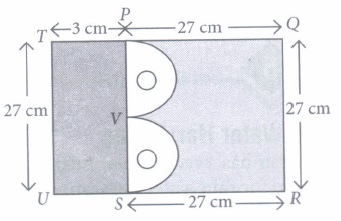
Based on the above information, answer the following questions.
(i) Area of square PQRS is
| (a) 700 cm2 | (b) 729 cm2 | (c) 732 cm2 | (d) 735 cm2 |
(ii) Area of rectangle left for car parking is
| (a) 64 cm2 | (b) 76 cm2 | (c) 81 cm2 | (d) 100 cm2 |
(iii) Radius of semi-circle is
| (a) 6.75 cm | (b) 7 cm | (c) 7.75 cm | (d) 8.75 cm |
(iv) Area of a semi-circle is
| (a) 61.59 cm2 | (b) 66.29 cm2 | (c) 70.36 cm2 | (d) 71.59 cm2 |
(v) Find the area of the shaded region
| (a) 660.82 cm2 | (b) 666.82 cm2 | (c) 669.89 cm2 | (d) 700 cm2 |
4.
While doing dusting a maid found a button whose upper face is of black colour, as shown in the figure. The diameter of each of the smaller identical circles is 1/4 of the diameter of the larger circle whose radius is 16 cm.
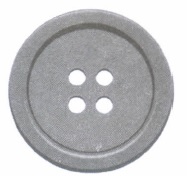
Based on the above information, answer the following questions.
(i) The area of each of the smaller circle is
| (a) 40.28 cm2 | (b) 46.39 cm2 | (c) 50.28 cm2 | (d) 52.3 cm2 |
(ii) The area of the larger circle is
| (a) 804.57 cm2 | (b) 704.57 cm2 | (c) 855.57 cm2 | (d) 990.57 cm2 |
(iii) The area of the black colour region is
| (a) 600.45 cm2 | (b) 603.45 cm2 | (c) 610.45 cm2 | (d) 623.45 cm2 |
(iv) The area of quadrant of a smaller circle is
| (a) 11.57 cm2 | (b) 13.68 cm2 | (c) 12 cm2 | (d) 12.57 cm2 |
(v) If two concentric circles are of radii 2 cm and 5 cm, then the area between them is
| (a) 60 cm2 | (b) 63 cm2 | (c) 66 cm2 | (d) 68 cm2 |
5.
Principle of a school decided to give badges to students who are chosen for the post of Head boy, Head girl, Prefect and Vice Prefect. Badges are circular in shape with two colour area, red and silver, as shown in figure. The diameter of the region representing red colour is 22 cm and silver colour is filled in 10.5 ern wide ring. Based on the above information, answer the following questions.
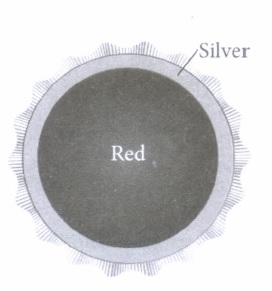
(i) The radius of circle representing the red region is
| (a) 9 cm | (b) 10 cm | (c) 11 cm | (d) 12 cm |
(ii) Find the area of the red region.
| (a) 380.28 cm2 | (b) 382.28 cm2 | (c) 384.28 cm2 | (d) 378.28 cm2 |
(iii) Find the radius of the circle formed by combining the red and silver region.
| (a) 20.5 cm | (b) 21.5 cm | (c) 22.5 cm | (d) 23.5 cm |
(iv) Find the area of the silver region.
| (a) 172.50 cm2 | (b) 1062.50 cm2 | (c) 1172.50 cm2 | (d) 1072.50 cm2 |
(v) Area of the circular path formed by two concentric circles of radii r1 and r2 (r1 > r2) =
| (a) \(\pi\)(\({r}_{1}^{2}\) + \({r}_{2}^{2}\)) sq. units | (b) \(\pi\)(\({r}_{1}^{2}\) - \({r}_{2}^{2}\)) sq. units |
| (c) 2 \(\pi\)(\({r}_{1}^{2}\) + \({r}_{2}^{2}\)) sq. units | (d) 2 \(\pi\)(\({r}_{1}^{2}\) - \({r}_{2}^{2}\)) sq. units |
1.
(i) (b): Volume of the earth taken out
\(=\pi\left(\frac{7}{2}\right)^{2} \times 12=\frac{22}{7} \times \frac{7}{2} \times \frac{7}{2} \times 12=462 \mathrm{~m}^{3}\)
(ii) (d): Area of the rectangular field = 30 x 15 = 450 m2
(iii) (a): Area of top of the pit = \(=\pi\left(\frac{7}{2}\right)^{2} =\frac{22}{7} \times \frac{7}{2} \times \frac{7}{2} \)
\(=\frac{77}{2}=38.5 \mathrm{~m}^{2}\)
(iv) (d): Area of the remaining field = Area of rectangular field - area of top of pit
= 450 - 38.5 = 411.5 m2
(v) (c): The rise in the level of field = \(=\frac{462}{411.5}=1.12 \mathrm{~m}\)
2.
(i) (b):Area of square ABCD = 42 x 42
= 1764 cm2
(ii) (c): Area of quadrant BCD
\(=\frac{1}{4} \times \frac{22}{7} \times 42 \times 42=1386 \mathrm{~cm}^{2}\)
(iii) (a) : Area of \(\Delta C E F=\frac{1}{2} \times C E \times C F\)
\(=\frac{1}{2} \times 7 \times 7=24.5 \mathrm{~cm}^{2}\)
(iv) (d): Area of shaded region = Area of quadrant BCD + Area of \(\Delta\)CEF
= 1386 + 24.5 = 1410.5 cm2
(v) (b): Area of the unshaded region = Area of square ABCD - Area of quadrant BCD
= 1764 - 1386 = 378 cm2
3.
(i) (b): Side of square PQRS = 27 cm
\(\therefore\) Area of square PQRS = 27 x 27 = 729 cm2
(ii) (c): Area of rectangle left for car parking is area of
region PSUT = 27 x 3 = 81 cm2
(iii) (a) : Diameter of semi circle = \(P V=\frac{P S}{2}=\frac{27}{2}\)
= 13.5 cm
\(\therefore\) Radius of semi circle \(=\frac{13.5}{2}=6.75 \mathrm{~cm}\)
(iv) (d): Area of a semi -circle \(=\frac{1}{2} \pi r^{2}\)
\(=\frac{1}{2} \times \frac{22}{7} \times 6.75 \times 6.75=71.59 \mathrm{~cm}^{2}\)
(v) (b): Area of shaded region = area of rectangular plot QRUT - area of two semi-circles
= 30 x 27 - 2 x 71.59 = 666.82 cm2
4.
Let r and R be the radii of each smaller circle and larger circle respectively.
We have, \(d=\frac{1}{4} D\)
\(\Rightarrow r=\frac{1}{4} R \Rightarrow r=\frac{1}{4} \times 16 \Rightarrow r=4 \mathrm{~cm}\)
(i) (c): Area of smaller circle = \(\pi r^{2}\)
\(=\frac{22}{7} \dot{\times} 4 \times 4=50.28 \mathrm{~cm}^{2}\)
(ii) (a): Area oflarger circle = \(\pi R^{2}\)
\(=\frac{22}{7} \times 16 \times 16=\frac{5632}{7}=804.57 \mathrm{~cm}^{2}\)
(iii) (b): Area of the black colour region = Area of larger circle - Area of 4 smaller circles
= 804.57 - 4 x 50.28 = 603.45 cm2
(iv) (d): Area of quadrant of a smaller circle
\(=\frac{1}{4} \times 50.28=12.57 \mathrm{~cm}^{2}\)
(v) (c): Area between two concentric circles
\(=\pi\left(R^{2}-r^{2}\right)=\frac{22}{7}\left(5^{2}-2^{2}\right) \)
\(=\frac{22}{7}(25-4)=\frac{22}{7} \times 21=66 \mathrm{~cm}^{2}\)
5.
(i) (c): Radius of circle representing red region
\(=\frac{22}{2}=11 \mathrm{~cm}\) [\(\because\) Diameter = 22 cm (Given)]
(ii) (a): Area of red region = \(\pi r^{2}\)
\(=\frac{22}{7} \times 11 \times 11=380.28 \mathrm{~cm}^{2}\)
(iii) (b): Radius of circle formed by combining red and silver region = Radius of red region + width of silver sign
= (11 + 10.5) cm = 21.5 cm
(iv) (d): Area of silver region
= Area of combined region - Area of red region
\(=\frac{22}{7} \times 21.5 \times 21.5-380.28\)
= 1452.78 - 380.28 = 1072.50 crrr'
(v) (b): Area of circular path formed by two concentric circles = \(\pi\left(r_{1}^{2}-r_{2}^{2}\right)\) sq. units

10th Standard CBSE Syllabus & Materials
10th Standard CBSE
CBSE 10th Social Science PS - Federalism - New Model Questions Papers Study Material - QB365 Set A
NEW10th Standard CBSE
CBSE 10th Social Science PS - Power Sharing - New Model Questions Papers Study Material - QB365 Set A
NEW10th Standard CBSE
CBSE 10th Social Science GEO - Manufacturing Industries - New Model Questions Papers Study Material - QB365 Set A
NEW10th Standard CBSE
CBSE 10th Social Science GEO - Minerals and Energy Resources - New Model Questions Papers Study Material - QB365 Set A



NCERT Books

Syllabus

Exam Pattern

Sample Question Papers

Previous year Question Papers

Important Notes

MCQ Practice test

NCERT Exemplers

Case study Questions

Image Based Questions

Passage based Questions

HOT Questions

Value Based Questions

Model Questions Papers
NCERT ( Book Back ) Questions

Assertion and Reason
Important Questions And Answers

CBSE 10th Standard CBSE Subjects
CBSE Standards



