
 100% FREE ACCESS
10th Standard CBSE Syllabus & Materials
10th Standard CBSE
CBSE 10th Social Science ECO - Globalisation and the Indian Economy - New Model Questions Papers Study Material - QB365 Set A
NEW10th Standard CBSE
CBSE 10th Social Science ECO - Money and Credit - New Model Questions Papers Study Material - QB365 Set A
NEW10th Standard CBSE
CBSE 10th Social Science ECO - Sectors of the Indian Economy - New Model Questions Papers Study Material - QB365 Set A
NEW10th Standard CBSE
CBSE 10th Social Science ECO - Development - New Model Questions Papers Study Material - QB365 Set A
NEW10th Standard CBSE
CBSE 10th Social Science PS - Outcomes of Democracy - New Model Questions Papers Study Material - QB365 Set A
NEW10th Standard CBSE
CBSE 10th Social Science PS - Gender, Religion and Caste - New Model Questions Papers Study Material - QB365 Set A

Published on: 22/05/2021
QB365 Provides the updated CASE Study Questions for Class 10 Maths, and also provide the detail solution for each and every case study questions . Case study questions are latest updated question pattern from NCERT, QB365 will helps to get more marks in Exams
Download CBSE Class 10th Standard CBSE Maths question papers, sample papers, important questions, and previous year solved papers in PDF format. Get free study materials, NCERT solutions, and exam preparation resources for Class 10th Standard CBSE Maths
Questions + Answers key
Take MCQ Maths Test
1.
A sequence is an ordered list of numbers. A sequence of numbers such that the difference between the consecutive terms is constant is said to be an arithmetic progression (A.P.).
On the basis of above information, answer the following questions.
(i) Which of the following sequence is an A.P.?
| (a) 10,24,39,52,.... | (b) 11,24,39,52, ... | (c) 10,24,38,52, ... | (d) 10, 38, 52, 66, .... |
(ii) If x, y and z are in A.P., then
| (a) x + z = y | (b) x - z = y | (c) x + z = 2y | (d) None of these |
(iii) If a1 a2, a3 ..... , an are in A.P., then which of the following is true?
| (a) a1 + k, a2 + k, a3 + k, , an + k are in A.P., where k is a constant. |
| (b) k - a1 k - a2, k - a3, , k - an are in A.P., where k is a constant. |
| (c) ka1, ka2, ka3 ..... , kan are in A.P., where k is a constant. |
| (d) All of these |
(iv) If the nth term (n > 1) of an A.P. is smaller than the first term, then nature of its common difference (d) is
| (a) d > 0 | (b) d < 0 |
| (c) d = 0 | (d) Can't be determined |
(v) Which of the following is incorrect about A.P.?
| (a) All the terms of constant A.P. are same. |
| (b) Some terms of an A.P. can be negative. |
| (c) All the terms of an A.P. can never be negative. |
| (d) None of these |
2.
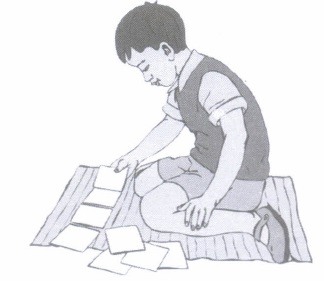
Amit was playing a number card game. In the game, some number cards (having both +ve or -ve numbers) are arranged in a row such that they are following an arithmetic progression. On his first turn, Amit picks up 6th and 14thcard and finds their sum to be -76. On the second turn he picks up 8th and 16thcard and finds their sum to be -96. Based on the above information, answer the following questions.
(i) What is the difference between the numbers on any two consecutive cards?
| (a) 7 | (b) -5 | (c) 11 | (d) -3 |
(ii) The number on first card is
| (a) 12 | (b) 3 | (c) 5 | (d) 7 |
(iii) What is the number on the 19th card?
| (a) -88 | (b) -82 | (c) -92 | (d) -102 |
(iv) What is the number on the 23rd card?
| (a) -103 | (b) -122 | (c) -108 | (d) -117 |
(v) The sum of numbers on the first 15 cards is
| (a) -840 | (b) -945 | (c) -427 | (d) -420 |
3.
Anuj gets pocket money from his father everyday. Out of the pocket money, he saves Rs 2.75 on first day, Rs 3 on second day, Rs 3.25 on third day and so on.
On the basis of above information, answer the following questions .

(i) What is the amount saved by Anuj on 14th day?
| (a) Rs 6.25 | (b) Rs 6 | (c) Rs 6.50 | (d) Rs 6.75 |
(ii) What is the total amount saved by Anuj in 8 days?
| (a) Rs 18 | (b) Rs 33 | (c) Rs 24 | (d) Rs 29 |
(iii) What is the amount saved by Anuj on 30th day?
| (a) Rs 10 | (b) Rs 12.75 | (c) Rs 10.25 | (d) Rs 9.75 |
(iv) What is the total amount saved by him in the month of June, if he starts savings from 1st June?
| (a) Rs 191 | (b) Rs 191.25 | (c) Rs 192 | (d) Rs 192.5 |
(v) On which day, he save tens times as much as he saved on day-I?
| (a) 9th | (b) 99th | (c) 10th | (d) 100th |
4.
In a class the teacher asks every student to write an example of A.P. Two friends Geeta and Madhuri writes their progressions as -5, -2, 1,4, ... and 187, 184, 181, .... respectively. Now, the teacher asks various students of the class the following questions on these two progressions. Help students to find the answers of the questions.

(i) Find the 34th term of the progression written by Madhuri.
| (a) 286 | (b) 88 | (c) -99 | (d) 190 |
(ii) Find the sum of common difference of the two progressions.
| (a) 6 | (b) -6 | (c) 1 | (d) 0 |
(iii) Find the 19th term of the progression written by Geeta.
| (a) 49 | (b) 59 | (c) 52 | (d) 62 |
(iv) Find the sum of first 10 terms of the progression written by Geeta.
| (a) 85 | (b) 95 | (c) 110 | (d) 200 |
(v) Which term of the two progressions will have the same value?
| (a) 31 | (b) 33 | (c) 32 | (d) 30 |
5.
In a pathology lab, a culture test has been conducted. In the test, the number of bacteria taken into consideration in various samples is all3-digit numbers that are divisible by 7, taken in order.

On the basis of above information, answer the following questions.
(i) How many bacteria are considered in the fifth sample?
| (a) 126 | (b) 140 | (c) 133 | (d) 149 |
(ii) How many samples should be taken into consideration?
| (a) 129 | (b) 128 | (c) 130 | (d) 127 |
(iii) Find the total number of bacteria in the first 10 samples.
| (a) 1365 | (b) 1335 | (c) 1302 | (d) 1540 |
(iv) How many bacteria are there in the 7th sample from the last?
| (a) 952 | (b) 945 | (c) 959 | (d) 966 |
(v) The number of bacteria in 50th sample is
| (a) 546 | (b) 553 | (c) 448 | (d) 496 |
1.
(i) (c)
(ii) (c)
(iii) (d)
(iv) (b)
(v) (c)
2.
Let the numbers on the cards be a, a + d, a + Zd, ...
According to question, We have (a + 5d) + (a + 13d) = -76
\(\Rightarrow\) 2a+18d = -76\(\Rightarrow\)a + 9d= -38 ... (1)
And (a + 7d) + (a + 15d) = -96
\(\Rightarrow\) 2a + 22d = -96 \(\Rightarrow\) a + 11d = -48 ...(2)
From (1) and (2), we get
2d= -10 \(\Rightarrow\) d= -5
From (1), a + 9(-5) = -38 \(\Rightarrow\) a = 7
(i) (b): The difference between the numbers on any two consecutive cards = common difference of the A.P.=-5
(ii) (d): Number on first card = a = 7
(iii) (b): Number on 19th card = a + 18d = 7 + 18(-5) = -83
(iv) (a): Number on 23rd card = a + 22d = 7 + 22( -5) = -103
(v) (d): \(S_{15}=\frac{15}{2}[2(7)+14(-5)]=-420\)
3.
Here the savings form an A.P. i.e., Rs 2.75, Rs 3, Rs 3.25, ...
So, a = 2.75, d = 3 - 2.75 = 0.25
(i) (b): Amount saved by Anuj on 14th day
= t14 = a + 13d = 2.75 + 13(0.25) = ₹ 6
(ii) (d): Total amount saved by Anuj in 8 days
\(=S_{8}=\frac{8}{2}[2(2.75)+7(0.25)]=₹ 29\)
(iii) (a): Amount saved by Anuj on 30th day
= t30 = a + 29d = 2.75 + 29(0.25) = ₹ 10
(iv) (b): Number of days in June = 30
\(\therefore S_{30}=\frac{30}{2}[2(2.75)+29(0.25)]=₹ 191.25\)
(v) (d): Let on nth day, he saves 10 times as he saves on 1st day.
tn = 10(2.75) \(\Rightarrow\) a + (n - 1)d = 27.5 \(\Rightarrow\) n = 100.
4.
Geeta's A.P. is -5, -2, 1,4, ...
Here, first term (a1) = -5 and common difference (d1) = -2 + 5 = 3
Similarly, Madhuri's A.P. is 187, 184, 181, ...
Here first term (a2) = 187 and common difference (d2) = 184 - 187 = -3
(i) (b): t34 = a2 + 33d2 = 187 + 33(-3) = 88
(ii) (d): Required sum = 3 + (-3) = 0
(iii) (a): t19 = a1 + 18d1 = (-5) + 18(3) = 49
(iv) (a) : \(S_{10}=\frac{n}{2}\left[2 a_{1}+(n-1) d_{1}\right]=\frac{10}{2}[2(-5)+9(3)]=85\)
(v) (b): Let nth terms of the two A.P:s be equal.
\(\therefore\) -5 + (n - 1)3 = 187 + (n - 1)(-3)
\(\Rightarrow\) 6(n - 1) = 192 \(\Rightarrow\) n = 33
5.
Here the smallest 3-digit number divisible by 7 is 105. So, the number of bacteria taken into consideration is 105, 112, 119, .... ,994 So, first term (a) = 105, d = 7 and last term = 994
(i) (c): t5 = a + 4d = 105 + 28 = 133
(ii) (b): Let n samples be taken under consideration.
\(\because\) Last term = 994
\(\Rightarrow\) a + (n - 1)d = 994 \(\Rightarrow\) 105 + (n - 1)7 = 994 \(\Rightarrow\) n = 128
(iii) (a): Total number of bacteria in first 10 samples
\(=S_{10}=\frac{10}{2}[2(105)+9(7)]=1365\)
(iv) (a): t7 from end = (128 - 7 + 1)th term from beginning = 122th term = 105 + 121(7) = 952
(v) (c): t50 = 105 + 49 x 7 = 448

10th Standard CBSE Syllabus & Materials
10th Standard CBSE
CBSE 10th Social Science PS - Federalism - New Model Questions Papers Study Material - QB365 Set A
NEW10th Standard CBSE
CBSE 10th Social Science PS - Power Sharing - New Model Questions Papers Study Material - QB365 Set A
NEW10th Standard CBSE
CBSE 10th Social Science GEO - Manufacturing Industries - New Model Questions Papers Study Material - QB365 Set A
NEW10th Standard CBSE
CBSE 10th Social Science GEO - Minerals and Energy Resources - New Model Questions Papers Study Material - QB365 Set A



NCERT Books

Syllabus

Exam Pattern

Sample Question Papers

Previous year Question Papers

Important Notes

MCQ Practice test

NCERT Exemplers

Case study Questions

Image Based Questions

Passage based Questions

HOT Questions

Value Based Questions

Model Questions Papers
NCERT ( Book Back ) Questions

Assertion and Reason
Important Questions And Answers

CBSE 10th Standard CBSE Subjects
CBSE Standards



