
 100% FREE ACCESS
10th Standard CBSE Syllabus & Materials
10th Standard CBSE
CBSE 10th Social Science ECO - Globalisation and the Indian Economy - New Model Questions Papers Study Material - QB365 Set A
NEW10th Standard CBSE
CBSE 10th Social Science ECO - Money and Credit - New Model Questions Papers Study Material - QB365 Set A
NEW10th Standard CBSE
CBSE 10th Social Science ECO - Sectors of the Indian Economy - New Model Questions Papers Study Material - QB365 Set A
NEW10th Standard CBSE
CBSE 10th Social Science ECO - Development - New Model Questions Papers Study Material - QB365 Set A
NEW10th Standard CBSE
CBSE 10th Social Science PS - Outcomes of Democracy - New Model Questions Papers Study Material - QB365 Set A
NEW10th Standard CBSE
CBSE 10th Social Science PS - Gender, Religion and Caste - New Model Questions Papers Study Material - QB365 Set A

Published on: 22/05/2021
QB365 Provides the updated CASE Study Questions for Class 10 Maths, and also provide the detail solution for each and every case study questions . Case study questions are latest updated question pattern from NCERT, QB365 will helps to get more marks in Exams
Download CBSE Class 10th Standard CBSE Maths question papers, sample papers, important questions, and previous year solved papers in PDF format. Get free study materials, NCERT solutions, and exam preparation resources for Class 10th Standard CBSE Maths
Questions + Answers key
Take MCQ Maths Test
1.
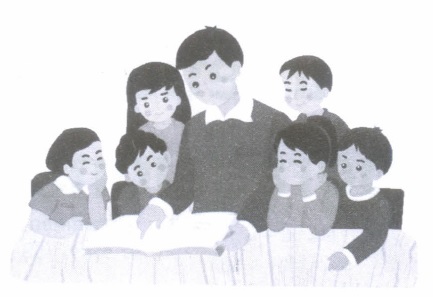
In a class the teacher asks every student to write an example of A.P. Two friends Geeta and Madhuri writes their progressions as -5, -2, 1,4, ... and 187, 184, 181, .... respectively. Now, the teacher asks various students of the class the following questions on these two progressions. Help students to find the answers of the questions.
(i) Find the 34th term of the progression written by Madhuri.
| (a) 286 | (b) 88 | (c) -99 | (d) 190 |
(ii) Find the sum of common difference of the two progressions.
| (a) 6 | (b) -6 | (c) 1 | (d) 0 |
(iii) Find the 19th term of the progression written by Geeta.
| (a) 49 | (b) 59 | (c) 52 | (d) 62 |
(iv) Find the sum of first 10 terms of the progression written by Geeta.
| (a) 85 | (b) 95 | (c) 110 | (d) 200 |
(v) Which term of the two progressions will have the same value?
| (a) 31 | (b) 33 | (c) 32 | (d) 30 |
2.
If p(x) is a quadratic polynomial i.e., p(x) = ax2- + bx + c, \(a \neq 0\), then p(x) = 0 is called a quadratic equation. Now, answer the following questions.
(i) Which of the following is correct about the quadratic equation ax2- + bx + c = 0 ?
| (a) a, band c are real numbers, \(c \neq 0\) | (b) a, band c are rational numbers, \(a \neq 0\) |
| (c) a, band c are integers, a, band \(c \neq 0\) | (d) a, band c are real numbers, \(a \neq 0\) |
(ii) The degree of a quadratic equation is
| (a) 1 | (b) 2 | (c) 3 | (d) other than 1 |
(iii) Which of the following is a quadratic equation?
| (a) x(x + 3) + 7 = 5x - 11 | (b) (x - 1)2 - 9 = (x - 4)(x + 3) |
| (c) x2-(2x + 1) - 4 = 5x2- 10 | (d) x(x - 1)(x + 7) = x(6x - 9) |
(iv) Which of the following is incorrect about the quadratic equation ax2- + bx + c = 0 ?
| (a) If a\(\alpha\)2 + b\(\alpha\). + c = 0, then x = -\(\alpha\) is the solution of the given quadratic equation. |
| (b)The additive inverse of zeroes of the polynomial ax2- + bx + c is the roots of the given equation. |
| (c) If a is a root of the given quadratic equation, then its other root is -\(\alpha\). |
| (d) All of these |
(v) Which of the following is not a method of finding solutions of the given quadratic equation?
| (a) Factorisation method | (b) Completing the square method |
| (c) Formula method | (d) None of these |
3.
In our daily life we use quadratic formula as for calculating areas, determining a product's profit or formulating the speed of an object and many more.
Based on the above information, answer the following questions.
(i) If the roots of the quadratic equation are 2, -3, then its equation is
| (a) x2 - 2x + 3 = 0 | (b) x2 + x - 6 = 0 | (c) 2x2 - 3x + 1 = 0 | (d) x2 - 6x - 1= 0 |
(ii) If one root of the quadratic equation 2x2 + kx + 1 = 0 is -1/2, then k =
| (a) 3 | (b) -5 | (c) -3 | (d) 5 |
(iii) Which of the following quadratic equations, has equal and opposite roots?
| (a) x2 - 4=0 | (b) 16x2 - 9=0 | (c) 3x2 + 5x - 5=0 | (d) Both (a) and (b) |
(iv) Which of the following quadratic equations can be represented as (x - 2)2 + 19 = 0?
| (a) x2 + 4x+15=0 | (b) x2 - 4x+15=0 | (c) x2 - 4x+23=0 | (d) x2 + 4x+23=0 |
(v) If one root of a qua drraattiic equation is \(\frac{1+\sqrt{5}}{7}\),then I.ts other root is
| \((a) \frac{1+\sqrt{5}}{7}\) | \((b) \frac{1-\sqrt{5}}{7}\) | \((c) \frac{-1+\sqrt{5}}{7}\) | \((d) \frac{-1-\sqrt{5}}{7}\) |
4.
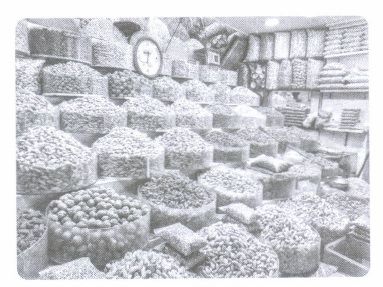
Raman usually go to a dry fruit shop with his mother. He observes the following two situations.
On 1st day: The cost of 2 kg of almonds and 1 kg of cashew was Rs 1600.
On 2nd day: The cost of 4 kg of almonds and 2 kg of cashew was Rs 3000.
Denoting the cost of 1 kg almonds by Rs x and cost of 1 kg cashew by Rs y, answer the following questions.
(i) Represent algebraically the situation of day-I.
| (a) x + 2y = 1000 | (b) 2x + y = 1600 | (c) x - 2y = 1000 | (d) 2x - y = 1000 |
(ii) Represent algebraically the situation of day- II.
| (a) 2x + y= 1500 | (b) 2x- y= 1500 | (c) x + 2y=1500 | (d) 2x + y = 750 |
(iii) The linear equation represented by day-I, intersect the x axis at
| (a) (0,800) | (b) (0,-800) | (c) (800,0) | (d) (-800,0) |
(iv) The linear equation represented by day-II, intersect the y-axis at
| (a) (1500,0) | (b) (0, -1500) | (c) (-1500,0) | (d) (0,1500) |
(v) Linear equations represented by day-I and day -II situations, are
| (a) non parallel | (b) parallel |
| (c) intersect at one point | (d) overlapping each other. |
5.
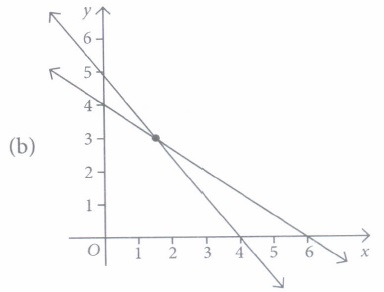
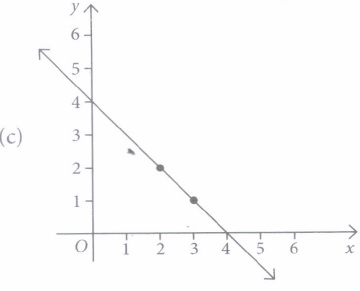
Puneet went for shopping in the evening by metro with his father who is an expert in mathematics. He told Puneet that path of metro A is given by the equation 2x + 4y = 8 and path of metro B is given by the equation 3x + 6y = 18. His father put some questions to Puneet. Help Puneet to solve the questions.
(i) Equation 2x + 4y = 8 intersects the x-axis and y-axis respectively at
| (a) (4,0), (0, 2) | (b) (0,4), (2,0) | (c) (4,0), (2,0) | (d) (0,4), (0, 2) |
(ii) Equation 3x + 6y = 18 intersects the x-axis and y-axis respectively at
| (a) (6,0), (0, 8) | (b) (0,6), (0, 8) | (c) (6,0), (0, 3) | (d) (0,6), (0, 3) |
(iii) Coordinates of point of intersection of two given equations are
| (a) (1,2) | (b) (2,4) | (c) (3,7) | (d) does not exist |
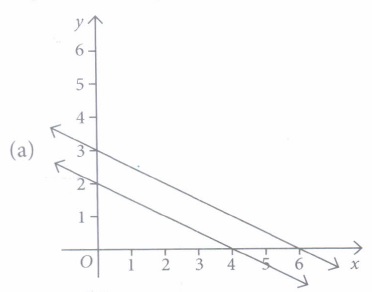
(iv) Represent the equations, 2x + 4y = 8 and 3x + 6y = 18 graphically.
 |
 |
 |
(d) None of these |
(v) System oflinear equations represented by two given lines is
| (a) inconsistent | (b) having infinitely many solutions |
| (c) consistent | (d) overlapping each other |
6.
From a shop, Sudhir bought 2 books of Mathematics and 3 books of Physics of class X for Rs 850 and Suman bought 3 books of Mathematics and 2 books of Physics of class X for Rs 900. Consider the price of one Mathematics book and that of one Physics book be Rs x and Rs y respectively.
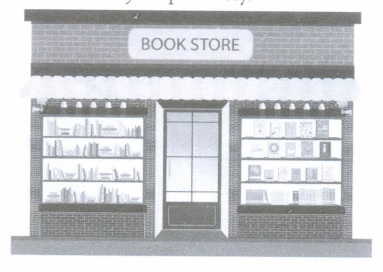
Based on the above information, answer the following questions.
(i) Represent the situation faced by Sudhir, algebraically,
| (a) 2x + 3y = 850 | (b) 3x+2y=850 | (c) 2x - 3y = 850 | (d) 3x - 2y = 850 |
(ii) Represent the situation faced by Suman, algebraically
| (a) 2x + 3y = 90 | (b) 3x + 2y = 900 | (c) 2x - 3y = 900 | (d) 3x - 2y = 900 |
(iii) The price of one Physics book is
| (a) Rs 80 | (b) Rs 100 | (c) Rs 150 | (d) Rs 200 |
(iv) The price of one Mathematics book is
| (a) Rs 80 | (b) Rs 100 | (c) Rs 150 | (d) Rs 200 |
(v) The system of linear equations represented by above situation, has
| (a) unique solution | (b) no solution |
| (c) infinitely many solutions | (d) none of these |
7.
Points A and B representing Chandigarh and Kurukshetra respectively are almost 90 km apart from each other on the highway. A car starts from Chandigarh and another from Kurukshetra at the same time. If these cars go in the same direction, they meet in 9 hours and if these cars go in opposite direction they meet in 9/7 hours. Let X and Ybe two cars starting from points A and B respectively and their speed be x km/hr and y km/hr respectively.
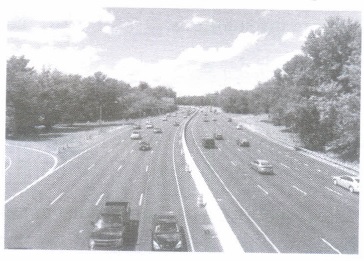
Then, answer the following questions.
(i) When both cars move in the same direction, then the situation can be represented algebraically as
| (a) x - y = 10 | (b) x + y = 10 | (c) x + y = 9 | (d) x - y = 9 |
(ii) When both cars move in opposite direction, then the situation can be represented algebraically as
| (a) x - y=70 | (b) x + y=90 | (c) x + y=70 | (d) x + y=10 |
(iii) Speed of car X is
| (a) 30 km/hr | (b) 40 km/hr | (c) 50 km/hr | (d) 60 km/hr |
(iv) Speed of car Y is
| (a) 50km//hr | (b) 40 km/hr | (c) 30 km/hr | (d) 60 km/hr |
(v) If speed of car X and car Y, each is increased by 10 km/hr, and cars are moving in opposite direction, then after how much time they will meet?
| (a) 5 hrs | (b) 4 hrs | (c) 2 hrs | (d) 1 hr |
8.
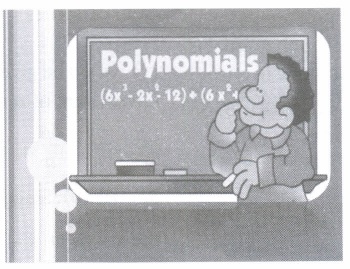
The tutor in a coaching centre was explaining the concept of cubic polynomial as - A cubic polynomial is of the form \(a x^{3}+b x^{2}+c x+d, a \neq 0\) and it has maximum three real zeroes. The zeroes of a cubic polynomial are namely the x-coordinates of the points where the graph of the polynomial intersects the x-axis. If \(\alpha\), \(\beta\) and \(\gamma\) are the zeroes of a cubic polynomial \(a x^{3}+b x^{2}+c x+d\) then the relation between their zeroes and their coefficients are \(\alpha+\beta+\gamma=-b / a \)
\(\alpha \beta+\beta \gamma+\alpha \gamma=c / a \)
\(\alpha \beta \gamma=-d / a\)
Based on-the above information, answer the following questions.
(i) Which of the following are the zeroes of the polynomial \(x^{3}-4 x^{2}-7 x+10 ?\)
| (a) -3,1 and 3 | (b) -1,2 and-3 |
| (c) 2, -1 and 5 | (d) -2,1 and 5 |
(ii) If \(-\frac{1}{2}\) -2 and 5 are zeroes of a cubic polynomial, then the sum of product of zeroes taken two at a time is
| \((a) \frac{23}{2}\) | \((b) -\frac{1}{2}\) |
| \((c) -23\) | \((d) -\frac{23}{2}\) |
(iii) In which of the following polynomials the sum and product of zeroes are equal?
| \((a) x^{3}-x^{2}+5 x-1\) | \((b) x^{3}-4 x\) |
| \((c) 3 x^{3}-5 x^{2}-11 x-3\) | (d) Both (a) and (b) |
(iv) The polynomial whose all the zeroes are same is
| \((a) x^{3}+x^{2}+x-1\) | \((b) x^{3}-3 x^{2}+3 x-1\) |
| \((c) x^{3}-5 x^{2}+6 x-1\) | \((d) 3 x^{3}+x^{2}+2 x-1\) |
(v) The cubic polynomial, whose graph is as shown below, is
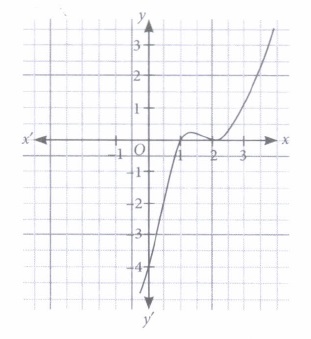
| \((a) x^{3}-5 x^{2}+8 x-4\) | \((b) x^{3}-7 x^{2}+11 x+9\) |
| \((c) 3 x^{3}-4 x^{2}+x-5\) | \((d) x^{3}-9\) |
9.
While playing badminton Ronit seeing the barrier chains hung between two posts at the edge of the walk way of a street. It is hung in the shape of the parabola. Parabola is the graphical representation of a particular type of polynomial. Based on the above information, answer the following questions.
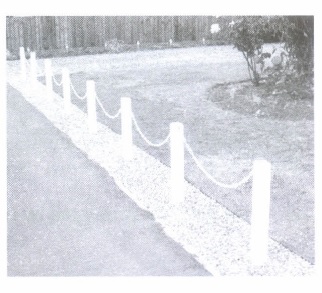
(i) Which of the following polynomial is graphically represented by a parabola?
| (a) Linear polynomial | (b) Quadratic polynomial |
| (c) Cubic polynomial | (d) None of these |
(ii) If a polynomial, represented by a parabola, intersects the x-axis at -3, 4 and y-axis at -2, then its zero(es) is/are
| (a) -1,2and-2 | (b) 2 and-2 | (c) -1 | (d) -3 and 4 |
(iii) If the barrier chains between two posts is represented by the polynomial \(x^{2}-x-12\) then its zeroes are
| (a) 4,3 | (b) -2,5 | (c) 4, -3 | (d) 4,-5 |
(iv) The sum of zeroes of the polynomial \(4 x^{2}-9 x+2 \text { is }\)
| (a) 1/4 | (b) 9/4 | (c) 2/4 | (d) -9/4 |
(v) The reciprocal of product of zeroes of the polynomial \(x^{2}-9 x+20 \text { is }\)
| (a) 5 | (b) 1/8 | (c) 1/20 | (d) 20 |
10.
Quadratic polynomial can be used to model the shape of many architectural structures in the world. Pershing field of Jersey city in US is one such structure. Based on the above information, answer the following questions.
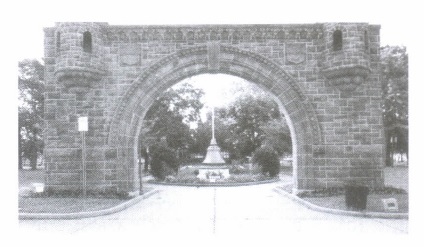
(i) If the Arch is represented by \(10 x^{2}-x-3\) then its zeroes are
| \((a) \frac{1}{2}, \frac{-3}{2}\) | \((b) \frac{-1}{2}, \frac{3}{5}\) | \((c) \frac{-1}{2}, \frac{1}{3}\) | \((d) \frac{-1}{3}, \frac{2}{3}\) |
(ii) The zeroes of the polynomial are the points where its graph
| (a) intersect the x-axis | (b) intersect the y-axis |
| (c) intersect either of the axes | (d) Can't say |
(iii) The quadratic polynomial whose sum of zeroes is 0 and product of zeroes is 1 is given by
| \((a) x^{2}-x\) | \((b) x^{2}+x\) | \((c) x^{2}-1\) | \((d) x^{2}+1\) |
(iv) Which of the following has \(\frac{-1}{2}\) and 2 as their zeroes?
| \((a) 6 x^{2}-4 x+6\) | \((b) 3 x^{2}-x+2\) | \((c) 2 x^{2}-7 x+2\) | \((d) 2 x^{2}-3 x-2\) |
(v) The product of zeroes of the polynomial \(\sqrt{3} x^{2}-14 x+8 \sqrt{3} \) is
| (a) 4 | (b) 6 | (c) 8 | (d) 10 |
11.
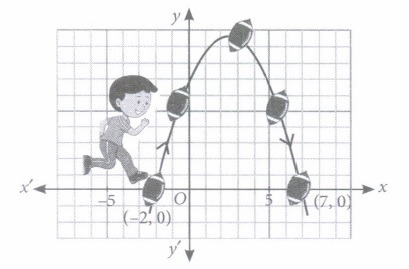
In a soccer match, the path of the soccer ball in a kick is recorded as shown in the following graph.
Based on the above i!;formation, answer the following questions.
(i) The shape of path of the soccer ball is a
| (a) Circle | (b) Parabola | (c) Line | (d) None of these |
(ii) The axis of symmetry of the given parabola is
| (a) y-axis | (b) x-axis |
| (c) line parallel to y-axis | (d) line parallel to x-axis |
(iii) The zeroes of the polynomial, represented in the given graph, are
| (a) -1,7 | (b) 5,-2 | (c) -2,7 | (d) -3,8 |
(iv) Which of the following polynomial has -2 and -3 as its zeroes?
| \((a) x^{2}-5 x-5\) | \((b) x^{2}+5 x-6\) | \((c) x^{2}+6 x-5\) | \((d) x^{2}+5 x+6\) |
(v) For what value of 'x', the value of the polynomial \(f(x)=(x-3)^{2}+9 \text { is } 9 ?\)
| (a) 1 | (b) 2 | (c) 3 | (d) 4 |
12.
Just before the morning assembly a teacher of kindergarten school observes some clouds in the sky and so she cancels the assembly. She also observes that the clouds has a shape of the polynomial. The mathematical representation of a cloud is shown in the figure.
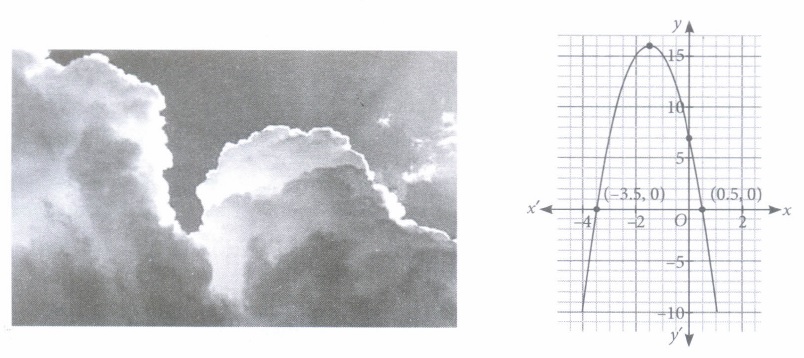
(i) Find the zeroes of the polynomial represented by the graph.
| (a) -1/2,7/2 | (b) 1/2, -7/2 | (c) -1/2, -7/2 | (d) 1/2,7/2 |
(ii) What will be the expression for the polynomial represented by the graph?
| \((a) p(x)=12 x^{2}-4 x-7\) | \((b) p(x)=-x^{2}-12 x+3\) | \((c) p(x)=4 x^{2}+12 x+7\) | \((d) p(x)=-4 x^{2}-12 x+7\) |
(iii) What will be the value of polynomial represented by the graph, when x = 3?
| (a) 65 | (b) -65 | (c) 68 | (d) -68 |
(iv) If a and \(\beta\) are the zeroes of the polynomial \(f(x)=x^{2}+2 x-8 \text { , then } \alpha^{4}+\beta^{4}=\)
| (a) 262 | (b) 252 | (c) 272 | (d) 282 |
(v) Find a quadratic polynomial where sum and product of its zeroes are 0,\(\sqrt (7)\) respectively.
| \((a) k\left(x^{2}+\sqrt{7}\right)\) | \((b) k\left(x^{2}-\sqrt{7}\right)\) | \((c) k\left(x^{2}+\sqrt{5}\right)\) | (d) none of these |
13.
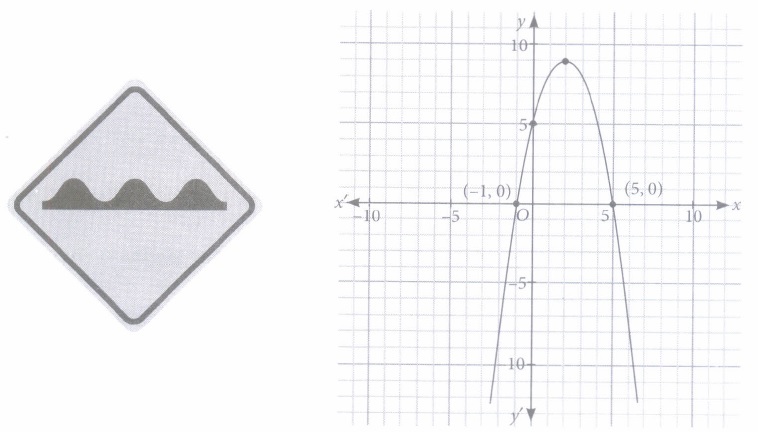
ABC construction company got the contract of making speed humps on roads. Speed humps are parabolic in shape and prevents overspeeding, mini mise accidents and gives a chance for pedestrians to cross the road. The mathematical representation of a speed hump is shown in the given graph.
Based on the above information, answer the following questions.
(i) The polynomial represented by the graph can be _______polynomial.
| (a) Linear | (b) Quadratic |
| (c) Cubic | (d) Zero |
(ii) The zeroes of the polynomial represented by the graph are
| (a) 1,5 | (b) 1,-5 |
| (c) -1,5 | (d) -1,-5 |
(iii) The sum of zeroes of the polynomial represented by the graph are
| (a) 4 | (b) 5 | (c) 6 | (d) 7 |
(iv) If a and β are the zeroes of the polynomial represented by the graph such that \(\beta>\alpha, \text { then }|8 \alpha+\beta|=\)
| (a) 1 | (b) 2 | (c) 3 | (d) 4 |
(v) The expression of the polynomial represented by the graph is
| \(\text { (a) }-x^{2}-4 x-5\) | \((b) x^{2}+4 x+5\) | \((c) x^{2}+4 x-5\) | \((d) -x^{2}+4 x+5\) |
14.
Decimal form of rational numbers can be classified into two types.
(i) Let x be a rational number whose decimal expansion terminates. Then x can be expressed in the form \(\frac{p}{\sqrt{q}}\) where p and q are co-prime and the prime faetorisation of q is of the form 2n·5m, where n, mare non-negative integers and vice-versa.
(ii) Let x = \(\frac{p}{\sqrt{q}}\) be a rational number, such that the prime faetorisation of q is not of the form 2n 5m, where n and m are non-negative integers. Then x has a non-terminating repeating decimal expansion.
(i) Which of the following rational numbers have a terminating decimal expansion?
| (a) 125/441 | (b) 77/210 | (c) 15/1600 | (d) 129/(22 x 52 x 72) |
(ii) 23/(23 x 52) =
| (a) 0.575 | (b) 0.115 | (c) 0.92 | (d) 1.15 |
(iii) 441/(22 x 57 x 72) is a_________decimal.
| (a) terminating | (b) recurring |
| (c) non-terminating and non-recurring | (d) None of these |
(iv) For which of the following value(s) of p, 251/(23 x p2) is a non-terminating recurring decimal?
| (a) 3 | (b) 7 | (c) 15 | (d) All of these |
(v) 241/(25 x 53) is a _________decimal.
| (a) terminating | (b) recurring |
| (c) non-terminating and non-recurring | (d) None of these |
15.
Real numbers are extremely useful in everyday life. That is probably one of the main reasons we all learn how to count and add and subtract from a very young age. Real numbers help us to count and to measure out quantities of different items in various fields like retail, buying, catering, publishing etc. Every normal person uses real numbers in his daily life. After knowing the importance of real numbers, try and improve your knowledge about them by answering the following questions on real life based situations.
(i) Three people go for a morning walk together from the same place. Their steps measure 80 cm, 85 cm, and 90 cm respectively. What is the minimum distance travelled when they meet at first time after starting the walk assuming that their walking speed is same?
| (a) 6120 cm | (b) 12240 cm | (c) 4080 cm | (d) None of these |
(ii) In a school Independence Day parade, a group of 594 students need to march behind a band of 189 members. The two groups have to march in the same number of columns. What is the maximum number of columns in which they can march?
| (a) 9 | (b) 6 | (c) 27 | (d) 29 |
(iii) Two tankers contain 768litres and 420 litres of fuel respectively. Find the maximum capacity of the container which can measure the fuel of either tanker exactly.
| (a) 4litres | (b) 7litres | (c) 12litres | (d) 18litres |
(iv) The dimensions of a room are 8 m 25 cm, 6 m 75 crn and 4 m 50 cm. Find the length of the largest measuring rod which can measure the dimensions of room exactly.
| (a) 1 m 25cm | (b) 75cm | (c) 90cm | (d) 1 m 35cm |
(v) Pens are sold in pack of 8 and notepads are sold in pack of 12. Find the least number of pack of each type that one should buy so that there are equal number of pens and notepads
| (a) 3 and 2 | (b) 2 and 5 | (c) 3 and 4 | (d) 4 and 5 |
1.
Geeta's A.P. is -5, -2, 1,4, ...
Here, first term (a1) = -5 and common difference (d1) = -2 + 5 = 3
Similarly, Madhuri's A.P. is 187, 184, 181, ...
Here first term (a2) = 187 and common difference (d2) = 184 - 187 = -3
(i) (b): t34 = a2 + 33d2 = 187 + 33(-3) = 88
(ii) (d): Required sum = 3 + (-3) = 0
(iii) (a): t19 = a1 + 18d1 = (-5) + 18(3) = 49
(iv) (a) : \(S_{10}=\frac{n}{2}\left[2 a_{1}+(n-1) d_{1}\right]=\frac{10}{2}[2(-5)+9(3)]=85\)
(v) (b): Let nth terms of the two A.P:s be equal.
\(\therefore\) -5 + (n - 1)3 = 187 + (n - 1)(-3)
\(\Rightarrow\) 6(n - 1) = 192 \(\Rightarrow\) n = 33
2.
(i) (d)
(ii) (b)
(iii) (a): x(x + 3) + 7 = 5x - 11
\(\Rightarrow x^{2}+3 x+7=5 x-11\)
\(\Rightarrow x^{2}-2 x+18=0 \) is a quadratic equation.
\((b) (x-1)^{2}-9=(x-4)(x+3)\)
\(\Rightarrow x^{2}-2 x-8=x^{2}-x-12\)
\(\Rightarrow x-4=0\) is not a quadratic equation.
\((c) x^{2}(2 x+1)-4=5 x^{2}-10\)
\(\Rightarrow 2 x^{3}+x^{2}-4=5 x^{2}-10\)
\(\Rightarrow 2 x^{3}-4 x^{2}+6=0\) is not a quadratic equation.
\((d) x(x-1)(x+7)=x(6 x-9)\)
\(\Rightarrow x^{3}+6 x^{2}-7 x=6 x^{2}-9 x\)
\(\Rightarrow x^{3}+2 x=0\) is not a quadratic equation.
(iv) (d)
(v) (d)
3.
(i) (b): Roots of the quadratic equation are 2 and -3.
\(\therefore\) The required quadratic equation is
\((x-2)(x+3)^{n}=0 \Rightarrow x^{2}+x-6=0\)
(ii) (a): We have, 2x2 + kx + 1 = 0
Since, -1/2 is the root of the equation, so it will satisfy the given equation
\(\therefore \quad 2\left(-\frac{1}{2}\right)^{2}+k\left(-\frac{1}{2}\right)+1=0 \Rightarrow 1-k+2=0 \Rightarrow k=3\)
(iii) (d): If the roots of the quadratic equations are opposites to each other, then coefficient of x (sum of roots) is 0.
So, both (a) and (b) have the coefficient of x = 0.
(iv) (c): The given equation is (x - 2)2 + 19 = 0
\(\Rightarrow x^{2}-4 x+4+19=0 \Rightarrow x^{2}-4 x+23=0\)
(v) (b): If one root of a quadratic equation is irrational, then its other root is also irrational and also its conjugate i.e., if one root is p +.\(\sqrt(q)\) then its other root is p -.\(\sqrt(q)\).
4.
(i) (b): Algebraic representation of situation of day-I is 2x + y = 1600.
(ii) (a): Algebraic representation of situation of day- II is 4x + 2y = 3000 \(\Rightarrow\) 2x + y = 1500.
(iii) (c) : At x-axis, y = 0
\(\therefore\) At y = 0, 2x + y = 1600 becomes 2x = 1600
\(\Rightarrow\) x = 800
\(\therefore\) Linear equation represented by day- I intersect the x-axis at (800, 0).
(iv) (d) : At y-axis, x = 0
\(\therefore\) 2x + Y = 1500 \(\Rightarrow\) y = 1500
\(\therefore\) Linear equation represented by day-II intersect the y-axis at (0, 1500).
(v) (b): We have, 2x + y = 1600 and 2x + y = 1500
Since \(\frac{a_{1}}{a_{2}}=\frac{b_{1}}{b_{2}} \neq \frac{c_{1}}{c_{2}} \text { i.e., } \frac{1}{1}=\frac{1}{1} \neq \frac{16}{15}\)
\(\therefore\) System of equations have no solution.
\(\therefore\) Lines are parallel.
5.
(i) (a): At x-axis, y = 0
\(\therefore\) 2x + 4y = 8 \(\Rightarrow\) x = 4
At y-axis, x = 0
\(\therefore\) 2x + 4y = 8 \(\Rightarrow\) Y = 2
\(\therefore\) Required coordinates are (4, 0), (0, 2).
(ii) (c): At x-axis, y = 0
\(\therefore\) 3x + 6y = 18 \(\Rightarrow\) 3x = 18 \(\Rightarrow\) x = 6
At y-axis, x = 0
\(\therefore\) 3x + 6y = 18 \(\Rightarrow\) 6y = 18 \(\Rightarrow\) Y = 3
\(\therefore\) Required coordinates are (6, 0), (0, 3).
(iii) (d): Since, lines are parallel. So, point of intersection of these lines does not exist.
(iv) (a)
(v) (a): Since the lines are parallel.
\(\therefore\) These equations have no solution i.e., the given system of linear equations is inconsistent.
6.
(i) (a): Situation faced by Sudhir can be represented algebraically as 2x + 3y = 850
(ii) (b): Situation faced by Suman can be represented algebraically as 3x + 2y = 900
(iii) (c) : We have 2x + 3y = 850 .........(i)
and 3x + 2y = 900 .........(ii)
Multiplying (i) by 3 and (ii) by 2 and subtracting, we get
5y = 750 \(\Rightarrow\) Y = 150
Thus, price of one Physics book is Rs 150.
(iv) (d): From equation (i) we have, 2x + 3 x 150 = 850
\(\Rightarrow\) 2x = 850 - 450 = 400 \(\Rightarrow\) x = 200
Hence, cost of one Mathematics book = Rs 200
(v) (a): From above, we have
\(a_{1} =2, b_{1}=3, c_{1}=-850 \)
\(\text { and } a_{2} =3, b_{2}=2, c_{2}=-900\)
\(\therefore \quad \frac{a_{1}}{a_{2}}=\frac{2}{3}, \frac{b_{1}}{b_{2}}=\frac{3}{2}, \frac{c_{1}}{c_{2}}=\frac{-850}{-900}=\frac{17}{18} \Rightarrow \frac{a_{1}}{a_{2}} \neq \frac{b_{1}}{b_{2}} \neq \frac{c_{1}}{c_{2}}\)
Thus system of linear equations has unique solution.
7.
(i) (a) : Suppose two cars meet at point Q. Then,
Distance travelled by car X = A Q,
Distance travelled by car Y = BQ.
It is given that two cars meet in 9 hours.
\(\therefore\) Distance travelled by car X in 9 hours = 9x km
\(\Rightarrow\) AQ=9x
Distance travelled by car Y in 9 hours = 9y km
\(\Rightarrow\) BQ=9y
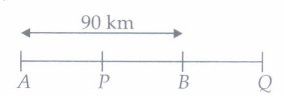
Clearly, AQ - BQ = AB
\(\Rightarrow\) 9x - 9y = 90
\(\Rightarrow\) x-y =10
(ii) (c): Suppose two cars meet at point P. Then
Distance travelled by car X = AP and
Distance travelled by car Y = BP.
In this case, two cars meet in 917 hours.
\(\therefore\) Distance travelled by car X in 9/7 hours = \(\frac {9}{7}\) x km
\(\Rightarrow A P=\frac{9}{7} x\)
Distance travelled by car Y in 9/7 hours \(\frac {9}{7}\) y km
\(\Rightarrow B P=\frac{9}{7} y\)
Clearly, AP + BP = AB
\(\Rightarrow \quad \frac{9}{7} x+\frac{9}{7} y=90 \Rightarrow \frac{9}{7}(x+y)=90 \Rightarrow x+y=70\)
(iii) (b): We have x - y = 10
\(\Rightarrow x+y=70\)
Adding equations (i) and (ii), we get
2x = 80 \(\Rightarrow\) x = 40
Hence, speed of car X is 40 km/hr.
(iv) (c): We have x - y = 10
\(\Rightarrow\) 40 - Y = 10 \(\Rightarrow\) Y = 30
Hence, speed of car y is 30 km/hr.
(v) (d)
8.
(i) (d): For finding zeroes, check whether \(x^{3}-4 x^{2}-7 x+10\) is 0 for given zeroes
Let p(x) = x3 - 4x2 - 7x + 10. Then, Clearly p( -2) = p(1) = p(5) = 0 So, the zeroes are -2, 1 and 5.
(ii) (d): Here \(\alpha=\frac{-1}{2}, \beta=-2 \text { and } \gamma=5\)
\(\therefore\) Sum of product of zeroes taken two at a time
\(=\alpha \beta+\beta \gamma+\gamma \alpha \)
\(=\left(\frac{-1}{2}\right)(-2)+(-2)(5)+(5)\left(\frac{-1}{2}\right)=1-10-\frac{5}{2}=\frac{-23}{2}\)
(iii) (d): Consider \(x^{3}-x^{2}+5 x-1\)
Sum of zeroes = 1 = Product of zeroes
Now, consider x3 - 4x
Sum of zeroes = 0 = Product of zeroes.
(iv) (b): Let a, a, a, be the zeroes of the cubic polynomial. [\(\because\) All zeroes are same]
Then, a3 = 1 => a = 1 [Using given options]
So, the required polynomial is \((x-1)^{3}=x^{3}-3 x^{2}+3 x-1\)
(v) (a): Clearly x = 1 and x = 2 are the zeroes of given polynomial, both of which satisfies \(x^{3}-5 x^{2}+8 x-4\)
9.
(i) (b)
(ii) (d): Since, the parabola intersects the x-axis at -3 and 4. So, zeroes of the polynomial are -3 and 4.
(iii) (c): Let \(f(x)=x^{2}-x-12\)
\(=x^{2}-4 x+3 x-12=(x+3)(x-4) \)
\(\text { Consider } f(x)=0 \Rightarrow(x+3)(x-4)=0 \Rightarrow x=4,-3\)
(iv) (b): Sum of zeroes \(=-\frac{\text { Coefficient of } x}{\text { Coefficient of } x^{2}} \)
\(=-\frac{(-9)}{4}=\frac{9}{4}\)
(v) (c): Product of zeroes \(=\frac{20}{1}=20\)
\(\therefore\) Reciprocal of product of zeroes \(=\frac{20}{1}\)
10.
(i) (b):Put \(10 x^{2}-x-3=0\)
\(\Rightarrow 10 x^{2}-6 x+5 x-3=0 \Rightarrow(2 x+1)(5 x-3)=0
\)
\(\Rightarrow \quad x=\frac{-1}{2} \text { or } \frac{3}{5}\)
\(\text { Thus, the zeroes are } \frac{3}{5} \text { and } \frac{-1}{2} \text { . }\)
(ii) (a): The zeroes of the polynomial are the points where its graph intersect the x-axis.
(iii) (d)
(iv) (d)
(v) (c): Product of zeroes \(=\frac{8 \sqrt{3}}{\sqrt{3}}=8\).
11.
(i) (b): The shape of the path of the soccer ball is a parabola.
(ii) (c): The axis of symmetry of the given curve is a line parallel to y-axis.
(iii) (a): The zeroes of the polynomial, represented in the given graph, are -2 and 7, since the curve cuts the x-axis at these points.
(iv) (d):A polynomial having zeroes -2 and -3 is \(p(x)=x^{2}-(-2-3) x+(-2)(-3)=x^{2}+5 x+6\)
(v) (c): We have \(f(x)=(x-3)^{2}+9\)
\(\text { Now, } 9=(x-3)^{2}+9 \)
\(\Rightarrow(x-3)^{2}=0 \Rightarrow x-3=0 \Rightarrow x=3\)
12.
(i) (b): Since the graph of the polynomial intersect the x-axis at \(x=\frac{1}{2}, \frac{-7}{2}\), therefore required zeroes of the polynomial are \(\frac{1}{2} \text { and } \frac{-7}{2}\)
(ii) (d): \(\because \frac{1}{2} \text { and } \frac{-7}{2}\) are the zeroes of the polynomial.
So, at \(x=\frac{1}{2}, \frac{-7}{2}\) the value of the polynomial will be 0.
From options, required polynomial is
p(x) = -4x2 - 12x + 7
(iii) (b) : we have, \(p(x)=-4 x^{2}-12 x+7\)
\(\therefore \quad p(3)=-4(3)^{2}-12(3)+7=-36-36+7=-65
\)
(iv) (c): Here \(f(x)=x^{2}+2 x-8 \text { and } \alpha, \beta \text { are its zeroes. }\)
\(\therefore \quad \alpha+\beta=-2 \text { and } \alpha \beta=-8 \)
\(\text { Now, } \alpha^{4}+\beta^{4}=\left(\alpha^{2}+\beta^{2}\right)^{2}-2 \alpha^{2} \beta^{2} \)
\(=\left((\alpha+\beta)^{2}-2 \alpha \beta\right)^{2}-2(\alpha \beta)^{2} \)
\(=\left[(-2)^{2}-2(-8)\right]^{2}-2(-8)^{2} \)
\(=[4+16]^{2}-2(-8)^{2}=(20)^{2}-2(64) \)
\(=400-128=272\)
(v) (a): We have sum of zeroes = 0 and product of zeroes = \(\sqrt(7)\)
So, required polynomial .\(=k\left(x^{2}-0 \cdot x+\sqrt{7}\right) \)
\(=k\left(x^{2}+\sqrt{7}\right)\)
13.
(i) (b): Since, the given graph is parabolic is shape, therefore it will represent a quadratic polynomial.
[\(\therefore\) Graph of quadratic polynomial is parabolic in shape 1
(ii) (c): Since, the graph cuts the x-axis at -1, 5. So the polynomial has 2 zeroes i.e., -1 and 5.
(iii) (a) : Sum of zeroes = -1 + 5 = 4
(iv) (c): Since a and β are zeroes of the given polynomial and β > a
\(\therefore\)a = - 1 and β = 5.
\(\therefore|8 \alpha+\beta|=|8(-1)+5|=|-8+5|=|-3|=3 .\)
(v) (d): Since the zeroes of the given polynomial are - 1 and 5.
\(\therefore\) Required polynomial p(x)
= k{ x2 -(-1 + 5)x + (-1)(5)} = k(.x2 - 4x - 5)
For k = -1, we get
p(x) = -.x2 + 4x + 5, which is the required polynomial.
14.
(i) (c): Here, the simplest form of given options are
125/441 = 53/(32 x 72), 77/210 = 11/(2 x 3 x 5),
15/1600 = 3/(26 x 5) Out of all the given options, the denominator of option (c) alone has only 2 and 5 as factors. So, it is a terminating decimal.
(ii) (b): 23/(23 x 52) = 23/200 = 0.115
(iii) (a): 441/(22 x 57 x 72) = 9/(22 x 57), which is a terminating decimal.
(iv) (d): The fraction form of a non-terminating recurring decimal will have at least one prime number other than 2 and 5 as its factors in denominator. So, p can take either of 3, 7 or 15.
(v) (a): Here denominator has only two prime factors i.e., 2 and 5 and hence it is a terminating decimal.
15.
(i) (b): Here 80 = 24 x 5, 85 = 17 x 5
and 90 = 2 x 32 x 5
L.C.M of 80, 85 and 90 = 24 x 3 x 3 x 5 x 17 = 12240
Hence, the minimum distance each should walk when they at first time is 12240 cm.
(ii) (c): Here 594 = 2 x 33 x 11 and 189 = 33 x 7
HCF of 594 and 189 = 33= 27
Hence, the maximum number of columns in which they can march is 27.
(iii) (c) : Here 768 = 28 x 3 and 420 = 22 x 3 x 5 x 7
HCF of 768 and 420 = 22 x 3 = 12
So, the container which can measure fuel of either tanker exactly must be of 12litres.
(iv) (b): Here, Length = 825 ern, Breadth = 675 cm and Height = 450 cm
Also, 825 = 5 x 5 x 3 x 11 , 675 = 5 x 5 x 3 x 3 x 3 and 450 = 2 x 3 x 3 x 5 x 5
HCF = 5 x 5 x 3 = 75
Therefore, the length of the longest rod which can measure the three dimensions of the room exactly is 75cm.
(v) (a): LCM of 8 and 12 is 24.
\(\therefore \)The least number of pack of pens = 24/8 = 3
\(\therefore \)The least number of pack of note pads = 24/12 = 2

10th Standard CBSE Syllabus & Materials
10th Standard CBSE
CBSE 10th Social Science PS - Federalism - New Model Questions Papers Study Material - QB365 Set A
NEW10th Standard CBSE
CBSE 10th Social Science PS - Power Sharing - New Model Questions Papers Study Material - QB365 Set A
NEW10th Standard CBSE
CBSE 10th Social Science GEO - Manufacturing Industries - New Model Questions Papers Study Material - QB365 Set A
NEW10th Standard CBSE
CBSE 10th Social Science GEO - Minerals and Energy Resources - New Model Questions Papers Study Material - QB365 Set A



NCERT Books

Syllabus

Exam Pattern

Sample Question Papers

Previous year Question Papers

Important Notes

MCQ Practice test

NCERT Exemplers

Case study Questions

Image Based Questions

Passage based Questions

HOT Questions

Value Based Questions

Model Questions Papers
NCERT ( Book Back ) Questions

Assertion and Reason
Important Questions And Answers

CBSE 10th Standard CBSE Subjects
CBSE Standards



