
 100% FREE ACCESS
10th Standard CBSE Syllabus & Materials
10th Standard CBSE
CBSE 10th Social Science ECO - Globalisation and the Indian Economy - New Model Questions Papers Study Material - QB365 Set A
NEW10th Standard CBSE
CBSE 10th Social Science ECO - Money and Credit - New Model Questions Papers Study Material - QB365 Set A
NEW10th Standard CBSE
CBSE 10th Social Science ECO - Sectors of the Indian Economy - New Model Questions Papers Study Material - QB365 Set A
NEW10th Standard CBSE
CBSE 10th Social Science ECO - Development - New Model Questions Papers Study Material - QB365 Set A
NEW10th Standard CBSE
CBSE 10th Social Science PS - Outcomes of Democracy - New Model Questions Papers Study Material - QB365 Set A
NEW10th Standard CBSE
CBSE 10th Social Science PS - Gender, Religion and Caste - New Model Questions Papers Study Material - QB365 Set A

Published on: 22/05/2021
QB365 Provides the updated CASE Study Questions for Class 10 Maths, and also provide the detail solution for each and every case study questions . Case study questions are latest updated question pattern from NCERT, QB365 will helps to get more marks in Exams
Download CBSE Class 10th Standard CBSE Maths question papers, sample papers, important questions, and previous year solved papers in PDF format. Get free study materials, NCERT solutions, and exam preparation resources for Class 10th Standard CBSE Maths
Questions + Answers key
Take MCQ Maths Test
1.
In an online test, Ishita comes across the statement - If a tangent is drawn to a circle from an external point, then the square of length of tangent drawn is equal to difference of squares of distance of the tangent from the centre of circle and radius of the circle.

Help Ishita, in answering the following questions based on the above statement.
(i) If AB is a tangent to a circle with centre O at B such that AB = 10 cm and OB = 5 cm, then OA =
| \((a) 3 \sqrt{5} \mathrm{~cm}\) | \((b) 5 \sqrt{5} \mathrm{~cm}\) | \((c) 4 \sqrt{5} \mathrm{~cm}\) | \((d) 6 \sqrt{5} \mathrm{~cm}\) |
(ii) In the adjoining figure, radius of the circle is
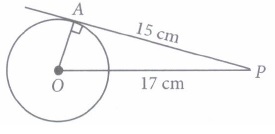
| (a) 8 cm | (b) 7 cm | (c) 9 cm | (d) 10 cm |
(iii) In the adjoining figure, length of tangent AP is
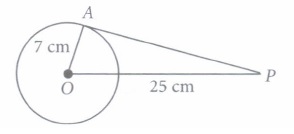
| (a) 12 cm | (b) 24 cm | (c) 30 cm | (d) None of these |
(iv) PT is a tangent to a circle with centre 0 and diameter = 40 cm. If PT = 21 cm, then OP =
| (a) 33 cm | (b) 29 cm | (c) 37 cm | (d) None of these |
(v) In the adjoining figure, the length of the tangent is
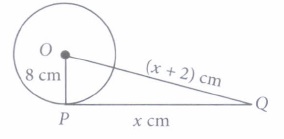
| (a) 15 cm | (b) 9 cm | (c) 8 cm | (d) 10 cm |
2.
Prem did an activity on tangents drawn to a circle from an external point using 2 straws and a nail for maths project as shown in figure.
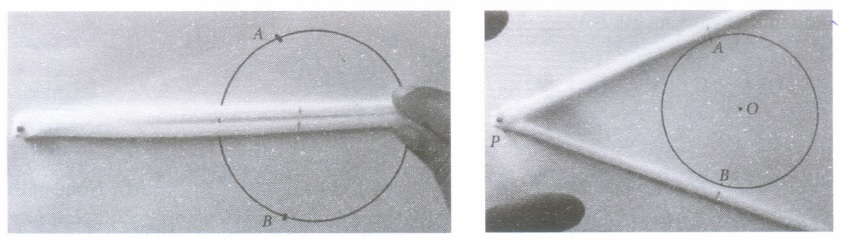
Based on the above information, answer the following questions.
(i) Number of tangents that can be drawn to a circle from an external point is
| (a) 1 | (b) 2 | (c) infinite | (d) any number depending on radius of circle |
(ii) On the basis of which of the following congruency criterion,\(\Delta \mathrm{OAP} \cong \Delta \mathrm{OBP} ?\)
| (a) ASA | (b) SAS | (c) RHS | (d) SSS |
(iii) If \(\angle\)AOB = 150°, then \(\angle\)APB =
| (a) 75° | (b) 30° | (c) 60° | (d) 100° |
(iv) If \(\angle\)APB = 40°, then \(\angle\)BAO =
| (a) 40° | (b) 30° | (c) 50° | (d) 20° |
(v) If \(\angle\)ABO = 45°, then which of the following is correct option?
| (a) \(A P \perp B P\) | (b) PAOB is square | (c) \(\angle\)AOB = 90° | (d) All of these |
3.
In a maths class, the teacher draws two circles that touch each other externally at point K with centres A and B and radii 5 em and 4 em respectively as shown in the figure.
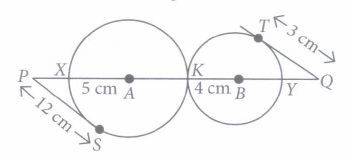
Based on the above information, answer the following questions.
(i) The value of PA =
| (a) 12 cm | (b) 5 cm | (c) 13 cm | (d) Can't be determined |
(ii) The value of BQ =
| (a) 4 cm | (b) 5 cm | (c) 6 cm | (d) None of these |
(iii) The value of PK =
| (a) 13 cm | (b) 15 cm | (c) 16 cm | (d) 18 cm |
(iv) The value of QY =
| (a) 2 cm | (b) 5 cm | (c) 1 cm | (d) 3 cm |
(v) Which of the following is true?
| (a) PS2=PA.PK | (b) TQ2=QB.QK | (c) PS2=PX.PK | (d) TQ2 = QA.QB |
4.
A backyard is in the shape of a triangle with right angle at B, AB = 6 m and BC = 8 m. A pit was dig inside it such that it touches the walls AC, BC and AB at P, Q and R respectively such that AP = x m.
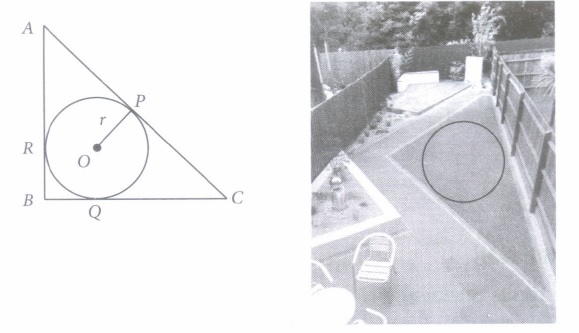
Based on the above information, answer the following questions.
(i) The value of AR =
| (a) 2x m | (b) x/2 m | (c) x m | (d) 3x m |
(ii) The value of BQ =
| (a) 2x m | (b) (6-x) m | (c) (2 - x) cm | (d) 4x m |
(iii) The value of CQ =
| (a) (4+x)m | (b) (10 - x) m | (c) (2+x)m | (d) both (b) and (c) |
(iv) Which of the following is correct?
| (a) Quadrilateral AROP is a square. | (b) Quadrilateral BROQ is a square. |
| (c) Quadrilateral CQOP is a square. | (d) None of these |
(v) Radius of the pit is
| (a) 2 cm | (b) 3 cm | (c) 4 cm | (d) 5 cm |
5.
Smita always finds it confusing with the concepts of tangent and secant of a circle. But this time she has determined herself to get concepts easier. So, she started listing down the differences between tangent and secant of a circle along with their relation. Here, some points in question form are listed by Smita in her notes. Try answering them to clear your concepts also.

(i) A line that intersects a circle exactly at two points is called
| (a) Secant | (b) Tangent | (c) Chord | (d) Both (a) and (b) |
(ii) Number of tangents that can be drawn on a circle is
| (a) 1 | (b) 0 | (c) 2 | (d) Infinite |
(iii) Number of tangents that can be drawn to a circle from a point not on it, is
| (a) 1 | (b) 2 | (c) 0 | (d) Infinite |
(iv) Number of secants that can be drawn to a circle from a point on it is
| (a) Infinite | (b) 1 | (c) 2 | (d) 0 |
(v) A line that touches a circle at only one point is called
| (a) Secant | (b) Chord | (c) Tangent | (d) Diameter |
1.
(i) (b): OA2=AB2+OB2
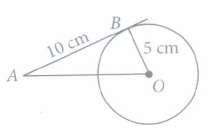
\(\Rightarrow \quad O A=\sqrt{10^{2}+5^{2}}=5 \sqrt{5} \mathrm{~cm}\)
(ii) (a) : \(O A=\sqrt{O P^{2}-A P^{2}} \text { (Given) }\)
\(=\sqrt{17^{2}-15^{2}}=\sqrt{64}=8 \mathrm{~cm}\)
(iii) (b): Length of tangent \(A P=\sqrt{O P^{2}-O A^{2}} \text { (Given) }\)
\(=\sqrt{25^{2}-7^{2}}=\sqrt{576}=24 \mathrm{~cm}\)
(iv) (b):
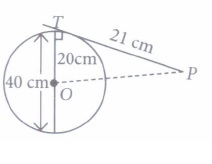
\(\text { Since, } O P=\sqrt{(P T)^{2}+(O T)^{2}}=\sqrt{21^{2}+20^{2}}=29 \mathrm{~cm}\)
(v) (a): Since, OP2 + PQ2 = OQ2
\(\Rightarrow\) 82 + x2 = (x + 2)2\(\Rightarrow\) 64 = 4x + 4\(\Rightarrow\) x = 15 cm
So, length of tangent, PQ = 15 cm.
2.
(i) (b)
(ii) (c): In \(\Delta\)OAP and \(\Delta\)OBP,
\(\angle\)OAP = \(\angle\)OBP = 90°
[Since, radius at the point of contact is perpendicular to tangent]
OP = OP (Common)
OA = OB (Radii of circle)
So, \(\angle\)OAP == \(\angle\)OBP (By RHS congruency criterion)
(iii) (b): In quadrilateral OAPB, \(\angle\)AOB = 150° [Given]
\(\angle\)OAP = \(\angle\)OBP = 90°
\(\therefore\) \(\angle\)APB = 360° - 90° - 90° - 150° = 30°
(iv) (d): We have, \(\angle\)APB = 40°
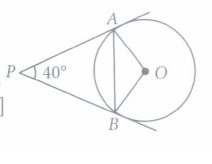
Now,PA =PB [Since, length of tangents drawn from an external point are equal]
In \(\Delta\)PAB, \(\angle\)PAB = \(\angle\)PBA = 70° [Angles opposite to equal sides are equal]
Also, \(\angle\)PAB + \(\angle\)BAO = 90°
[Since, radius at the point of contact is perpendicular to tangent]
\(\Rightarrow\) \(\angle\)BAO = 90° - 70° = 20°
(v) (d): We have, \(\angle\)ABO = 45°
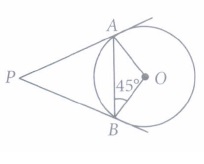
\(\because\) AO = OB (Radii of circle)
\(\therefore\) \(\angle\)BAO = \(\angle\)ABO = 45° [Angles opposite to equal sides are equal]
Now, in \(\Delta\)OAB,
\(\angle\)AOB = 180° - 45° - 45° = 90°
Since, \(\angle\)APB = 360° - 90° - 90° - 90° = 90° i.e., AP\(\perp\) BP
So, OAPB is a square.
3.
Here, AS = 5 cm, BT = 4 cm [\(\therefore\)Radii of circles]
(i) (c): Since, radius at point of contact is perpendicular to tangent.
\(\therefore\) By Pythagoras theorem, we have
\(P A=\sqrt{P S^{2}+A S^{2}}=\sqrt{12^{2}+5^{2}}=\sqrt{169}=13 \mathrm{~cm}\)
(ii) (b): Again by Pythagoras theorem, we have
\(B Q=\sqrt{T Q^{2}+B T^{2}}=\sqrt{3^{2}+4^{2}}=\sqrt{25}=5 \mathrm{~cm}\)
(iii) (d): PK = PA + AK = 13 + 5 = 18 cm
(iv) (c): QY = BQ - BY = 5 - 4 = 1 cm
(v) (c): PS2 = PA2 - AS2 = PA2 - AK2
= (PA + AK)(PA - AK) = PK.PX [\(\because\) AK = AX]
4.
Here in right angled triangle ABC, AB = 6 m and BC= 8 cm.
\(\therefore\) By Pythagoras theorem \(A C=\sqrt{(A B)^{2}+(B C)^{2}}\)
\(=\sqrt{(8)^{2}+(6)^{2}}=\sqrt{100}=10 \mathrm{~m}\)
Also, AP = x m.
(i) (c):AR=AP = xm ..(1)
[Since, length of tangents drawn from an external point are equal]
(ii) (b): BQ = BR = AB - AR = (6 - x) m (Using (1))
(iii) (d): CQ = CP = AC - AP = (10 - x) m
Also, CQ = BC - BQ = BC - BR = 8 - (6 - x) = 2 + x
(iv) (b): Since, CQ = 10 - x = 2 + x
\(\Rightarrow\) 8 = 2x \(\Rightarrow\) x = 4
\(\therefore\) AR = AP = 4 m, BR = BQ = 2 m
and CP = CQ = 6 m
Also, OQ.\(\perp\)BQ and OR.l BR
\(\therefore\) BROQ is a square.
(v) (a): Radius of the circle, OR = BR = 2 cm
5.
(i) (a)
(ii) (d)
(iii) (b)
(iv) (a)
(v) (c)

10th Standard CBSE Syllabus & Materials
10th Standard CBSE
CBSE 10th Social Science PS - Federalism - New Model Questions Papers Study Material - QB365 Set A
NEW10th Standard CBSE
CBSE 10th Social Science PS - Power Sharing - New Model Questions Papers Study Material - QB365 Set A
NEW10th Standard CBSE
CBSE 10th Social Science GEO - Manufacturing Industries - New Model Questions Papers Study Material - QB365 Set A
NEW10th Standard CBSE
CBSE 10th Social Science GEO - Minerals and Energy Resources - New Model Questions Papers Study Material - QB365 Set A



NCERT Books

Syllabus

Exam Pattern

Sample Question Papers

Previous year Question Papers

Important Notes

MCQ Practice test

NCERT Exemplers

Case study Questions

Image Based Questions

Passage based Questions

HOT Questions

Value Based Questions

Model Questions Papers
NCERT ( Book Back ) Questions

Assertion and Reason
Important Questions And Answers

CBSE 10th Standard CBSE Subjects
CBSE Standards



