
 100% FREE ACCESS
10th Standard CBSE Syllabus & Materials
10th Standard CBSE
CBSE 10th Social Science ECO - Globalisation and the Indian Economy - New Model Questions Papers Study Material - QB365 Set A
NEW10th Standard CBSE
CBSE 10th Social Science ECO - Money and Credit - New Model Questions Papers Study Material - QB365 Set A
NEW10th Standard CBSE
CBSE 10th Social Science ECO - Sectors of the Indian Economy - New Model Questions Papers Study Material - QB365 Set A
NEW10th Standard CBSE
CBSE 10th Social Science ECO - Development - New Model Questions Papers Study Material - QB365 Set A
NEW10th Standard CBSE
CBSE 10th Social Science PS - Outcomes of Democracy - New Model Questions Papers Study Material - QB365 Set A
NEW10th Standard CBSE
CBSE 10th Social Science PS - Gender, Religion and Caste - New Model Questions Papers Study Material - QB365 Set A

Published on: 26/05/2021
QB365 Provides the updated NCERT Examplar Questions for Class 10 Maths, and also provide the detail solution for each and every ncert examplar questions , QB365 will give all kind of study materials will help to get more marks
Download CBSE Class 10th Standard CBSE Maths question papers, sample papers, important questions, and previous year solved papers in PDF format. Get free study materials, NCERT solutions, and exam preparation resources for Class 10th Standard CBSE Maths
Questions + Answers key
Take MCQ Maths Test1.
Find the perimeter of a triangle with vertices (0, 4), (0, 0) and (3, 0).
[Hint The perimeter of a triangle is the sum of lengths of its three sides, so first find the length of three sides and then add them.]
2.
Find the angle subtended by these points \(P\left( \sqrt { 2 } ,\sqrt { 2 } \right) ,Q(-\sqrt { 2 } ,-\sqrt { 2 } )\text {and} R(-\sqrt { 6 } ,\sqrt { 6 } ).\)
3.
Show that the points A (-6, 10), B(-4, 6) and C(3, -8) are collinear, such that \(AB=\frac { 2 }{ 9 } AC\) .
4.
Check, whether the points (-4, 0), (4, 0) and (0, 3) are the vertices of an isosceles triangle or equilateral triangle.
5.
Find the area of a triangle with vertices (a, b +c), (b, c + a) and (c, a + b).
6.
Show that \(\Delta \)ABC with vertices A(-2, 0), B(0, 2) and C(2,0) is similar to \(\Delta \)DFE with vertices D(- 4, 0), E(4, 0) and F(0, 4).
7.
Name the type of triangle PQR formed by the points \(P(\sqrt { 2 } ,\sqrt { 2 } ),Q(-\sqrt { 2 } ,-\sqrt { 2 } )\) and \(R(-\sqrt { 6 } ,\sqrt { 6 } )\)
8.
The points A(2, 9), B(a, 5) and C(5, 5) Are the vertices of \(\triangle ABC\) right angled at B. Find the value of a and hence the area of \(\triangle ABC\).
9.
Find the value of m if the points (5, 1), (-2, -3) and (8, 2m) are collinear.
10.
Name the type of triangle formed by the points A(-5, 6), B(-4, 2) and C(7, 5).
1.
It is clear from the figure that,
Perimeter of \(\Delta\)AOB
=Distance (AO) + Distance (OB) + Distance (AB)
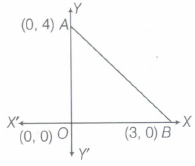
\(=\sqrt { { (0-0) }^{ 2 }+{ (4-0) }^{ 2 } } +\sqrt { { (0-3) }^{ 2 }+{ (0-0) }^{ 2 } } +\sqrt { { (0-3) }^{ 2 }+{ (4-0) }^{ 2 } } \)
[ using distance formula]
\(=\sqrt { { ({ x }_{ 1 }-{ x }_{ 2 }) }^{ 2 }+{ ({ y }_{ 1 }-{ y }_{ 2 }) }^{ 2 } } \)
\(=\sqrt { { (4) }^{ 2 } } +\sqrt { { (3) }^{ 2 } } +\sqrt { 9+16 } \)
= 4+3+\(\sqrt { 25 } \) = 4 + 3 + 5 = 12 units
Hence, the perimeter of given triangle is 12 units.
2.
Hint : First find the type of triangle using distance formula and hence obtain the angles.
Ans. 60°, equilateral triangle.
3.
Here, coordinates of \(A\equiv ({ x }_{ 1 },{ y }_{ 2 })\) = (-6, 10),
Coordinates of B \(\equiv \) (x2, y2) = (-4, 6) and
Coordinates of C \(\equiv \) (x3, y3) = (3, -8).
We know that,
Area of triangle = \(\frac { 1 }{ 2 } \left| { x }_{ 1 }({ y }_{ 2 }-{ y }_{ 3 })+{ x }_{ 2 }({ y }_{ 3 }-{ y }_{ 1 })+{ x }_{ 3 }({ y }_{ 1 }-{ y }_{ 2 }) \right| \)
\(\therefore\) Area of \(\Delta ABC\) = \(\frac { 1 }{ 2 } \left| -6\{ 6-(-8)\} +(-4)(-8-10)+3(10-6) \right| \)
\(=\frac { 1 }{ 2 } \left| -6(14)+(-4)(-18)+2(4) \right| \)
\(=\frac { 1 }{ 2 } \left| -84+72+12 \right| =0\)
Since, area of \(\Delta ABC\) is zero. So, points A, B and C are collinear.
Now, \(AB=\sqrt { { (-4+6) }^{ 2 }+{ (6-10) }^{ 2 } } \)
[ using distance formula ]
\(=\sqrt { { 2 }^{ 2 }+{ (-4) }^{ 2 } } =\sqrt { 4+16 } =\sqrt { 20 } \)
\(=2\sqrt { 5 } units\)
\(AC=\sqrt { ({ 3+6) }^{ 2 }+(-8-10)^{ 2 } } \)
\(=\sqrt { { 9 }^{ 2 }+({ -18 })^{ 2 } } =\sqrt { 81+324 } \)
\(=\sqrt { 405 } =\sqrt { 81\times 5 } =9\sqrt { 5 } units\)
\(\therefore \quad AB=2\sqrt { 5 } \times \frac { 9 }{ 9 } =\frac { 2 }{ 9 } AC\)
Hence proved.
4.
Let A = (x1,y1) = (-4, 0), B = (x2,y2) = (4, 0) and C = (x3, y3) = (0, 3)
Now, AB = \(\sqrt { { [4-(-4)] }^{ 2 }+{ (0-0) }^{ 2 } } \) [ using distance formula ]
\(=\sqrt { { (4+4) }^{ 2 } } =\sqrt { { 8 }^{ 2 } } =8\quad units\)
\(BC=\sqrt { (0-4{ ) }^{ 2 }+{ (3-0) }^{ 2 } } =\sqrt { { (-4) }^{ 2 }+{ (3) }^{ 2 } } \)
\(=\sqrt { 16+9 } =\sqrt { 25 } =5\quad units\)
and AC \(=\sqrt { [0-(-4){ ] }^{ 2 }+(3-0{ ) }^{ 2 } } \)
\(=\sqrt { 16+9 } =\sqrt { 25 } =5\quad units\)
\(\because BC = AC\)
So, \(\triangle \) ABC is an isosceles triangle.
5.
Here, (x1, y1) = (a, b + c), (x2, y2) = (b,c + a) and (x3, y3) = (c, a + b)
Now, area of a triangle
=\(\frac { 1 }{ 2 } \)[x1y2 + x2y3 + x3y1 - x1y3 - x2y1 - x3y2]
=\(\frac { 1 }{ 2 } \)[a(c + a) + b(a + b) + c(b + c)-a(a + b) - b(b + c) - c(c + a)]
=\(\frac { 1 }{ 2 } \)[ac + a2 + ba + b2 + cb + c2 - a2 - ab - b2 - bc - c2 - ca]
=\(\frac { 1 }{ 2 } \)(0) = 0
Hence, the area of a triangle with vertices (a,b + c), (b, c + a) and (c, a + b) is zero.
6.
Given, vertices of \(\Delta \)ABC are A(-2, 0), B(0, 2) and C(2,0) and D(- 4, 0), E(4, 0) and F(0, 4).
Now, AB = \(\sqrt { { (0+2) }^{ 2 }+{ (2-0) }^{ 2 } } =\sqrt { 4+4 } =2\sqrt { 2 } \) units [\(\because \) distance=\(\sqrt { { \left( { x }_{ 2 }-{ x }_{ 1 } \right) }^{ 2 }-{ \left( { y }_{ 2 }-{ y }_{ 1 } \right) }^{ 2 } } \)]
BC = \(\sqrt { { (2-0) }^{ 2 }+{ (0-2) }^{ 2 } } \) \( =\sqrt { 4+4 } =2\sqrt { 2 } \) units
CA = \(\sqrt { { (-2-2) }^{ 2 }+{ (0-0) }^{ 2 } } \) = \(\sqrt { { (-4) }^{ 2 }+0 } \)= 4 units
FD = \(\sqrt { { (0+4) }^{ 2 }+{ (4-0) }^{ 2 } } \) = \(\sqrt { { (4) }^{ 2 }+{ (-4) }^{ 2 } } \) = \(4\sqrt { 2 } \) units
FE = \(\sqrt { { (4-0) }^{ 2 }+{ (0-4) }^{ 2 } } \) = \(\sqrt { { (4) }^{ 2 }+{ (-4) }^{ 2 } } \) = \(4\sqrt { 2 } \) units
and ED = \(\sqrt { { (-4-4) }^{ 2 }+{ (0-0) }^{ 2 } } \) = \(\sqrt { { (-8) }^{ 2 }} \) = \(\sqrt { {64} }\) = 8 units
Here, we see that sides of \(\Delta \) DEF are twice the sides of \(\Delta \)ABC.

Hence, both the triangle are similar.
Hence proved.
7.
We have P(\(\sqrt{2}\) , \(\sqrt{2}\)) , Q(-\(\sqrt{2}\),-\(\sqrt{2}\)) and R(-\(\sqrt{6}\),\(\sqrt{6}\))
\(\therefore\) PQ = \(\sqrt { \left( \sqrt { 2 } +\sqrt { 2 } \right) ^{ 2 }+\left( \sqrt { 2 } +\sqrt { 2 } \right) ^{ 2 } } \)
\(=\sqrt { \left( 2\sqrt { 2 } \right) ^{ 2 }+\left( 2\sqrt { 2 } \right) ^{ 2 } } \)
\(=\sqrt { 4\times 2+4\times 2 } =\sqrt { 8+8 } \)
\(=\sqrt { 16 } \)=4 units
PR = \(\sqrt { \left( \sqrt { 2 } +\sqrt { 6 } \right) ^{ 2 }+\left( \sqrt { 2 } +\sqrt { 6 } \right) ^{ 2 } } \)
\(=\sqrt { 2+6+2\sqrt { 2 } +2+6-2\sqrt { 2 } } \)
\(=\sqrt { 2+6+2+6 } \)
\(=\sqrt { 16 } \) = 4 units
RQ = \(\sqrt { [(-\sqrt { 2 } )+\sqrt { 6 } ^{ 2 }+\left( -\sqrt { 2 } -\sqrt { 6 } \right) ^{ 2 } } \)
\(=\sqrt { 2+6-2\sqrt { 2 } +2+6+2\sqrt { 2 } } \)
\(=\sqrt { 2+6+2+6 } \)
\(=\sqrt { 16 } \) =4 units
Since PQ=PR=RQ = 4 units
∴ PQR is an equilateral triangle.
8.
\(a=2,\ OR\ \left( \triangle ABC \right) =6\ sq.units\)
9.
\(m=\frac { 19 }{ 14 } \)
10.
scalene triangle

10th Standard CBSE Syllabus & Materials
10th Standard CBSE
CBSE 10th Social Science PS - Federalism - New Model Questions Papers Study Material - QB365 Set A
NEW10th Standard CBSE
CBSE 10th Social Science PS - Power Sharing - New Model Questions Papers Study Material - QB365 Set A
NEW10th Standard CBSE
CBSE 10th Social Science GEO - Manufacturing Industries - New Model Questions Papers Study Material - QB365 Set A
NEW10th Standard CBSE
CBSE 10th Social Science GEO - Minerals and Energy Resources - New Model Questions Papers Study Material - QB365 Set A



NCERT Books

Syllabus

Exam Pattern

Sample Question Papers

Previous year Question Papers

Important Notes

MCQ Practice test

NCERT Exemplers

Case study Questions

Image Based Questions

Passage based Questions

HOT Questions

Value Based Questions

Model Questions Papers
NCERT ( Book Back ) Questions

Assertion and Reason
Important Questions And Answers

CBSE 10th Standard CBSE Subjects
CBSE Standards




