
 100% FREE ACCESS
10th Standard CBSE Syllabus & Materials
10th Standard CBSE
CBSE 10th Social Science ECO - Globalisation and the Indian Economy - New Model Questions Papers Study Material - QB365 Set A
NEW10th Standard CBSE
CBSE 10th Social Science ECO - Money and Credit - New Model Questions Papers Study Material - QB365 Set A
NEW10th Standard CBSE
CBSE 10th Social Science ECO - Sectors of the Indian Economy - New Model Questions Papers Study Material - QB365 Set A
NEW10th Standard CBSE
CBSE 10th Social Science ECO - Development - New Model Questions Papers Study Material - QB365 Set A
NEW10th Standard CBSE
CBSE 10th Social Science PS - Outcomes of Democracy - New Model Questions Papers Study Material - QB365 Set A
NEW10th Standard CBSE
CBSE 10th Social Science PS - Gender, Religion and Caste - New Model Questions Papers Study Material - QB365 Set A

Published on: 29/05/2021
QB365 Provides the HOT Question Papers for Class 10 Maths, and also provide the detail solution for each and every HOT Questions. HOT Questions will help to get more idea about question pattern in every exams and also will help to get more marks in Exams
Download CBSE Class 10th Standard CBSE Maths question papers, sample papers, important questions, and previous year solved papers in PDF format. Get free study materials, NCERT solutions, and exam preparation resources for Class 10th Standard CBSE Maths
Questions + Answers key
Take MCQ Maths Test1.
How many shots each having diameter 3 cm can be made from a cuboidal lead solid of dimensions 9 cm X 11 cm X 12 cm?
2.
Show that A (6,4), B (4,- 3)and C (8,- 3) are the vertices of an isosceles triangle. Also, find the length of the median through A.
3.
From a group of 3 Girls and 2 Boys, two children are selected at random.Find the probability such that at least one boy is selected.
4.
In the adjoining figure, PQR is an equilateral triangle inscribed in a circle of radius 7 cm. Find the area of the shaded region.
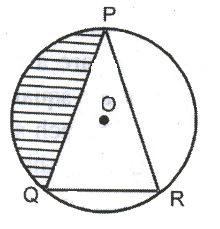
5.
In the given figure, from each corner of a square ABCD, of side 4 cm, quadrant of a circle of radius 1 cm each is cut and a circle of radius 1 cm is cut from the centre. Find the area of the shaded region.
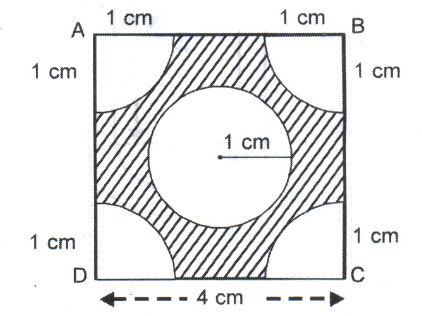
6.
Construct a triangle whose perimeter is 13.5 cm and the ratio of the three sides is 2 : 3 : 4.
7.
In given figure, find the perimeter of \(\angle ABC\), if AP = 10 cm.
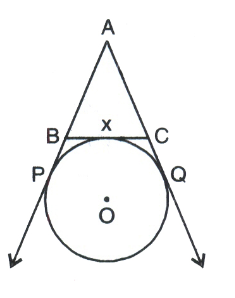
8.
The angles of depression of top and bottom of tower as seen from the top of a 100m high cliff are 300 and 600 respectively.Find the height of the tower.
9.
If the sum of the first n terms of an A.P. is given by 3n2+5n, find the common difference of the A.P.
10.
A triangle ABC is drawn to circumscribe a circle of radius 4 cm such that the segments BD and DC into which BC is divided by the point of contact D are of lengths 8 cm and 6 cm respectively (see Fig). Find the sides AB and AC.
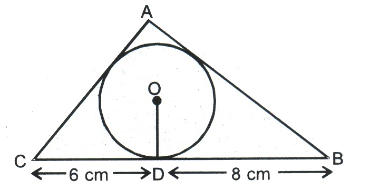
1.
Given, dimensions of cuboidal lead = 9 cm x 11 cm x 12 cm
ஃ Volume of cuboidal= 9 x 11 x 12=1188 cm3 and diameter of shot=3 cm [\(\because \) volume of cuboid=l x b x h]
ஃ Radius of shot, \(r=\frac { 3 }{ 2 } =1.5\quad cm\)
Now, volume of shot
\(=\frac { 4 }{ 3 } { \pi r }^{ 3 }=\frac { 4 }{ 3 } \times \frac { 22 }{ 7 } \times { (1.5) }^{ 3 }\\ =\frac { 297 }{ 21 } =14.143{ \quad cm }^{ 3 }\)
ஃ Required number of shots\(=\frac { Volume \ of \ cuboidal \ lead }{ Volume \ of \ shot } \)
\(=\frac { 1188 }{ 14.143 } =84(approx)\)
2.
Given vertices of a triangle are A(6,4), B(4,-3) and C(8,-3).
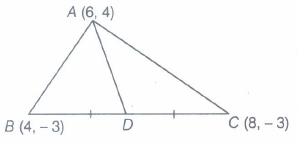
We have, AB = \(\sqrt { { \left( 6-4 \right) }^{ 2 }+{ \left( 4+3 \right) }^{ 2 } } \) [\(\because \) distance=\(\sqrt { { \left( { x }_{ 2 }-{ x }_{ 1 } \right) }^{ 2 }-{ \left( { y }_{ 2 }-{ y }_{ 1 } \right) }^{ 2 } } \)
=\(\sqrt { { \left( 2 \right) }^{ 2 }+{ \left( 7 \right) }^{ 2 } } \) = \(\sqrt { 4+49 } \)=\(\sqrt { 53 } \)units
and BC = \(\sqrt { { \left( 4-8 \right) }^{ 2 }+{ \left( -3+3 \right) }^{ 2 } } \) = \(\sqrt { { \left( -4 \right) }^{ 2 }+0 } \)= 4 units
\(\because \ \ \ \ AB=AC\)
So, \(\Delta \)ABC is an isosceles triangle.
Let D be the midpoint of BC, then the coordinates of D are \(\left( \frac { 4+8 }{ 2 } ,\frac { -3-3 }{ 2 } \right) \) i.e. (6, -3) \(\left[ \because \ coordinates\ of\ mid-point=\left( \frac { { x }_{ 1 }+{ x }_{ 2 } }{2 } ,\frac { { y }_{ 1 }+{ y }_{ 2 } }{ 2 } \right) \right] \)
Now, AD = \(\sqrt { { \left( 6-6 \right) }^{ 2 }+{ \left( 4+3 \right) }^{ 2 } } =\sqrt { 0+{ \left( 7 \right) }^{ 2 } } \)= 7 units.
Hence, length of the median AD is 7 units.
3.
Let G1, G2, G3 and B1, B2 be three girls and two boys respectively.
Since two children are selected at random, therefore the following are the possible groups:
B1B2, B1G1, B1G2, B1G3, B2G1, B2G2, B2G3, G1G2, G1G3, G2G3
Total number of cases = 10
Now, at least one boy is selected in the following ways:
B1B2, B1G1, B1G2, B1G3, B2G1, B2G2, B2G3
Total number of favourable cases = 7
\(\therefore\) Required probability = \(\frac {7} {10}\)
4.
30.38 cm2
5.
9.72 cm2
6.
Steps of Construction :
1. Draw a line segment AB = 13.5 cm.
2. Through A, construct an acute angle ㄥBAX ( < 90o).
3. Mark nine points (2 + 3 + 4 = 9) at equal distances on AX Such that AA1= A1A2 = A2A3 = A3A4 = A4A5 = A5A6 = A6A7 = A7A8 = A8A9.
4. Join A9B.
5. Through A2 and A5 draw A5R || A9B and A2Q || A9B, intersecting AB in Q and R.
6. With Q as centre draw an arc of radius AQ.
7. With R as centre draw another arc of radius RB, intersecting previous arc in P.
8. Join PQ and PR
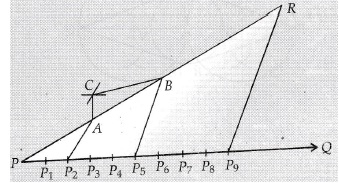
Thus, ΔPQR is the required triangle.
7.
20 cm
8.
66.67m
9.
Since the sum of the first n terms of an A.P. is given as 3n2 + 5n
\(\therefore\) Sn = 3n2 + 5n ....(i)
\(\therefore\) Sn-1 = 3( n - 1)2 + 5 ( n - 1 )
= 3( n2 + 1 - 2n ) + 5( n - 1 )
= 3n2 + 3 - 6n + 5n - 5
= 3n2 - n - 2 ...(ii)
Now, an = Sn - Sn-1
= 3n2 + 5n - 3n2 + n + 2
an = 6n + 2
Put n = 1 and n = 2, we have
a1 = 8 and a2 = 14
Hence, the common difference is 6.
10.
Given, CD = 6 cm, BD = 8 cm and radius = 4 cm
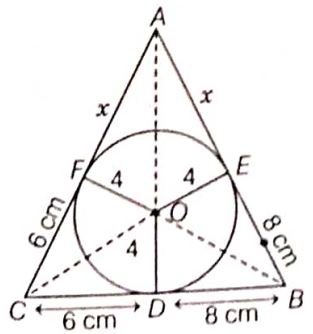
Join OC, OA and OB.
Let the circle touches the other sides AB and AC at points E and F, respectively.
We know that tangents drawn from an external point to the circle are equal in length.
\(\therefore\) CD = CF = 6 cm [\(\because\) C is an external point]
BD = BE = 8 cm [\(\because\) B is an external point]
and AF = AE = x cm (say [\(\because\) A is an external point]
Area of \(\Delta\)OCB, \(A_1=\frac{1}{2} \times \text { Base } \times \text { Height }\)
\(\begin{aligned} & =\frac{1}{2} \times C B \times O D \\ \end{aligned}\)
\(\begin{aligned} & =\frac{1}{2} \times 14 \times 4=28 \mathrm{~cm}^2 \\ \end{aligned}\)
\(\begin{aligned} & \quad[\because C B=C D+B D=6+8=14] \end{aligned}\)
Area of \(\Delta\)OCA,
\(\begin{aligned} A_2 & =\frac{1}{2} \times A C \times O F \end{aligned}\)
\(\begin{aligned} =\frac{1}{2}(6+x) \times 4=(12+2 x) \mathrm{cm}^2 \end{aligned}\)
and area of \(\Delta\)OBA,
\(A_3=\frac{1}{2} \times A B \times O E=\frac{1}{2}(8+x) \times 4=(16+2 x) \mathrm{cm}^2\)
Thus, area of \(\Delta\)ABC
= A1 + A2 + A3 = [28 + (12 + 2x) + (16+ 2x)]
= (56 + 4x) cm2 ...(i)
Now, semi-perimeter of \(\Delta\)ABC=\(\frac{1}{2}\)(AB + BC + CA)
\(\Rightarrow \quad s=\frac{1}{2}(x+8+14+6+x)\)
\(\Rightarrow\) s = (14 + x) cm
Using Heron's formula,
area of \(\Delta\)ABC = \(\begin{aligned} & =\sqrt{s(s-a)(s-b)(s-c)} \end{aligned}\)
\(\begin{aligned} =\sqrt{(14+x)(14+x-14)(14+x-x-6)(14+x-x-8)} \end{aligned}\)
\(\begin{aligned} & =\sqrt{(14+x) \times x \times 8 \times 6} \end{aligned}\)
\(\begin{aligned} =\sqrt{(14+x) 48 x} \end{aligned}\) ...(ii)
From Eqs. (i) and (ii), we get
\(\sqrt{(14+x) 48 x}=56+4 x=4(14+x)\)
On squaring both sides, we get
(14 + x) 48 x = 42 (14 + x)2
\(\Rightarrow\) 3x = 14 + x
\(\Rightarrow\) 2x = 14
\(\Rightarrow\) x = 7
\(\therefore\) Length of AC = 6 + x = 6 + 7 = 13 cm
and length of AB = 8 + x = 8 + 7 = 15 cm

10th Standard CBSE Syllabus & Materials
10th Standard CBSE
CBSE 10th Social Science PS - Federalism - New Model Questions Papers Study Material - QB365 Set A
NEW10th Standard CBSE
CBSE 10th Social Science PS - Power Sharing - New Model Questions Papers Study Material - QB365 Set A
NEW10th Standard CBSE
CBSE 10th Social Science GEO - Manufacturing Industries - New Model Questions Papers Study Material - QB365 Set A
NEW10th Standard CBSE
CBSE 10th Social Science GEO - Minerals and Energy Resources - New Model Questions Papers Study Material - QB365 Set A



NCERT Books

Syllabus

Exam Pattern

Sample Question Papers

Previous year Question Papers

Important Notes

MCQ Practice test

NCERT Exemplers

Case study Questions

Image Based Questions

Passage based Questions

HOT Questions

Value Based Questions

Model Questions Papers
NCERT ( Book Back ) Questions

Assertion and Reason
Important Questions And Answers

CBSE 10th Standard CBSE Subjects
CBSE Standards




