
 100% FREE ACCESS
10th Standard CBSE Syllabus & Materials
10th Standard CBSE
CBSE 10th Social Science ECO - Globalisation and the Indian Economy - New Model Questions Papers Study Material - QB365 Set A
NEW10th Standard CBSE
CBSE 10th Social Science ECO - Money and Credit - New Model Questions Papers Study Material - QB365 Set A
NEW10th Standard CBSE
CBSE 10th Social Science ECO - Sectors of the Indian Economy - New Model Questions Papers Study Material - QB365 Set A
NEW10th Standard CBSE
CBSE 10th Social Science ECO - Development - New Model Questions Papers Study Material - QB365 Set A
NEW10th Standard CBSE
CBSE 10th Social Science PS - Outcomes of Democracy - New Model Questions Papers Study Material - QB365 Set A
NEW10th Standard CBSE
CBSE 10th Social Science PS - Gender, Religion and Caste - New Model Questions Papers Study Material - QB365 Set A

Published on: 26/05/2021
QB365 Provides the updated NCERT Examplar Questions for Class 10 Maths, and also provide the detail solution for each and every ncert examplar questions , QB365 will give all kind of study materials will help to get more marks
Download CBSE Class 10th Standard CBSE Maths question papers, sample papers, important questions, and previous year solved papers in PDF format. Get free study materials, NCERT solutions, and exam preparation resources for Class 10th Standard CBSE Maths
Questions + Answers key
Take MCQ Maths Test1.
If the length of the shadow of a tower is increasing, then the angle of elevation of the Sun is also increasing. Is it true? Justify your answer.
2.
If x = a , y = b is the solution of the equations x - y = 2 and x + y = 4, then find the values of Q and b.
3.
The product of three consecutive positive integers is divisible by 6. Is this statement true or false? Justify your answer.
4.
In the following distribution, find the number of families having income range 16000-19000 (in RS).
| Monthly income range (in RS) | Number of families |
|---|---|
| Income more than RS.10000 | 100 |
| Income more than RS.13000 | 85 |
| Income more than RS.16000 | 69 |
| Income more than RS.19000 | 50 |
| Income more than RS.22000 | 33 |
| Income more than RS.25000 | 15 |
5.
Prove \((\tan { \theta } +2)(2\tan { \theta } +1)=5\tan { \theta } +2\sec ^{ 2 }{ \theta } .\)
6.
If x=a, y=b is the solution of the equations x-y=2 and x+y=4, then find the values of a and b.
7.
Can (x-1) be the remainder on division of a polynomial, p(x) by (2x+3)? Justify your answer.
8.
If the zeroes of the quadratic polynomial ax2+bx+c, where c\(\neq \)0, are equal, then show that c and a have same sign.
9.
Can the number 6n , where n being a natural number, ends with digit 5? Give reason.
10.
In Euclid's division lemma, the value of r, when a positive integer a is divided by 3, are 0 and 1 only. Is this statement true or false? Justify your answer.
11.
Find the largest number which divides 70 and 125 leaving remainders 5 and 8. respectively.
12.
In an AP, if d = -4, n =7 and \(a_n=4,\) then find the value of a first term.
13.
If the nth terms of the two A.P's. : 9, 7, 5, ...... and 24, 21, 18, .....are the same, find the value of n. Also, find that term.
14.
If (-4, 0), (4, 0) and (0, 3) are the vertices of a triangle, then write the shape of the triangle.
15.
Find the distance between the points (0, 5) and (-5, 0).
16.
If the common difference of an A.P. is 5, then find the value of a18 - a13 .
17.
If 7 times the 7th term of A.P. is equal to 11 times the 11th term, then find the 18th term.
18.
In an A.P., if a = 1, an = 20 and Sn = 399, then find the value of n.
19.
If the first term of an A.P. is -5 and the common difference is 2, then find the sum of the first 6 terms.
20.
Which constant should be added or subtracted to solve the quadratic equation \(4x^{2} - \sqrt {3 }x -5 = 0\) by the method of completing the square?
21.
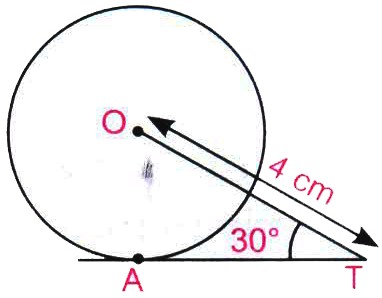
In figure AT is a tangent to the circle with centre O such that OT = 4cm and \(\angle OTA=30^0\ and\ \angle OTA=30^0.\)Find AT.
22.
State whether the following quadratic equations have two different real roots. Justify your answer. \(\sqrt2 x^2-{3\over\sqrt2}x+{1\over\sqrt2}=0\)
23.
State whether the following quadratic equations have two different real roots. Justify your answer. \((x-\sqrt2)^2-2(x+1)=0\)
1.
False, because when length of shadow increases, the angle of elevation of the Sun decreasesand vice-versa.
2.
The values a and b will satisfy given equations.
Thus, we have
a -b =2 ... (i)
and a + b =4 ...(ii)
Now, solving Eqs. (i) and (ii) to find a and b.
Ans. a = 3, b = 1
3.
Let three consecutive integers are n, (n + 1) and (n + 2).
Then, one of these three must be divisible by 2 and another one must be divisible by 3.
Hence, the product of numbers is divisible by 6.
e.g.lf n = 1, then the three consecutive numbers are 1,2,3.
∴ Product = 1 x 2 x 3 := 6;
So, it is divisible by 6.
Given statement is true.
4.
We prepare a contiuous grouped frequency distribution table.
| Monthly income range (in RS) | Number of families |
|---|---|
| 10000-13000 | 100-85=15 |
| 13000-16000 | 85-69=16 |
| 16000-19000 | 69-50=19 |
| 19000-22000 | 50-33=17 |
| 22000-25000 | 33-15=18 |
| More than 25000 | 15 |
| \(\sum { f_{ i }=100 } \) |
Observing the above table, we find that there are 19 families having income range 16000-19000 (in RS).
5.
LHS=\((\tan { \theta } +2)(2\tan { \theta } +1)\)
\(=2\tan ^{ 2 }{ \theta } +4\tan { \theta } +\tan { \theta } +2\)
\(=2\tan ^{ 2 }{ \theta } +2+5\tan { \theta } \)
\(=2(\tan ^{ 2 }{ \theta } +1)+5\tan { \theta } \)
\(=2\sec ^{ 2 }{ \theta } +5\tan { \theta } \quad \left[ \because 1+\tan ^{ 2 }{ \theta } =\sec ^{ 2 }{ \theta } \right] \)
\(=5\tan { \theta } +2\sec ^{ 2 }{ \theta } \)=RHS
Hence proved.
6.
Since, x = a and y = b is the solution of the equations x - y = 2 and x + y = r, therefore these values will satisfy that equations . Thus, we have
a - b = 2 ..(i)
and a+b=4 ...(ii)
On adding Eqs. (i) and (ii), we get
2a = 6 ⇒ a = 3
On substituting a=3 in Eq. (i), we get
3 - b = 2 ⇒ b = 1
Hence, a = 3 and b = 1
7.
No, here degree of (x-1)=degree of (2x+3)=1.
We know that, degree of remainder (x) is always less than the degree of divisior g(x).
i.e. degree r(x) So, (x-1) cannot be remainder of a polynomial p(x), when divided by (2x+3).
8.
Let α and α are the same zeroes of the given polynomial ax2+bx+c. Then, we have
\(\alpha .\alpha =\frac { c }{ a } \Rightarrow a^{ 2 }=\frac { c }{ a } \Rightarrow \frac { c }{ a } >0\quad \left[ \because \alpha ^{ 2 } \text{is always positive} \right] \)
⇒ c and a have same sign.
9.
No, because 6n = (2 x 3)n = 2n x 3n
If the number 6n ends with digit 5, then it will be divisible by 5, i.e. its one factor will be 5. But the only primes in the factorisation of 6n are 2 and 3, but not 5.
Hence, it cannot end with digit 5.
10.
False, according to Euclid's division lemma, if a is divided by 3, then a = 3q + r
where, \(0\le r<3\) and r is an integer.
Therefore, the value of r can be 0, 1 or 2.
Hence, it is false statement.
11.
Here, 5 and 8 are the remainders, which obtained on dividing 70 and 125 respectively. Thus, after subtracting these remainders from the given numbers, we have new numbers 65 (i.e. 70 - 5) and 117 (i.e. 125 - 8), which are divisible by the required number.
\(\therefore \) Required number = HCF of 65 and 117
Now, by Euclid's division algorithm,
117 = ( 65 x 1) + 52
Here, divisor is 65 and remainder is 52.
Again, by using Euclid's division algorithm, we get
65 = (52 x 1) + 13
Here, divisor is 52 and remainder is 13.
Again, by using Euclid's division algorithm, we get
52 = (13 x 4) + 0
\(\therefore \) HCF = 13
which is the largest number, which divides 70 and 125 leaving remainders 5 and 8.
12.
Given, d = - 4, n = 7 and \(a_n=4\)
We know that,
\({a}_{n}=a + (n-1)d\)
\(\Rightarrow\) 4 = a + (7 - 1) (-4)
\(\Rightarrow\) 4 = a + 6 (-4)
\(\Rightarrow\) 4+24 = a
\(\Rightarrow\) a = 28
13.
Here, n term th term of I A.P. = nth term of II A.P.
\(\Rightarrow \) 9 + (n - 1) (- 2) = 24 + (n-1)(-3)
\(\Rightarrow \) 9 - 2n + 2 = 24 - 3n + 3
\(\Rightarrow \) n = 27 - 11 = 16
Hence, the value of n is 16.
14.
an isosceles triangle
15.
\(5\sqrt { 2 }\ \ units\)
16.
25
17.
0
18.
38
19.
0
20.
\({3\over16}\)
21.
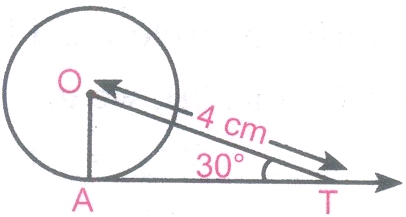
\(\angle \) OAT = 90° [∵ TAngent and radius are ⊥ to each other at the point of contact]
In right angled \(\triangle\) OAT,
\(AT \over OT\) = cos 30° ⇒ \(AT \over4\) = \(\sqrt3\over2\)
⇒ At = 2\(\sqrt3\) cm
22.
Yes \(\sqrt { 2 } x^{ 2 }-\frac { 3 }{ \sqrt { 2 } } x+\frac { 1 }{ \sqrt { 2 } } =0\)
\(\Rightarrow 2x^{ 2 }-3x+1=0\)
b2-3x+1=0
Distinct real roots.
23.
Yes x2+2-2 \(\sqrt { 2x } -2x-2=0\)
\(\Rightarrow x^{ 2 }-2(\sqrt { 2 } +1)x=0\)
b2-4ac=4 \(\sqrt { 2 } +1)^{ 2 }\) -4X1X0
4(2+1+\(2\sqrt { 2 } )=12+8\sqrt { 2 } \)
\(\therefore \) D>0 Distinct real roots

10th Standard CBSE Syllabus & Materials
10th Standard CBSE
CBSE 10th Social Science PS - Federalism - New Model Questions Papers Study Material - QB365 Set A
NEW10th Standard CBSE
CBSE 10th Social Science PS - Power Sharing - New Model Questions Papers Study Material - QB365 Set A
NEW10th Standard CBSE
CBSE 10th Social Science GEO - Manufacturing Industries - New Model Questions Papers Study Material - QB365 Set A
NEW10th Standard CBSE
CBSE 10th Social Science GEO - Minerals and Energy Resources - New Model Questions Papers Study Material - QB365 Set A



NCERT Books

Syllabus

Exam Pattern

Sample Question Papers

Previous year Question Papers

Important Notes

MCQ Practice test

NCERT Exemplers

Case study Questions

Image Based Questions

Passage based Questions

HOT Questions

Value Based Questions

Model Questions Papers
NCERT ( Book Back ) Questions

Assertion and Reason
Important Questions And Answers

CBSE 10th Standard CBSE Subjects
CBSE Standards




