
 100% FREE ACCESS
10th Standard CBSE Syllabus & Materials
10th Standard CBSE
CBSE 10th Social Science ECO - Globalisation and the Indian Economy - New Model Questions Papers Study Material - QB365 Set A
NEW10th Standard CBSE
CBSE 10th Social Science ECO - Money and Credit - New Model Questions Papers Study Material - QB365 Set A
NEW10th Standard CBSE
CBSE 10th Social Science ECO - Sectors of the Indian Economy - New Model Questions Papers Study Material - QB365 Set A
NEW10th Standard CBSE
CBSE 10th Social Science ECO - Development - New Model Questions Papers Study Material - QB365 Set A
NEW10th Standard CBSE
CBSE 10th Social Science PS - Outcomes of Democracy - New Model Questions Papers Study Material - QB365 Set A
NEW10th Standard CBSE
CBSE 10th Social Science PS - Gender, Religion and Caste - New Model Questions Papers Study Material - QB365 Set A

Published on: 26/05/2021
QB365 Provides the updated NCERT Examplar Questions for Class 10 Maths, and also provide the detail solution for each and every ncert examplar questions , QB365 will give all kind of study materials will help to get more marks
Download CBSE Class 10th Standard CBSE Maths question papers, sample papers, important questions, and previous year solved papers in PDF format. Get free study materials, NCERT solutions, and exam preparation resources for Class 10th Standard CBSE Maths
Questions + Answers key
Take MCQ Maths Test1.
If the length of the shadow of a tower is increasing, then the angle of elevation of the Sun is also increasing. Is it true? Justify your answer.
2.
If x = a , y = b is the solution of the equations x - y = 2 and x + y = 4, then find the values of Q and b.
3.
The product of three consecutive positive integers is divisible by 6. Is this statement true or false? Justify your answer.
4.
The time (in seconds) taken by 150 athletes to run a 110m hurdle race are tabulated below:
| Class interval | Frequency |
|---|---|
| 13.8-14.0 | 2 |
| 14.0-14.2 | 4 |
| 14.2-14.4 | 5 |
| 14.4-14.6 | 71 |
| 14.6-14.8 | 48 |
| 14.8-15.0 | 20 |
Find the number of athletes, who completed the race in less than 14.6 s.
5.
The abscissa of the point of intersection of the less than type and more than type cumulative frequency curves of a grouped data gives which measure of central tendency?
6.
Find the value of \(\left[ \frac { \sin ^{ 2 }{ { 22 }^{ 0 } } +\sin ^{ 2 }{ { 68 }^{ 0 } } }{ \cos ^{ 2 }{ { 22 }^{ 0 } } +\cos ^{ 2 }{ { 68 }^{ 0 } } } +\sin ^{ 2 }{ { 63 }^{ 0 } } +\sin { { 27 }^{ 0 } } \cos { { 63 }^{ 0 } } \right] .\)
7.
Prove \((\tan { \theta } +2)(2\tan { \theta } +1)=5\tan { \theta } +2\sec ^{ 2 }{ \theta } .\)
8.
Given that \(\sin { \alpha } =\frac { 1 }{ 2 } \) and \(\cos { \beta } =\frac { 1 }{ 2 } ,\) what is the value of \((\alpha +\beta )?\)
9.
Can the number 6n , where n being a natural number, ends with digit 5? Give reason.
10.
A solid metallic sphere of radius 10.5 cm is melted and recast into a number of smaller cones, each of radius 3.5 cm and height 3 cm. Find the number of cone so formed.
11.
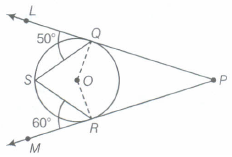
In adjoining figure, PQ and PR are tangents to the circle with centre O and S is a point on the circle such that \(\angle\)SQL = 50\(°\)and \(\angle\)SRM = 60\(°\)Find \(\angle\)QSR.
12.
The angles of a triangle are in AP. The greatest angle is twice the last. Find all the angles of the triangle.
13.
What is the nature of roots of the quadratic equation 2x2-\(\sqrt { 5 } \)x+1=0?
14.
Which term of the AP 21, 42, 63, 84, ... is 210?
15.
In the length of the shadow of a tower is increasing, then the angle of elevation of the Sin is also increasing. Is it true? Justify your answer.
16.
Find the probability of getting multiple of 3 in a single throw of an ordinary die.
17.
A number is chosen from 1 to 100. Find the probability that it is a prime number.
18.
The probability of getting a rotten egg from a lot of 400 eggs is 0.035. Find the number of rotten eggs in the lot.
19.
Does the point P(-2, 4) lie on a circle of radius 6 units and centre C(3, 5)?
20.
Find the distance of the point P(-6, 8) from the origin.
21.
Find the 10th term of the A.P., 5, 8, 11, 14,.....
22.
If an = 3 - 4n, show that a1, a2, a3,.......form an A.P.
23.
Write first three terms of the A.P., whose first terms is \(\frac{1}{2}\) and common difference is \(-\frac{1}{6}\) .
24.
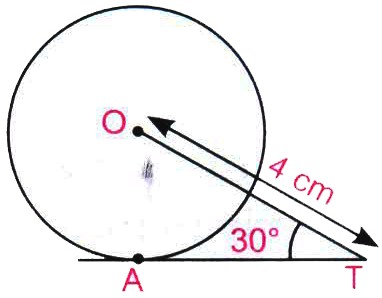
In figure AT is a tangent to the circle with centre O such that OT = 4cm and \(\angle OTA=30^0\ and\ \angle OTA=30^0.\)Find AT.
1.
False, because when length of shadow increases, the angle of elevation of the Sun decreasesand vice-versa.
2.
The values a and b will satisfy given equations.
Thus, we have
a -b =2 ... (i)
and a + b =4 ...(ii)
Now, solving Eqs. (i) and (ii) to find a and b.
Ans. a = 3, b = 1
3.
Let three consecutive integers are n, (n + 1) and (n + 2).
Then, one of these three must be divisible by 2 and another one must be divisible by 3.
Hence, the product of numbers is divisible by 6.
e.g.lf n = 1, then the three consecutive numbers are 1,2,3.
∴ Product = 1 x 2 x 3 := 6;
So, it is divisible by 6.
Given statement is true.
4.
The less than type frequency distribution of given table is
| Class interval | Frequency | Time taken | Cumulative frequency |
|---|---|---|---|
| 13.8-14.0 | 2 | Less than 14 | 2 |
| 14.0-14.2 | 4 | Less than 14.2 | 2+4=6 |
| 14.2-14.4 | 5 | Less than 14.4 | 6+5=11 |
| 14.4-14.6 | 71 | Less than 14.6 | 11+71=82 |
| 14.6-14.8 | 48 | Less than 14.8 | 82+48=130 |
| 14.8-15.0 | 20 | Less than 15.0 | 130+20=150 |
Hence the required number of athletes, who completed the race in less than 14.6 is 82.
5.
Median
6.
\(\frac { \sin ^{ 2 }{ { 22 }^{ 0 } } +\sin ^{ 2 }{ { 68 }^{ 0 } } }{ \cos ^{ 2 }{ { 22 }^{ 0 } } +\cos ^{ 2 }{ { 68 }^{ 0 } } } +\sin ^{ 2 }{ { 63 }^{ 0 } } +\sin { { 27 }^{ 0 } } \cos { { 63 }^{ 0 } } \)
\(=\frac { \sin ^{ 2 }{ { 22 }^{ 0 } } +[\sin { { ({ 90 }^{ 0 }-{ 22 }^{ 0 }) }]^{ 2 } } }{ [\cos { { { ({ 90 }^{ 0 }-{ 22 }^{ 0 }) }]^{ 2 }] } } +\cos ^{ 2 }{ { 68 }^{ 0 } } } +\sin ^{ 2 }{ { 63 }^{ 0 } } +\cos { { 63 }^{ 0 } } \sin { { ({ ({ 90 }^{ 0 }-{ 22 }^{ 0 }) }]^{ 2 } } } \)
\(=\frac { \sin ^{ 2 }{ { 22 }^{ 0 } } +\cos ^{ 2 }{ { 22 }^{ 0 } } }{ \sin ^{ 2 }{ { 68 }^{ 0 } } +\cos ^{ 2 }{ { 68 }^{ 0 } } } +\sin ^{ 2 }{ { 63 }^{ 0 } } +\cos { { 63 }^{ 0 } } \cos { { 63 }^{ 0 } } \)
\(=\frac { 1 }{ 1 } +\sin ^{ 2 }{ { 63 }^{ 0 } } +\cos ^{ 2 }{ { 63 }^{ 0 } } \)
\(=1+1\quad \left[ \because \sin ^{ 2 }{ \theta } +\cos ^{ 2 }{ \theta } =1 \right] \)
7.
LHS=\((\tan { \theta } +2)(2\tan { \theta } +1)\)
\(=2\tan ^{ 2 }{ \theta } +4\tan { \theta } +\tan { \theta } +2\)
\(=2\tan ^{ 2 }{ \theta } +2+5\tan { \theta } \)
\(=2(\tan ^{ 2 }{ \theta } +1)+5\tan { \theta } \)
\(=2\sec ^{ 2 }{ \theta } +5\tan { \theta } \quad \left[ \because 1+\tan ^{ 2 }{ \theta } =\sec ^{ 2 }{ \theta } \right] \)
\(=5\tan { \theta } +2\sec ^{ 2 }{ \theta } \)=RHS
Hence proved.
8.
\(sin\ \alpha =\frac { 1 }{ 2 } and\ cos\ \beta =\frac { 1 }{ 2 }\)
\( \\ \Rightarrow d sin\ \alpha =sin\ 30°\left[ \because \ sin\ 30°=\frac { 1 }{ 2 } \right] \ \)
\(\ and\ cos\ \beta \ =\ cos\ 60°\ \left[ \because \ cos\ 60°=\frac { 1 }{ 2 } \right] \)
\(\\ \Rightarrow \ \alpha \ =\ 30°\ and\ \ beta \ = \ 60°\)
\(\\ \therefore \ \alpha \ +\ \beta \ =\ 30°+60°=90°\)
9.
No, because 6n = (2 x 3)n = 2n x 3n
If the number 6n ends with digit 5, then it will be divisible by 5, i.e. its one factor will be 5. But the only primes in the factorisation of 6n are 2 and 3, but not 5.
Hence, it cannot end with digit 5.
10.
126
11.
Given, PQL and PRM are the tangents to the circle with centre O at the points Q and R
S is a point on the circle such that ∠SQL = 50° and ∠SRM = 60°
We have to determine if ∠QSR is equal to 40°.
We know that the radius of the circle is perpendicular to the tangent at the point of contact.
So, ∠LQO = ∠MRO = 90°
From the figure,
∠LQO = ∠LQS + ∠SQO
90° = 50° + ∠SQO
∠SQO = 90° - 50°
∠SQO = 40°
From the figure,
∠MRO = ∠MRS + ∠SRO
90° = 60° + ∠SRO
∠SRO = 90° - 60°
∠SRO = 30°
Considering triangle OSQ,
OS = OQ = radius
Two sides of a triangle are equal
So, OSQ is an isosceles triangle.
In an isosceles triangle, two sides and two angles are equal.
Two equal angles are ∠SOQ = ∠ORS
∠QSR = ∠OSQ + ∠OSR
∠QSR = 30° + 40°
Therefore, ∠QSR = 70°
12.
Let the angles are (a - d)o, ao, (a + d)o.
Then, we get (a - d) + a + (a + d) = 180
and a + d = 2(a - d)
40°, 60° and 80°
13.
No real roots, i.e., the imaginary roots.
14.
Let nth term, \(a_n\) be 210.
Then, a + (n-1)d = 210 \([\because a_n=a+(n-1)d]\)
\(\Rightarrow\) 21 + (n-1) 21 = 210
\(\Rightarrow\) [\(\because\) a = 21, d =42 - 21 = 21, given]
\(\Rightarrow\) 21 + 21n - 21 = 210
\(\therefore\) n = 10
15.
False, because when angle of elevation increases, the length of shadow decrease and Vice-vers.
16.
Elementary events associated to the given random experiment, throwing an ordinary die are 1,2,3,4,5,6.
∴ n(S)=6
Let E be the events of getting multiple of 3, i.e.3,6.
∴ n(E)=12
Now, \(P(E)=\frac { n(E) }{ n(S) } =\frac { 2 }{ 6 } =\frac { 1 }{ 3 } \)
Hence, the probability of getting multiple of 3 in a single throw of an ordinary die is \(\frac { 1 }{ 3 } \) .
17.
Total number of outcomes, n(S)=100
Let E=Event of getting a prime number
={2,3,5,7,11,13,17,19,23,29,31,37,41,43,47,53,59,61,71,73,79,83,89,97}
∴ n(E)=25
Hence, P (getting a prime number)
\(=\frac { n(E) }{ n(S) } =\frac { 25 }{ 100 } =\frac { 1 }{ 4 } \)
18.
Given, total number of eggs, n(S)=400
Probability of getting a rotten egg,
P(E)=0.035
∵ \(P(E)=\frac { n(E) }{ n(S) } \)
∴ Number of rotten eggs,
\(n(E)=n(S)\times P(E)\)
\(=400\times 0.035=14\)
Hence, the number of rotten eggs are 14.
19.
No
20.
10 units
21.
32
22.
5, 13, 21,........
23.
\(\frac{1}{2},\frac{1}{3},\frac{1}{6}\)
24.
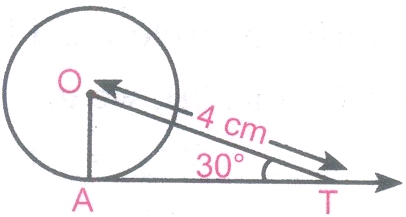
\(\angle \) OAT = 90° [∵ TAngent and radius are ⊥ to each other at the point of contact]
In right angled \(\triangle\) OAT,
\(AT \over OT\) = cos 30° ⇒ \(AT \over4\) = \(\sqrt3\over2\)
⇒ At = 2\(\sqrt3\) cm

10th Standard CBSE Syllabus & Materials
10th Standard CBSE
CBSE 10th Social Science PS - Federalism - New Model Questions Papers Study Material - QB365 Set A
NEW10th Standard CBSE
CBSE 10th Social Science PS - Power Sharing - New Model Questions Papers Study Material - QB365 Set A
NEW10th Standard CBSE
CBSE 10th Social Science GEO - Manufacturing Industries - New Model Questions Papers Study Material - QB365 Set A
NEW10th Standard CBSE
CBSE 10th Social Science GEO - Minerals and Energy Resources - New Model Questions Papers Study Material - QB365 Set A



NCERT Books

Syllabus

Exam Pattern

Sample Question Papers

Previous year Question Papers

Important Notes

MCQ Practice test

NCERT Exemplers

Case study Questions

Image Based Questions

Passage based Questions

HOT Questions

Value Based Questions

Model Questions Papers
NCERT ( Book Back ) Questions

Assertion and Reason
Important Questions And Answers

CBSE 10th Standard CBSE Subjects
CBSE Standards




