
 100% FREE ACCESS
10th Standard CBSE Syllabus & Materials
10th Standard CBSE
CBSE 10th Social Science ECO - Globalisation and the Indian Economy - New Model Questions Papers Study Material - QB365 Set A
NEW10th Standard CBSE
CBSE 10th Social Science ECO - Money and Credit - New Model Questions Papers Study Material - QB365 Set A
NEW10th Standard CBSE
CBSE 10th Social Science ECO - Sectors of the Indian Economy - New Model Questions Papers Study Material - QB365 Set A
NEW10th Standard CBSE
CBSE 10th Social Science ECO - Development - New Model Questions Papers Study Material - QB365 Set A
NEW10th Standard CBSE
CBSE 10th Social Science PS - Outcomes of Democracy - New Model Questions Papers Study Material - QB365 Set A
NEW10th Standard CBSE
CBSE 10th Social Science PS - Gender, Religion and Caste - New Model Questions Papers Study Material - QB365 Set A

Published on: 26/05/2021
QB365 Provides the updated NCERT Examplar Questions for Class 10 Maths, and also provide the detail solution for each and every ncert examplar questions , QB365 will give all kind of study materials will help to get more marks
Download CBSE Class 10th Standard CBSE Maths question papers, sample papers, important questions, and previous year solved papers in PDF format. Get free study materials, NCERT solutions, and exam preparation resources for Class 10th Standard CBSE Maths
Questions + Answers key
Take MCQ Maths Test1.
Check whether 12n can end with the digit 0 or 5, for any natural number n
2.
Use Euclid's division algorithm to find the HCF of the following three numbers
441, 567 and 693
3.
Use Euclid's division algorithm to find the HCF of the following three numbers
2, 7 and 12
4.
Which of the following is not a quadratic equation?
\((\sqrt{2} x+\sqrt{3})^{2}=3 x^{2}-5 x\)
5.
The taxi fare after each kilometre, when the fare is Rs.15 for the first kilometre and Rs. 8 for each additional kilometre, does not form an AP as the total fare (in Rs.) after each kilometre is 15, 8, 8 ,8, .... Is the statement true? Give reasons.
6.
Find 11th term of AP : - 5, - 5 / 2, 0, 5 / 2, ...
7.
If the zeroes of the cubic polynomial x3 - 6x2 + 3x + 10 are of the form a, a + b and a + 2b for some real numbers a and b, then find the values of a and b.
8.
The weight (in kg) of 50 wrestlers are recorded in the following table:
| Weight (in kg) | 100-110 | 110-120 | 120-130 | 130-140 | 140-150 |
|---|---|---|---|---|---|
| Number of wrestlers | 4 | 14 | 21 | 8 | 3 |
Find the mean weight of the wrestlers.
9.
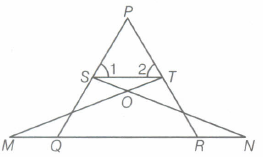
In the given figure, if \(\angle1=\angle2\) and \(\triangle NSQ\cong \triangle MTR\) , prove that \(\triangle PTS\sim \triangle PRQ\)
10.
ABCD is a trapezium in which \(AB\parallel DC\). P and Q are points on sides AD and BC respectively such that \(PQ\parallel AB\). If PD = 18 cm, BQ = 35 cm and QC = 15 cm, find the value of AD.
11.
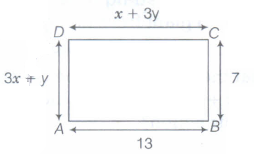
Find the values of x and y in the given rectangle.
12.
If the angles of a triangle are x, y and 400 and the difference between the two angles x and y is 300 . Then, find the values of x and y.
13.
A rational number in its decimal expansion is 327.7081. What can you say about the prime factors of q. when this number is expressed in the form \(\frac{p}{q}\)? Give reason.
14.
In the given figure, common tangents AB and CD to two circles intersect at E. Prove that AB = CD

15.
Find the sum of all the 11 terms of an AP whose middle most term is 30.
16.
Split 207 into three parts such that these are in A.P. and the products of the two smaller parts is 4623.
17.
500 persons are taking a dip into a cuboidal pond which is 80 m long and 50 m broad. What is the rise of water level in the pond, if the average displacement of the water by a person is 0.04 m3 ?
18.
Name the type of triangle formed by the points A(-5, 6), B(-4, 2) and C(7, 5).
19.
The angle of depressions of two ships from the top of a light house and on the same side of it are found to be 45o and 30o . If the ships are 200 m apart, then find the height of the light house.
20.
How many terms of the AP: -15, -13, -11,.... are needed to make the sum -55? Explain the reason for double answer.
21.
In which of the following situations do the lists of numbers involved form an AP? Give reasons for your answers.
(i) The fee charged from a student every month by a school for the whole session, when the monthly fee is Rs.400.
(ii) The fee charged every month by a school from classes I to XII, when the monthly fee for class I is Rs.250, and it increased by Rs.50 for the next higher class.
(iii) The amount of money in the account of Varun at the end of every year when Rs.1000 is deposited at simple interest of 10% per annum.
(iv) The number of bacteria in a certain food after each second, when they double in every second.
22.
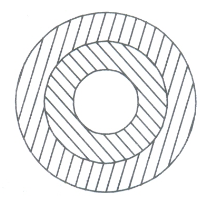
An archery target has three regions formed by three concentric circles as shown in Fig. If the diameters of the concentric circles are in the ratio 1 : 2 : 3, then find the ratio of the areas of three regions.
23.
Justify whether it is true to say that -1,\(-\frac{3}{2}\) -2,\(-\frac{5}{2}\)..... forms an AP as a2 - a1 = a3 - a2.
24.
The eighth term of an AP is half its second term and the eleventh term exceeds one-third of its fourth term by 1. Find the 15th term.
1.
Here, Number=12n where n stand for any natural number .
Now 12n= (22 x3)n
Now , For 12n to end with 0, it should have 2 as well as 5 in its Prime factors to end with 0, Also to end with 5 , it requires at least a single multiple of 5 in its Prime Factors, So 12n cannot end with the digit 0 or 5.
2.
63
3.
1
4.
It is a quadratic equation.
5.
The total fare (in Rs.) after each kilometre is 15, 23, 31, 39,....
No
6.
20
7.
x3 + 6x2 + 3x + 10 thus we know that,
a + a + b + a + 2b = 6
\(\Rightarrow\) 3(a + b) = 6 \(\Rightarrow\) a + b = 2
a(a + b) + (a + b)(a + 2b) + a(a + 2b) = 3
\(\Rightarrow\) (a + b)(2a + 2b) + a(a + 2b) = 3
\(\Rightarrow\) 2 x 2 x 2 + a2 + 2ba = 3
\(\Rightarrow\) a2 +2ba=-5 \(\Rightarrow\) ab= \(\frac{-5-a^{2}}{2}\)
a(a+b)(a+2b) = -1
a(2)(a+b) = -1
\( a^{2}+a b =-\frac{1}{2} \)
\(\Rightarrow \quad a^{2}+\left(\frac{-5-a^{2}}{2}\right) =-\frac{1}{2}\)
\(\Rightarrow\) 2a2 - 5 - a2 = - 1 ~ a2 = 4
\(\Rightarrow\) a= ± 2
a+b=2
\(\Rightarrow\) b=0 or 4
8.
123.4 kg
9.
Given \(\triangle NSQ\cong \triangle MTR\) and \(\angle1=\angle2\)
To prove \(\triangle PTS\sim \triangle PRQ\)
Proof Since, \(\triangle NSQ\cong \triangle MTR\)
\(\therefore\) SQ = TR ... (i)
Also, \(\angle1=\angle2\)
\(\Rightarrow\) PT = PS .... (ii)
[since, sides opposite to equal angles are also equal]
From Eqs.(i) and (ii), \(\frac{PS}{SQ}=\frac{PT}{TR}\)
\(\Rightarrow ST\parallel QR\)
[by converse of basic proportionality theorem]
\(\therefore \angle 1=\angle PQR\) and \( \angle 2=\angle PRQ\)
[\(\therefore\) atternate exterior angle]
In \(\triangle PTS\) and \(\triangle PRQ\),
\(\angle P=\angle P\) [common angle]
\(\angle 1=\angle PQR\) [proved above]
and \(\angle 2=\angle PRQ\)
\(\therefore \triangle PTS\sim \triangle PRQ\)
[by AAA similarity criterion]
10.
A trapezium ABCD in which \(PQ\parallel AB\), draw a line AC, which intersects PQ at O.
Join AC, which intersects PQ at O.
Given, \(AB\parallel DC\) and \(PQ\parallel AB\)
Then, \(AB\parallel PQ\parallel DC\)
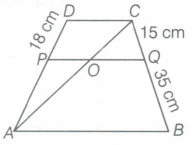
In \(\triangle ADC\), \(PO\parallel DC\)
By basic proportionality theorem,
\(\frac{AP}{PD}=\frac{AO}{OC}\) ... (i)
In \(\triangle CAB\), \(OQ\parallel AB\)
By basic proportionality theorem,
\(\frac{AO}{OC}=\frac{BQ}{QC}\) ... (ii)
On comparing Eqs. (i) and (ii), we get
\(\frac{AP}{PD}=\frac{BQ}{QC} \Rightarrow \frac{AP}{18}=\frac{35}{15}\)
[\(\because\) PD = 18 cm, BQ = 35 cm and QC = 15 cm]
\(\Rightarrow AP=\frac { 18\times 35 }{ 15 } \) = 42 cm
\(\therefore\) AD = AP + PO
= 42 + 18 = 60 cm
11.
By property of rectangle, we know that its opposite sides are of equal lengths.
i.e. DC=AB \(\Rightarrow\) x+3y=13 ...(i)
and AD=BC \(\Rightarrow\) 3x+y=7 .....(ii)
On multiplying Eq. (ii) by 3 and then subtracting Eq. (i), we get
| 9x+3y=21 |
| x+3y=13 |
| 8x=8 |
\(\Rightarrow\) x=1
On putting x=1 in Eq. (i), we get
3y=12 \(\Rightarrow\) y=4
Hence, x=1 and y=4.
12.
Given that, x, y ane 400 are the angles of a triangle.
\(\therefore\) x+y+400=1800 [\(\because\) sum of all the angles of a triangle is 1800 ]
\(\Rightarrow\)x+y=1400 ...(i)
Also, x-y=300 ...(ii)
On adding Eqs. (i) and (ii), we get
2x=1700 \(\Rightarrow\) x=850
On putting x=850 in Eqs. (i), we get
850+y=1400 \(\Rightarrow\) y=550
Hence, the required values of x and y are 850 and 550 respectively.
13.
Here, 327.7081 is terminating. So, it represents a rational number.
Thus, \(327.7081=\frac { 3277081 }{ 10000 } =\frac { p }{ q } \)
Here, q = 104 = 2 x 2 x 2 x 2 x 5 x 5 x 5 x 5
= 24 x 54 = (2 x 5)4
So, the prime factors of q are 2 and 5.
14.
Given AB and CD are two common tangents of circles C1, and C2 (say).
To prove AB = CD
Proof Let F and G be the centres of the circles C, and C2'
respectively.
Join AF, FC, FB and FD.

Now, tangents FB and FD are drawn from an external point F to the circle C2.
FD = FB ... (i)
Since, radius is perpendicular to the tangent at the point of contact.
AF⊥AD and FC丄BC
⇒ ㄥFAD=ㄥFCB=900
In right angled ΔAFD and ΔCFB,
AF=FC
ㄥA=ㄥC=900
and FD=FB
∴ ΔAFD=ΔCFB
Then, AD=BC
15.
Since, the total number of terms (n) = 11 odd
\(\because\) Middle most term \(= \frac {\left(n+1\right)}{2}\) th term
\(\Rightarrow\) \(30 = \left (\frac {11+1}{2}\right)\) th term
\(\Rightarrow\) 6th term = 30
and \({a}_{6}=30\)
\(\Rightarrow\) a + (6-1)d = 30
\(\Rightarrow\) a + 5d = 30
\(\because\)Sum of n terms of an AP, ...(i)
\({ S }_{ n }=\frac { n }{ 2 } \left[ 2a+\left( n-1 \right) d \right] \)
\(\therefore\) \({ S }_{ 11 }=\frac { n }{ 2 } \left[ 2a+\left( 11-1 \right) d \right] \)
\(\therefore\) \({ S }_{ 11 }=\frac { n }{ 2 } \left( 2a+10d \right) \)
= 11(a+5d)
\(\Rightarrow\) \({ S }_{ 11 }=11\times 30\)
= 330 [from Eq.(i)]
16.
Let the three parts of 207 be a -d, and a + d
\(\therefore\) a - d + a + a + d = 207
3a = 207
a = \(\frac{207}{3}\)
a = 69
Also, ( a - d ) a = 4623
\(\Rightarrow\) ( 69 - d ) 69 = 4623
\(\Rightarrow\) 69 - d = 67
\(\Rightarrow\) d = 69 - 67 = 2
Hence, the three parts of 207are 69 - 2, 69 + 2
i.e., 67, 69 and 71.
17.
Water displaced by a person = 0.04 m3
Water displaced by 500 persons = 500 x 0.04 = 20 m3
Volume of cuboid = Volume of water displaced
Ibh=20
80 x 50 x h=20
h=\(\frac{20}{80\times{50}}\)=\(\frac{1}{200}\)m
⇒ h=0.5 cm
18.
scalene triangle
19.
\(100 (\sqrt {3} + 1) \ m\)
20.
n=5, 11 here both answers are correct be cause sum of 6th term to 11trm is zero
21.
(ii) The fee charged every month by a school from classes I to XII, when the monthly fee for class I is Rs.250, and it increased by Rs.50 for the next higher class
22.
Let,diameter of inner most circle = x
Diameter of middle circle = 2x
Diameter of outer most circle = 3x
∴ Area of inner most circle = π(x)2
Area of middle circle =π(4x2 - x2)
=π(3x2)
Area of outer most circle =π(3x)2-π(2x)2
=π(9x2 - 4x2)
=π X 5x2
Ratio of the areas of three regions.
πx2: π(3x2):π(5x2)=1:3:5
23.
Yes
24.
Here, t8 = \(\frac{{t}_{2}}{2}\Rightarrow\) a + 7d = \(\frac{a+d}{2}\)
\(\Rightarrow\) 2a + 14d = a + d \(\Rightarrow\) a = - 13d (i)
and t11-\(\frac{{t}_{4}}{3}=1\)
\(\Rightarrow\) a + 10d - \(\frac{a+3d}{3}=1\)
\(\Rightarrow\frac{3a+30d-a-3d}{3}=1\)
\(\Rightarrow\) 2a + 27d = 3
\(\Rightarrow\) 2 ( - 13d ) + 27d = 3 [ using (i) ]
\(\Rightarrow\) -26d + 27d = 3
\(\Rightarrow\) d = 3,
\(\therefore\) from (i) a = -13 x 3 = - 39
Therefore,, t15 = a + 14d
= - 39 + 14 x 3
= - 39 + 42 = 3

10th Standard CBSE Syllabus & Materials
10th Standard CBSE
CBSE 10th Social Science PS - Federalism - New Model Questions Papers Study Material - QB365 Set A
NEW10th Standard CBSE
CBSE 10th Social Science PS - Power Sharing - New Model Questions Papers Study Material - QB365 Set A
NEW10th Standard CBSE
CBSE 10th Social Science GEO - Manufacturing Industries - New Model Questions Papers Study Material - QB365 Set A
NEW10th Standard CBSE
CBSE 10th Social Science GEO - Minerals and Energy Resources - New Model Questions Papers Study Material - QB365 Set A



NCERT Books

Syllabus

Exam Pattern

Sample Question Papers

Previous year Question Papers

Important Notes

MCQ Practice test

NCERT Exemplers

Case study Questions

Image Based Questions

Passage based Questions

HOT Questions

Value Based Questions

Model Questions Papers
NCERT ( Book Back ) Questions

Assertion and Reason
Important Questions And Answers

CBSE 10th Standard CBSE Subjects
CBSE Standards




