
 100% FREE ACCESS
10th Standard CBSE Syllabus & Materials
10th Standard CBSE
CBSE 10th Social Science ECO - Globalisation and the Indian Economy - New Model Questions Papers Study Material - QB365 Set A
NEW10th Standard CBSE
CBSE 10th Social Science ECO - Money and Credit - New Model Questions Papers Study Material - QB365 Set A
NEW10th Standard CBSE
CBSE 10th Social Science ECO - Sectors of the Indian Economy - New Model Questions Papers Study Material - QB365 Set A
NEW10th Standard CBSE
CBSE 10th Social Science ECO - Development - New Model Questions Papers Study Material - QB365 Set A
NEW10th Standard CBSE
CBSE 10th Social Science PS - Outcomes of Democracy - New Model Questions Papers Study Material - QB365 Set A
NEW10th Standard CBSE
CBSE 10th Social Science PS - Gender, Religion and Caste - New Model Questions Papers Study Material - QB365 Set A

Published on: 26/05/2021
QB365 Provides the updated NCERT Examplar Questions for Class 10 Maths, and also provide the detail solution for each and every ncert examplar questions , QB365 will give all kind of study materials will help to get more marks
Download CBSE Class 10th Standard CBSE Maths question papers, sample papers, important questions, and previous year solved papers in PDF format. Get free study materials, NCERT solutions, and exam preparation resources for Class 10th Standard CBSE Maths
Questions + Answers key
Take MCQ Maths Test1.
An observer, 1.5 m tall, is 20.5 m away from a tower 22 m high. Determine the angle of elevation of the top of the tower from the eye of the observer.
2.
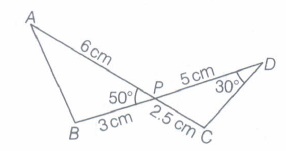
In the given figure, two line segments AC and BD intersect each other at the point P such that PA = 6 cm. PB = 3 cm, PC = 2.5 cm, PD = 5 cm \(\angle A P B=50^{\circ} \text { and } \angle C D P=30^{\circ} . \text { Then find } \angle P B A\)
3.
Check whether 12n can end with the digit 0 or 5, for any natural number n
4.
Use Euclid's division algorithm to find the HCF of the following three numbers
2, 7 and 12
5.
Which of the following form an AP? Justify your answer.
\(4,4+\sqrt{2}, 4+2 \sqrt{2}, 4+3 \sqrt{2}, \ldots\)
6.
Which of the following form an AP? Justify your answer.
0.3, 0.33, 0.333,
7.
If the zeroes of the cubic polynomial x3 - 6x2 + 3x + 10 are of the form a, a + b and a + 2b for some real numbers a and b, then find the values of a and b.
8.
Two numbers are in the ratio 5:6. If 8 is subtracted from each of the numbers, the ratio becomes 4:5. Find the numbers.
9.
A rational number in its decimal expansion is 327.7081. What can you say about the prime factors of q. when this number is expressed in the form \(\frac{p}{q}\)? Give reason.
10.
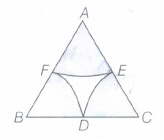
In the given figure, arcs are drawn by taking vertices A. B and C of an equilateral triangle of side 10 cm, to intersect the sides BC, CA and AB at their respective mid-points D, E and F. Find the area of the shaded region.
11.
Find the perimeter of a triangle with vertices (0, 4), (0, 0) and (3, 0).
[Hint The perimeter of a triangle is the sum of lengths of its three sides, so first find the length of three sides and then add them.]
12.
Find the angle subtended by these points \(P\left( \sqrt { 2 } ,\sqrt { 2 } \right) ,Q(-\sqrt { 2 } ,-\sqrt { 2 } )\text {and} R(-\sqrt { 6 } ,\sqrt { 6 } ).\)
13.
Find the radius of a circle whose circumference is equal to the sum of the circumference of two circles of radii 15cm and 18 cm.
14.
A building is in the form of a cylinder surmounted by a hemispherical dome as shown in the figure. The base diameter of the dome is equal to \(\frac { 2 }{ 3 } \) of the total height of the building. Find the height of the building, if it contains \(67\frac { 1 }{ 21 } { m }^{ 3 }\) of air.
15.
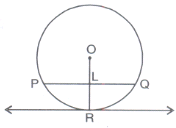
A chord PQ of a circle is parallel to the tangent drawn at a point R of the circle. Prove that R bisects the arc PRQ.
16.
Split 207 into three parts such that these are in A.P. and the products of the two smaller parts is 4623.
17.
There are 1000 sealed envelopes in a box, 10 of them contain a cash prize of Rs. 100 each, 100 of them contain a cash prize of Rs. 50 each and 200 of them contain a cash and an envelope is picked up out, what is the probability that it contains no cash prize?
18.
Find the value of m if the points (5, 1), (-2, -3) and (8, 2m) are collinear.
19.
Name the type of triangle formed by the points A(-5, 6), B(-4, 2) and C(7, 5).
20.
An observer 1.5 m tall is 20.5 m away from a tower 22 m high. Determine the angle of elevation of the top of the tower from the eye of the observer.
21.
How many terms of the AP: -15, -13, -11,.... are needed to make the sum -55? Explain the reason for double answer.
22.
Find the sum of the two middle terms of the AP: \(-\frac{ 4}{3 },-1,-\frac{ 2}{ 3},....,4\frac{ 1}{ 3}.\)
23.
Two APs have the same common difference. The first term of one AP is 2 and that of the other is 7. The difference between their 10th terms is the same as the difference between their 21st terms, which is the same as the difference between any two corresponding terms. Why?
24.
Justify whether it is true to say that -1,\(-\frac{3}{2}\) -2,\(-\frac{5}{2}\)..... forms an AP as a2 - a1 = a3 - a2.
25.
The eighth term of an AP is half its second term and the eleventh term exceeds one-third of its fourth term by 1. Find the 15th term.
1.
Let BE = 22 m be the height of the tower and AD = 1.5m be the height of the observer. The point D be the observer's eye. Draw DC \\ AB.
Then, AB = 20.5 m = DC and, EC = BE - BC = BE - AD = 22 -1.5 = 20.5 m [∵ BC = AD]
Let S be the angle of elevation make by observer's eye to the top of the tower i.e. ∠EDC = θ.
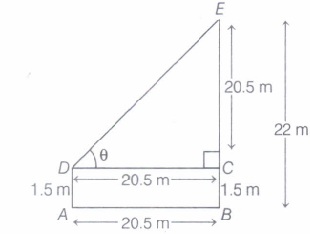
In right angled ΔDCE,
\(\tan \theta=\frac{P}{B}=\frac{C E}{D C}=\frac{20.5}{20.5}=1\)
45\(\unicode{xb0} \)
2.
100°
3.
Here, Number=12n where n stand for any natural number .
Now 12n= (22 x3)n
Now , For 12n to end with 0, it should have 2 as well as 5 in its Prime factors to end with 0, Also to end with 5 , it requires at least a single multiple of 5 in its Prime Factors, So 12n cannot end with the digit 0 or 5.
4.
1
5.
Yes.
6.
No
7.
x3 + 6x2 + 3x + 10 thus we know that,
a + a + b + a + 2b = 6
\(\Rightarrow\) 3(a + b) = 6 \(\Rightarrow\) a + b = 2
a(a + b) + (a + b)(a + 2b) + a(a + 2b) = 3
\(\Rightarrow\) (a + b)(2a + 2b) + a(a + 2b) = 3
\(\Rightarrow\) 2 x 2 x 2 + a2 + 2ba = 3
\(\Rightarrow\) a2 +2ba=-5 \(\Rightarrow\) ab= \(\frac{-5-a^{2}}{2}\)
a(a+b)(a+2b) = -1
a(2)(a+b) = -1
\( a^{2}+a b =-\frac{1}{2} \)
\(\Rightarrow \quad a^{2}+\left(\frac{-5-a^{2}}{2}\right) =-\frac{1}{2}\)
\(\Rightarrow\) 2a2 - 5 - a2 = - 1 ~ a2 = 4
\(\Rightarrow\) a= ± 2
a+b=2
\(\Rightarrow\) b=0 or 4
8.
Let the two numbers be x and y, then \(\frac { x }{ y } =\frac { 5 }{ 6 } \quad \Rightarrow \quad y=\frac { 6x }{ 5 } \quad ..(i)\)
Also, \(\frac { x-8 }{ y-8 } =\frac { 4 }{ 5 } \quad \Rightarrow \quad 5x-4y=8\quad \quad ..(ii)\)
Draw graphs of Eq. (i) and Eq. (ii) to get the required numbers.
Numbe0 are 49 and 48.
9.
Here, 327.7081 is terminating. So, it represents a rational number.
Thus, \(327.7081=\frac { 3277081 }{ 10000 } =\frac { p }{ q } \)
Here, q = 104 = 2 x 2 x 2 x 2 x 5 x 5 x 5 x 5
= 24 x 54 = (2 x 5)4
So, the prime factors of q are 2 and 5.
10.
Given, triangle ABC is an equilateral triangle.
\(\therefore \quad \angle A=\angle B=\angle C={ 60 }^{ 0 }\quad and\quad radius,\quad r=\frac { 10 }{ 2 } cm=5cm\)
Area of sector AFEA\(=\frac { \theta }{ { 360 }^{ 0 } } \times \pi { r }^{ 2 }\)
\(=\frac { { 60 }^{ 0 } }{ { 360 }^{ 0 } } \times \pi { \times (5) }^{ 2 }\)
\(=\frac { 25 }{ 6 } \pi \quad { cm }^{ 2 }\)
Since, area of all three sectors are equal.
Total area of shaded region
=3 x Area of sector AFEA\(=3\left( \frac { 25 }{ 6 } \pi \right) \)
\(=3\times \frac { 25 }{ 6 } \times 3.14=39.25\quad { cm }^{ 2 }\)
Hence, the area of shaded region is 39.25 cm2
11.
It is clear from the figure that,
Perimeter of \(\Delta\)AOB
=Distance (AO) + Distance (OB) + Distance (AB)
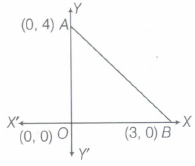
\(=\sqrt { { (0-0) }^{ 2 }+{ (4-0) }^{ 2 } } +\sqrt { { (0-3) }^{ 2 }+{ (0-0) }^{ 2 } } +\sqrt { { (0-3) }^{ 2 }+{ (4-0) }^{ 2 } } \)
[ using distance formula]
\(=\sqrt { { ({ x }_{ 1 }-{ x }_{ 2 }) }^{ 2 }+{ ({ y }_{ 1 }-{ y }_{ 2 }) }^{ 2 } } \)
\(=\sqrt { { (4) }^{ 2 } } +\sqrt { { (3) }^{ 2 } } +\sqrt { 9+16 } \)
= 4+3+\(\sqrt { 25 } \) = 4 + 3 + 5 = 12 units
Hence, the perimeter of given triangle is 12 units.
12.
Hint : First find the type of triangle using distance formula and hence obtain the angles.
Ans. 60°, equilateral triangle.
13.
33 cm
14.
Here, radius of the hemispherical part = r (say)
Let the total height of the building be h
And the height of the cylindrical part be H
\(\because\) [ Base of diameter of the done ] = \({{2}\over{3}}\) [ Total height of the building ]
\(\therefore\) 2r = \({{2}\over{3}}h\)
\(\Rightarrow\) r = \({{1}\over{2}}\times{{2}\over{3}}h={{h}\over{3}},\)
\(\therefore\) H = \(h - {{h}\over{3}}={{2}\over{3}}h\) meters
-s.jpg)
Now, Volume of air inside the building = Volume of air inside the done + Volume of air inside the cylindrical part
\(={{2}\over{3}}{\pi r}^{3}+{\pi r}^{2}H\)
\(={{2}\over{3}}\pi\left[ {{h}\over{3}} \right]^{3}+\pi\left[ {{h}\over{3}} \right]^{2}\times\left[ {{2}\over{3}}h \right]\)
\(={\pi}\times{{8}\over{81}}\times{h}^{3}{m}^{3}\)
But, volume of the air in the building
\(={67}{{1}\over{27}}\) m3
\(\therefore\) \({\pi}\times{{8}\over{81}}\times{h}^{3}=67{{1}\over{21}}\) m3
\(\Rightarrow\) \({{22}\over{7}}\times{{8}\over{81}}\times{h}^{3}={{1408}\over{21}}\)
\(\Rightarrow\) h3 = \({{1408}\over{21}}\times{{7}\over{22}}\times{{81}\over{8}}\)
\(\Rightarrow\) h3 = 8 X 27 = 216
\(\Rightarrow\) h3 = (6)3
\(\Rightarrow\) h = 6 m
Hence, the required height of the building is 6 meters.
15.
Since PQ is parallel to the tangent drawn at the point R and radius OR is perpendicular to the tangent.
ஃ OR ⊥ PQ
ஃ OL bisects the chord PQ.
ஃ PL = LQ
ஃ arc PR arc RQ
i.e., R bisects arc PRQ
16.
Let the three parts of 207 be a -d, and a + d
\(\therefore\) a - d + a + a + d = 207
3a = 207
a = \(\frac{207}{3}\)
a = 69
Also, ( a - d ) a = 4623
\(\Rightarrow\) ( 69 - d ) 69 = 4623
\(\Rightarrow\) 69 - d = 67
\(\Rightarrow\) d = 69 - 67 = 2
Hence, the three parts of 207are 69 - 2, 69 + 2
i.e., 67, 69 and 71.
17.
Total number of enevelopes = 1000
Let A = envelope contains no cash
Number of envelopes containing no cash
= 1000 - (10 + 100 + 200) = 690
\(\therefore\) P(A) = \(\frac{690}{100}=\frac{69}{100}=0.69\)
18.
\(m=\frac { 19 }{ 14 } \)
19.
scalene triangle
20.
\(45^{\circ}\)
21.
n=5, 11 here both answers are correct be cause sum of 6th term to 11trm is zero
22.
3
23.
Yes
24.
Yes
25.
Here, t8 = \(\frac{{t}_{2}}{2}\Rightarrow\) a + 7d = \(\frac{a+d}{2}\)
\(\Rightarrow\) 2a + 14d = a + d \(\Rightarrow\) a = - 13d (i)
and t11-\(\frac{{t}_{4}}{3}=1\)
\(\Rightarrow\) a + 10d - \(\frac{a+3d}{3}=1\)
\(\Rightarrow\frac{3a+30d-a-3d}{3}=1\)
\(\Rightarrow\) 2a + 27d = 3
\(\Rightarrow\) 2 ( - 13d ) + 27d = 3 [ using (i) ]
\(\Rightarrow\) -26d + 27d = 3
\(\Rightarrow\) d = 3,
\(\therefore\) from (i) a = -13 x 3 = - 39
Therefore,, t15 = a + 14d
= - 39 + 14 x 3
= - 39 + 42 = 3

10th Standard CBSE Syllabus & Materials
10th Standard CBSE
CBSE 10th Social Science PS - Federalism - New Model Questions Papers Study Material - QB365 Set A
NEW10th Standard CBSE
CBSE 10th Social Science PS - Power Sharing - New Model Questions Papers Study Material - QB365 Set A
NEW10th Standard CBSE
CBSE 10th Social Science GEO - Manufacturing Industries - New Model Questions Papers Study Material - QB365 Set A
NEW10th Standard CBSE
CBSE 10th Social Science GEO - Minerals and Energy Resources - New Model Questions Papers Study Material - QB365 Set A



NCERT Books

Syllabus

Exam Pattern

Sample Question Papers

Previous year Question Papers

Important Notes

MCQ Practice test

NCERT Exemplers

Case study Questions

Image Based Questions

Passage based Questions

HOT Questions

Value Based Questions

Model Questions Papers
NCERT ( Book Back ) Questions

Assertion and Reason
Important Questions And Answers

CBSE 10th Standard CBSE Subjects
CBSE Standards




