
 100% FREE ACCESS
10th Standard CBSE Syllabus & Materials
10th Standard CBSE
CBSE 10th Social Science ECO - Globalisation and the Indian Economy - New Model Questions Papers Study Material - QB365 Set A
NEW10th Standard CBSE
CBSE 10th Social Science ECO - Money and Credit - New Model Questions Papers Study Material - QB365 Set A
NEW10th Standard CBSE
CBSE 10th Social Science ECO - Sectors of the Indian Economy - New Model Questions Papers Study Material - QB365 Set A
NEW10th Standard CBSE
CBSE 10th Social Science ECO - Development - New Model Questions Papers Study Material - QB365 Set A
NEW10th Standard CBSE
CBSE 10th Social Science PS - Outcomes of Democracy - New Model Questions Papers Study Material - QB365 Set A
NEW10th Standard CBSE
CBSE 10th Social Science PS - Gender, Religion and Caste - New Model Questions Papers Study Material - QB365 Set A

Published on: 26/05/2021
QB365 Provides the updated NCERT Examplar Questions for Class 10 Maths, and also provide the detail solution for each and every ncert examplar questions , QB365 will give all kind of study materials will help to get more marks
Download CBSE Class 10th Standard CBSE Maths question papers, sample papers, important questions, and previous year solved papers in PDF format. Get free study materials, NCERT solutions, and exam preparation resources for Class 10th Standard CBSE Maths
Questions + Answers key
Take MCQ Maths Test1.
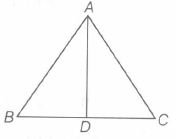
Find the altitude of an equilateral triangle of side 8 cm.
2.
Diagonals of a trapezium PQRS intersect each other at the point O, \(PQ\parallel RS\) and PQ = 3RS. Find the ratio of the areas of \(\triangle POQ\) and \(\triangle ROS\) .
3.
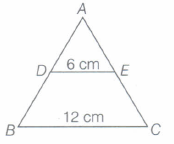
In the given figure, if \(DE\parallel BC\), find the ratio of ar \(\left( \triangle ADE \right) \) and ar \(\left( \triangle DECB \right) \)
4.
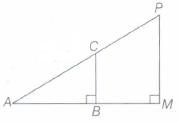
\(\triangle ABC\) and \(\triangle AMP\) are two right angled triangles. right angled at B and M, respectively. Prove that CA x MP = PA x BC
5.
It is given that \(\triangle ABC\sim \triangle EDF\) such that AB = 5 cm, AC = 7 cm, DF = 15 cm and DE = 12 cm. Find the lengths of the remaining sides of the triangles.
6.
For going to city B from city A, there is a route via city C such that \(AC\bot CB\) , AC = 2x km and CB = 2 (x + 7) km. It is proposed to construct a 26 km highway, which directly connects the two cities A and B. Find how much distance will be saved in reaching city B from city A after the construction on the highway?
7.
If the lengths of the diagonals of rhombus are 16 cm and 12 cm. Then, find the length of the sides of the rhombus.
8.
Given that, \(\sqrt { 2 } \) is a zero of the cubic polynomial \(6x^{ 3 }+\sqrt { 2x^{ 2 } } -10x-4\sqrt { 2 } \). Find its other two zeroes.
9.
If an isosceles ∆ABC in which AB = AC = 6 cm is inscribed in a circle of radius 9 cm, then find the area of the triangle
10.
Find the sum of those integers between 1 and 500, which are multiples of 2 as well as of 5.
11.
Draw a right angled \(\Delta ABC\) , in which BC = 12 cm, AB = 5 cm and \(\angle B=90°\). Then, construct a triangle similar to it and of scale factor \(\frac { 2 }{ 3 } \). Is the new triangle also a right angled triangle?
12.
A milk container of height 16 cm is made of metal sheet in the form of a frustum o cone with radii of its lower and upper ends as 8 cm and 20 cm, respectively. Find the cost of milk at the rate of Rs.22 per L, which the container can hold.
13.
A canal is 300 cm wide and 120 m deep. The water in the canal is flowing with a speed of 20 km/h. How much area will it irrigate in 20 min, if 8 cm of standing water is desired?
14.
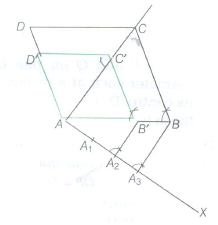
Given, a rhombus ABCD, in which AB = 4 cm and \(\angle ABC=60°\) divides it into two triangles say ABC and ADC. Construct the \(\Delta A{ B }^{ ' }{ C }^{ ' }\) similar \(\Delta ABC\) with scale factor 2/3. Draw a line segment C' D' parallel to CD, where D' lies on AD. Is AB' C' D' a rhombus? Give reason.
15.
The sum of the first five terms and the sum of the first seven terms of an AP is 167. If the sum of the first ten terms of this AP is 235. then find the sum of its first twenty terms.
16.
If P(9a-2, -b) divides line segment joining A(3a+1, -3) and B(8a, 5) in the ratio 3: 1, then find the value of a and b.Also, determine the value of \({ a }^{ 2 }+{ b }^{ 2 }\) .
17.
What is/are the value(s) of k for which the quadratic equation \(2x^{ 2 }-kx+k=0\) has equal root ?
18.
A pen stand made of wood is in the shape of a cuboid with four conical depressions and a cubical depression to hold the pens and pins, respectively. The dimensions of cuboid are 10 cm, 5 cm, and 4 cm. The radius of each of the conical depressions is 0.5 cm and the depth is 2.1 m. The edge of the cubical depression is 3 cm. Find the volume of the wood in the entire stand.
19.
Kanika was given her pocket money on Jan 1st, 2008. She puts Rs 1 on day, 1, Rs 2 on day 2, Rs 3 on day 3 and continued doing so till the end of the month, from this money into her piggy back she also spent Rs 204 of her pocket money and found that at the end of the month she still had Rs 100 with her. How much was her pocket money for the month?
20.
A carton of 24 bulbs contains 6 defective bulbs.One bulb is drawn at random.What is the probability that the bulb is not defective? If the bulb selected is defective and it is not replaced and a second bulb is selected at random from the rest, what is the probability that the second bulb is defective?
21.
The sum of first three terms of an A.P. is 33. If the product of the first and third term exceeds the second term by 29, find the A.P.
22.
A die has its six faces marked 0, 1, 1, 1, 6, 6. Two such dice are thrown together and the total score is recorded.
(i) How many different scores are possible?
(ii) What is the probability of getting a total of 7?
23.
Box A contains 25 slips of which 19 are marked Rs. 1 and other are marked Rs. 5 each. Box B contains 50 slips of which 45 are marked Rs 1 each and others are marked Rs 13 each. Slips of both boxes are poured into a third box and reshuffled. A slip is drawn at random. What is the probability that it is marked other than Rs 1?
24.
From an external point P, two tangents, PA and PB are drawn to a circle with centre O.At one point E on the circle tangent is drawn which intersect PA and PB at C and D, respectively.If PA = 10cm, find the perimeter of the triangle PCD.
25.
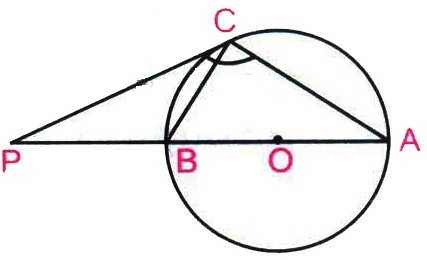
The tangent at a point C of a circle and a diameter AB when extended intersect at P.If \(\angle PCA=110^0\), find \(\angle CBA\) [see figure] Join C with centre O
1.
Altitude AD which is perpendicular to BC, then D is the mid-point of BC.
BD = CD = \(\frac{1}{2}\) BC = \(\frac{8}{2}\) = 4 cm.
Apply, Pythagoras theorem to find AD.
AD = \(4\sqrt{3}\) cm.
2.
Given, PQRS is a trapezium in which \(PQ\parallel RS\) and PQ = 3RS.
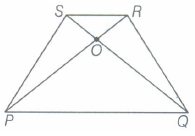
\(\Rightarrow \frac { PQ }{ RS } =\frac { 3 }{ 1 } \) ...(i)
In \(\triangle POQ\) and \(\triangle ROS\),
\(\angle SOR=\angle QOP \) [vertically opposite angles]
\(\angle SRP=\angle RPQ\) [alternate angles]
\(\therefore \triangle POQ\sim \triangle ROS\) [by AA similarity criterion]
By property of area of similar triangle,
\(\frac { ar\left( \triangle POQ \right) }{ ar\left( \triangle ROS \right) } =\frac { { \left( PQ \right) }^{ 2 } }{ { \left( RS \right) }^{ 2 } } =\left( \frac { 3 }{ 1 } \right) ^{ 2 }\) [from Eq.(i)]
\(\Rightarrow \frac { ar\left( \triangle POQ \right) }{ ar\left( \triangle SOR \right) } =\frac { 9 }{ 1 } \)
Hence, the required ratio is 9 : 1.
3.
Given, \(DE\parallel BC\) , DE = 6 cm and BC = 12 cm
In \(\triangle ABC\) and \(\triangle ADE\),
\(\angle ABC=\angle ADE\) [corresponding angles]
\(\angle ACB=\angle AED\) [corresponding angles]
and \(\angle A=\angle A\) [common angle]
\(\therefore \triangle ABC\sim \triangle ADE\) [by AAA similarity criterion]
We know that, the ratio of areas of two similar triangles is equal to the ratio of squares of their corresponding sides.
\(\therefore \frac { ar\left( \triangle ADE \right) }{ ar\left( \triangle ABC \right) } =\frac { { \left( DE \right) }^{ 2 } }{ { \left( BC \right) }^{ 2 } } =\frac { { \left( 6 \right) }^{ 2 } }{ { \left( 12 \right) }^{ 2 } } =\left( \frac { 1 }{ 2 } \right) ^{ 2 }\)
\(\Rightarrow \frac { ar\left( \triangle ADE \right) }{ ar\left( \triangle ABC \right) } =\left( \frac { 1 }{ 2 } \right) ^{ 2 }=\frac { 1 }{ 4 } \)
Let \(ar\left( \triangle ADE \right) =k\) , then \(ar\left( \triangle ABC \right) =4k\)
Now, \(ar\left( \triangle DECB \right) =ar\left( \triangle ADC \right) - ar\left( \triangle ADE \right) \)
= 4k - k = 3k
\(\therefore \) Required ratio = \(ar\left( \triangle ADE \right) : ar\left( \triangle DECB \right) \)
= k : 3k = 1 : 3
4.
Prove \(\triangle ABC\) and \(\triangle AMP\) are similar.
then take ratio \(\frac{AC}{AP}=\frac{BC}{MP}\)
5.
Given, \(\triangle ABC\sim \triangle EDF\)
Also, AB = 5 cm, AC = 7 cm, DF = 15 cm
and DE = 12 cm .... (i)
Since, \(\triangle ABC\sim \triangle EDF\)
\(\therefore \frac { AB }{ ED } =\frac { AC }{ EF } =\frac { BC }{ DF } \)
[ ∵ Corresponding sides of similar triangles are proportions]
\(\Rightarrow \frac { 5 }{ 12 } =\frac { 7 }{ EF } =\frac { BC }{ 15 } \) [from Eq. (i)]
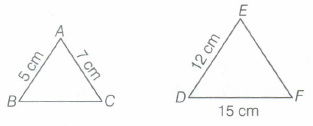
On taking first and second terms, we get
\(\frac { 5 }{ 12 } =\frac { 7 }{ EF } \Rightarrow EF=\frac { 7\times 12 }{ 5 } \) = 16.8 cm
On taking first and third terms, we get
\(\frac { 5 }{ 12 } =\frac { BC }{ 15 } \Rightarrow BC=\frac { 5\times 15 }{ 12 } \) = 6.25 cm
Hence, lengths of the remaining sides of the triangles are EF = 16.8 cm and BC = 6.25 cm.
6.
Draw the figure according to the given conditions and use Pythagoras theorem to find the value of x, then required saved distance will be equal to the difference of (AC + BC) and 26.
8 km.
7.
Diagonals of a rhombus bisect each other at right angles.
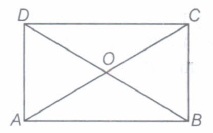
So, OA = OC = 8 cm
and OB = OD = 6 cm
Now use pythagoras theorem in ΔAOB
10 cm.
8.
Given, \(\sqrt { 2 } \) is one of the zeroes of the cubic polynomial. Thus, \((x-\sqrt { 2 } )\) is one of the factors of the given polynomial p(x)=\(6x^{ 3 }+\sqrt { 2x^{ 2 } } -10x-4\sqrt { 2 } \).
Then, division process is
Here, quotient \(=6x^{ 2 }+7\sqrt { 2x } +4\) and remainder =0
Now, factorise the quotient by splitting the middle term i.e. write
\(6x^{ 2 }+7\sqrt { 2x } +4=6x^{ 2 }+4\sqrt { 2x } +4\\ =2x(3x+2\sqrt { 2 } )+\sqrt { 2 } (3x+2\sqrt { 2 } )\\ =(2x+\sqrt { 2 } )(3x+2\sqrt { 2 } )\)
For other zeroes of p(x), put \(6x^{ 2 }+7\sqrt { 2x } +4=0\)
\((2x+\sqrt { 2 } )(3x+2\sqrt { 2 } )=0\)
⇒ \(x=-\frac { \sqrt { 2 } }{ 2 } ,\frac { -2\sqrt { 2 } }{ 3 } \)
Hence, other two zeroes of p(x) are \(\frac { -1 }{ \sqrt { 2 } } \) and \(\frac { -2\sqrt { 2 } }{ 3 } \) .
9.
Let O be the centre and P be the mid-point of BC.Then, OP丄BC.
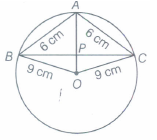
Since, ∆ABC is an isosceles triangle and P is the mid-point of BC. Therefore, AP .L BC as median from the vertex in an isosceles triangle is perpendicular to the base.
Let AP = x
and PB = CP = y
In ΔAPB and ΔOPB,
AB2 = BP2 + AP2
36 = y2 + x2
and OB2=OP2+BP2
81= (9- x)2 + y2
On subtracting Eqq.(i) from Eq.(ii) we get
81- 36 = [(9 - x)2 + y2]- (y2 + x2)
45 =81-18x+x2+y2 -y2 -x2
45=81-18x
18x=81-45
18x = 36
\(x={36\over 18}\)
x=2cm
On putting x = 2 in Eq.(i), we get
36=y2+4
y2=32
\(y=4\sqrt{2}cm\)
BC=2BP
=2y=\(8\sqrt{2}cm\)
Now, area of ∆ABC=\({1\over2}\times BC\times AP\)
\(={1\over2}\times8\sqrt{2}\times2\)
\(=8\sqrt{2}cm^2\)
Hence, the area of ∆ABC is \(=8\sqrt{2}cm^2\)
10.
Consider 10, 20, 30, 40, ... 490. According to question
490 = 10 + (n - 1) x 10
[\(\because\) a = 10, an = 490]
and \(S_{n}=\frac{n}{2}[2 \times 10+(n-1) \times 10]\)
On solving, we get n = 49.
= 12,250
11.
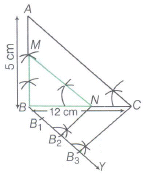
Given, scale factor = \(\frac { 2 }{ 3 } <1\)
Steps of Construction:
1. Draw a line segment Be = 12 cm.
2. From B, draw a line AB = 5 cm, which makes right angle at B.
3. Join AC. Thus, \(\Delta ABC\) is the required right angled triangle.
4. From B, draw an acute \(\angle CBY\) downwards.
5. On ray BY, mark three points B1 , B2 and B3 such that BB1 = B1B2 = B2B3
6. Join B3C,
7. From point B2, draw B2N || B3C intersecting BC at N.
8. From point N, draw NM II CA intersecting BA at M.Thus \(\Delta MBN\) is the required triangle.
Hence, \(\Delta MBN\) is also a right angled triangle, right-angled at B.
12.
Rs.230.12
13.
30 hec
14.
To draw a rhombus AB' C' D' similar to rhombus ABCD, we use the following steps of construction
1. First, draw a rhombus ABCD, in which AB = 4 cm and \(\angle ABC=60°\) and join its diagonal ACwhich divides it into two triangles ABC and ADC
2. Now, construct MB' C' similar to MBC with scale factor 2/3
(i) First, draw a ray AX making an acute angle with AB downwards.
(ii) Mark 3 points A1 A2 and A3 on AX such that
AA1 = A1A2 = A2A3
(iii) Join A3B and then draw A 2B' II A3B which intersects AB at B'.
(iv) Draw B' C' parallel to BC which intersects AC at C' . Thus,\(\Delta A{ B }^{ ' }{ C }^{ ' }\) similar, to \(\Delta ABC\) is constructed.
3. Draw the line segment D'C' II DC. Thus, AB' C' D' is the required rhombus similar to given rhombus ABCD.
15.
Given, S5 + S7 = 167 and S10 = 235
\(\Rightarrow 12 a+31 d=167 \text { and } 2 a+9 d=47\)
Now, find a and d, and then S20
S20 = 970
16.
Let P(9a-2, -b) divides AB internally in the ratio 3: 1.
\(\therefore \) By section formula, we get 9a-2 = \(\frac { 3(8a)+1(3a+1) }{ 3+1 } \) and -b = \(\frac { 3(5)+1(-3) }{ 3+1 } \) [\(\because \) for internally ratio, coordinates are \(\left( \frac { { m }_{ 1 }{ x }_{ 2 }+{ m }_{ 2 }{ x }_{ 1 } }{ { m }_{ 1 }+{ m }_{ 2 } } ,\frac { { m }_{ 1 }{ y }_{ 2 }+{ m }_{ 2 }{ y }_{ 1 } }{ { m }_{ 1 }+{ m }_{ 2 } } \right) \)]
\(\Rightarrow 9a-2=\frac { 24a+3a+1 }{ 4 } \) and \(-b=\frac { 15-3 }{ 4 } \)
\(\Rightarrow 9a-2=\frac { 27a+1 }{ 4 }\) and \(-b=\frac { 12 }{ 4 } \)
\(\Rightarrow \) 36a-8 = 27a+1 and b = -3
\(\Rightarrow \) 9a-9 =0 and b=-3
\(\Rightarrow \) a=1 and b=-3
Now,\({ a }^{ 2 }+{ b }^{ 2 }={ (1) }^{ 2 }+{ (-3) }^{ 2 }\) = 1+9 = 10 units.
17.
k=0 and 8
18.
Volume of the wood in the entire stand =Volume of cuboid - 4 x Volume of each cone - Volume of a cube
170.8 cm3
19.
Let her pocket money be Rs x. Now, she takes Rs 1 on day 1, Rs 2 on day 2, Rs 3 on day 3 and so on till the end of the month, from this money.
i.e. 1 + 2 + 3 + 4 + ..... + 31
which form an AP, in which number of terms is 31 and first term
\(\therefore\) Sum of first terms = S 31
Sum of n terms, \({ S }_{ n }=\frac { n }{ 2 } \left[ 2a+\left( n-1 \right) d \right] \)
\(\therefore\) \({ S }_{ 31 }=\frac { 31 }{ 2 } \left[ 2\times 1+\left( 31-1 \right) \times 1 \right] \)
\(=\frac { 31 }{ 2 } \left( 2+30 \right) \)
\(=\frac { 31\times 32 }{ 2 } \)
\(=31\times 16=496\)
So, Kanika takes Rs 496 till the end of the month from this money.
Also, she spent Rs 204 of her pocket money and found that at the end of the month, she still has Rs 100 with her.
Now, according to the condition
\(\left( x-496 \right) -204=100\)
\(\Rightarrow\) x - 700 = 100
\(\Rightarrow\) x = Rs 800
Hence, Rs 800 was her pocket money for the month.
20.
Total number of bulbs=24
Number of defective buls=6
Number of good ones=24-6=18
P (not defective)=\({18\over24}={3\over4}\)
P (2nd bulb is defective) =\(5\over23\)
[first bulb is defective and not replaced]
21.
Let the first three terms of an A.P. be a - d, a, a + d
\(\therefore\) a - d + a + a + d = 33
\(\Rightarrow\) 3a = 33
a = 11
Now, according to the given condition|
( a - d ) ( a + d ) = a + 29
( 11 - d ) ( 11 + d ) = 11 + 29
\(\Rightarrow\) 121 - d1 = 40
\(\Rightarrow\) d2 = 81
\(\Rightarrow\) d = \(\pm\) 9
\(\therefore\) The required A.P is 2, 11, 20, ... or 20, 11, 2, ...
22.
Possible outcomes
(0,0),(0,1),(0,1),(0,1),(0,6),(0,6)
(1,0),(1,1),(1,1),(1,1),(1,6),(1,6)
(1,0),(1,1),(1,1),(1,1),(1,6),(1,6)
(1,0),(1,1),(1,1),(1,1),(1,6),(1,6)
(6,0),(6,1),(6,1),(6,1),(6,6),(6,6)
(6,0),(6,1),(6,1),(6,1),(6,6),(6,6)
Different total scores are 0, 1, or 12
Let A = getting a total of 7
No. of favourable outcomes are = 12
\(\therefore\) P(A) = \(\frac{12}{36}=\frac{1}{3}\)
23.
Total number of slips = 25 + 50 = 75
Number of slips marked with Rs 1 = 19 + 45 = 64
\(\therefore\) Number of slips marked other than 1 = 75 - 64 = 11
\(\therefore\) Required probability = \(\frac{11}{75}\)
24.
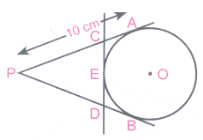
PA= 10 cm.
PA = PB [If P is external point] .....(i)
[ ∵ From an external point tangents drawn to a circle are equal in length]
If C is external point, then CA = CE
If D is external point, then
DB = DE ......(ii)
Perimeter of triangle \(\triangle\)PCD
= PC + CD + PD
= PC + CE + ED + PD
= pc + CA + DB + PD
= PA + PB
-PA + PA = 2 PA
= 2 x 10 = 20 cm.[From (ii)]
25.
\(\angle \)PCA = 110°
\(\angle \)CBA = ?
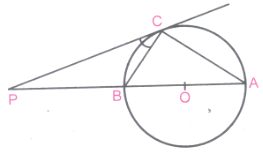
\(\angle \)ACB = 90°e [Angle in a semicircle is right agle]
\(\angle \)PCB = 110° - 90° = 20°
\(\angle \)PCB = \(\angle \)CAB = 20° [Alternate segment theorm]
In \(\triangle\)ABC
\(\angle \)ABC + \(\angle \)CAB + \(\angle \)BCA = 180° [∵ Sum of angles of a is 180°]
⇒ \(\angle \)ABC = 180° - 110° = 70°

10th Standard CBSE Syllabus & Materials
10th Standard CBSE
CBSE 10th Social Science PS - Federalism - New Model Questions Papers Study Material - QB365 Set A
NEW10th Standard CBSE
CBSE 10th Social Science PS - Power Sharing - New Model Questions Papers Study Material - QB365 Set A
NEW10th Standard CBSE
CBSE 10th Social Science GEO - Manufacturing Industries - New Model Questions Papers Study Material - QB365 Set A
NEW10th Standard CBSE
CBSE 10th Social Science GEO - Minerals and Energy Resources - New Model Questions Papers Study Material - QB365 Set A



NCERT Books

Syllabus

Exam Pattern

Sample Question Papers

Previous year Question Papers

Important Notes

MCQ Practice test

NCERT Exemplers

Case study Questions

Image Based Questions

Passage based Questions

HOT Questions

Value Based Questions

Model Questions Papers
NCERT ( Book Back ) Questions

Assertion and Reason
Important Questions And Answers

CBSE 10th Standard CBSE Subjects
CBSE Standards




