
 100% FREE ACCESS
10th Standard CBSE Syllabus & Materials
10th Standard CBSE
CBSE 10th Social Science ECO - Globalisation and the Indian Economy - New Model Questions Papers Study Material - QB365 Set A
NEW10th Standard CBSE
CBSE 10th Social Science ECO - Money and Credit - New Model Questions Papers Study Material - QB365 Set A
NEW10th Standard CBSE
CBSE 10th Social Science ECO - Sectors of the Indian Economy - New Model Questions Papers Study Material - QB365 Set A
NEW10th Standard CBSE
CBSE 10th Social Science ECO - Development - New Model Questions Papers Study Material - QB365 Set A
NEW10th Standard CBSE
CBSE 10th Social Science PS - Outcomes of Democracy - New Model Questions Papers Study Material - QB365 Set A
NEW10th Standard CBSE
CBSE 10th Social Science PS - Gender, Religion and Caste - New Model Questions Papers Study Material - QB365 Set A

Published on: 26/05/2021
QB365 Provides the updated NCERT Examplar Questions for Class 10 Maths, and also provide the detail solution for each and every ncert examplar questions , QB365 will give all kind of study materials will help to get more marks
Download CBSE Class 10th Standard CBSE Maths question papers, sample papers, important questions, and previous year solved papers in PDF format. Get free study materials, NCERT solutions, and exam preparation resources for Class 10th Standard CBSE Maths
Questions + Answers key
Take MCQ Maths Test1.
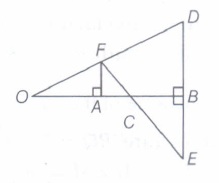
In given figure, OB is the perpendicular bisector of the line segmemnt DE.FA ⊥ OB and FE intersects OB at the point c.
Prove that \(\frac{1}{O A}+\frac{1}{O B}=\frac{2}{O C}\)
2.
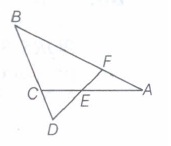
In the given figure, ∠AEF = ∠AFE and E is the mid-point of CA Prove that \(\frac{B D}{C D}=\frac{B F}{C E}\)
3.
Form the pair of linear equation in the following problems and find their solutions graphically.
The cost of 4 pens and 4 pencil boxes is Rs.100. Threetimes the cost of a pen is Rs.15 more than the cost of a pencil box. Find the cost of a pen and a pencil box.
4.
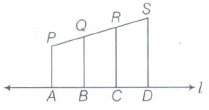
In the given figure, PA, QB, RC and SD are all perpendiculars to a line l, AB = 6 cm, BC = 9 cm, CD = 12 cm and SP = 36 cm. Find PQ, QR and RS.
5.
For which values of p and q, will the following pair of linear equations have infinitely many solutions?
4x+5y=2, (2p+71)x+(p+8q)y=2q-p+1
6.
Reduce the following pair of equations into a pair of linear equations and solve them
\(\frac { 2xy }{ x+y } =\frac { 3 }{ 2 } ,\quad \frac { xy }{ 2x-y } =\frac { -3 }{ 10 } ;\quad x+y\neq 0,\quad 2x-y\neq 0\)
7.
Find the solution of the pair of equations \(\frac { x }{ 10 } +\frac { y }{ 5 } -1=0\) and \(\frac { x }{ 8 } +\frac { y }{ 6 } =15\) and find \(\lambda ,\) if \(y=\lambda x+5.\)
8.
Find the zeroes of the polynomial x2-3 and verify the relationship between the zeroes and the coefficients.
9.
What will be the quotient and the remainder on division of ax2+bx+c by px3+qx2+rx+5,p\(\neq \)0
10.
Find the least number that is divisible by all the numbers from 1 to 10 (both inclusive).
11.
If two positive integers a and b are written as a = x3y2 and b = xy3; where x, y are prime numbers, find the HCF of a and b.
12.
Show that the square of an odd positive integer is of the form 8m + 1, where m is some whole number.
13.
Write whether every positive integer can be of the form 4q + 2, where q is an integer. Justify your answer.
14.
The product of two consecutive positive integers is divisible by 2. Is this statement true or false? Give reason.
15.
The sum of four consecutive numbers in an AP is 32 and the ratio of the product of the first and the last terms to the product of the two middle terms is 7:15. Find the numbers.
16.
If the sum of first n terms of an AP is given by Sn= n (4n+1), then find the nth term of the AP. Also, find the AP.
17.
If d=-4, n=7 and an =4, then find the value of a.
18.
A train travelling at a uniform speed at a uniform speed for 360 km, would have taken 48 min less to travel the same distance , if its speed was 5 km/h more .Find the original speed of the train.
19.
Jaspal Singh repays his total loan of Rs.118000 by paying every month starting with the first instalment of Rs.1000. If he increases the instalment by Rs.100 every month,
(i) What will be paid by him in the 30th instalment?
(ii) What amount of loan does he still have to pay after the 30th instalment?
20.
Solve the equation - 4 + (-1) + 2 + ...+ x = 437
21.
The sum of the first five terms of an AP and the first seven terms of the same AP is 167. If the sum of the first ten terms of this AP is 235, find the sum of its first twenty terms.
22.
Kanoka was given her pocket money on Jan 1st, 2008. She puts Rs.1 on day 1, Rs.2 on day 2, Rs.3 on day 3, and continued doing so til the end of the month, from this money into her piggy bank. She also spent Rs.204 of her pocket money, and found that at the end of the month she still had Rs.100 with her. How much was her pocket money for the month?
23.
If the sum of first 6 terms of an AP is 36 and that of the first 16 terms is 256, find the sum of first 10 terms.
24.
The students of a school decided to beautify the school on the Annual Day by fixing colourful flags on the straight passage of the school. They have 27 flags to be fixed at intervals of every 2m. The flags are stored at the position of the middle most flag. Ruchi was given the responsibility of placing the flags. Ruchi kept her books where the flags were stored. She could carry only one flag at a time. How much distance did she cover in completing this job and returning back to collect her books? What is the maximum distance she travelled carrying a flag?
25.
At present Asha's age (in years) is 2 more than the square of her daughter Nisha's age. When Nisha grows to her mother's present age, Asha's age would be one year less than 10times the present age of Nisha. Find the present ages of both Asha and Nisha.
1.
\(\Delta A O F \sim \Delta B O D \Rightarrow \frac{O A}{O B}=\frac{F A}{D B}\) .......(i)
\(\Delta F A C \sim \Delta E B C \Rightarrow \frac{F A}{E B}=\frac{A C}{B C} \Rightarrow \frac{F A}{D B}=\frac{A C}{B C} \) ......(ii) [∵ EB = DB]
From Eqs. (i) and (ii), we get
\(\frac{O A}{O B}=\frac{A C}{B C} \Rightarrow \frac{O A}{O B}=\frac{O C-O A}{O B-O C}\)
\(\Rightarrow (O B+O A) \cdot O C=2 O A \cdot O B\)
Divide both sides by OA. OB. OC.
2.
Given ∠AEF = ∠AFE and E is the mid-point of CA.
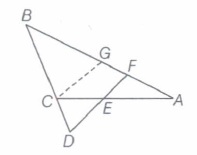
To prove \(\frac{B D}{C D}=\frac{B F}{C E}\)
Construction Draw a line CG parallel to DF.
Proof Given, ∠AEF = ∠AFE and E is mid-point of CA.
\(\therefore C E=A E=\frac{A C}{2}\) ........(i)
In ΔBDF, CG II DF
By basic proportionality theorem,
\(\frac{B D}{C D}=\frac{B F}{G F}\) .......(ii)
In ΔAFE, ∠AEF = ∠AFE [given]
⇒ AF = AE [since, sides opposite to equal angles are equal]
⇒ AF = AE = CE [from Eq. (i)] ... (iii)
In ΔACG, E is the mid-point of AC and EF II CG.
⇒ FG = AF [∵ AE = CEl ... (iv)
From Eqs. (ii), (iii) and (iv),
\(\frac{B D}{C D}=\frac{B F}{C E} [\because G F=A F=C E]\)
3.
Cost of one pen = Rs.10, cost of one pencil box = Rs.15
4.
By BPT,
PQ : QR : RS = AB : BC : CD = 6 : 9 : 12
Let PQ = 6x, QR = 9x and RS = 12x
Since, length of PS = 36km
\(\therefore \) PQ + QR + RS = 36
\(\Rightarrow \) 6x + 9x + 12x = 36
\(\Rightarrow \) 27x = 36 \(\Rightarrow \) x = \(\frac{4}{3}\)
PQ = 8 cm, QR = 12 cm and RS = 16 cm
5.
p=-1, q=2
6.
The given system of equations is
\(\frac { 2xy }{ x+y } =\frac { 3 }{ 2 } \) and \(\frac { xy }{ 2x-y } =\frac { -3 }{ 10 } \)
\(\Rightarrow\) \(\frac { x+y }{ 2xy } =\frac { 4 }{ 3 } \) and \(\frac { 2x-y }{ xy } =\frac { -10 }{ 3 } \)
\(\frac { 1 }{ y } +\frac { 1 }{ x } =\frac { 4 }{ 3 } \) and \(\frac { 2 }{ y } -\frac { 1 }{ x } =\frac { -10 }{ 3 } \)
Put \(\frac { 1 }{ x } =u\) and \(\frac { 1 }{ y } =v\) then the system of equations becomes u+v=\(\frac { 4 }{3 } \) and -u+2v=\(\frac { -10 }{3 } \)
Now, solve these equation.
x=\(\frac {1}{2}\) and y=\(\frac {-3}{2}\)
7.
By solving both equations. Find the values of x and y and then put these values in \(y=\lambda x+5\) to get required values of \(\lambda .\)
x=340, y=-165, \(\lambda =-\frac { 1 }{ 2 } \)
8.
Recall the identity a2 - b2 = (a - b)(a + b). Using it, we can write:
x2 - 3 = (x - \(\sqrt{3}\))(x + \(\sqrt{3}\))
So, the value of x2 - 3 is zero when x = \(\sqrt{3}\) or x = -\(\sqrt{3}\)
Therefore, the zeroes of x2 - 3 are \(\sqrt{3}\) and -\(\sqrt{3}\)
Now,
sum of zeroes = \(\sqrt{3}\) - \(\sqrt{3}\) = 0 = \(\frac{-(Coefficient \quad of \quad x)}{Coefficient \quad of \quad x^{2}}\)
product of zeroes = (\(\sqrt{3}\))(-\(\sqrt{3}\)) = -3 = \(\frac{-3}{1}=\frac{Constant \quad term}{Coefficient \quad of \quad x^{2}}\)
9.
We have,
\(ax^{ 2 }+bx+c=(px^{ 3 }+qx^{ 2 }+rx+5).0+ax^{ 2 }+bx+c\)
By division algorithm, we get
Quotient=0 and remainder =ax2+bx+c
10.
Factors of 1 to 10 numbers
1 = 1
2 = 1 x 2
3 = 1 x 3
4 = 1 x 2 x 2
5 = 1 x 5
6 = 1 x 2 x 3
7 = 1 x 7
8 = 1 x 2 x 2 x 2
9 = 1 x 3 x 3
10 = 1 x 2 x 5
\(\therefore \) LCM of numbers 1 to 10
= LCM (1, 2, 3, 4, 5, 6, 7, 8, 9, 10)
= 2 x 2 x 2 x 3 x 3 x 5 x 7 = 2520
11.
\(a={ x }^{ 3 }{ y }^{ 2 }=x\times x\times x\times y\times y\) and \(b={ x }{ y }^{ 3 }=x\times y\times y\times y\)
HCF (a,b) = xy2
12.
Let a be any positive integer.
We know that, any odd positive integer is of the form 2q + 1, where q is a whole number.
\(\therefore \) a = 2q + 1
\(\Rightarrow \) a2 = (2q + 1)2 [squaring both sides]
\(\Rightarrow \) a2 = 4q(q + 1) + 1 ...(i)
Note that q(q + 1) is either '0' or even, for any whole number q.
So, let q(q + 1) = 2m where m is a whole number.
From Eq.(i), we get a2 = 4(2m) + 1 = 8m + 1
13.
No, because by Euclid's division lemma,
we have, a = 4q + r, \(0\le r<4\) ...(i)
a can be in the form 4q, 4q + 1, 4q + 2 or 4q + 3
14.
True, because the product of any two consecutive numbers, say n(n + 1) will always be even as one out of n or (n+1) must be even.
15.
Let the four consecutive number in AP are
a - 3d, a - d, a + d, a + 3d
Then, we have
(a - 3d) + (a - d) + (a + d) + (a + 3d)
⇒ 4a = 32
⇒ a = 8
Also, it is given that the ratio of the product of first and the last terms to the product of the two middle terms is 7:15, therefore we have
\(\frac { (a-3d)(a+3d) }{ (a-d)(a+d) } =\frac { 7 }{ 15 } \ \)
\(\ \Rightarrow \ \frac { a^{ 2 }-9d^{ 2 } }{ a^{ 2 }-d^{ 2 } } =\frac { 7 }{ 15 } \Rightarrow 15a^{ 2 }-135d^{ 2 }=7a^{ 2 }-7d^{ 2 }\ \)
\(\ \Rightarrow 8a^{ 2 }-128d^{ 2 }\Rightarrow a^{ 2 }=16d^{ 2 }\)
\(\\ \Rightarrow \ 64=16d^{ 2 }\quad \quad \ d \left[ \because \quad a=8 \right] \)
\(\\ \Rightarrow \ d^{ 2 }=4\Rightarrow d=\pm 2\)
Hence, the number are 2, 6, 10, 14 or 14, 10, 6, 2.
16.
8 n-3; 5,13,21,...
17.
28
18.
45 km/h.
19.
Since, Jaspal Singh repays his loan of Rs.118000, with first instalment of Rs 1000 and increases each instalment by Rs 100.
\(\therefore \) His instalments are Rs 1000, Rs 1100, Rs 1200, Rs 1300, ... which forms an A.P.
Here, first term is Rs 1000 and common difference is Rs 100.
\(\therefore \) 30th instalment = a30 = a + 29d
= Rs (1000 + 29 \(\times \) 100)
= Rs (1000 + 2900) = Rs 3900
Amount paid in 30 instalments = S30
\(\Rightarrow \) S30 = Rs \(\quad \frac { 30 }{ 2 } (2\times 1000+29\times 100)\)
\(=\ Rs\ 15 (2000+2900)\\ =\ Rs\ 15(4900)\ =\ Rs\ 73500\)
Amount of loan still have to pay
= Rs (118000 - 73500)
= Rs 44500
20.
Here, in L.H.S. of the given equation, we have
a = - 4 and d = - 1 - ( - 4 ) = - 1 + 4 = 3 and l = x
\(\therefore\) - 4 + ( - 1 ) + 2 + ... + x = 437
\(\Rightarrow\) \({n\over2}(-4+x)=437\) [ \(\because\) Sn = \({n\over2}(a+l)\) ]
\(\Rightarrow\) n ( - 4 + x ) = 874 ...(i)
Also, n ( - 4 + x ) = 874 ...(ii)
[ \(\because\) an = a + ( n - 1 )d ]
From (i) and (ii), we have
n ( - 4 - 4 + ( n - 1)d) = 874
\(\Rightarrow\) - 8n + n ( n - 1 )3 = 874
\(\Rightarrow\) - 8n + 3n2 - 3n - 874 = 0
\(\Rightarrow\) 3n2 - 11n - 874 = 0
\(n={{{11\pm\sqrt{(-11)^{2}-4\times3\times(-874)}}}\over{2\times3}}\)
\(={{11\pm\sqrt{121+10488}}\over{5}}\)
\(={{11\pm103}\over{6}}={{11+103}\over{6}},{{11-103}\over{6}}\)
\(=19,{-{92}\over{6}}\) ( Rejecting )
n = 19
From(ii), we obtain
x = - 4 + ( 19 - 1 )3
x = - 4 + 54
x = 50
21.
A.T.Q., S5 + S7 = 167
\(\Rightarrow\) \({5\over2}[2a+14d]+{7\over2}[2a+6d]=167\)
\(\Rightarrow\) 5 ( a + 2d ) + 7 ( a + 3d ) = 167
\(\Rightarrow\) 12a + 31d = 167 ...(i)
and S10 = 235
\(\Rightarrow\) \({10\over2}[2a+9d]=235\)
\(\Rightarrow\) 2a + 9d = \({235\over4}=47\) ...(ii)
Multiplying equation (ii) by 6 and then subtractigfrom (i), we have
12a + 31d = 167
12a + 54d = 282
- - -
-23d = -115
d= \({-115\over-23}=5\)
\(\therefore\) From (ii), 2a + 9d = 47
\(\Rightarrow\) 2a + 9 x 5 = 47
\(\Rightarrow\) 2a = 47 - 45
\(\Rightarrow\) 2a = 2 \(\Rightarrow\) a = 1
Hence, S20 = \({20\over2}[2a+19d]\)
= 10 [ 2 x 1 + 19x 5 ]
= 10 [ 2 + 95 ] = 10 x 97 = 970
22.
Here a = 1, d = 1 and n = 31
Sn = \({n\over2}[2a+(n-1)d]\)
\(={31\over2}[2\times1+(31-1)]\)
\(={31\over2}[2+30]={31\over2}\times 32\)
= 496
\(\therefore\) Piggy bank amount = Rs 496
Amount spent = Rs 204
Amount left = Rs 100
Total pocket money = Rs 800
23.
\(\because\) S6 = 36 and S16 = 256.
\(\Rightarrow\) S6 = \({6\over2}\) [ 2a + 5d ]
[ \(\because\) Sn = \({n\over2} [ 2a + ( n - 1)d ]\)
\(\Rightarrow\) S6 = 3 ( 2a + 5d )
\(\Rightarrow\) \({36\over3}\) = 2a + 5d
\(\Rightarrow\) 12 = 2a + 5d ...(i)
and S16 = \({16\over2}[2a+15d]\)
\(\Rightarrow\) \({256\over8}=2a+15d\)
\(\Rightarrow\) 32 = 2a + 15d ...(ii)
Subtracting (i) and (ii), 2n + 5d = 12
2a + 15d = 32
- - -
-10d = -20 \(\Rightarrow\) d = 2
\(\therefore\) From (i), 12 = 2a + 5(2)
12 - 10 = 2a \(\Rightarrow\) 2a = 2 \(\Rightarrow\) a = 1
Hence S10 = \({10\over2}[2a+9d]\)
= 5 ( 2 x 1 + 9 x 2 )
= 5 ( 2 + 18 )
\(\Rightarrow\) S10 = 5 x 20 = 100.
24.
n = 27
Middle most term = \(\frac { n+1 }{ 2 } =\frac { 28 }{ 2 } =14\)
t13 + t15 = 2 + 2 = 4
t12 + t16 = 4 + 4 = 8
t11 + t17 = 6 + 6 = 12
t10 + t18 = 8 + 8 = 16
t1 + t27 = 26 + 26 = 52
Hence AP becomes 4,8,12,16,......,52
a = 4, d = 4, an = 52, n = 13
\({ S }_{ 13 }=\frac { 13 }{ 2 } \left[ 4+52 \right] =364m\)
and distance covered to collect the books = 364 m
Total distance covered = 364 + 364 = 728 m
Maximum distance she travelled carrying a flag is 26 m
25.
Let present age of Asha be x years
and present age of Nisha be y years
ATQ x=y2 + 2
Difference in ages = (x years)
Mother's age after (x — y) years is
x+(x-y) = 10y-1
\(\Rightarrow \) 2x-y-10y+1=0
\(\Rightarrow \) 2(y2+2)-11y+1=0
\(\Rightarrow \) 2y2-+4-11y+5=0
\(\Rightarrow \) 2y2-11y+5=0
\(\Rightarrow \)2y2-10y-y+5=0
\(\Rightarrow \) (y-5) (2y-1) =0
\(\Rightarrow \) y=5 or y = \(\frac { 1 }{ 2 } \) [rejecting]
Nisha's present age = 5 years
Asha's present age = 52 + 2 = 27 years.

10th Standard CBSE Syllabus & Materials
10th Standard CBSE
CBSE 10th Social Science PS - Federalism - New Model Questions Papers Study Material - QB365 Set A
NEW10th Standard CBSE
CBSE 10th Social Science PS - Power Sharing - New Model Questions Papers Study Material - QB365 Set A
NEW10th Standard CBSE
CBSE 10th Social Science GEO - Manufacturing Industries - New Model Questions Papers Study Material - QB365 Set A
NEW10th Standard CBSE
CBSE 10th Social Science GEO - Minerals and Energy Resources - New Model Questions Papers Study Material - QB365 Set A



NCERT Books

Syllabus

Exam Pattern

Sample Question Papers

Previous year Question Papers

Important Notes

MCQ Practice test

NCERT Exemplers

Case study Questions

Image Based Questions

Passage based Questions

HOT Questions

Value Based Questions

Model Questions Papers
NCERT ( Book Back ) Questions

Assertion and Reason
Important Questions And Answers

CBSE 10th Standard CBSE Subjects
CBSE Standards




